
Explosive Trace Detection Market Outlook: Size, Share, Trends, Growth Analysis, Competitive Landscape & Forecast, 2026-2033

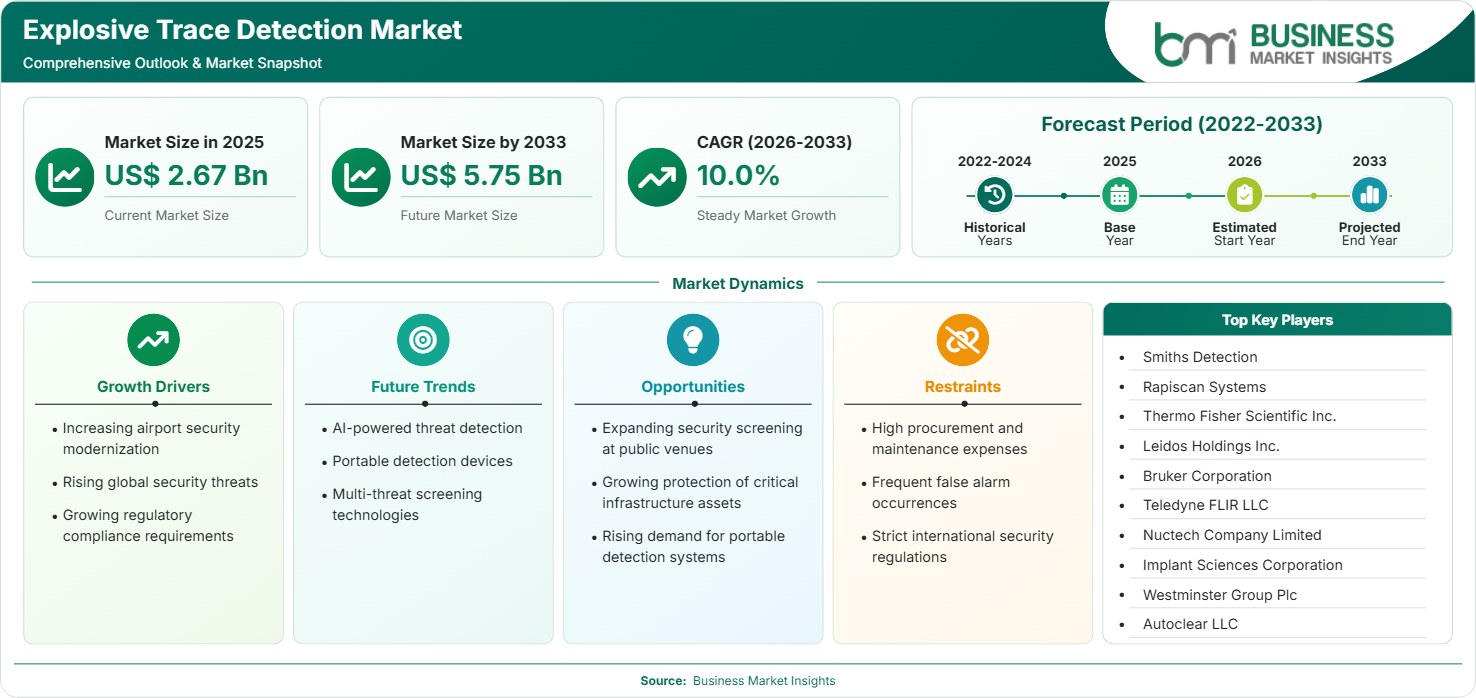
The Explosive Trace Detection Market size was valued at US$ 2.67 Billion in 2025 and is projected to reach US$ 5.75 Billion by 2033, growing at a CAGR of 10.0% during 2026–2033. Rising airport security modernization, increasing geopolitical risks, stricter regulatory compliance, expansion of critical infrastructure protection, and growing demand for advanced portable screening technologies are accelerating adoption across commercial and government security applications.

Report Coverage
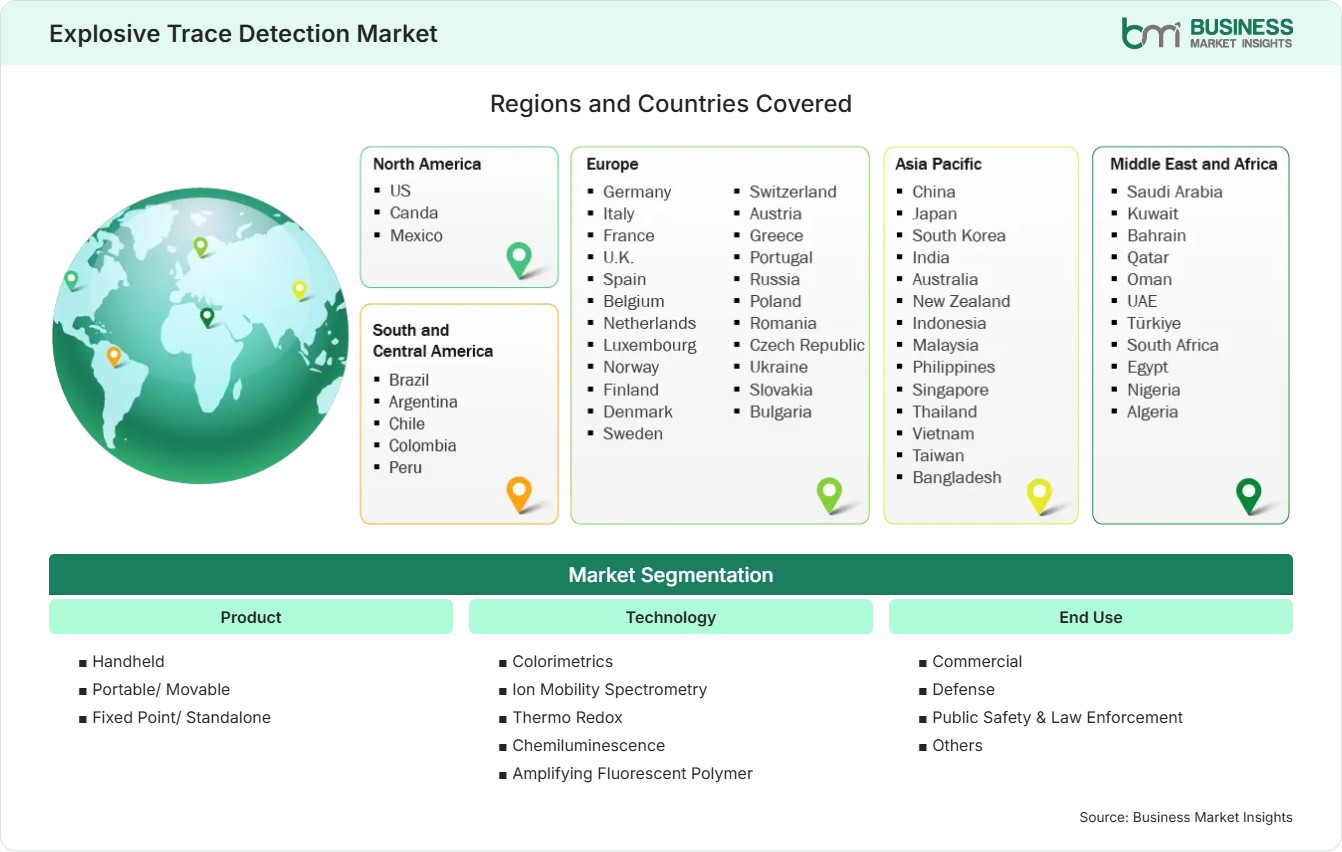
  • Product: Handheld, Portable/ Movable, Fixed Point/ Standalone
  • Technology: Colorimetrics, Ion Mobility Spectrometry, Thermo Redox, Chemiluminescence, Amplifying Fluorescent Polymer
  • End Use: Commercial, Defense, Public Safety & Law Enforcement, Others
US$ 2.67 Bn Market size in 2025
US$ 5.75 Bn Market Size by 2033
10.0% CAGR, 2026 - 2033
2026-2033 Forecast Period

01 AI Overview

Explosive Trace Detection Market Summary

  • North America Region: North America holds a market share of 34%–37% in 2025 and is projected to grow at a CAGR of 9.2%–9.8% during 2026–2033. Growth is driven by airport security upgrades, defense modernization programs, advanced detection technology adoption, and regulatory requirements. The US market demonstrates strong demand with a CAGR of 9.5%–10.1% supported by transportation security investments, law enforcement modernization, and critical infrastructure protection initiatives.
  • Fastest Growing Region: Asia Pacific represents 27%–30% market share in 2025 and is expected to expand at a CAGR of 11.2%–12.0% through 2026–2033. Growth is supported by expanding airport networks, urban infrastructure development, rising defense expenditure, and increasing adoption of advanced security screening systems.
  • Leading Segment: Fixed Point/Standalone systems account for 42%–45% market share in 2025 and are projected to grow at a CAGR of 9.4%–10.0% during 2026–2033. Airports, government facilities, and critical infrastructure operators continue deploying permanent detection installations for continuous threat monitoring.
  • High Growth Segment: Portable/Movable systems represent 30%–33% market share in 2025 and are anticipated to achieve a CAGR of 11.0%–11.8% through 2026–2033. Increasing requirements for flexible screening operations, mobile security deployments, and rapid response capabilities are strengthening demand.
  • Key Market Opportunity: Expansion of explosive detection screening beyond airports into public venues, transportation hubs, industrial facilities, and critical infrastructure sites creates opportunities for manufacturers developing compact, accurate, and connected detection platforms.
  • Major Market Players: Smiths Detection, Rapiscan Systems, Thermo Fisher Scientific Inc., Leidos Holdings, Inc., Bruker Corporation, Teledyne FLIR LLC, Nuctech Company Limited, Implant Sciences Corporation, Westminster Group Plc, Autoclear LLC.
02 Strategic Insights

Explosive Trace Detection Market: Strategic Insights

Explosive Trace Detection Market Strategic Framework
FREE PDF
Request your free sample
Request free sample
03 Stakeholder View

Key Takeaways

  • The market ecosystem is structured around detection equipment manufacturers, security technology providers, government agencies, airport operators, and defense organizations. Integration capabilities, maintenance support, and compliance certification are becoming important competitive differentiators.
  • Portable and handheld detection platforms represent high-growth opportunities as security teams require flexible solutions for temporary events, field operations, emergency response activities, and decentralized screening environments.
  • Sensor miniaturization, artificial intelligence-assisted analysis, improved chemical identification algorithms, and connected security networks are influencing product development strategies among detection technology providers.
  • Asia Pacific offers strong investment potential due to airport expansion projects, increasing defense modernization programs, urban security initiatives, and growing adoption of advanced screening technologies across transportation networks.
  • Strategic partnerships between security equipment manufacturers, government agencies, and infrastructure operators are increasing as organizations seek integrated solutions combining detection hardware, software analytics, and operational support services.
  • Future market competitiveness will depend on improving detection accuracy, reducing false alarms, lowering lifecycle costs, and developing scalable systems capable of supporting multiple security environments.
04 Geographic Outlook

Explosive Trace Detection Market Regional Highlights

North America Explosive Trace Detection Market

North America is expected to account for 34% to 37% of the global Explosive Trace Detection Market in 2025, with growth at a CAGR of 9.2% to 9.8% over the forecast period of 2026 to 2033. The growth in the region can be attributed to the presence of robust airport security measures, strong defense spending, and stringent regulatory norms. The U.S. is a major contributor due to transportation security investments, government procurement programs, and the adoption of advanced threat detection technologies.

  • The United States maintains regional leadership through airport screening modernization, defense procurement initiatives, and increasing deployment of advanced explosive detection equipment across transportation facilities.
  • Canada is expanding security technology adoption through airport infrastructure improvements, border security investments, and public safety programs requiring enhanced threat identification capabilities.
  • Government agencies are prioritizing next-generation detection systems with improved sensitivity, faster analysis capabilities, and reduced operational complexity for security personnel.
  • Defense organizations continue investing in advanced chemical detection technologies to support military operations, counterterrorism programs, and critical asset protection requirements.

US Explosive Trace Detection Market

The US represented a 30%–33% share of the Explosive Trace Detection Market in 2025 and is estimated to grow at a CAGR of 9.5%–10.1% through 2026–2033. The country benefits from extensive aviation infrastructure, strong homeland security investments, and continuous upgrades in public safety technologies. Demand is supported by transportation agencies, defense departments, and law enforcement organizations.

  • Airport security agencies are adopting advanced detection platforms to improve passenger screening efficiency and address evolving aviation security requirements.
  • Defense organizations are increasing investments in portable detection technologies for military operations, tactical deployments, and field-based threat identification.
  • Public infrastructure operators are implementing explosive detection solutions to strengthen protection at transportation hubs, government buildings, and high-risk locations.
  • Regulatory compliance requirements continue encouraging organizations to replace aging detection equipment with modern analytical systems.

Europe Explosive Trace Detection Market

Europe accounted for a 22%–25% share of the Explosive Trace Detection Market in 2025 and is forecast to grow at a CAGR of 9.8%–10.6% during 2026–2033. The region is supported by strict aviation security regulations, counterterrorism initiatives, and modernization of public infrastructure. The United Kingdom, Germany, and France represent leading markets, while Eastern European countries are increasing security investments.

  • The United Kingdom demonstrates strong adoption through airport security upgrades, government security programs, and investments in advanced detection technologies.
  • Germany is expanding explosive screening capabilities across transportation and industrial facilities due to increased focus on infrastructure resilience.
  • France continues strengthening public safety systems through counterterrorism measures and deployment of advanced screening equipment.
  • European airports are integrating automated detection technologies to improve passenger flow while maintaining strict security compliance standards.

Asia Pacific Explosive Trace Detection Market

Asia Pacific captured a 27%–30% share of the Explosive Trace Detection Market in 2025 and is expected to achieve a CAGR of 11.2%–12.0% through 2026–2033. The region represents the fastest-growing market due to airport expansion, rising defense expenditure, urban infrastructure development, and increasing security requirements. China, India, Japan, and Southeast Asian countries are driving regional adoption.

  • China is investing in large-scale transportation security infrastructure and advanced detection systems across airports, public facilities, and government locations.
  • India is expanding airport networks and strengthening security capabilities through modernization programs and increased adoption of advanced screening technologies.
  • Japan is improving security preparedness through technology upgrades at transportation facilities, public venues, and critical infrastructure locations.
  • Southeast Asian countries are increasing investments in security screening due to tourism growth, infrastructure development, and aviation expansion.

Rest of World Explosive Trace Detection Market

Rest of World represented a 10%–13% share of the Explosive Trace Detection Market in 2025 and is projected to grow at a CAGR of 10.0%–10.8% between 2026–2033. South and Central America are increasing security investments, while the Middle East and Africa markets are adopting advanced detection technologies for airports, energy facilities, and government infrastructure.

Brazil, Mexico, Saudi Arabia, and the United Arab Emirates are emerging markets due to infrastructure expansion, aviation development, and heightened security requirements. Government initiatives and private sector investments are supporting broader deployment of detection systems.

  • Brazil is improving security capabilities through airport modernization projects and increased adoption of advanced passenger screening technologies.
  • Mexico is expanding detection system deployment across transportation facilities, border security locations, and public infrastructure sites.
  • Saudi Arabia is investing in security technologies as part of airport expansion and critical infrastructure protection initiatives.
  • The United Arab Emirates is strengthening aviation security through advanced screening systems and smart infrastructure programs.
  • African markets are gradually adopting portable detection solutions due to increasing security awareness and infrastructure development requirements.
Global Market Geography
FREE PDF
Request your free sample
Request free sample
05 Segment Analysis

Explosive Trace Detection Market Segmentation

Product

Product segmentation includes handheld, portable/movable, and fixed-point/standalone detection solutions used across transportation, defense, public safety, and commercial environments. The segment structure reflects growing demand for flexible screening capabilities and continuous monitoring systems. Fixed point/standalone solutions held the largest explosive trace detection market share in 2025, while portable technologies are gaining momentum due to operational flexibility. The segment is expected to maintain a CAGR of 10.0%–10.6% between 2026–2033, supported by security modernization initiatives and evolving threat detection requirements.

  • Handheld: Handheld explosive trace detection systems provide mobility for security personnel conducting targeted inspections. Adoption is increasing across law enforcement, defense, and emergency response applications requiring rapid deployment capabilities.
  • Portable/ Movable: Portable and movable systems support flexible screening operations at airports, public venues, and temporary security locations. Demand is rising due to operational versatility, field deployment requirements, and improved sensor portability.
  • Fixed Point/ Standalone: Fixed point and standalone systems enable continuous monitoring at airports, government facilities, and critical infrastructure sites. Growth is supported by permanent security installations and automated screening requirements.

Technology

Technology segmentation is divided into Colorimetrics, Ion Mobility Spectrometry, Thermo Redox, Chemiluminescence, and Amplifying Fluorescent Polymer. Ion Mobility Spectrometry continues to be widely used for its high sensitivity, rapid processing, and applications in aviation security. The technology segment will generate a CAGR of 9.6%–10.3% between 2026 and 2033. The Explosive Trace Detection trends reflect ongoing developments in innovative sensor technology, with an emphasis on enhanced accuracy, lower detection limits, and fewer false alarms.

  • Colorimetrics: Colorimetric detection technologies provide simple visual identification methods for explosive residues. Adoption continues in applications requiring cost-effective screening solutions with straightforward operational procedures.
  • Ion Mobility Spectrometry: Ion Mobility Spectrometry enables sensitive chemical identification through rapid analysis. It remains widely used in airports, defense facilities, and security operations requiring reliable explosive residue detection.
  • Thermo Redox: Thermo Redox technologies support chemical detection through oxidation-reduction reactions. Applications include specialized security environments requiring analytical detection capabilities and improved chemical recognition.
  • Chemiluminescence: Chemiluminescence-based systems detect explosive compounds through light-producing chemical reactions. These solutions support specialized screening applications requiring high sensitivity and accurate residue identification.
  • Amplifying Fluorescent Polymer: Amplifying Fluorescent Polymer technology offers advanced molecular detection capabilities with high sensitivity. Research and commercialization efforts focus on improving portability, response time, and detection performance.

End Use

End-user segmentation includes Commercial, Defense, Public Safety & Law Enforcement, and Others. Demand will be driven by defense and public safety usage owing to rising security concerns, while the usage in the commercial sector will increase in airports, transport hubs, and other large venues. The market segment is expected to grow at a CAGR of 10.2%–10.9% during 2026–2033 as companies adopt systems for early threat detection. Increasing regulatory requirements and infrastructure protection initiatives continue to strengthen adoption across multiple end users.

  • Commercial: Commercial users adopt explosive trace detection systems across airports, logistics facilities, industrial locations, and public venues to improve safety and regulatory compliance.
  • Defense: Defense organizations utilize advanced detection systems for military operations, border protection, tactical missions, and counterterrorism activities requiring reliable threat identification capabilities.
  • Public Safety & Law Enforcement: Law enforcement agencies deploy detection technologies for security operations, emergency response, and protection of high-risk locations requiring rapid screening capabilities.
06 Market Forces

Explosive Trace Detection Market Dynamics

Key Market Drivers

Increasing Airport Security Modernization

Modernization of airport security systems is a key driver of the need to develop advanced explosive detection technology, as aviation authorities continually upgrade security facilities to counter emerging threats. Security standards for both passengers and their luggage have become increasingly important for aviation companies worldwide. The Explosive Trace Detection Market growth is driven by growing interest in automated detection systems, chemical detection, and security systems. All these factors show that airports prefer technologies that allow them to have greater sensitivity, shorter inspection periods, and network compatibility. Growth in the number of air passengers and the growth of airports are other factors.

Rising Global Security Threats

The rise of geopolitics, terrorism, and security risks in transportation and infrastructure has led to an increase in the development of explosive detectors. Defense departments, law enforcement agencies, and organizations are developing advanced detection systems to recognize threats before they arise. The Explosive Trace Detection market trends indicates growing complexity of security challenges is increasing demand for technologies capable of detecting trace quantities of explosive materials with high accuracy. Manufacturers have taken this up by incorporating improved sensor design, enhanced analytical tools, and greater portability for use in the field. Increased security consciousness in airports and other government institutions keeps feeding into market growth.

Growing Regulatory Compliance Requirements

Requirements regarding aviation security, transportation safety, and critical infrastructure security are driving organizations to procure explosive trace detection solutions that have been tested and proven through certification. There has been increased regulation of screening procedures by governments and international authorities, requiring greater sophistication in detection technologies and process reliability. The compliance-driven procurement process is especially prevalent in airport organizations, border control agencies, and other public safety organizations. This trend is leading manufacturers to develop products with higher detection accuracy, greater ease of use, and improved reporting capabilities.

Key Market Opportunities

Expanding Security Screening at Public Venues

The use of security screening services beyond airports provides many opportunities for manufacturers of explosive detection devices. Large-scale places such as stadiums, entertainment centers, transportation hubs, and government buildings are becoming more interested in using the latest security systems for the protection of their staff and property. The problem of public safety is becoming more urgent, and encourages companies to develop portable detection systems that would be able to support temporary and mass screening. Thus, the development of lightweight and fast-acting devices becomes very promising due to the demand of venue owners who want to get efficient systems for threat identification.

Growing Protection of Critical Infrastructure Assets

Protecting critical infrastructure has become a key objective for many organizations as they attempt to protect their energy, transport, communications, and industrial sites from any security threat. The explosive trace detectors offer an extra layer of security in that they facilitate the early detection of any suspicious material. The trend towards integration of detection technology into overall security management systems is becoming more widespread among operators. Infrastructure growth in developing countries and modernization in developed ones are opening up new possibilities for deployment. Firms that provide flexible, scalable systems and remote monitoring stand to gain from rising demands for security solutions.

Rising Demand for Portable Detection Systems

The need for mobile explosive detection is becoming increasingly relevant, as security organizations demand technologies that can be easily used on-site and provide mobility for inspectors during emergency and temporary inspection tasks. Improvements in sensor portability, energy efficiency, and effectiveness are enhancing the usefulness of such technologies. Military organizations, police departments, and security companies responsible for event safety are beginning to use mobile detection systems. The growing need for rapid deployment capabilities creates opportunities for manufacturers focusing on compact designs, improved usability, and faster detection response times, supporting the explosive trace detection market forecast.

Market Restraints and Challenges

High Procurement and Maintenance Expenses

Factor: High equipment acquisition costs, specialized maintenance requirements, and periodic calibration expenses create financial challenges for organizations adopting explosive trace detection systems. Impact: Smaller operators and budget-constrained institutions may delay technology upgrades or limit deployment coverage. However, advanced detection systems demand constant maintenance, skilled labour, and spare parts to sustain their performance. Such costs throughout their lifecycle may affect the purchase decisions made in emerging countries that have tight security budgets. While modern systems offer higher precision and other benefits, manufacturers have to consider cost reduction, easy maintenance, and scalability to make their systems more accessible.

Frequent False Alarm Occurrences

Factor: False alarm incidents caused by environmental conditions, chemical interference, or complex sample analysis can reduce operational efficiency. Impact: Frequent alerts increase screening delays, require additional verification procedures, and may reduce user confidence in detection systems. Security operators require technologies that balance high sensitivity with accurate identification to minimize unnecessary disruptions. Manufacturers are investing in improved algorithms, advanced chemical libraries, and artificial intelligence-based analysis methods to enhance reliability. Reducing false positives remains a critical development objective as organizations seek detection solutions that improve security effectiveness while maintaining smooth passenger flow and operational efficiency.

07 Company Analysis

Competitive Landscape

The Explosive Trace Detection Market analysis highlights increasing competition among security technology manufacturers, defense solution providers, analytical instrument companies, and specialized detection system developers. Companies are focusing on improving detection accuracy, reducing false alarms, enhancing portability, and integrating advanced analytics to address evolving security requirements across aviation, defense, public safety, and critical infrastructure applications.

Company Name

Overview

Products and Services relevant to this market

Smiths Detection

Security technology provider specializing in threat detection solutions for transportation and defense sectors.

Explosive trace detectors, aviation screening systems, checkpoint security solutions, and threat identification technologies.

Rapiscan Systems

Security screening company providing inspection technologies for government and commercial applications worldwide.

Explosive detection systems, baggage screening equipment, cargo inspection, and security checkpoint solutions.

Thermo Fisher Scientific Inc.

Scientific technology company offering analytical instruments and detection solutions.

Chemical detection systems, trace analysis instruments, laboratory security solutions, and analytical technologies.

Leidos Holdings, Inc.

Technology and defense company delivering security and mission-focused solutions.

Security screening systems, defense technologies, threat detection services, and integrated security platforms.

Bruker Corporation

Analytical instrumentation company supporting advanced chemical detection applications.

Spectroscopy solutions, chemical analysis systems, detection instruments, and scientific measurement technologies.

Teledyne FLIR LLC

Technology company developing sensing and security solutions for government and industrial users.

Detection technologies, thermal imaging solutions, security systems, and integrated sensing platforms.

Nuctech Company Limited

Security inspection technology provider serving airports, customs, and government organizations.

Explosive detection equipment, security screening systems, inspection technologies, and automated solutions.

Implant Sciences Corporation

Detection technology company focused on security screening and explosive trace detection products.

Explosive trace detection systems, chemical detection equipment, and security screening solutions.

Westminster Group Plc

Security services and technology provider supporting infrastructure protection.

Security screening equipment, detection solutions, airport security services, and protection technologies.

Autoclear LLC

Security technology provider specializing in inspection and detection solutions.

Explosive trace detection systems, X-ray screening, security inspection equipment, and threat detection technologies.

08 Industry Activity

Recent Developments

December 2025

Leidos achieved European Civil Aviation Conference (ECAC) G1 Standard certification for its B220-HT explosive trace detection (ETD) system, strengthening its position in global aviation security screening and supporting compliance with upcoming EU airport detection requirements.

November 2025

Smiths Detection received ECAC/EU G1 approval for its IONSCAN 600 explosives trace detector, enhancing the system’s compliance with updated European aviation security standards for passenger and cargo screening applications.

May 2025

OSI Systems (Rapiscan Systems) secured a contract worth approximately US$ 36 million to provide airport security screening solutions, including Rapiscan Itemiser 5X trace detection systems for detecting explosive and narcotics threats at an international Middle East airport.

February 2025

Leidos partnered with SeeTrue to integrate artificial intelligence-based threat detection algorithms into airport security screening solutions, aiming to improve automated identification of prohibited items and enhance aviation security operations.

10 Trust & Transparency

Research Methodology

The market analysis combines proprietary research with secondary data from government agencies, company disclosures, regulatory filings, industry databases and expert interviews. Market estimates are validated through data triangulation, cross-market benchmarking and analyst review.

View Full Research Methodology

11 Questions Answered

Frequently Asked Questions

How does the Explosive Trace Detection Market Report assess industry competition?

The report evaluates company strategies, product portfolios, technology advancements, regional expansion, partnerships, and competitive positioning across security detection applications.

What factors influence purchasing decisions for explosive trace detection equipment?

Organizations evaluate detection accuracy, false alarm rates, lifecycle costs, regulatory compliance, maintenance requirements, integration capabilities, and operational usability when selecting detection systems.

Why are portable explosive detection systems gaining demand?

Portable systems provide operational flexibility for law enforcement, defense teams, and event security organizations requiring rapid deployment, field-based screening, and temporary security operations.

Which technology is widely used in the explosive trace detection market?

Ion Mobility Spectrometry remains one of the most widely adopted technologies due to its rapid analysis capability, high sensitivity, and established deployment across aviation security environments.

What industries are adopting explosive trace detection systems beyond airports?

Explosive trace detection systems are increasingly used in public venues, defense facilities, government buildings, transportation hubs, industrial locations, and critical infrastructure sites requiring advanced security screening capabilities.

Access the Full Explosive Trace Detection Market Report

Get segment-level forecasts, regional estimates, competitive benchmarking, company profiles and downloadable Excel datasets.

Access the full Explosive Trace Detection Market Report
350 pages PDF & Excel | 2026-07-31