Market Summary
Executive Summary and Global Market Analysis
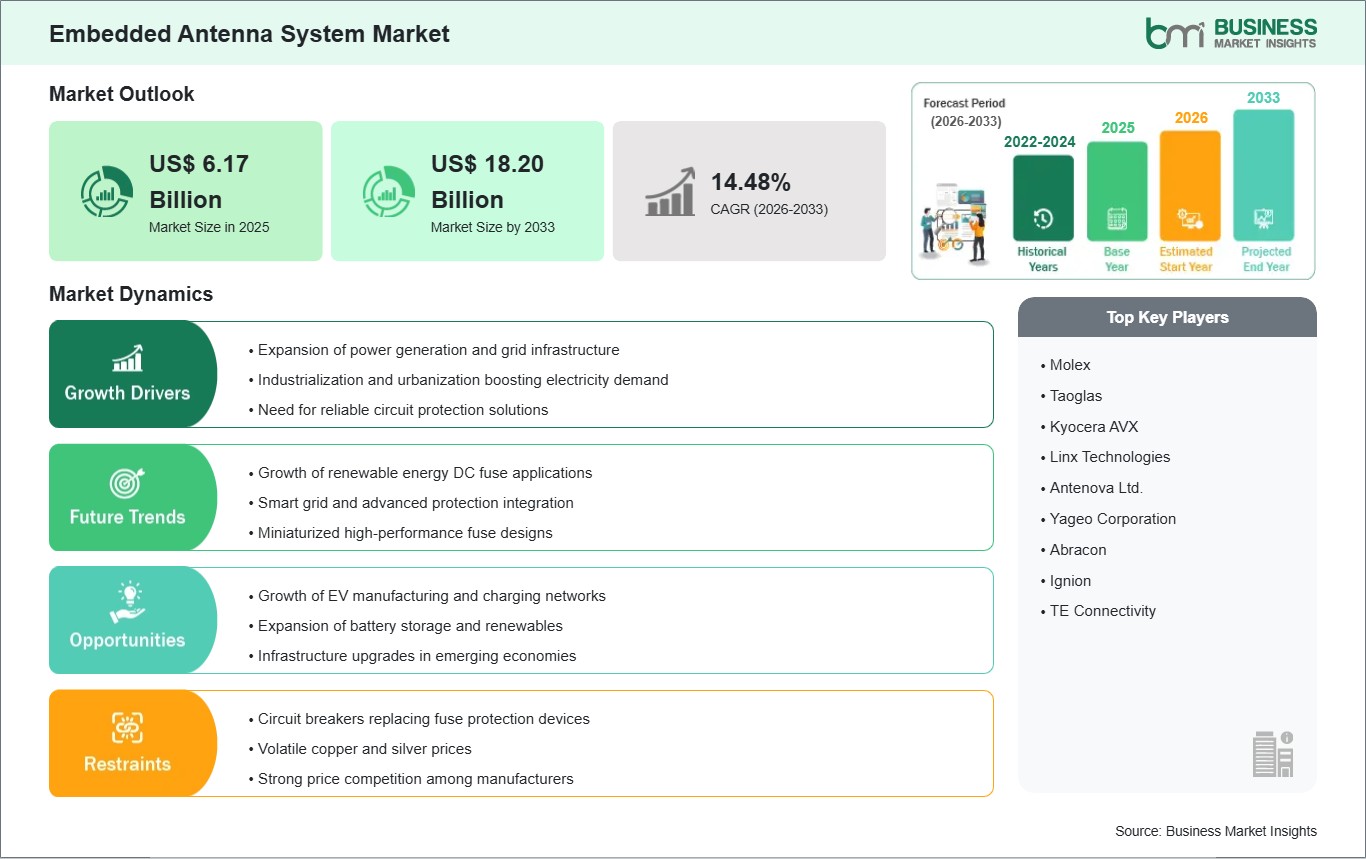
The global embedded antenna systems market is witnessing strong growth driven by rapid advancements in wireless communication technologies and the proliferation of connected devices. Increasing adoption of 4G/5G networks, IoT-enabled devices, smart wearables, connected vehicles, and industrial automation systems is significantly boosting demand for compact, high-performance embedded antennas. The shift toward miniaturized electronic products has accelerated the integration of PCB trace, chip, patch, and FPC antennas across consumer electronics, automotive, healthcare, and industrial applications. Rising demand for reliable high-speed data transmission, low-latency connectivity, and multi-band support is further encouraging innovation in antenna design and materials. Additionally, the expansion of smart cities, Industry 4.0 initiatives, and telematics solutions is creating new growth opportunities. Asia Pacific dominates the market due to strong electronics manufacturing ecosystems, while North America and Europe continue to witness steady growth supported by technological advancements and early adoption of next-generation wireless infrastructure..
Segment Analysis
Embedded Antenna System Market Segmentation
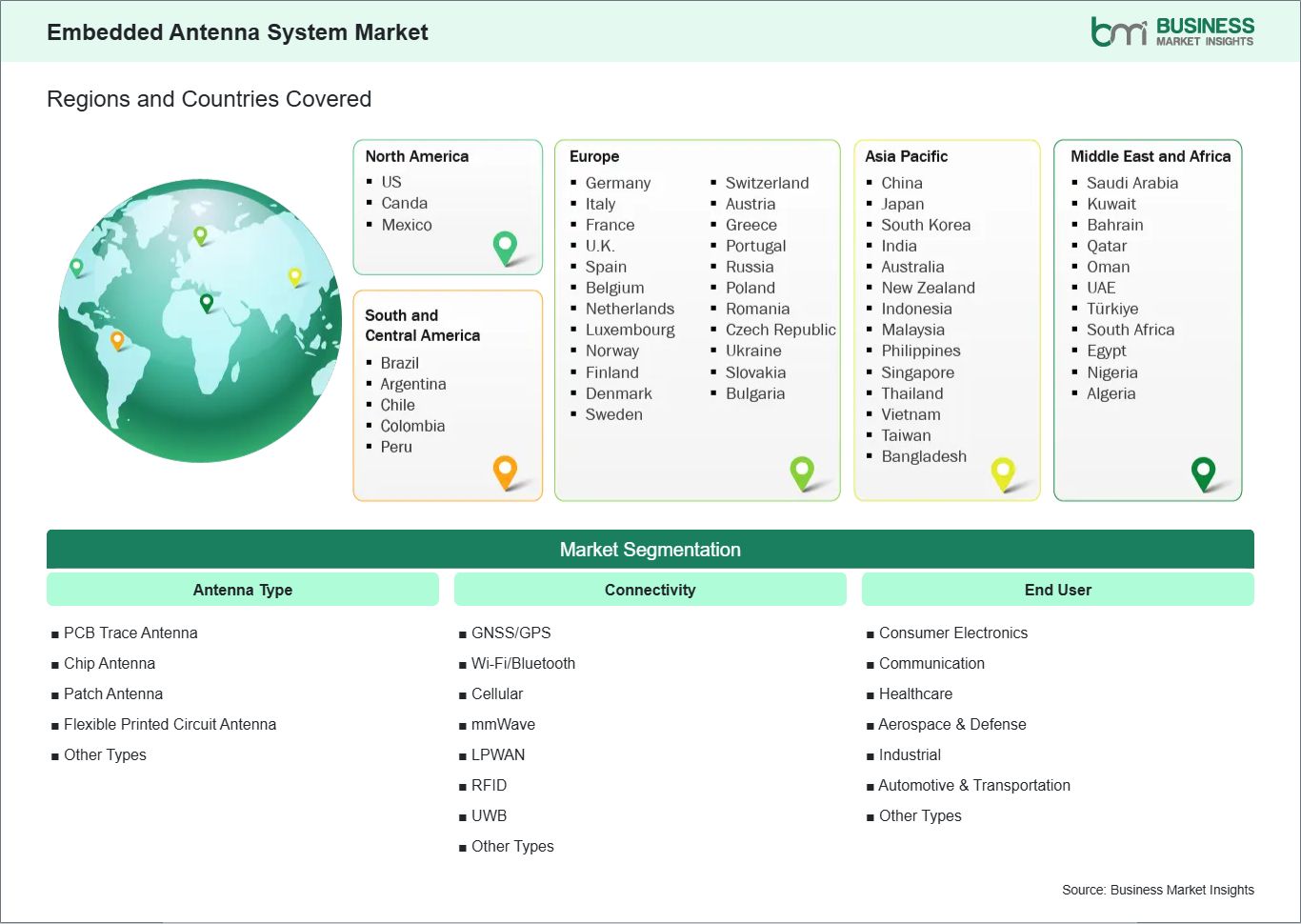
Key segments that contributed to the derivation of the Embedded Antenna Systems market analysis are antenna type, connectivity, end user.
- Based on antenna type, the market is segmented into PCB Trace Antenna, Chip Antenna, Patch Antenna, Flexible Printed Circuit (FPC) Antenna, and Other Types. Among these, the PCB Trace Antenna segment accounted for the largest share in 2025.
- Based on connectivity, the market is segmented into GNSS/GPS, Wi-Fi/Bluetooth, Cellular, mmWave (5G), LPWAN, RFID, UWB, and Other Types. Among these, the Cellular segment accounted for the largest share in 2025.
- Based on end user, the market is segmented into Consumer Electronics, Communication (Datacom & Telecom), Healthcare, Aerospace & Defense, Industrial, Automotive & Transportation, and Other Types. Among these, the Consumer Electronics segment accounted for the largest share in 2025.
Market Forces
Embedded Antenna System Market Drivers and Opportunities
Expansion of Power Infrastructure and Industrialization
The growth of global power infrastructure and rapid industrialization is a major driver for the Embedded Antenna Systems market. Increasing investments in power generation, transmission, and distribution networks—particularly in emerging economies—are creating strong demand for reliable circuit protection solutions. Industrial facilities, commercial buildings, and renewable energy installations require efficient overcurrent protection to safeguard electrical equipment and ensure operational safety. Additionally, rising urbanization and electrification projects are accelerating the deployment of low- and medium-voltage systems. Embedded Antenna Systemss remain widely preferred due to their cost-effectiveness, high breaking capacity, simple design, and dependable performance in preventing short circuits and overload-related damage across diverse applications.
Growth of Renewable Energy and Electric Vehicles
The rapid adoption of renewable energy systems and electric vehicles (EVs) presents significant growth opportunities for the Embedded Antenna Systems market. Solar farms, wind power installations, battery energy storage systems, and EV charging infrastructure require advanced protection solutions to manage fluctuating loads and high fault currents. As governments worldwide promote decarbonization and clean energy transitions, investments in grid modernization and distributed energy resources are increasing. Embedded Antenna Systemss designed for DC applications and high-voltage environments are gaining traction in these sectors. Furthermore, the expansion of EV manufacturing and charging networks is expected to generate sustained demand for reliable and compact fuse technologies..
Size and Share Analysis
Embedded Antenna System Market Size and Share Analysis
Based on antenna type, the market is segmented into PCB Trace Antenna, Chip Antenna, Patch Antenna, Flexible Printed Circuit (FPC) (FPC) Antenna, and Other Types. Among these, the PCB Trace Antenna segment accounted for the largest share in 2025. This dominance is attributed to its low cost, compact size, and ease of integration into high-volume consumer electronic devices.
Based on connectivity, the market is segmented into GNSS/GPS, Wi-Fi/Bluetooth, Cellular, mmWave (5G), LPWAN, RFID, UWB, and Other Types. Among these, the Cellular segment accounted for the largest share in 2025. The growth of this segment is driven by the rapid expansion of 4G/5G networks and increasing demand for always-connected smart devices.
Based on end user, the market is segmented into Consumer Electronics, Communication (Datacom & Telecom), Healthcare, Aerospace & Defense, Industrial, Automotive & Transportation, and Other Types. Among these, the Consumer Electronics segment accounted for the largest share in 2025. The large share is supported by rising adoption of smartphones, wearables, tablets, and IoT-enabled consumer devices worldwide.
Report Coverage
Embedded Antenna System Market Report Coverage and Deliverables
The "Embedded Antenna Systems Market Size and Forecast (2022 - 2033)" report provides a detailed analysis of the market covering below areas:
- Embedded Antenna Systems market size and forecast at global, regional, and country levels for all the key market segments covered under the scope
- Embedded Antenna Systems market trends, as well as market dynamics such as drivers, restraints, and key opportunities
- Embedded Antenna Systems market analysis covering key market trends, global and regional framework, major players, regulations, and recent market developments
- Industry landscape and competition analysis covering market concentration, heat map analysis, prominent players, and recent developments for the Embedded Antenna Systems market
- Detailed company profiles, including SWOT analysis
Geographic Insights
Embedded Antenna System Market Geographic Insights
The geographical scope of the Embedded Antenna Systems market report is divided into five regions: North America, Asia Pacific, Europe, Middle East and Africa, and South and Central America. The Embedded Antenna Systems market in Asia Pacific is expected to grow significantly during the forecast period.
The Embedded Antenna Systems market exhibits varied regional dynamics driven by infrastructure development, industrial growth, and energy transition initiatives. Asia Pacific leads the market, fueled by rapid urbanization, expanding power grids, and strong manufacturing bases in China, India, and Southeast Asia. Investments in smart grid modernization and renewable energy projects further support demand for fuses. North America and Europe show steady growth, underpinned by grid upgrades, stringent electrical safety standards, and rising adoption of advanced protection devices. In Middle East & Africa and Latin America, increasing electrification efforts and industrial expansion present emerging opportunities. Overall, regional emphasis on reliable electrical protection across residential, commercial, and industrial sectors is shaping market trajectories.
Industry Activity
Recent Developments
The Embedded Antenna Systems market is evaluated by gathering qualitative and quantitative data post primary and secondary research, which includes important corporate publications, association data, and databases. A few of the key developments in the Embedded Antenna Systems market are:
- In February 2026, Airgain secured a multi‑year, multi‑million‑dollar embedded antenna design win with a major North American mobile network operator (MNO) for its next‑generation 5G home connectivity platform. The agreement includes Airgain`s antenna systems for a 5G fixed wireless access (FWA) router and a companion in‑home Wi‑Fi extender, with pre‑production units expected to ship in early 2026 and mass production later in the year. This win expands Airgain`s position with Tier‑1 operators and reinforces its strength in embedded antenna technology for high‑performance broadband platforms.
- In February2026, AntennaWare announced the launch of a viable low‑profile alternative to traditional monopole antennas for Sub‑GHz (868/915MHz) wireless applications, unveiling a new omni‑directional Sub‑GHz antenna designed to deliver monopole‑class performance with a flat form factor. The antenna, based on the company`s patented BodyWave technology, offers reliable radiation patterns even when embedded close to challenging platforms such as metal or body‑worn equipment and will be showcased at embedded world2026. In addition, AntennaWare revealed a new Wi‑Fi6E BodyWave antenna aimed at high‑frequency applications, expanding its product portfolio for industrial IoT and wireless audio markets.
Trust & Transparency
Research Methodology
The market analysis combines proprietary research with secondary data from government agencies, company disclosures, regulatory filings, industry databases and expert interviews. Market estimates are validated through data triangulation, cross-market benchmarking and analyst
review.
View Full Research Methodology
Key Sources Referred:
World Bank - Global Trade Indicators World Trade Organization (WTO) International Monetary Fund (IMF) International Trade Administration (ITA) Company website Company annual reports Company investor presentations