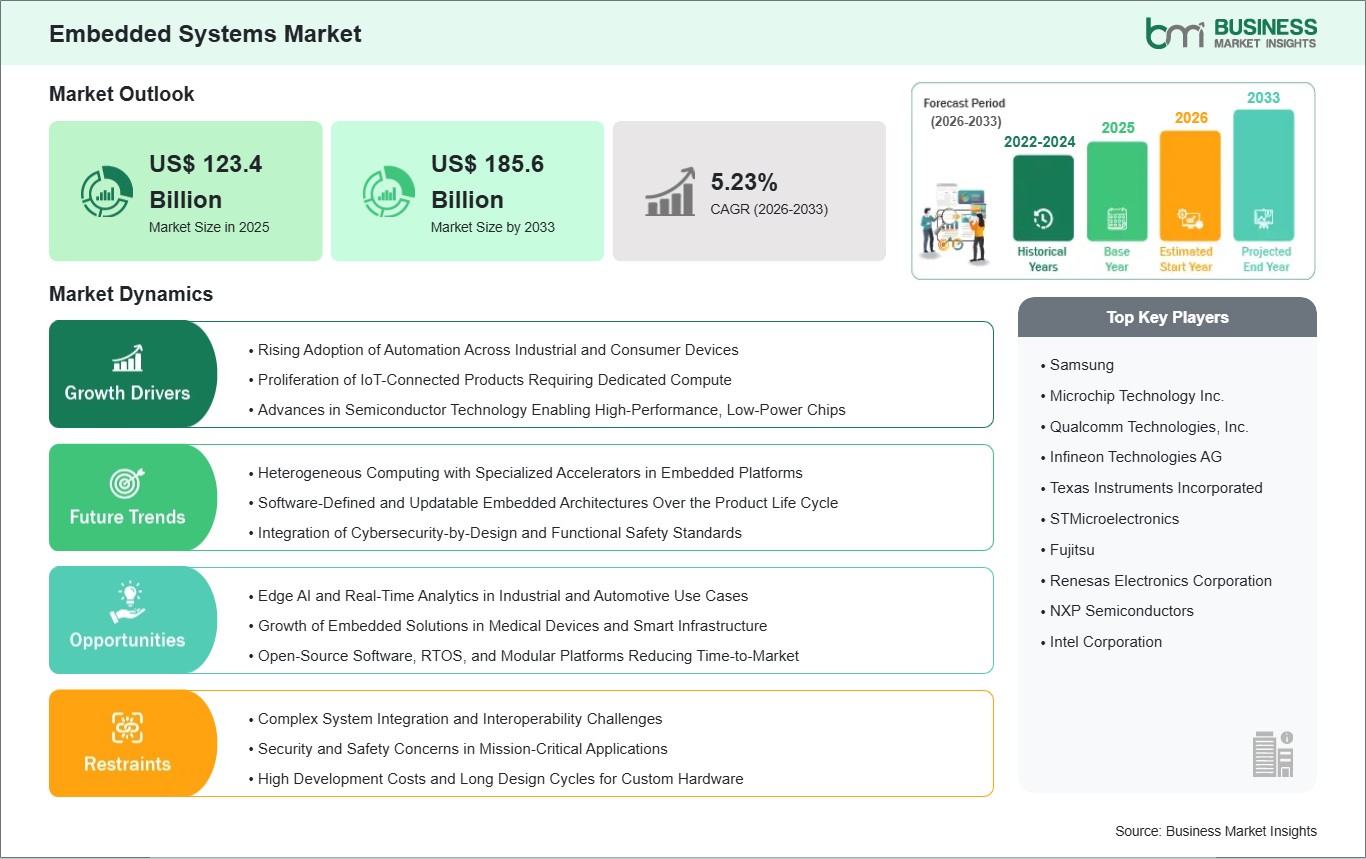
The Embedded Systems Market size is expected to reach US$ 185.6 Billion by 2033 from US$ 123.4 Billion in 2025. The market is estimated to record a CAGR of 5.23% from 2026 to 2033.
The embedded systems market is at the core of the modern electronics wave. It is the market that provides specialized computing, thus enabling embedded systems to be the least expensive unit in the ecosystem, in products ranging from cars and heavy industry machinery to consumer devices and medical gadgets. These systems give the possibility of real, time control, energy efficiency, security, and connectivity to a broad range of applications like factory automation, infotainment, robotics, and smart appliances. The demand worldwide is going up rapidly as industries are digitalizing, integrating IoT and adopting edge computing. These trends are driving up requirements for more processing power, less latency, and better security while the design has to be small, rugged, and power, efficient.
The growth is fueled by developments in semiconductor technology, automotive electronics, industrial automation, telecom infrastructure, and smart, city initiatives, particularly in Asia, Pacific and other emerging manufacturing hubs. Nevertheless, the market is still confronted with the issues of complicated hardware, software integration, cybersecurity threats, legacy code maintenance, and long design cycles that make the cost of development and time, to, market for OEMs and tier, one suppliers higher. At the same time, standardization, open architectures, model, based design, and mature toolchains are instruments in the hands of developers to overcome these obstacles and shorten the time of development. There are major long, term prospects in AI, powered edge devices, safety, critical medical and automotive systems, industrial IoT platforms, and embeddable upgradeable solutions that allow continuous feature enhancements over product lifecycles.
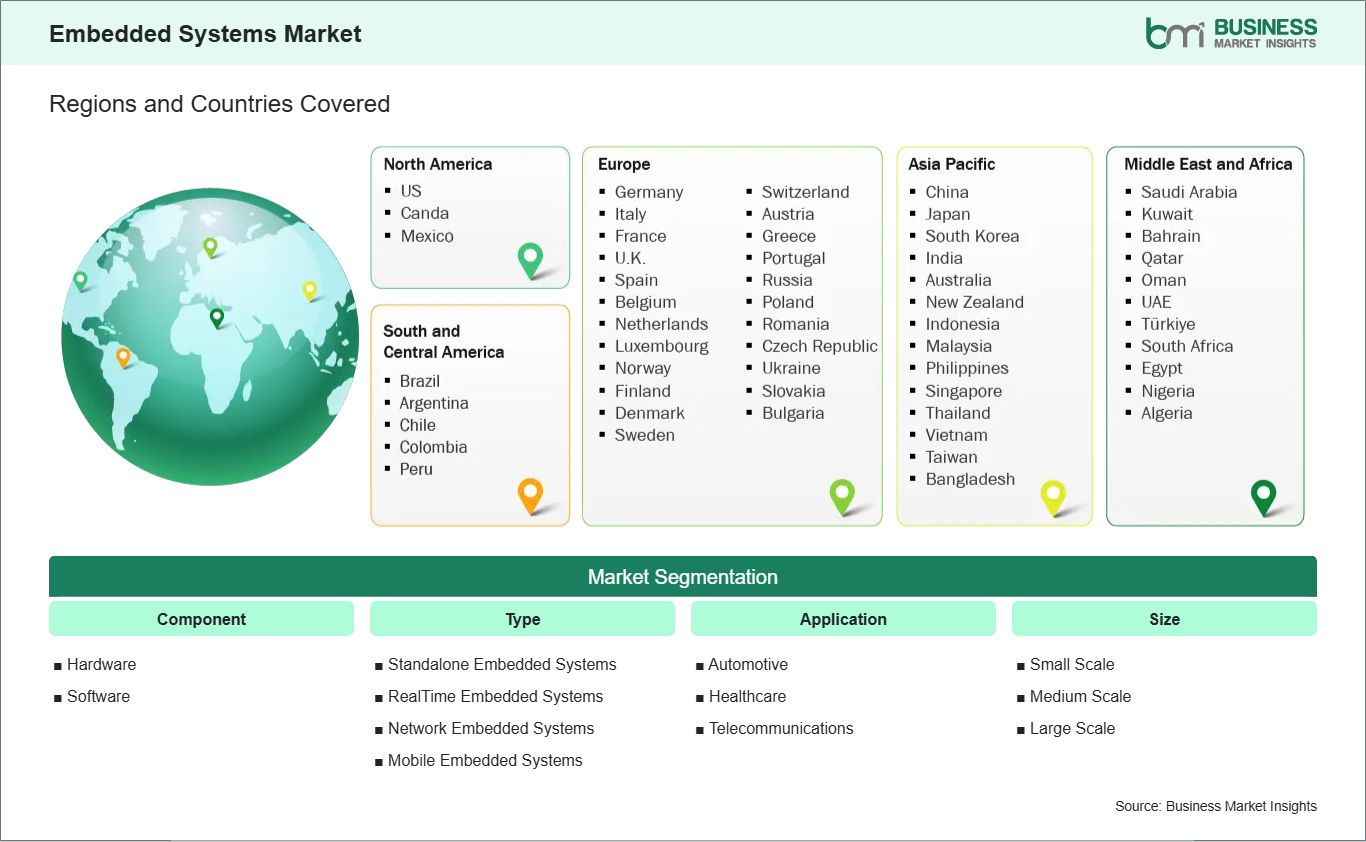
Key segments that contributed to the derivation of the Embedded Systems market analysis are component, type, application, and size.
The embedded systems market is largely influenced by the rapid growth of IoT and edge, computing applications. As industries undergo digital transformation, the deployment of sensors, controllers, and smart endpoints has gone into billions. These devices aim to monitor machines, vehicles, infrastructure, and consumer environments in real, time. Every one of these endpoints has to have embedded processors, memory, and firmware that are specifically designed for low power consumption, rugged operation, and deterministic performance. In manufacturing, embedded systems are the source of power for industrial robots, PLCs, and condition, monitoring devices that are at the core of Industry 4.0 and predictive maintenance. In the automotive sector, they are the foundation of ADAS, infotainment, powertrain, and body electronics, which in turn, lead to a considerable increase in the amount of electronic content per vehicle. The devices used in healthcare, such as imaging systems, wearables, and implantable, are rapidly getting equipped with embedded intelligence that can assist in diagnostics and therapy. Smart homes and consumer electronics, therefore, by connected appliances, entertainment devices, and personal gadgets, are contributing even more to the volume. At the level of architecture, the movement toward edge AI is a reason why more inference workloads are carried out locally on embedded hardware rather than in the cloud. This, in turn, calls for more powerful MCUs, SoCs, and accelerators which still have to meet strict cost and power limitations. Together, these trends are a guarantee of continued and varied demand for embedded systems across different verticals, with the level of design complexity and functionality increasing at an even faster rate than the number of unit shipments.
The substantial chance in the embedded systems market is where AI, powered, safety, critical platforms that are high, performing yet strictly reliable and secure are involved. Automotive ADAS and autonomous driving need real, time sensor fusion and decision, making, which is why they require heterogeneous compute architectures with GPUs, NPUs, and safety, certified MCUs. Medical devices have to be very conforming to regulations, and at the same time, be capable of running advanced algorithms for imaging, monitoring, and therapy. Industrial automation and collaborative robots are no different as they also require deterministic control, functional safety, and secure connectivity even in tough environments. Suppliers who are able to deliver pre, certified hardware and software stacks such as real, time operating systems, hypervisors, and development toolchains that comply with standards like ISO 26262, IEC 61508, or DO, 178C can drastically shorten the time, to, market for OEMs. Moreover, the other opening is at lifecycle management: embedded products are the kind of products that stay in the field for a long time, usually ten years or even more and this situation creates a demand for long, term availability, over, the, air software updates, and security patching. Devices that are made with remote management, secure boot, and cryptographic protection in mind can not only garner continuous service revenues but also assist in meeting regulatory requirements for cybersecurity. The more equipment that gets connected, the more open architectures, modular hardware, and containerized software at the edge will be the factors that suppliers will be able to differentiate themselves from the rest and thus, helping their customers to continuously add AI features and analytics without costly hardware redesigns.

By component, the embedded systems market is divided into hardware and software. The hardware segment was the largest one in the market in 2024. With hardware, one speaks about microcontrollers, microprocessors, memory, sensors, power management ICs, and boards that provide the core computing and control capabilities inside devices. The segment is leading because, on the one hand, every embedded application across automotive, industrial, consumer, and healthcare needs dedicated hardware platforms, and on the other hand, continuous breakthroughs in semiconductor integration and performance still result in replacement and upgrade cycles.
By type, the market is divided into standalone embedded systems, real, time embedded systems, network embedded systems, and mobile embedded systems. The standalone embedded systems segment had the largest share of the market in 2024. These types of systems execute specified functions in products such as home appliances, industrial machines, and basic automotive controllers, and, as they are manufactured in extremely high volumes with relatively low unit costs, their significant share is supported.
By application, the market is divided into automotive, healthcare, and telecommunications. The automotive segment was the one with the largest share in the market in 2024. Embedded systems in vehicles are the main reason for the rising electronic content per vehicle as they enable engine control, ADAS, infotainment, body electronics, and EV powertrains.
The market, by size, splits into small, scale, medium, scale, and large, scale embedded systems. In 2024, the segment of small, scale embedded system was the leading one in terms of market share, as a majority of the unit shipments of simple, single, function devices for both consumer and industrial products were dominated by 8, bit and 16, bit controllers.
| Report Attribute | Details |
|---|---|
| Market size in 2025 | US$ 123.4 Billion |
| Market Size by 2033 | US$ 185.6 Billion |
| Global CAGR (2026 - 2033) | 5.23% |
| Historical Data | 2022-2024 |
| Forecast period | 2026-2033 |
| Segments Covered | By Component
|
|
Regions and Countries Covered
| |
| North America | US, Canada, Mexico |
| Europe | Belgium, Austria, Finland, Denmark, Greece, Poland, Romania, Russia, Ukraine, Czech Republic, Slovakia, Bulgaria, Italy, Luxembourg, Germany, Switzerland, France, Netherlands, Norway, Portugal, Spain, Sweden, United Kingdom |
| Asia-Pacific | Australia, China, India, Japan, South Korea, Indonesia, Malaysia, Philippines, Singapore, Thailand, Vietnam, Bangladesh, New Zealand, Taiwan |
| South and Central America | Brazil, Argentina, Peru, Chile, Colombia |
| Middle East and Africa | Bahrain, Kuwait, Oman, Qatar, Saudi Arabia, United Arab Emirates, Turkiye, South Africa, Egypt, Algeria, Nigeria |
| Market leaders and key company profiles |
|
The Embedded Systems Market Size and Forecast (2022–2033) report provides a detailed analysis of the market covering below areas:
The geographical scope of the embedded systems market report is divided into five regions: North America, Asia Pacific, Europe, Middle East & Africa, and South & Central America. The Embedded systems market in Asia Pacific is expected to grow significantly during the forecast period.
The local terrain includes China, Japan, South Korea, India, Taiwan, Singapore, and the next stage of industrialization in the Southeast Asian countries. Three of China, South Korea, and Taiwan have the latest technology in semiconductor foundries and the most competitive clusters of electronics manufacturing in these regions, China, South Korea, and Taiwan. This has been the major source of the intensive consumption of microcontrollers, processors, and embedded boards for products such as smartphones, consumer devices, networking gear, and industrial equipment. Japan has been the largest hub of the automotive industry, factory automation, and the production of robotics that heavily rely on sophisticated embedded control systems. India, on the other hand, is making its way to become the major hub of embedded, software design and R&D centers that support global OEMs in the automotive, industrial, and telecom sectors. Initiatives started by the Government such as "Made in China 2025, " "Digital India, " and Industry 4.0 programs in South Korea and ASEAN countries are the major factors behind the rise of local production of electronics, smart, factory upgrades, and EV adoption, hence, the demand is increasing further. North America and Europe are still holding strong positions in segments that are of high value such as aerospace, medical devices, and industrial automation, which are sustained by advanced design ecosystems and very strict safety standards. At the same time, Latin America and Middle East & Africa are smaller in size but are on the rise as markets due to the expanding of the automotive assembly, telecom rollouts, and slow industrial modernization, usually relying on imported components, but they are increasingly establishing local design capabilities.
The Embedded systems market is evaluated by gathering qualitative and quantitative data post primary and secondary research, which includes important corporate publications, association data, and databases. A few of the key developments in the embedded systems market are:
The Embedded Systems Market is valued at US$ 123.4 Billion in 2025, it is projected to reach US$ 185.6 Billion by 2033.
As per our report Embedded Systems Market, the market size is valued at US$ 123.4 Billion in 2025, projecting it to reach US$ 185.6 Billion by 2033. This translates to a CAGR of approximately 5.23% during the forecast period.
The Embedded Systems Market report typically cover these key segments-
The historic period, base year, and forecast period can vary slightly depending on the specific market research report. However, for the Embedded Systems Market report:
The Embedded Systems Market is populated by several key players, each contributing to its growth and innovation. Some of the major players include:
The Embedded Systems Market report is valuable for diverse stakeholders, including:
Essentially, anyone involved in or considering involvement in the Embedded Systems Market value chain can benefit from the information contained in a comprehensive market report.
Please tell us your area of interest
(Market Segments/ Regions and Countries/ Companies)