Market Summary
Executive Summary and Global Market Analysis
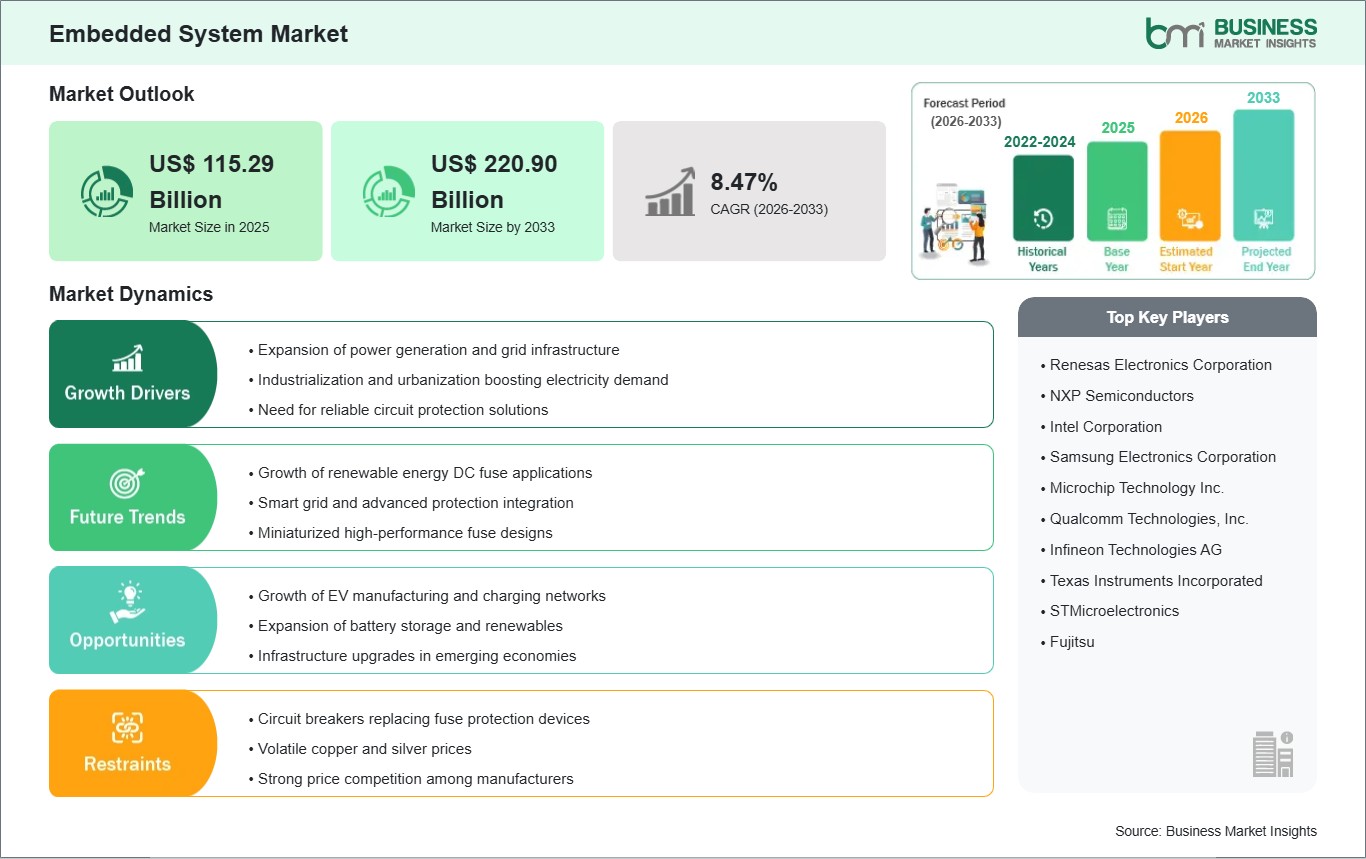
The global embedded system market is experiencing significant growth, driven by the increasing adoption of connected devices, IoT applications, and smart technologies across industries. Rising demand for automation in consumer electronics, automotive, industrial, healthcare, and telecommunications sectors is fueling the need for high-performance embedded hardware and software solutions. Small-scale embedded systems are witnessing the largest adoption due to their compact design, cost efficiency, and suitability for IoT and wearable devices. Technological advancements, including AI-enabled systems, edge computing, and low-power designs, are further enhancing system capabilities and efficiency. Geographically, Asia Pacific dominates the market due to its strong manufacturing ecosystem and high adoption of smart devices, while North America and Europe maintain steady growth through early adoption of advanced technologies and industrial automation. Increasing investments in smart cities, connected infrastructure, and digitalization initiatives globally present new opportunities for market expansion, positioning embedded systems as critical enablers of next-generation electronics.
Segment Analysis
Embedded System Market Segmentation
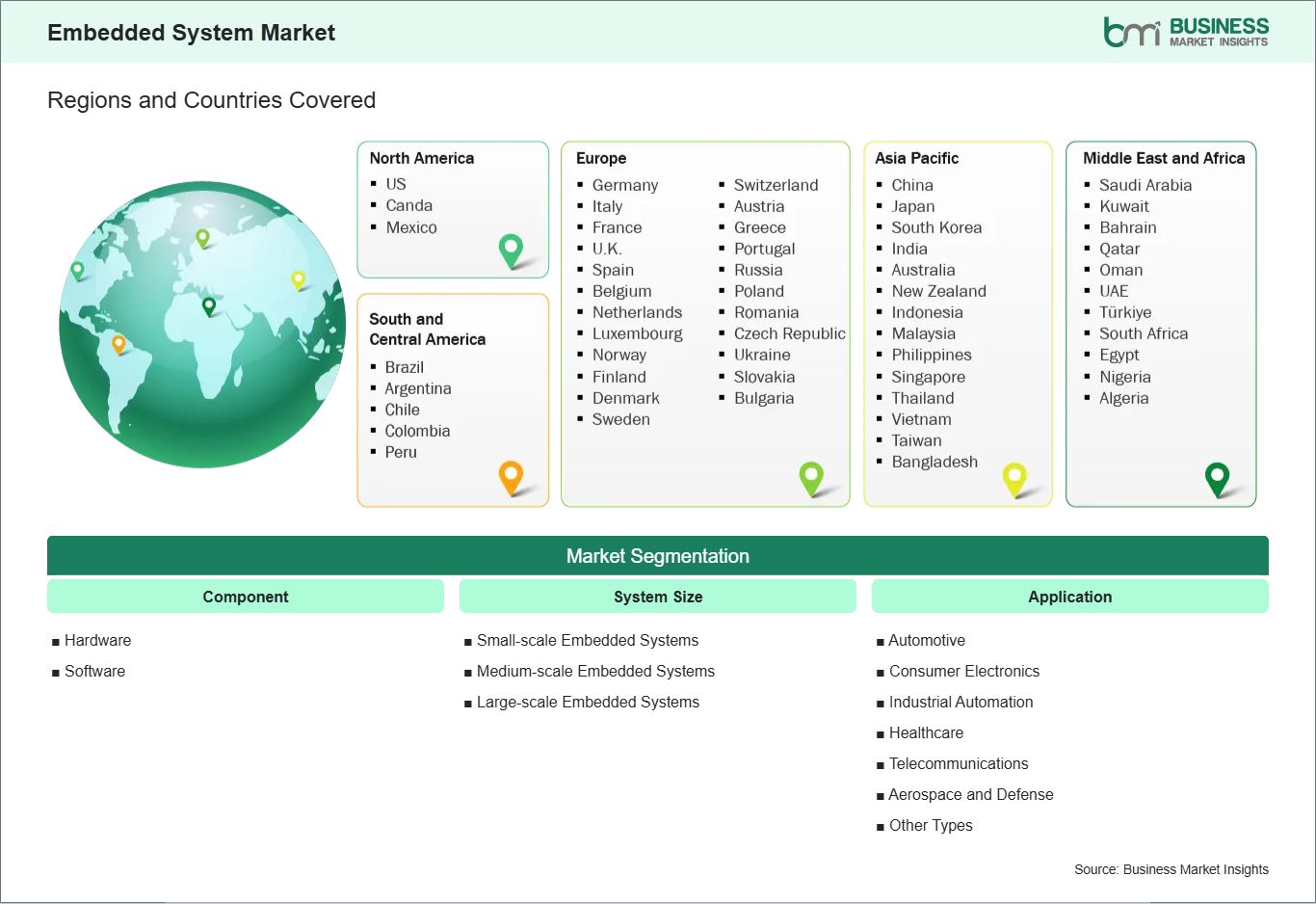
Key segments that contributed to the derivation of the Embedded Systems market analysis are component, system size, application.
- Based on component, the market is segmented into Hardware and Software. Among these, the Hardware segment accounted for the largest share in 2025.
- Based on system size, the market is segmented into Small-scale Embedded Systems, Medium-scale Embedded Systems, and Large-scale Embedded Systems. Among these, the Small-scale Embedded Systems segment accounted for the largest share in 2025.
- Based on application, the market is segmented into Automotive, Consumer Electronics, Industrial Automation, Healthcare, Telecommunications, Aerospace and Defense, and Other Types. Among these, the Consumer Electronics segment accounted for the largest share in 2025..
Market Forces
Embedded System Market Drivers and Opportunities
Growing Adoption of IoT and Smart Devices
The rapid proliferation of Internet of Things (IoT) devices and smart technologies is a key driver for the embedded systems market. Consumer electronics, automotive, industrial automation, and healthcare sectors are increasingly integrating embedded systems to enable connectivity, automation, and real-time monitoring. The rising demand for compact, energy-efficient, and high-performance devices fuels the need for advanced embedded hardware and software solutions. Additionally, the push for automation in manufacturing, smart homes, and connected vehicles is driving adoption. The combination of cost-effectiveness, scalability, and enhanced system functionality makes embedded systems essential for supporting the growing ecosystem of intelligent and connected devices.
Expansion of Automotive and Industrial Applications
The expansion of automotive and industrial applications presents significant opportunities for the embedded systems market. Increasing adoption of electric vehicles (EVs), autonomous driving technologies, advanced driver-assistance systems (ADAS), and smart manufacturing solutions requires sophisticated embedded systems for real-time data processing, safety, and communication. Industrial sectors are investing in robotics, automation, and predictive maintenance, further driving demand. The integration of AI, edge computing, and low-power embedded solutions enhances performance and efficiency, creating new growth avenues. Emerging economies with growing automotive production and industrial modernization projects offer additional market opportunities for embedded system vendors worldwide.
Size and Share Analysis
Embedded System Market Size and Share Analysis
Based on component, the market is segmented into Hardware and Software. Among these, the Hardware segment accounted for the largest share in 2025, driven by the increasing demand for robust and high-performance embedded devices across industries.
Based on system size, the market is segmented into Small-scale Embedded Systems, Medium-scale Embedded Systems, and Large-scale Embedded Systems. Among these, the Small-scale Embedded Systems segment accounted for the largest share in 2025, owing to their cost-effectiveness, compact size, and suitability for consumer electronics and IoT applications.
Based on application, the market is segmented into Automotive, Consumer Electronics, Industrial Automation, Healthcare, Telecommunications, Aerospace and Defense, and Other Types. Among these, the Consumer Electronics segment accounted for the largest share in 2025, supported by the widespread adoption of smartphones, wearables, and smart home devices.
Report Coverage
Embedded System Market Report Coverage and Deliverables
The "Embedded Systems Market Size and Forecast (2022 - 2033)" report provides a detailed analysis of the market covering below areas:
- Embedded Systems market size and forecast at global, regional, and country levels for all the key market segments covered under the scope
- Embedded Systems market trends, as well as market dynamics such as drivers, restraints, and key opportunities
- Embedded Systems market analysis covering key market trends, global and regional framework, major players, regulations, and recent market developments
- Industry landscape and competition analysis covering market concentration, heat map analysis, prominent players, and recent developments for the Embedded Systems market
- Detailed company profiles, including SWOT analysis
Geographic Insights
Embedded System Market Geographic Insights
The geographical scope of the Embedded Systems market report is divided into five regions: North America, Asia Pacific, Europe, Middle East and Africa, and South and Central America. The Embedded Systems market in Asia Pacific is expected to grow significantly during the forecast period.
The embedded systems market shows significant regional variations driven by technological adoption, industrial growth, and infrastructure development. Asia Pacific dominates the market due to its strong electronics manufacturing base, rapid industrialization, and widespread adoption of IoT and smart devices in countries such as China, India, Japan, and South Korea. The region benefits from cost-effective production and a large consumer electronics market, driving demand for small- and medium-scale embedded systems. North America maintains steady growth, supported by early adoption of advanced technologies, industrial automation, and smart vehicle innovations, with the U.S. leading in R&D and innovation. Europe follows closely, driven by automotive advancements, industrial IoT, and regulatory emphasis on energy efficiency and safety standards. Emerging markets in Latin America and Middle East & Africa are witnessing gradual growth due to increasing electrification, digitalization initiatives, and industrial modernization projects. Overall, regional focus on automation, connectivity, and smart infrastructure is shaping market expansion globally.
Industry Activity
Recent Developments
The Embedded Systems market is evaluated by gathering qualitative and quantitative data post primary and secondary research, which includes important corporate publications, association data, and databases. A few of the key developments in the Embedded Systems market are:
- In February 2026, DigiKey announced it will spotlight new embedded system products and technical demonstrations from leading suppliers such as Arduino, Microchip, NXP, and STMicroelectronics at its booth (4A‑633) during embedded world 2026, scheduled for March10 - 12 in Nuremberg, Germany. The company also plans to showcase tools at its TechBench, offer giveaways, and feature interactive demos aimed at engaging engineers and designers.
- February 25, 2026 - PayPal and Rainforest launched a new embedded PayPal integration for vertical software platforms, enabling software platforms to seamlessly embed PayPal, Venmo, and PayPal Pay Later into their checkout experiences. This integration helps merchants shift more processing volume from cash and checks to digital payments and offers unified onboarding, reporting, and reconciliation via a single API.
Trust & Transparency
Research Methodology
The market analysis combines proprietary research with secondary data from government agencies, company disclosures, regulatory filings, industry databases and expert interviews. Market estimates are validated through data triangulation, cross-market benchmarking and analyst
review.
View Full Research Methodology
Key Sources Referred:
World Bank - Global Trade IndicatorsWorld Trade Organization (WTO)International Monetary Fund (IMF)International Trade Administration (ITA)Company websiteCompany annual reportsCompany investor presentations