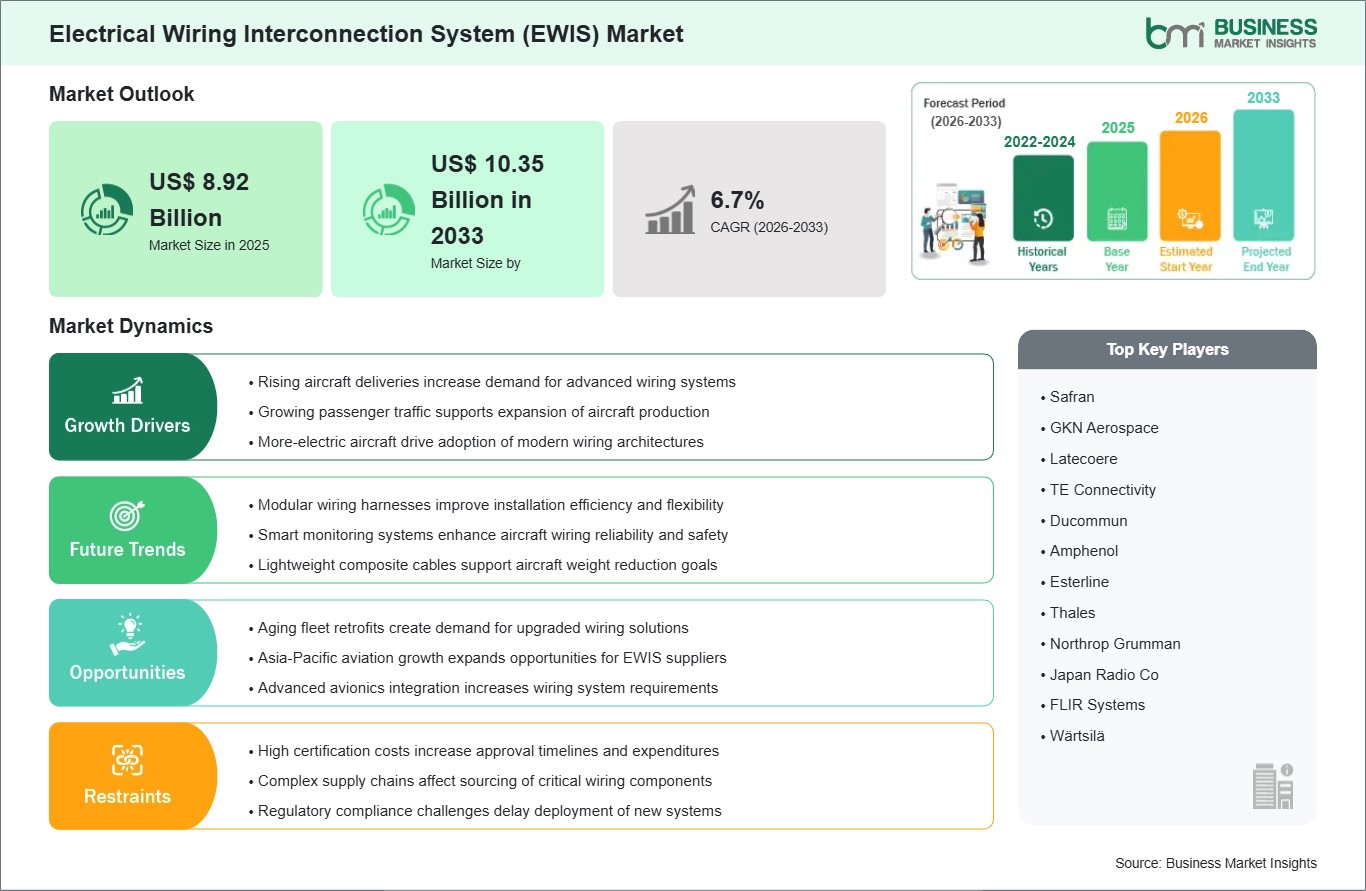
The electrical wiring interconnection system (EWIS) market size is expected to reach US$ 10.35 billion by 2033 from US$ 8.92 billion in 2025. The market is estimated to record a CAGR of 6.7% from 2026 to 2033.
Electrical Wiring Interconnection System's (EWIS) market occupies a strategic position within modern aerospace platforms, serving as the critical network that enables power distribution, signal transmission, communication, monitoring, and control functions throughout an aircraft. As aircraft architectures become increasingly digitized and electrically intensive, EWIS has evolved from a conventional wiring framework into an integrated system supporting advanced avionics, flight control technologies, cabin electronics, and onboard connectivity solutions.
A significant market driver is the aviation industry's transition toward more-electric and hybrid-electric aircraft concepts, which require sophisticated wiring architectures capable of handling higher electrical loads while maintaining operational safety and efficiency. Manufacturers have begun to focus on light-weight wires, enhanced insulating methods, and modularity of wiring harnesses in order to minimize the overall weight of aircraft, which results in fuel economy for the planes. In addition to that, with the advent of connected flight technology, predictive maintenance and real-time data transmission, the role of high-performance EWIS system architecture has gained significant importance.
The market is also benefiting from the modernization of aging aircraft fleets and the increasing emphasis on aircraft safety and system reliability. Airlines and aircraft operators are prioritizing advanced wiring systems that offer enhanced durability, resistance to environmental stress, and improved fault detection capabilities. This trend is particularly evident in retrofit programs where outdated wiring networks are being replaced with more efficient and maintenance-friendly solutions designed to support evolving operational requirements.
Despite strong growth prospects, the market faces challenges related to stringent certification standards, installation complexity, and the high costs associated with advanced aerospace-grade materials. The integration of increasingly complex electronic systems can also create design and maintenance challenges. Nevertheless, continuous innovation in electrical architecture, materials engineering, and aircraft

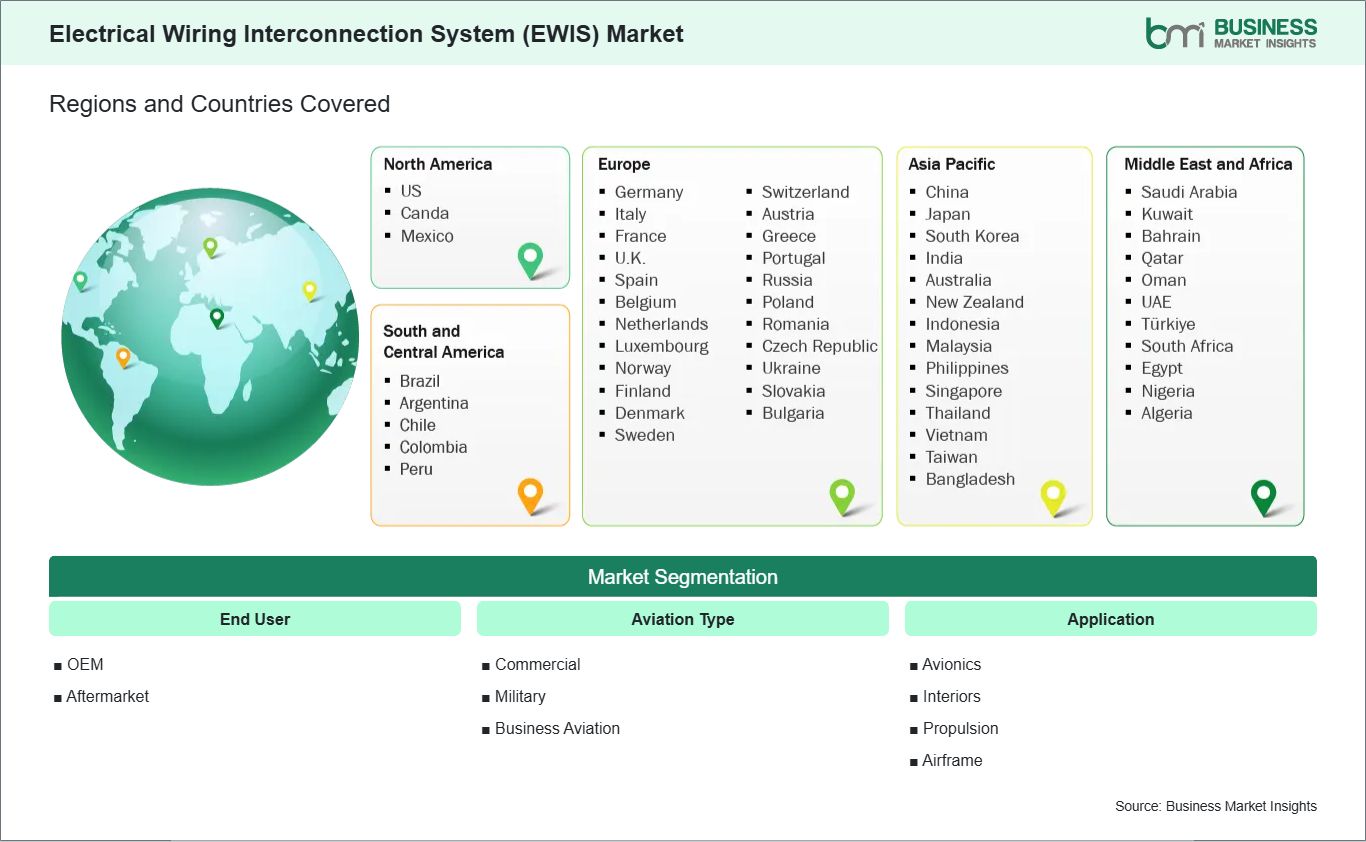
The electrical wiring interconnection system (EWIS) market is segmented based on end user, aviation type, and application, reflecting the growing demand for reliable electrical connectivity, advanced avionics integration, and enhanced aircraft safety and performance across the aviation industry.
The Electrical Wiring Interconnection System (EWIS) market is being driven by the steady increase in aircraft deliveries across commercial, military, and business aviation segments. Aircraft are increasing their capacity as a result of increased numbers of passengers traveling through them, and airplane manufacturing companies are increasing their capacity to fulfill previous orders. Each plane has to be wired to distribute power, control the navigation process, communication equipment, and safety equipment, among others, thus ensuring that the market for EWIS remains strong.
The increasing complexity of modern aircraft is further strengthening market growth. The current generation of aircrafts makes use of state-of-the-art avionics, cockpit systems, in-flight connectivity systems, and monitoring systems that rely on reliable wiring systems to function properly. As more electronics become a part of the modern-day aircraft, there has been increased emphasis on developing light and efficient wiring systems.
Another important growth factor is the ongoing trend toward aircraft electrification. Modern platforms employ electrical components instead of traditional hydraulic and pneumatic components to increase fuel economy and minimize maintenance needs. This change will make a higher amount and level of wiring harness, connector, cable, and interconnection systems required for aircraft use. With increasing production rate and ongoing technological advancements in aircraft design, the need for advanced EWIS is expected to persist in the aerospace market.
A significant opportunity in the EWIS market lies in the growing retrofit requirements of aging aircraft fleets. Many airplanes that have already taken flight over the decades have required upgrading from time to time due to the need for safety and conformity to regulations. Among the many systems that are prone to deterioration and need replacing is the wiring system since it is subjected to vibrations, temperature changes, and environmental stressors.
Airlines are increasingly investing in cabin modernization, avionics upgrades, and connectivity enhancements to improve passenger experience and operational performance. These retrofits frequently lead to the need for changes in existing wiring architecture, which means that replacement harnesses, connectors, and interconnection systems will be needed. The fact that new electronic devices should function in harmony with existing aircraft infrastructure gives additional opportunities for EWIS providers.
Additionally, aviation authorities continue to emphasize electrical system reliability and safety through ongoing maintenance and inspection requirements. These organizations are taking proactive steps in upgrading old wiring systems to minimize chances of system breakdowns, thereby improving aircraft availability and longevity. As airline companies look for ways to minimize costs that do not involve fleet replacement, it is anticipated that retrofits and upgrades will bring great opportunities for EWIS businesses.
The electrical wiring interconnection system (EWIS) market is projected to grow from US$ 8.92 billion in 2025 to US$ 10.35 billion by 2033, registering a CAGR of 6.7% from 2026 to 2033.
By end user, the OEM segment dominates the market due to the extensive integration of wiring interconnection systems during aircraft manufacturing. Aircraft manufacturers increasingly require advanced EWIS solutions to support modern avionics, electrification trends, and stringent safety standards, making OEM installations the primary source of demand.
By aviation type, commercial aviation dominates the market owing to the large volume of commercial aircraft production and deliveries worldwide. Rising air passenger traffic, fleet expansion programs, and the growing adoption of technologically advanced aircraft continue to drive demand for sophisticated EWIS solutions in this segment.
By application, the avionics segment dominates the market as modern aircraft rely heavily on complex communication, navigation, flight control, and monitoring systems that require extensive and highly reliable wiring networks. The increasing digitalization of aircraft and integration of advanced electronic systems further strengthen the demand for EWIS in avionics applications.
| Report Attribute | Details |
|---|---|
| Market size in 2025 | US$ 8.92 Billion |
| Market Size by | US$ 10.35 Billion in 2033 |
| Global CAGR (2026 - 2033) | 6.7% |
| Historical Data | 2022-2024 |
| Forecast period | 2026-2033 |
| Segments Covered | By End User
|
|
Regions and Countries Covered
| |
| North America | US, Canada, Mexico |
| Europe | Germany, Italy, France, U.K., Spain, Belgium, Netherlands, Luxembourg, Norway, Finland, Denmark, Sweden, Switzerland, Austria, Greece, Portugal, Russia, Poland, Romania, Czech Republic, Ukraine, Slovakia, Bulgaria |
| Asia-Pacific | China, Japan, South Korea, India, Australia, New Zealand, Indonesia, Malaysia, Philippines, Singapore, Thailand, Vietnam, Taiwan, Bangladesh |
| South and Central America | Brazil, Argentina, Chile, Colombia, Peru |
| Middle East and Africa | Saudi Arabia, United Arab Emirates, Kuwait, Bahrain, Qatar, Oman, Turkiye, South Africa, Egypt, Nigeria, Algeria |
| Market leaders and key company profiles |
|
The "Electrical Wiring Interconnection System (EWIS) Market Size and Forecast (2022-2033)" report provides a detailed analysis of the market covering below areas:
In terms of geographical distribution of the Electrical Wiring Interconnection System (EWIS) Market, there is a varied pattern of adoption based on factors such as aircraft production rates, fleet expansion programs, increasing investments in aerospace and defense sectors, and the growing integration of advanced avionics and electrical systems.
North America is a leading market for electrical wiring interconnection systems, supported by the presence of major aircraft manufacturers, aerospace suppliers, and defense organizations.There are investments being made continually in the aviation industry, military aviation upgrade, and aerospace technology in both the US and Canada. This is due to the increasing need for wiring and connection products with the implementation of avionics systems and communication systems on board aircrafts, as well as parts for electric aircraft systems. Moreover, the concern for safety, reliability, and aircraft maintenance in the region is driving the market even further.
Asia Pacific is experiencing significant growth in the EWIS market due to rising aircraft deliveries, expanding airline fleets, and increasing defense procurement activities. Countries such as China, India, Japan, and South Korea are investing heavily in building up air transportation infrastructure and local capabilities to build their own planes. The development of the aircraft industry within this region, coupled with increased traffic in the air and the efforts made by these countries to modernize their armed forces, is leading to an increased demand for more advanced electrical wiring systems to facilitate power distribution and communication.
Both North America and Asia Pacific play a crucial role in the expansion of the electrical wiring interconnection system market, driven by increasing aircraft production, ongoing fleet modernization initiatives, advancements in aerospace electrical technologies, and the growing need for reliable, lightweight, and high-performance wiring solutions across commercial and defense aviation platforms.

The electrical wiring interconnection system (EWIS) market is evaluated by gathering qualitative and quantitative data post primary and secondary research, which includes important corporate publications, association data, and databases. Recent developments and news in the market include:
The Electrical Wiring Interconnection System (EWIS) Market is valued at US$ 8.92 Billion in 2025, it is projected to reach US$ 10.35 Billion in 2033 by .
As per our report Electrical Wiring Interconnection System (EWIS) Market, the market size is valued at US$ 8.92 Billion in 2025, projecting it to reach US$ 10.35 Billion in 2033 by . This translates to a CAGR of approximately 6.7% during the forecast period.
The Electrical Wiring Interconnection System (EWIS) Market report typically cover these key segments-
The historic period, base year, and forecast period can vary slightly depending on the specific market research report. However, for the Electrical Wiring Interconnection System (EWIS) Market report:
The Electrical Wiring Interconnection System (EWIS) Market is populated by several key players, each contributing to its growth and innovation. Some of the major players include:
The Electrical Wiring Interconnection System (EWIS) Market report is valuable for diverse stakeholders, including:
Essentially, anyone involved in or considering involvement in the Electrical Wiring Interconnection System (EWIS) Market value chain can benefit from the information contained in a comprehensive market report.
Please tell us your area of interest
(Market Segments/ Regions and Countries/ Companies)