
Effervescent Packaging Market Outlook: Size, Share, Trends, Growth Analysis, Competitive Landscape & Forecast, 2026-2033

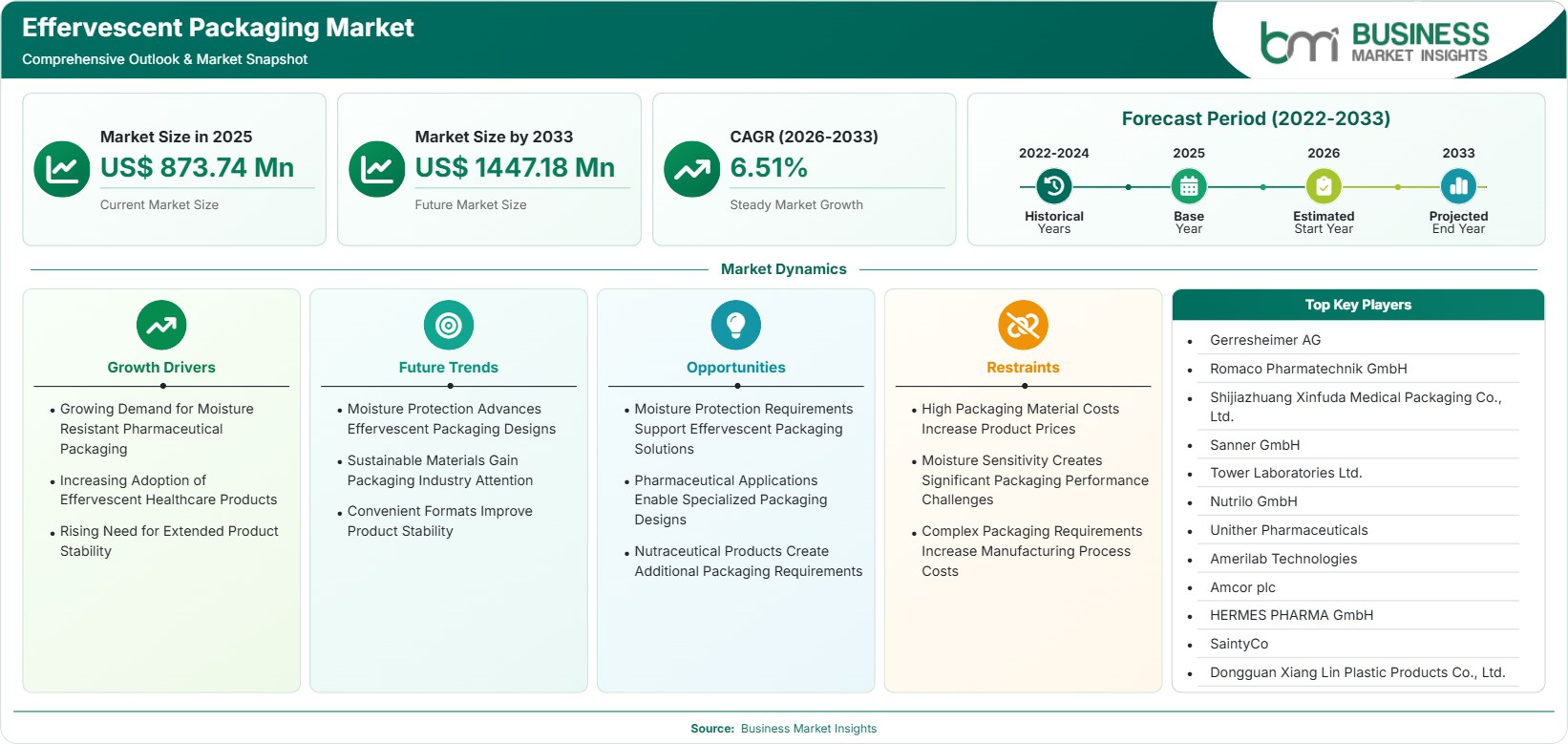
The Effervescent Packaging Market was valued at US$ 873.74 Million in 2025 and is projected to reach US$ 1447.18 Million by 2033, growing at a CAGR of 6.51% during 2026–2033, driven by moisture protection, pharmaceutical demand, nutraceutical adoption, sustainable materials, and convenient single-dose formats. The market report provides detailed analysis of market size, regional performance, segment trends, competitive developments, growth opportunities, and the evolving demand for high-barrier and sustainable packaging solutions.

Report Coverage
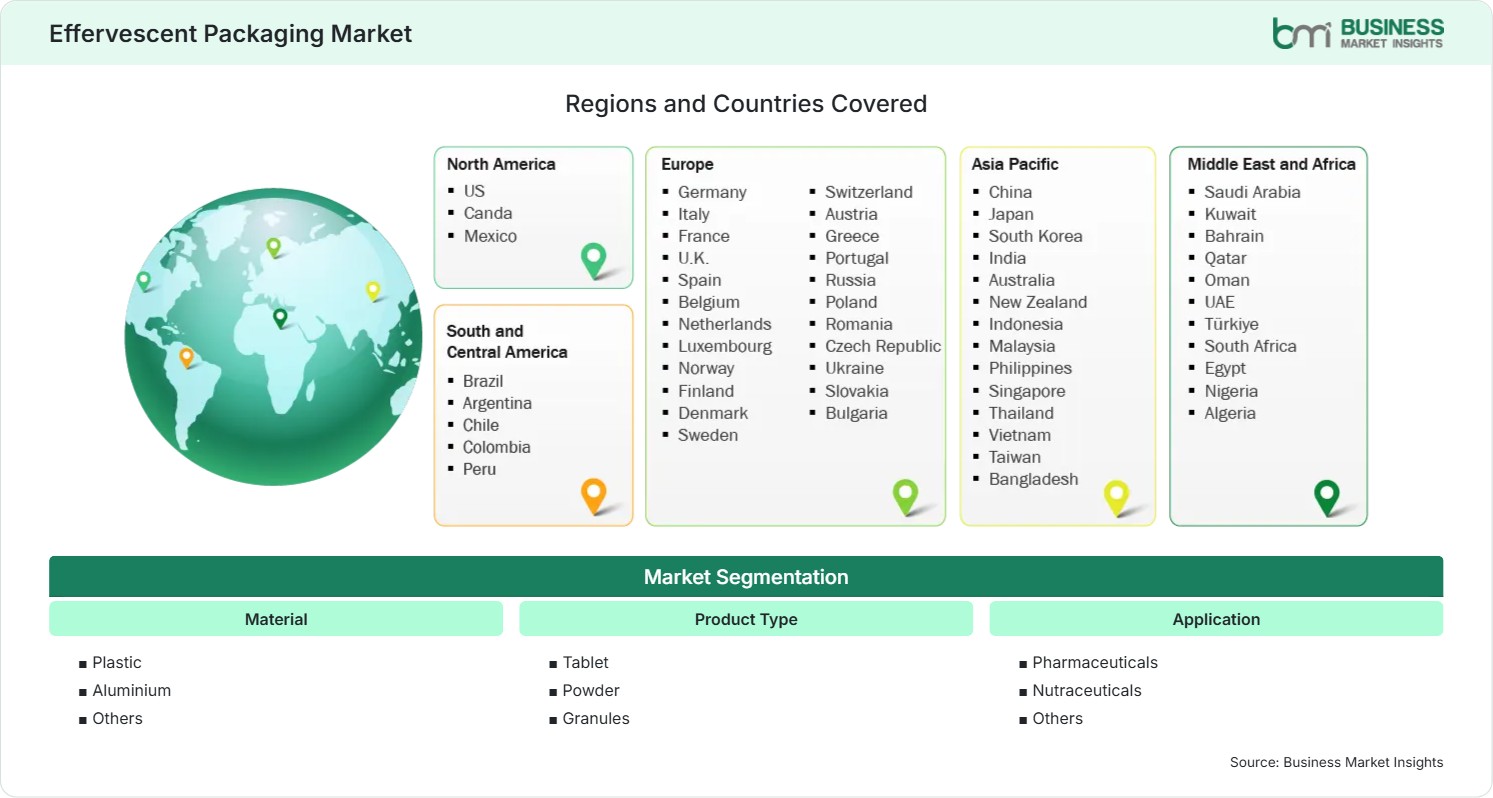
  • Material: Plastic, Aluminium, Others
  • Product Type: Tablet, Powder, Granules
  • Application: Pharmaceuticals, Nutraceuticals, Others
US$ 873.74 Mn Market size in 2025
US$ 1447.18 Mn Market Size by 2033
6.51% CAGR, 2026 - 2033
2026-2033 Forecast Period

AI Overview

Effervescent Packaging Market Summary

  • North America Region: North America holds a market share of 31%–34% in 2025, growing with a CAGR of 6.2%–6.7% during 2026–2033, influenced by pharmaceutical demand, preventive healthcare, nutraceutical consumption, advanced barrier packaging, and premium convenience formats. The U.S. accounts for most regional demand, supported by established pharmaceutical packaging infrastructure and strong supplement consumption, with a CAGR of 6.3%–6.8%.
  • Fastest Growing Region: Asia Pacific holds an Effervescent Packaging Market share of 27%–30% in 2025, growing with a CAGR of 7.0%–7.6% during 2026–2033, driven by pharmaceutical manufacturing expansion, rising healthcare expenditure, urbanization, nutraceutical adoption, contract manufacturing, and increasing demand for moisture-resistant packaging across humid climates.
  • Leading Segment: Plastic holds market share of 49%–53% in 2025, growing with a CAGR of 6.1%–6.6% during 2026–2033, supported by lightweight construction, cost efficiency, breakage resistance, design flexibility, moisture protection, recyclable polymer development, and compatibility with automated filling and closure systems.
  • High Growth Segment: Powder holds market share of 22%–26% in 2025, growing with a CAGR of 6.8%–7.4% during 2026–2033, supported by single-dose convenience, sports nutrition, hydration products, flexible sachets, portable formats, and growing consumer preference for rapid preparation.
  • Key Market Opportunity: Sustainable high-barrier packaging creates an attractive investment opportunity in the Effervescent Packaging Market as pharmaceutical and nutraceutical manufacturers seek recyclable structures, lower material intensity, moisture control, patient-friendly opening systems, and validated shelf-life performance.
  • Major Market Players: Gerresheimer AG, Romaco Pharmatechnik GmbH, Shijiazhuang Xinfuda Medical Packaging Co., Ltd., Sanner GmbH, Tower Laboratories Ltd., Nutrilo GmbH, Unither Pharmaceuticals, Amerilab Technologies, Amcor plc, HERMES PHARMA GmbH, SaintyCo, Dongguan Xiang Lin Plastic Products Co., Ltd., Parekhplast India Ltd., Bactolac Pharmaceutical, Inc., and Vitaquest International LLC.
Strategic Insights

Effervescent Packaging Market: Strategic Insights

Effervescent Packaging Market Strategic Framework
FREE PDF
Request your free sample
Request free sample
Stakeholder View

Key Takeaways

  • The supply chain is becoming increasingly integrated, linking polymer and aluminum suppliers, desiccant specialists, tube and closure manufacturers, filling-equipment providers, pharmaceutical CDMOs, and finished-dose manufacturers. Competitive advantage increasingly depends on coordinated barrier performance rather than packaging material alone.
  • Powder and granule formats offer attractive upside because they support single-dose packaging, hydration products, sports nutrition, and portable consumer-health applications. Flexible high-barrier laminates can expand these applications while reducing packaging weight compared with rigid multi-dose containers.
  • Innovation is moving toward recyclable mono-material structures, renewable feedstocks, digitally connected closures, improved desiccant performance, and child-resistant designs. Sanner's BioBase portfolio and Amcor's recyclable healthcare structures demonstrate the industry's movement toward performance-equivalent alternatives.
  • Asia Pacific presents a compelling investment case because pharmaceutical production capacity, nutraceutical consumption, and local packaging manufacturing are expanding simultaneously. Amcor's 2026 investment in its Sira, Karnataka facility illustrates the strategic importance of localized healthcare packaging capacity in India.
  • Investment activity is increasingly directed toward manufacturing localization, sustainable materials, automation, and high-barrier healthcare packaging. Rather than pursuing capacity alone, suppliers are prioritizing technologies that improve lead times, quality consistency, regulatory documentation, and compatibility with established filling lines.
Geographic Outlook

Effervescent Packaging Market Regional Highlights

North America Effervescent Packaging Market

The North American region accounted for 31% to 34% of the market in 2025, with an expected CAGR of 6.2% to 6.7% from 2026 to 2033. Such positioning of the regional market is credited to advanced competencies in pharmaceutical packaging, strong nutraceutical consumption, contract manufacturing competence, and high requirements for product stability. In this context, the United States emerges as the major source of demand in the region. Competition among suppliers has intensified due to packaging materials offering moisture protection, a child-resistant cap, an environmentally friendly polymer, and manufacturing competence. The regional Effervescent Packaging Market share is bolstered by strict regulations and consumers' widespread acceptance of premium health products. Growth prospects in the market are tied to pharmaceutical and wellness consumption.

  • Pharmaceutical manufacturers increasingly require validated moisture protection because effervescent formulations can degrade when exposed to humidity during filling, storage, or distribution.
  • Nutraceutical brands favor lightweight tubes, bottles, sachets, and stick packs that support vitamins, minerals, electrolytes, and functional wellness products across retail and e-commerce channels.
  • Sustainable packaging development is accelerating as suppliers seek recyclable structures without sacrificing barrier performance, sealing reliability, child resistance, or compatibility with existing packaging equipment.
  • Contract manufacturers increasingly value suppliers capable of combining packaging development, filling support, stability testing, regulatory documentation, and scalable production under one commercial relationship.

US Effervescent Packaging Market

The effervescent packaging market share in the United States accounted for around 80%-83% of total North American demand in 2025, while its CAGR is estimated at 6.3%-6.8% during the forecast period through 2033. Factors such as existing OTC pharmaceuticals, dietary supplements, sports nutrition, and consumer health channels drive demand. Regulatory compliance is driving demand by increasing the safety and suitability of packaging materials. USP guidelines on plastics and packaging systems are boosting demand for material qualification.

  • Consumer preference for portable dosage forms supports demand for single-dose packaging, particularly among supplement, hydration, and functional-health brands targeting active consumers.
  • Pharmaceutical packaging suppliers increasingly differentiate through moisture-barrier engineering, tamper evidence, child resistance, senior-friendly opening, and documentation supporting regulated product launches.
  • Domestic manufacturing provides strategic advantages when customers require shorter lead times, rapid packaging qualification, lower supply disruption exposure, and close technical collaboration.

Europe Effervescent Packaging Market

The effervescent packaging market in Europe accounted for 18%–21% of the market share in 2025 and is anticipated to grow at a CAGR of 6.0%–6.5% during 2025–2033. The key countries in Europe contributing to demand and production include Germany, France, Italy, and the United Kingdom; however, Germany plays a key role in specialty packaging and pharma production. The German market is estimated at a 6.1%–6.6% CAGR, and the French market at 6.4%–6.9%. Sustainable packaging regulations are forcing innovation in packaging design, while pharma quality standards ensure demand for validated moisture/oxygen barriers.

  • Germany benefits from concentrated pharmaceutical packaging expertise, specialized machinery suppliers, desiccant technologies, and established relationships between packaging developers and drug manufacturers.
  • France combines pharmaceutical production with strong consumer-health and nutraceutical activity, supporting demand for portable, attractive, and stability-oriented packaging solutions.
  • European packaging redesign increasingly considers recyclability, recycled content, material reduction, and compatibility with existing filling systems rather than sustainability as a separate packaging objective.
  • Suppliers with validated barrier performance and documented material provenance are better positioned to serve regulated pharmaceutical customers navigating changing packaging legislation.

Asia Pacific Effervescent Packaging Market

The Asia Pacific Effervescent Packaging market accounted for 27% to 30% market share in 2025, making it one of the largest regional markets, while its 7.0% to 7.6% CAGR makes it the fastest-growing region. India, China, Japan, South Korea, and Southeast Asia are key consumption hubs. India is expected to grow at a 7.3%-7.9% CAGR, driven by pharmaceutical manufacturing and nutraceutical growth. China is boosted by large-scale manufacturing operations as well as demand for healthcare services.

  • India combines pharmaceutical manufacturing scale with rising consumer-health consumption, creating opportunities for local production of high-barrier tubes, closures, laminates, and flexible dosage packaging.
  • China provides extensive polymer conversion and packaging manufacturing capacity, enabling competitive production while supporting increasingly sophisticated pharmaceutical and nutraceutical specifications.
  • Tropical and subtropical markets create strong technical requirements because humidity exposure can accelerate degradation of moisture-sensitive effervescent formulations during storage and distribution.
  • Regional suppliers increasingly compete on quality systems, automation, export compliance, and the ability to reproduce validated packaging specifications consistently across larger production volumes.

Rest of World Effervescent Packaging Market

The effervescent packaging market in the Rest of World accounted for around 16%–19% and is projected to grow at a 5.8%–6.4% CAGR from 2026 to 2033. The South and Central American region benefits from the increasing adoption of consumer healthcare products and supplements, and Brazil and Mexico are significant manufacturing and distribution hubs. The Brazilian market is expected to grow at a 6.1%–6.7% CAGR. Demand for effervescent products in the Middle East and Africa is driven by pharmaceutical import substitution, healthcare development, and increasing wellness consumption; however, price sensitivity is higher.

The Gulf nations are an important target market for high-end health supplements and medicines, while South Africa is the region's healthcare and logistics hub. Firms operating in these environments must strike a proper balance between moisture resistance and packaging efficiency.

  • Brazil offers an attractive combination of pharmaceutical manufacturing, nutraceutical demand, retail distribution infrastructure, and consumer interest in convenient supplement formats.
  • Mexico benefits from proximity to North American pharmaceutical and consumer-health supply chains, encouraging localized packaging production and cross-border manufacturing relationships.
  • Gulf countries provide opportunities for premium nutraceutical and pharmaceutical products where packaging aesthetics, stability, portability, and protection from harsh storage conditions influence purchasing decisions.
  • African markets remain more price sensitive, creating opportunities for simplified moisture-resistant packaging and scalable pack sizes that reduce unit costs while preserving product integrity.
Global Market Geography
FREE PDF
Request your free sample
Request free sample
Segment Analysis

Effervescent Packaging Market Segmentation

Material

The Plastic segment accounted for the largest share of material types in the Effervescent Packaging market in 2025, at 49%-53%, with a CAGR of 6.1%-6.6% in the period 2026-2033. This growth is attributable to properties such as lightweight, moisture resistance, durability, moldability, closure, and ease of filling through automation. Sustainable plastics are becoming popular.

  • Plastic: Plastic packaging combines lightweight construction, design flexibility, breakage resistance, moisture protection, and efficient high-volume manufacturing, supporting pharmaceutical and nutraceutical applications across tubes, bottles, and closures.
  • Aluminium: Aluminium provides strong moisture, oxygen, and light barriers, making it valuable for highly sensitive formulations requiring robust protection throughout storage, transport, and distribution.
  • Others: Alternative materials address specialized sustainability, barrier, aesthetic, and compatibility requirements, particularly where manufacturers seek differentiated packaging architectures or reduced dependence on conventional polymers.

Product Type

Tablet packaging continued to be the leading product segment, with 54%- 58% market share in 2025 and a 6.0%- 6.5% CAGR in 2026–2033 in the Effervescent Packaging Market. Tablets remain compatible with existing tube and closure systems; however, powder is considered the high-growth form due to single-dose packaging, which enables use in hydration and fitness.

  • Tablet: Tablet packaging requires tight closures and effective moisture management because formulation stability can be compromised by humidity, encouraging integrated desiccants and high-barrier tube designs.
  • Powder: Powder formats support flexible sachets and stick packs, providing precise single-dose delivery, portability, rapid preparation, and attractive opportunities across hydration, nutrition, and consumer healthcare.
  • Granules: Granules enable convenient dose delivery and can be packaged in high-barrier stick packs, supporting orally administered products where portability, controlled dosing, and moisture protection matter.

Application

Pharmaceuticals represented the leading application category with a 56%–60% share in 2025 and a 6.0%–6.5% CAGR of the Effervescent Packaging Market during 2026–2033. Regulatory expectations, stability requirements, and the criticality of dosage integrity make pharmaceutical customers strong purchasers of engineered packaging systems.

  • Pharmaceuticals: Pharmaceutical applications demand validated barrier properties, material compatibility, tamper evidence, reliable closures, and documentation supporting stability and regulatory submissions across commercial product lifecycles.
  • Nutraceuticals: Nutraceutical applications emphasize portability, shelf appeal, moisture protection, convenient dosing, and sustainable packaging, particularly for vitamins, minerals, electrolytes, sports nutrition, and preventive wellness products.
Market Forces

Effervescent Packaging Market Dynamics

Key Market Drivers

Moisture protection is becoming a core packaging specification

Moisture sensitivity remains the fundamental technical driver because effervescent formulations contain reactive ingredients that can initiate premature reaction when exposed to humidity. High-barrier tubes, desiccant closures, aluminum packaging, and laminated sachets are hence essential for product stability. Sanner provides integrated desiccant solutions and claims to have packaging solutions tailored to climatic regions, highlighting the importance of controlled internal humidity. The market's growth path is thus associated with pharmaceutical and nutraceutical manufacturers' search for validated shelf-life protection. Effervescent Packaging market trends will hence continue to shift towards integrated moisture-protection solutions rather than mere packaging containers. This trend helps those suppliers who can prove closure integrity, desiccant efficacy, material compatibility, and filling integrity.

Pharmaceutical dosage-form diversification expands packaging requirements

Expansions into tablets, powders, granules, instant beverages, and orally disintegrating forms increase the technological requirements imposed on packaging vendors. HERMES PHARMA, for instance, uses high-throughput technology for stick packs and sachets, and inert gas fill technology for oxygen-sensitive components. Such types of production increase the need for packaging that can handle varying formulations while maintaining accurate, safe dosing. Packaging needs are not just about containment but also about seal integrity, atmospheric control, ease of opening, and compatibility with filling processes. There is also an increasing desire among pharmaceutical and nutraceutical companies to reduce time to market, which makes suppliers of packaging engineering and manufacturing services more appealing. Thus, the Effervescent Packaging Market growth catalysts favor companies able to integrate materials, packaging design, filling, qualification, and manufacturing capabilities.

Convenience-led consumer healthcare supports portable packaging formats

Consumer health purchases have increasingly preferred easy-to-administer, easy-to-distribute, and easy-to-store packaging. Stick pack, sachet, mini tube, and unit-dose packaging address this need and provide opportunities for brand and dose differentiation. HERMES PHARMA packaging for 2025 is an example of this consideration: it is both child-resistant and easily accessible to the elderly, and tests show it opens easily for adults but fails when attempted by children. These concerns affect the packaging of effervescent products due to their interactive nature, in which the packaging is actually a component of the product rather than just packaging. Portable packaging also enables e-commerce and travel-based consumption, where resistance to mechanical stresses and environmental factors gains importance.

Key Market Opportunities

Recyclable high-barrier packaging creates premium positioning

Sustainability represents an economic opportunity for companies to offer recyclable structures without compromising moisture resistance. Amcor has a line of healthcare products that include recyclable, mono-material structures designed to ensure barrier performance, whereas Sanner offers renewable materials for effervescent packaging. The Effervescent Packaging Market Forecasts suggest that suppliers that can demonstrate quantifiable environmental benefits and validated product stability will have an edge in the market. Funding should be given to technologies that can reduce environmental impact without major alterations to filling systems. It is especially important for pharmaceutical clients to have documented validation of sustainability and regulatory quality.

Asia Pacific localization offers capacity expansion opportunities

Manufacturing healthcare packaging products in proximity to markets helps reduce time, enhance supply security, and reduce dependence on logistics. Amcor’s June 2026 capital outlay for its Sira, Karnataka site included an increase in manufacturing capacity, automation of online vision systems, the use of renewable energy, and the hiring of over 30 new workers. This kind of investment explains the strategic value of India and Asian manufacturing locations for packaging suppliers. The opportunities are not confined to manufacturing scale, as the local facility is capable of offering technical assistance, tooling, validation, and quick response to customers. Packaging cluster investors may focus on packaging hubs for pharmaceutical exporters, domestic drug manufacturers, nutraceutical producers, and CDMOs.

Smart and patient-centric packaging can increase value per pack

The ability to build margin through patient-related packaging functions includes child-resistant features, senior-friendly opening, traceability, connected closures, and improved dose messaging. One company, Gerresheimer, showcased its digitally connected Gx Cap at Pharmapack 2025. The demonstration showed how pharmaceutical closures could be used for medication adherence use cases. Similarly, for effervescents, it would be possible to combine packaging interaction with dose messaging, authentication, or consumer education. This is more relevant in the realm of chronic care, premium nutraceuticals, or high-end OTC products. Commercial success here means striking the right balance between technology, data privacy, reliability, regulations, and actual patient or brand value.

Market Restraints and Challenges

Stringent stability validation increases qualification costs

Factor: Pharmaceutical packaging changes can trigger material compatibility, extractables, closure-integrity, stability, and regulatory evaluation.

Impact: Qualification criteria add time to the process and make it difficult for manufacturers to adopt newer packaging systems, despite any potential sustainability or cost benefit they may provide. USP packaging requirements are a good example of how packaging criteria have shifted toward material and system suitability: USP 661.1 covers plastic construction materials, while USP 661.2 covers packaging system suitability. From the supplier's perspective, it becomes harder to substitute an existing polymer with a recyclable one, as the recyclable polymer must match the existing material in performance and compliance. The result is slower adoption of novel materials in highly regulated applications and greater commercial advantage for established suppliers with extensive validation documentation.

High-performance barrier materials can raise packaging costs

Factor: Aluminum, multilayer laminates, specialty coatings, integrated desiccants, and precision closures can increase unit costs compared with conventional packaging.

Impact: Economical plastic containers for nutraceuticals with low price sensitivity, or for developing pharmaceuticals, may choose inexpensive plastic containers even if more expensive structures offer better moisture resistance. Cost concerns become especially important when packaging is a significant portion of the final product's cost or when the product competes in a mass-market supplement category. In such a case, suppliers need to optimize material thickness, barrier properties, closure geometry, and manufacturing processes rather than using high-cost materials. This concern also makes the transition to sustainable packaging harder since sustainable containers will most likely require different tooling and qualification or filling procedures.

Company Analysis

Competitive Landscape

The competitive landscape reflects a combination of packaging manufacturers, pharmaceutical technology providers, contract development and manufacturing organizations, and specialized moisture-management suppliers. Effervescent Packaging Market analysis indicates that differentiation increasingly depends on barrier performance, sustainable material engineering, production compatibility, regulatory support, and customer-specific development rather than commodity packaging supply alone.

Company Name

Overview

Products and Services relevant to this market

Gerresheimer AG

Global pharmaceutical packaging and drug-delivery specialist serving regulated healthcare customers with integrated development capabilities.

Pharmaceutical containers, closures, plastic packaging, development support, stability services, and patient-centric packaging technologies.

Romaco Pharmatechnik GmbH

Pharmaceutical machinery specialist with strong expertise in automated packaging and production equipment for regulated manufacturers.

Blister packaging equipment, format systems, filling technologies, packaging machinery, and production-line support.

Shijiazhuang Xinfuda Medical Packaging Co., Ltd.

Chinese pharmaceutical packaging manufacturer serving domestic and international healthcare packaging requirements.

Pharmaceutical packaging components, plastic packaging solutions, containers, closures, and related production capabilities.

Sanner GmbH

Specialized packaging company with extensive expertise in desiccant closures and effervescent tablet packaging.

Effervescent tubes, closures, integrated desiccants, sustainable packaging, printing, and packaging development services.

Tower Laboratories Ltd.

U.S. pharmaceutical and consumer-health manufacturer specializing in effervescent and specialty dosage products.

Effervescent tablets, formulation development, contract manufacturing, packaging, and consumer-health production services.

Nutrilo GmbH

European contract manufacturer focused on vitamins, minerals, supplements, and functional nutrition products.

Nutraceutical formulation, powder and tablet manufacturing, filling, packaging, and private-label services.

Unither Pharmaceuticals

French pharmaceutical CDMO supporting oral and other dosage-form development and manufacturing.

Pharmaceutical development, manufacturing, packaging, dosage-form technologies, and contract production services.

Amerilab Technologies

U.S. contract manufacturer specializing in effervescent and specialty oral dosage products.

Effervescent tablets, powders, packaging, formulation development, manufacturing, and private-label solutions.

Amcor plc

Global packaging company providing healthcare packaging across rigid and flexible material platforms.

High-barrier laminates, pharmaceutical bottles, blisters, thermoformed packaging, closures, and healthcare packaging development.

HERMES PHARMA GmbH

Consumer-health specialist focused on user-friendly dosage forms and patient-centric pharmaceutical packaging.

Effervescent tablets, orally disintegrating granules, stick packs, sachets, packaging development, and contract manufacturing.

SaintyCo

Pharmaceutical equipment and packaging technology supplier serving drug manufacturers globally.

Tablet production, packaging machinery, filling systems, blister equipment, and pharmaceutical manufacturing technologies.

Dongguan Xiang Lin Plastic Products Co., Ltd.

Chinese plastic packaging manufacturer serving healthcare and consumer product packaging requirements.

Plastic containers, tubes, closures, injection-molded components, and customized packaging products.

Parekhplast India Ltd.

Indian rigid plastic packaging manufacturer with capabilities serving pharmaceutical and consumer markets.

Plastic bottles, containers, closures, injection molding, extrusion solutions, and customized pharmaceutical packaging.

Bactolac Pharmaceutical, Inc.

U.S. contract manufacturer focused on dietary supplements and consumer-health products.

Tablet and capsule manufacturing, powder production, formulation, packaging, private-label, and contract manufacturing.

Vitaquest International LLC

U.S. nutritional ingredient and contract manufacturing specialist serving health and wellness brands.

Nutraceutical formulation, powders, tablets, capsules, ingredient processing, packaging support, and contract manufacturing.

Trust & Transparency

Research Methodology

The market analysis combines proprietary research with secondary data from government agencies, company disclosures, regulatory filings, industry databases and expert interviews. Market estimates are validated through data triangulation, cross-market benchmarking and analyst review.

View Full Research Methodology

Questions Answered

Frequently Asked Questions

What should pharmaceutical manufacturers evaluate before changing packaging?

Manufacturers should assess moisture and oxygen transmission, closure integrity, material compatibility, extractables and leachables, stability performance, filling-line compatibility, regulatory documentation, recyclability, and total lifecycle cost. Packaging changes should be qualified against the product's actual sensitivity and distribution environment rather than evaluated only on material price.

What role does packaging play in nutraceutical product differentiation?

Packaging influences shelf life, portability, dosing convenience, visual positioning, and consumer confidence. For nutraceutical brands, stick packs, sachets, tubes, and compact containers can support sports nutrition, hydration, vitamins, and wellness products while providing opportunities for premium presentation and controlled dosing.

How are sustainability requirements changing pharmaceutical packaging?

Sustainability requirements are encouraging recyclable mono-materials, renewable feedstocks, recycled content, lighter structures, and lower-carbon manufacturing. The commercial challenge is maintaining equivalent moisture protection and regulatory performance. Sanner and Amcor are among companies developing solutions that address both sustainability and pharmaceutical packaging performance.

Which packaging material offers the strongest barrier performance?

According to the analysis presented in the Effervescent Packaging Market report, aluminium generally provides an excellent barrier against moisture, oxygen, and light, making it valuable for highly sensitive formulations. However, plastics with optimized structures and integrated desiccant closures can provide an effective balance of protection, cost, weight, manufacturability, and recyclability.

Why is moisture protection especially important for effervescent products?

Effervescent formulations contain reactive ingredients that can respond prematurely to humidity. Packaging therefore needs effective moisture barriers, tight closures, and, where appropriate, integrated desiccants to preserve stability and shelf life. Sanner specifically designs effervescent packaging around moisture management and climate-zone requirements.

Access the Full Effervescent Packaging Market Report

Get segment-level forecasts, regional estimates, competitive benchmarking, company profiles and downloadable Excel datasets.

Access the full Effervescent Packaging Market Report
350 pages PDF & Excel | 2026-09-16
Similar Research

Related Market Reports