
Eclinical Solutions Market Outlook: Size, Share, Trends, Growth Analysis, Competitive Landscape & Forecast, 2026-2033

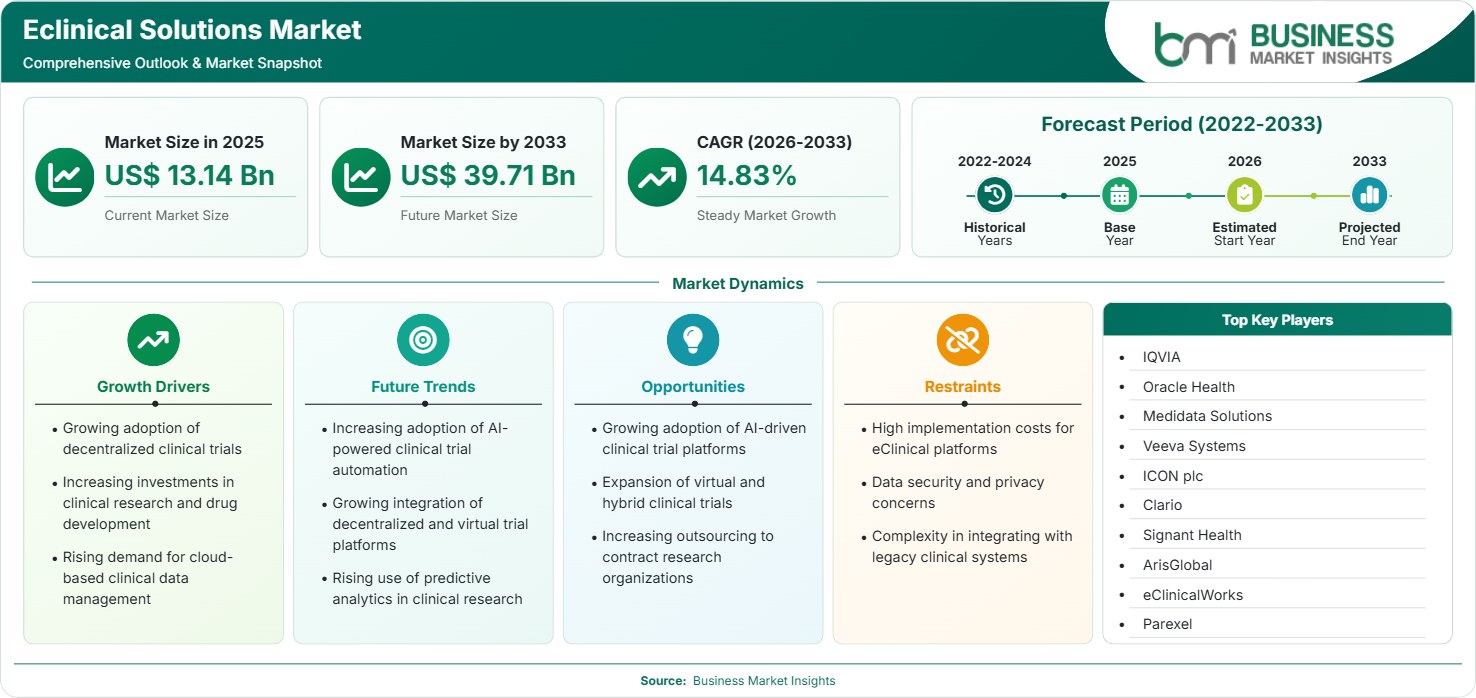
The Eclinical Solutions Market size was valued at US$ 13.14 Billion in 2025 and is projected to reach US$ 39.71 Billion by 2033, growing at a CAGR of 14.83% from 2026 to 2033, driven by decentralized clinical trials, rising clinical research investments, cloud-based data management adoption, AI-enabled trial platforms, and increasing outsourcing to contract research organizations.

Report Coverage
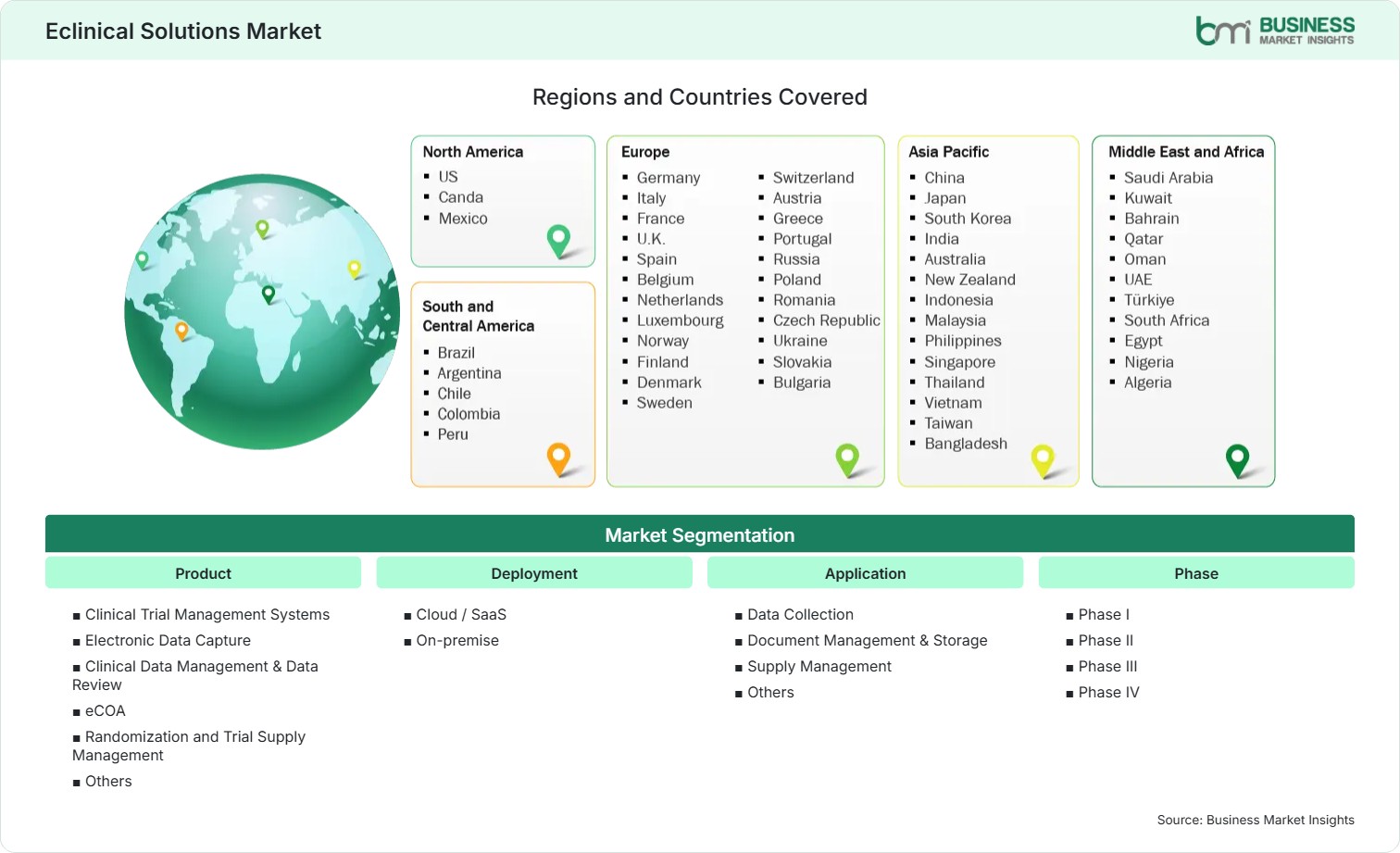
  • Product: Clinical Trial Management Systems, Electronic Data Capture, Clinical Data Management & Data Review, eCOA, Randomization and Trial Supply Management, Others
  • Deployment: Cloud / SaaS, On-premise
  • Application: Data Collection, Document Management & Storage, Supply Management, Others
  • Phase: Phase I, Phase II, Phase III, Phase IV
  • End User: Pharmaceutical & Biotechnology Companies, CROs, Hospitals & Clinics, Academic & Research Institutes, Others
US$ 13.14 Bn Market size in 2025
US$ 39.71 Bn Market Size by 2033
14.83% CAGR, 2026 - 2033
2026-2033 Forecast Period

AI Overview

Eclinical Solutions Market Summary

  • North America Region: North America holds a market share of 41%–44% in 2025, growing with a CAGR of 14%–16% driven by high clinical trial activity, digital healthcare infrastructure, cloud adoption, and strong pharmaceutical R&D investments. The US market grows at a CAGR of 14%–16% during 2026–2033, supported by expanding decentralized clinical trials, regulatory digitization, and AI-enabled research platforms.
  • Fastest Growing Region: Asia Pacific accounts for 22%–25% of the market in 2025 and is projected to register a CAGR of 16%–18% owing to increasing CRO activity, expanding pharmaceutical manufacturing, growing research investments, and favorable clinical trial environments.
  • Leading Segment: Electronic Data Capture holds a 28%–31% market share in 2025 and is expected to grow at a CAGR of 15%–17% due to rising demand for efficient data collection, regulatory compliance, and real-time monitoring capabilities.
  • High Growth Segment: Cloud / SaaS accounts for 60%–63% share in 2025 and is anticipated to expand at a CAGR of 16%–18% because of scalability, lower infrastructure costs, remote accessibility, and integration with digital trial platforms.
  • Key Market Opportunity: AI-powered clinical trial automation, virtual clinical studies, and increasing CRO outsourcing are accelerating digital transformation across global clinical research ecosystems.
  • Major Market Players: IQVIA, Oracle Health, Medidata Solutions, Veeva Systems, ICON plc, Clario, Signant Health, ArisGlobal, eClinicalWorks, and Parexel.
Strategic Insights

Eclinical Solutions Market: Strategic Insights

Eclinical Solutions Market Strategic Framework
FREE PDF
Request your free sample
Request free sample
Stakeholder View

Key Takeaways

  • Digital clinical research ecosystems are replacing fragmented trial management systems with integrated cloud-based platforms supporting end-to-end study execution.
  • Electronic Data Capture and cloud deployment continue offering the highest commercial potential due to increasing digitalization of clinical research operations.
  • Artificial intelligence, predictive analytics, and automation are reshaping protocol design, patient recruitment, monitoring, and clinical data validation.
  • Asia Pacific offers significant long-term investment opportunities because of expanding CRO capacity, lower trial costs, and improving regulatory environments.
  • Strategic collaborations between software vendors, pharmaceutical companies, and CROs are accelerating innovation and integrated platform development.
  • Patient-centric virtual trial models are improving recruitment efficiency, participant retention, and operational flexibility across multinational clinical studies.
Geographic Outlook

Eclinical Solutions Market Regional Highlights

North America Eclinical Solutions Market

North America accounted for 41%–44% of the market in 2025 and is expected to expand at a CAGR of 14%–16% during 2026–2033. The region leads global adoption due to strong pharmaceutical R&D spending, established biotechnology ecosystems, advanced healthcare IT infrastructure, and widespread implementation of digital clinical research platforms. The Eclinical Solutions Market share remains highest in this region because of continuous investments in decentralized clinical trial technologies.

  • Pharmaceutical companies continue adopting AI-enabled clinical trial management platforms to improve operational efficiency.
  • Regulatory agencies increasingly support electronic documentation and digital clinical workflows.
  • CROs are investing in integrated cloud platforms for multinational study management.
  • Digital health partnerships are accelerating innovation across clinical research technologies.

US Eclinical Solutions Market

The United States represented 36%–39% of the market in 2025 and is projected to register a CAGR of 14%–16% through 2026–2033. Strong pharmaceutical innovation, biotechnology leadership, and increasing adoption of decentralized clinical trial technologies continue supporting expansion. The Eclinical Solutions Market growth is reinforced by growing AI integration, cloud adoption, and increasing regulatory acceptance of digital clinical processes.

  • Life science companies continue modernizing clinical development platforms.
  • AI-assisted patient recruitment solutions are improving enrollment efficiency.
  • Cloud infrastructure investments are supporting enterprise-scale digital clinical operations.

Europe Eclinical Solutions Market

Europe accounted for 27%–30% of the global market in 2025 and is forecast to grow at a CAGR of 13%–15% during 2026–2033. The region benefits from increasing pharmaceutical innovation, harmonized regulatory frameworks, expanding clinical research collaborations, and growing investments in digital health technologies. Germany, the United Kingdom, and France remain leading contributors, while Eastern Europe continues attracting outsourced clinical studies.

  • Germany leads through strong pharmaceutical R&D infrastructure.
  • The United Kingdom continues expanding decentralized clinical trial adoption.
  • France supports digital clinical transformation through healthcare innovation initiatives.
  • Regional CRO expansion is increasing demand for integrated eClinical platforms.

Asia Pacific Eclinical Solutions Market

Asia Pacific represented 22%–25% of the global market in 2025 and is expected to grow at a CAGR of 16%–18% through 2026–2033. Rising pharmaceutical outsourcing, expanding biotechnology sectors, improving healthcare infrastructure, and increasing clinical trial activity continue supporting regional growth. China, India, Japan, and South Korea are strengthening their positions through regulatory modernization and expanding digital clinical research capabilities.

  • China continues expanding pharmaceutical innovation and digital trial infrastructure.
  • India remains a preferred destination for outsourced clinical research.
  • Japan is increasing adoption of AI-enabled clinical technologies.
  • South Korea is strengthening digital healthcare ecosystems supporting clinical research.

Rest of World Eclinical Solutions Market

South and Central America accounted for a 5%–7% market share in 2025, while the Middle East and Africa represented 4%–6%. These regions are projected to register CAGRs of 13%–15% and 14%–16%, respectively, during 2026–2033. Expanding pharmaceutical research activities, increasing healthcare digitalization, and rising investments in clinical trial infrastructure are encouraging adoption of integrated eClinical platforms. Brazil, Mexico, Saudi Arabia, and the UAE are emerging as important regional markets.

  • Brazil is expanding clinical research capabilities through growing pharmaceutical investments and increasing CRO participation.
  • Mexico is strengthening digital clinical trial infrastructure supported by international research collaborations.
  • UAE is investing in healthcare digital transformation and advanced research ecosystems.
  • Saudi Arabia is promoting life sciences innovation through healthcare modernization and biotechnology investments.
Global Market Geography
FREE PDF
Request your free sample
Request free sample
Segment Analysis

Eclinical Solutions Market Segmentation

Product

Product segmentation is driven by the increasing need for integrated digital platforms that streamline clinical trial management, improve regulatory compliance, and enhance data accuracy. Electronic Data Capture dominated with a 28%–31% market share in 2025 and is expected to grow at a CAGR of 15%–17% during 2026–2033. The Eclinical Solutions Market scope continues expanding as pharmaceutical companies increasingly implement end-to-end digital clinical ecosystems.

  • Clinical Trial Management Systems: Enable centralized planning, monitoring, and execution of clinical studies while improving operational efficiency and regulatory compliance.
  • Electronic Data Capture: Supports secure real-time clinical data collection, validation, and reporting, reducing manual errors and accelerating study completion.
  • Clinical Data Management & Data Review: Improves data quality, standardization, monitoring efficiency, and regulatory reporting across multicenter clinical trials.
  • eCOA: Enables electronic collection of patient-reported outcomes, improving participant engagement, compliance, and remote trial execution.
  • Randomization and Trial Supply Management: Optimizes subject randomization, drug allocation, inventory tracking, and supply chain coordination throughout clinical studies.

Deployment

Deployment segmentation reflects increasing preference for scalable and remotely accessible digital platforms. Cloud / SaaS accounted for a 60%–63% share in 2025 and is projected to register a CAGR of 16%–18% through 2026–2033. Cloud deployment continues gaining momentum because of lower infrastructure costs, improved scalability, seamless software updates, and enhanced collaboration across global clinical research networks.

  • Cloud / SaaS: Supports flexible deployment, centralized data access, automated updates, and efficient collaboration across geographically distributed clinical research teams.
  • On-premise: Preferred by organizations requiring customized infrastructure, greater internal control, and compliance with specific institutional security policies.

Application

Application segmentation continues expanding as organizations digitize multiple aspects of clinical trial execution. Data Collection represented a 40%–43% share in 2025 and is forecast to grow at a CAGR of 15%–17% during 2026–2033. Increasing demand for accurate, real-time clinical information and regulatory compliance continues supporting widespread adoption of digital data collection solutions.

  • Data Collection: Enables accurate electronic capture of patient information, reducing errors and improving research efficiency across multicenter trials.
  • Document Management & Storage: Supports secure electronic documentation, regulatory compliance, audit readiness, and collaborative research workflows.
  • Supply Management: Optimizes investigational product distribution, inventory monitoring, and logistics throughout clinical development programs.

Phase

Phase segmentation reflects growing adoption of digital platforms throughout drug development lifecycles. Phase III accounted for a 38%–41% market share in 2025 and is projected to expand at a CAGR of 15%–17% between 2026–2033. Large participant populations, multinational trials, and complex regulatory requirements continue driving significant technology investments during Phase III studies.

  • Phase I: Supports early safety evaluation through streamlined patient management and secure electronic data capture.
  • Phase II: Facilitates efficacy evaluation, protocol management, and integrated monitoring across expanding clinical studies.
  • Phase III: Requires comprehensive digital platforms for large-scale multinational clinical trials and extensive regulatory documentation.
  • Phase IV: Supports post-marketing surveillance, long-term safety monitoring, and real-world evidence collection.

End User

End-user segmentation reflects increasing digital transformation across pharmaceutical research organizations. Pharmaceutical & Biotechnology Companies accounted for a 46%–49% share in 2025 and are projected to grow at a CAGR of 15%–17% during 2026–2033. Growing clinical development pipelines, increasing digital investments, and expanding global research collaborations continue driving technology adoption.

  • Pharmaceutical & Biotechnology Companies: Lead adoption through extensive clinical development programs, regulatory compliance requirements, and digital transformation initiatives.
  • CROs: Expand implementation to improve operational efficiency, multinational study management, and sponsor collaboration.
  • Hospitals & Clinics: Utilize eClinical platforms to support investigator-led studies and patient-centered research activities.
  • Academic & Research Institutes: Adopt digital research platforms to strengthen clinical collaboration and improve research data quality.
Market Forces

Eclinical Solutions Market Dynamics

Key Market Drivers

Growing Adoption of Decentralized Clinical Trials

Decentralized clinical trials are transforming clinical research by enabling remote patient participation, virtual monitoring, and digital data collection. Sponsors increasingly implement decentralized models to improve patient recruitment, enhance retention, reduce geographic limitations, and accelerate study completion. Cloud technologies, wearable devices, telemedicine, and electronic patient-reported outcomes are supporting this transition. The Eclinical Solutions Market trends indicate sustained investment in digital trial platforms as pharmaceutical companies seek greater operational flexibility while maintaining regulatory compliance. Regulatory agencies are also encouraging innovative trial designs that improve accessibility, data quality, and participant diversity across global research programs.

Increasing Investments in Clinical Research and Drug Development

Global players in the pharma and biotech industries are continually investing more in clinical research to accelerate the development of new drugs and biologics. With increasing R&D spending, growing pipelines and regulatory requirements, there is an increasing need for integrated eClinical platforms that can facilitate the management of multi-national clinical trials. Technology allows sponsors to streamline the process, minimize costs and ensure regulatory compliance. Collaboration among pharma companies, CROs, academia and technology vendors has been continuously boosting demand for advanced clinical software solutions.

Rising Demand for Cloud-Based Clinical Data Management

Cloud-based platforms for the management of clinical data have become the preferred choice for implementation because they allow for secure data access, real-time collaboration, automatic software updates, and scalable enterprises. Enterprises are gradually shifting from on-premise data management systems to cloud systems for decentralized research, coordinated studies, and analysis. The combination of cloud computing technologies with artificial intelligence and predictive analytics results in more efficient processes and simplified infrastructure. Growing confidence in cloud security standards and regulatory compliance is driving the rapid adoption of cloud-based technologies by enterprises.

Key Market Opportunities

Growing Adoption of AI-Driven Clinical Trial Platforms

Artificial intelligence is transforming clinical research by improving protocol design, patient recruitment, site selection, risk-based monitoring, and predictive analytics. AI-powered platforms enable sponsors to analyze large datasets, automate repetitive workflows, and improve decision-making throughout clinical development. The Eclinical Solutions Market Forecasts indicate increasing investments in intelligent automation as pharmaceutical companies seek to reduce trial timelines and operational costs. AI also enhances data quality through automated validation and anomaly detection while supporting personalized patient engagement strategies. These capabilities are expected to create long-term growth opportunities for technology providers offering integrated AI-enabled eClinical platforms.

Expansion of Virtual and Hybrid Clinical Trials

The growing trend towards virtual/hybrid clinical trials is providing immense scope for companies engaged in digital clinical technology. There is an increased tendency by sponsors to integrate remote patient monitoring, telemedicine services, wearable technologies, and e-consent systems to enhance efficiency and convenience. The hybrid model of clinical trials removes geographical constraints while enhancing patient diversity and increasing patient retention rates. Decentralized clinical trials gaining regulatory acceptance are making it imperative to implement a digital trial ecosystem. Companies that have the capability of implementing a virtual trial solution will find scope in future demand.

Increasing Outsourcing to Contract Research Organizations

Growing outsourcing of clinical development activities to contract research organizations is creating new opportunities for eClinical solution providers. CROs increasingly require integrated digital platforms capable of managing multinational studies, regulatory documentation, patient engagement, and clinical data management. Pharmaceutical companies continue outsourcing research activities to improve efficiency, reduce operational costs, and accelerate product development timelines. As CROs expand global operations and diversify service offerings, demand for scalable cloud-based eClinical software continues increasing. Technology vendors supporting flexible deployment and interoperability are well positioned to capitalize on this growing outsourcing trend.

Market Restraints and Challenges

High Implementation Costs for eClinical Platforms

Factor: Enterprise-scale eClinical platforms require significant investments in software licensing, implementation services, integration, customization, employee training, and long-term maintenance. Impact: High deployment costs may delay digital transformation initiatives among smaller biotechnology companies, research institutions, and healthcare providers with limited budgets. Complex implementation projects can also increase operational disruptions during migration from legacy systems. Although cloud deployment reduces infrastructure expenses, organizations must continue investing in cybersecurity, compliance management, and system upgrades. Cost-related barriers remain a key consideration affecting broader adoption of advanced eClinical technologies across resource-constrained organizations.

Data Security and Privacy Concerns

Factor: eClinical platforms manage highly sensitive patient information, clinical research data, and regulatory documentation that require stringent protection against cyber threats and unauthorized access. Impact: Security breaches or regulatory non-compliance can result in financial penalties, operational disruption, reputational damage, and reduced stakeholder confidence. Organizations must continuously strengthen cybersecurity frameworks, encryption technologies, identity management systems, and regulatory compliance programs to safeguard clinical information. Increasing digital connectivity across global research networks further emphasizes the importance of secure and resilient eClinical infrastructures.

Company Analysis

Competitive Landscape

The competitive landscape is characterized by continuous innovation in cloud computing, artificial intelligence, decentralized clinical trial technologies, and integrated research platforms. Eclinical Solutions Market analysis indicates that leading companies are strengthening their portfolios through AI-powered automation, strategic acquisitions, cloud-native software development, and global research partnerships. Vendors continue investing in interoperable digital ecosystems that improve operational efficiency, regulatory compliance, and patient engagement.

Company Name

Overview

Products and Services Relevant to this Market

IQVIA

Global healthcare analytics and clinical research technology provider.

Clinical trial management, EDC, analytics, decentralized trial solutions.

Oracle Health

Healthcare technology company delivering enterprise clinical software.

Clinical data management, cloud healthcare platforms, research solutions.

Medidata Solutions

Leading provider of cloud-based clinical development platforms.

Electronic data capture, CTMS, AI-enabled clinical trial software.

Veeva Systems

Cloud software provider focused on life sciences.

Clinical operations, regulatory management, quality and data platforms.

ICON plc

Global contract research organization supporting drug development.

Clinical trial management, decentralized trial services, consulting.

Clario

Clinical trial technology company specializing in endpoint solutions.

eCOA, imaging, cardiac safety, digital clinical technologies.

Signant Health

Digital health company supporting patient-centric clinical trials.

eConsent, eCOA, patient engagement, clinical trial software.

ArisGlobal

Life sciences software company providing regulatory solutions.

Clinical development platforms, safety, regulatory, compliance software.

eClinicalWorks

Healthcare IT company providing cloud-based clinical software.

Electronic health records, clinical workflow, healthcare management solutions.

Parexel

Global CRO supporting pharmaceutical and biotechnology research.

Clinical development, regulatory consulting, digital clinical services.

Trust & Transparency

Research Methodology

The market analysis combines proprietary research with secondary data from government agencies, company disclosures, regulatory filings, industry databases and expert interviews. Market estimates are validated through data triangulation, cross-market benchmarking and analyst review.

View Full Research Methodology

Questions Answered

Frequently Asked Questions

How is AI influencing clinical research?

Artificial intelligence improves protocol optimization, patient recruitment, predictive analytics, automated monitoring, data validation, and operational efficiency throughout the clinical development lifecycle.

What does the Eclinical Solutions Market Report include?

The report provides market size, segmentation, regional analysis, competitive landscape, technological trends, growth opportunities, challenges, and future outlook.

Why are cloud-based eClinical platforms gaining popularity?

Cloud platforms provide scalability, remote accessibility, lower infrastructure costs, automated updates, and seamless collaboration across multinational clinical research programs.

Which product segment dominates the market?

Electronic Data Capture represents the leading product segment because of its ability to improve data accuracy, accelerate clinical studies, and support regulatory compliance.

What factors are driving the Eclinical Solutions Market growth?

The market is driven by decentralized clinical trials, increasing pharmaceutical R&D investments, cloud-based clinical platforms, AI integration, and growing outsourcing to contract research organizations.

Access the Full Eclinical Solutions Market Report

Get segment-level forecasts, regional estimates, competitive benchmarking, company profiles and downloadable Excel datasets.

Access the full Eclinical Solutions Market Report
350 pages PDF & Excel | 2026-08-05