
E-Prescribing Market Outlook: Size, Share, Trends, Growth Analysis, Competitive Landscape & Forecast, 2026-2033

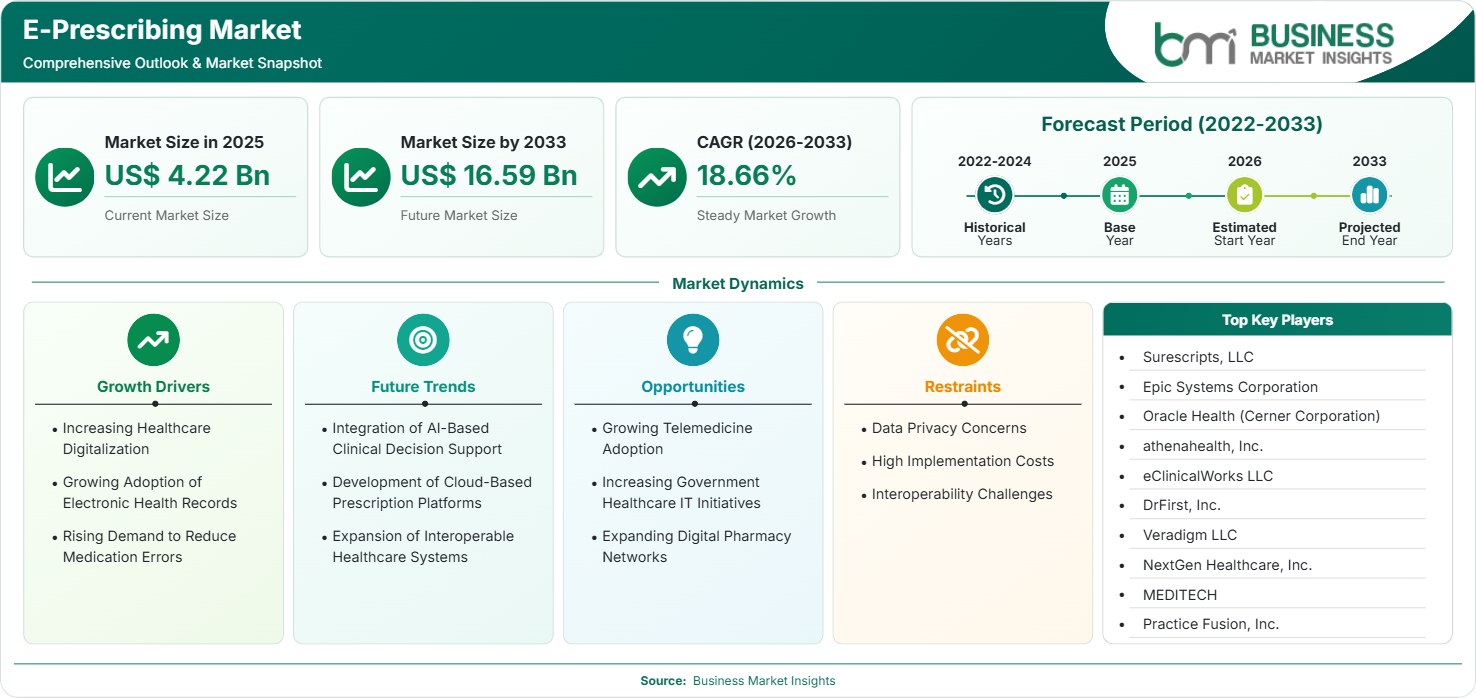
The E-Prescribing Market size was valued at US$ 4.22 Billion in 2025 and is projected to reach US$ 16.59 Billion by 2033, growing at a CAGR of 18.66% during 2026–2033, driven by expanding healthcare digitalization, electronic health record integration, medication safety initiatives, and opportunities created by telemedicine expansion and digital pharmacy ecosystems.

Report Coverage
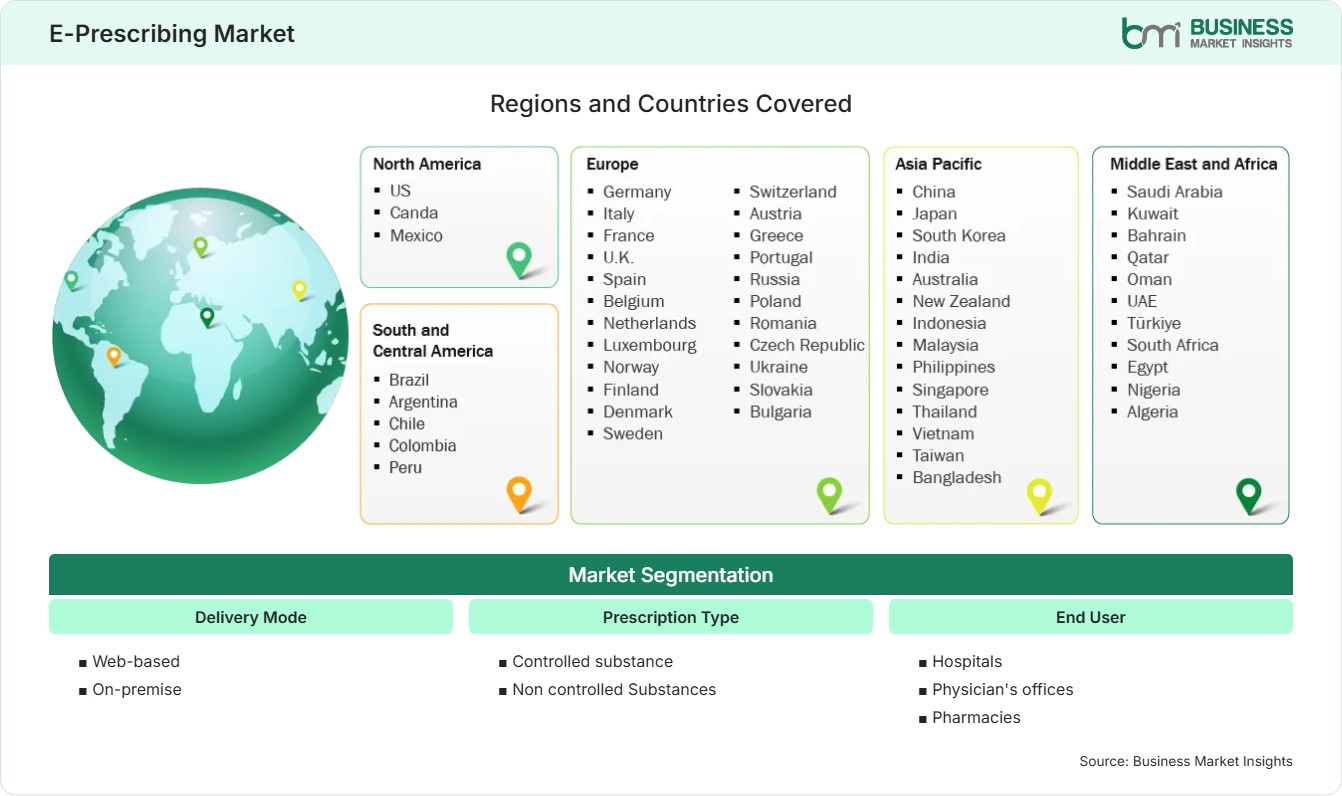
  • Delivery Mode: Web-based, On-premise
  • Prescription Type: Controlled substance, Non controlled Substances
  • End User: Hospitals, Physician's offices, Pharmacies
US$ 4.22 Bn Market size in 2025
US$ 16.59 Bn Market Size by 2033
18.66% CAGR, 2026 - 2033
2026-2033 Forecast Period

AI Overview

E-Prescribing Market Summary

  • North America Region: North America holds 39%–42% share in 2025, growing with a 17.0%–18.2% CAGR during 2026–2033, supported by mature healthcare IT infrastructure, widespread EHR adoption, regulatory mandates, and opportunities from interoperability improvements and cloud-based prescribing platforms. The U.S. market expands at a 17.5%–18.5% CAGR, supported by federal digital health initiatives, high physician adoption, and integrated healthcare information systems.
  • Fastest Growing Region: Asia Pacific holds 23%–26% share in 2025, expanding at a 21.0%–22.5% CAGR between 2026 and 2033 due to rapid healthcare digitalization, government e-health investments, expanding hospital infrastructure, and rising deployment of cloud-enabled prescribing platforms.
  • Leading Segment: Web-based delivery mode accounts for 69%–73% share in 2025 and grows at a 19.0%–20.2% CAGR, driven by cloud deployment, scalability, lower infrastructure costs, and increasing preference for remote healthcare workflows.
  • High Growth Segment: Controlled substance prescriptions represent 29%–33% share in 2025 while expanding at a 20.5%–21.8% CAGR, supported by regulatory compliance requirements, secure authentication technologies, and increasing electronic prescribing mandates.
  • Key Market Opportunity: Growing digital healthcare ecosystems, artificial intelligence integration, interoperable prescribing networks, and expansion of connected pharmacy infrastructure are creating new opportunities for healthcare providers, software vendors, and technology investors worldwide.
  • Major Market Players: Surescripts, LLC, Epic Systems Corporation, Oracle Health, athenahealth, Inc., eClinicalWorks LLC, DrFirst, Inc., Veradigm LLC, NextGen Healthcare, Inc., MEDITECH, and Practice Fusion, Inc.
Strategic Insights

E-Prescribing Market: Strategic Insights

E-Prescribing Market Strategic Framework
FREE PDF
Request your free sample
Request free sample
Stakeholder View

Key Takeaways

  • The industry value chain is becoming increasingly integrated as software developers, healthcare providers, pharmacies, insurers, and interoperability network operators collaborate to establish secure and efficient prescription exchange ecosystems that improve medication management and patient safety.
  • Web-based deployment models provide the strongest commercial opportunity because healthcare organizations increasingly prioritize scalable cloud infrastructure, subscription-based software, lower implementation costs, and seamless integration with electronic health records across multi-site healthcare systems.
  • Artificial intelligence, predictive clinical decision support, automated prescription validation, and interoperability technologies are reshaping product development strategies, enabling vendors to improve prescribing accuracy, workflow efficiency, and regulatory compliance simultaneously.
  • Asia Pacific offers one of the strongest regional investment opportunities due to expanding healthcare digitization programs, increasing physician adoption of electronic medical records, and substantial government funding supporting healthcare information technology modernization.
  • Strategic acquisitions, cloud platform investments, and interoperability partnerships are intensifying competitive dynamics as vendors seek broader healthcare network connectivity, stronger cybersecurity capabilities, and differentiated digital prescribing solutions for enterprise healthcare organizations.
  • Future competitive advantage will increasingly depend on cybersecurity, real-time prescription monitoring, artificial intelligence-enabled clinical recommendations, and seamless integration with pharmacy management, telemedicine, and electronic health record platforms.
Geographic Outlook

E-Prescribing Market Regional Highlights

North America E-Prescribing Market

North America accounted for 39%–42% share in 2025 and is projected to expand at a 17.0%–18.2% CAGR during 2026–2033. Strong healthcare IT infrastructure, high electronic health record adoption, favorable reimbursement frameworks, and federal digital health initiatives continue supporting regional expansion. Healthcare providers increasingly deploy interoperable prescribing platforms to improve medication safety and workflow efficiency. The E-Prescribing Market share remains the highest globally due to mature healthcare digitization, established pharmacy connectivity networks, and continuous investment in healthcare information technology.

  • Healthcare providers continue integrating electronic prescribing with electronic health records, pharmacy management systems, and clinical decision support platforms, improving prescription accuracy while reducing administrative workload and medication-related complications.
  • Regulatory requirements encouraging electronic prescribing for controlled substances continue strengthening software deployment across hospitals, physician practices, and outpatient care facilities throughout the United States and Canada.
  • Artificial intelligence-enabled prescribing assistance, automated allergy verification, and real-time drug interaction alerts are improving prescribing efficiency while supporting better clinical outcomes and enhanced patient safety.
  • Technology vendors continue expanding interoperability capabilities through partnerships with pharmacies, insurers, and healthcare organizations, enabling secure prescription transmission across increasingly connected healthcare ecosystems.
  • Increasing cybersecurity investments are supporting secure prescription exchange, protecting patient information, and strengthening healthcare provider confidence in cloud-based prescribing platforms.

US E-Prescribing Market

The United States represented 31%–34% of the global market in 2025 and is expected to register a 17.5%–18.5% CAGR through 2026–2033. Nationwide electronic prescribing mandates, widespread EHR deployment, strong pharmacy connectivity, and healthcare digitalization initiatives continue supporting adoption. The E-Prescribing Market growth benefits from increasing physician participation, continuous software innovation, and expanding integration with telehealth and population health management platforms.

  • Federal healthcare policies continue encouraging electronic prescribing adoption, particularly for controlled substances, improving prescription security and reducing fraudulent prescription activities across healthcare systems.
  • Major healthcare software vendors continue enhancing interoperability, allowing clinicians to exchange prescription information seamlessly between hospitals, physician offices, laboratories, and retail pharmacies.
  • Artificial intelligence and analytics capabilities are improving prescribing recommendations, medication adherence monitoring, and personalized treatment planning while reducing unnecessary prescription modifications.
  • Cloud deployment and subscription-based pricing models are increasing accessibility for independent physician practices seeking cost-effective digital prescribing solutions.

Europe E-Prescribing Market

Europe accounted for 26%–29% share in 2025 and is forecast to grow at a 18.0%–19.2% CAGR between 2026 and 2033. Digital health strategies, interoperability regulations, and increasing cross-border healthcare initiatives are accelerating implementation across regional healthcare systems. Germany represents the leading national market, while Central and Eastern European countries demonstrate faster expansion as governments modernize healthcare infrastructure and digital prescription services.

  • Germany maintains regional leadership through advanced healthcare IT infrastructure, strong electronic medical record adoption, and national digital healthcare initiatives supporting secure prescription exchange.
  • The United Kingdom continues strengthening electronic prescribing through National Health Service digital transformation programs focused on reducing prescribing errors and improving patient outcomes.
  • France, the Netherlands, and Nordic countries continue investing in interoperable digital health ecosystems that improve coordination among healthcare providers, pharmacies, and reimbursement agencies.
  • Poland and several Central European countries represent high-growth markets due to expanding healthcare modernization investments, increasing physician digitization, and supportive healthcare information technology policies.
  • Growing European cybersecurity regulations continue encouraging vendors to strengthen encryption, authentication, and patient data protection capabilities.

Asia Pacific E-Prescribing Market

Asia Pacific held 23%–26% share in 2025 and is anticipated to achieve the fastest 21.0%–22.5% CAGR during 2026–2033. Rapid healthcare digitalization, expanding hospital infrastructure, increasing smartphone penetration, and government-supported e-health initiatives are transforming prescribing practices. China leads regional revenues, while India demonstrates the strongest long-term growth potential because of expanding digital healthcare programs and increasing investments in healthcare technology.

  • China continues investing heavily in hospital digitization, cloud healthcare platforms, and electronic medical records, creating substantial opportunities for prescription management software providers.
  • India is witnessing accelerated adoption through the Ayushman Bharat Digital Mission, expanding healthcare IT infrastructure, and increasing digital healthcare awareness among providers and patients.
  • Japan and South Korea continue deploying sophisticated clinical information systems integrating electronic prescribing with hospital information platforms and pharmacy automation technologies.
  • Southeast Asian healthcare providers increasingly adopt cloud-based prescribing solutions as governments modernize healthcare delivery and encourage digital transformation initiatives.
  • Regional software developers continue partnering with global healthcare IT companies to expand interoperable prescribing capabilities across diverse healthcare environments.

Rest of World E-Prescribing Market

Rest of World accounted for 8%–10% share in 2025 and is projected to register a 19.0%–20.0% CAGR through 2026–2033. South and Central America are benefiting from expanding healthcare digitization, while Middle East and Africa are strengthening healthcare IT investments through national digital transformation strategies. Brazil, Mexico, Saudi Arabia, the United Arab Emirates, and South Africa remain important markets supporting long-term software deployment opportunities.

  • Brazil and Mexico continue modernizing healthcare information systems while expanding electronic medical record deployment across public and private healthcare organizations.
  • Gulf Cooperation Council countries are investing significantly in digital hospitals, smart healthcare infrastructure, and interoperable clinical information systems supporting electronic prescribing adoption.
  • South Africa is gradually expanding healthcare digitization initiatives through public-private partnerships focused on improving healthcare accessibility and prescription management efficiency.
  • International software vendors increasingly collaborate with regional healthcare providers to customize prescribing platforms according to local regulatory requirements and clinical workflows.
  • Expansion of cloud infrastructure, mobile healthcare applications, and digital pharmacy ecosystems continues improving prescription connectivity throughout emerging healthcare markets.
Global Market Geography
FREE PDF
Request your free sample
Request free sample
Segment Analysis

E-Prescribing Market Segmentation

Delivery Mode

Delivery Mode represents the technological foundation of digital prescribing solutions, influencing deployment flexibility, cybersecurity, scalability, and integration capabilities. This segment accounted for the largest adoption across healthcare organizations in 2025 as providers increasingly shifted toward cloud-enabled healthcare platforms. The E-Prescribing Market scope continues expanding through digital transformation initiatives, with Delivery Mode holding 69%–73% market share and expected to register a 19.0%–20.2% CAGR during 2026–2033 as healthcare institutions modernize prescribing infrastructure.

  • Web-based: Web-based platforms dominate adoption because they offer cloud accessibility, simplified implementation, automatic software updates, lower maintenance costs, and seamless integration with electronic health records across geographically distributed healthcare facilities.
  • On-premise: On-premise solutions remain preferred among organizations requiring greater infrastructure control, customized deployment environments, enhanced internal security policies, and compliance with institution-specific healthcare information governance requirements.

Prescription Type

Prescription Type segmentation reflects evolving regulatory requirements and medication management priorities across healthcare systems. Secure authentication, prescription validation, and compliance capabilities continue influencing adoption. The segment accounted for approximately 29%–33% share for controlled substances in 2025 and is projected to expand at a 20.5%–21.8% CAGR through 2026–2033. The E-Prescribing Market trends indicate increasing digital monitoring of medication prescribing and stronger regulatory oversight worldwide.

  • Controlled substance: Electronic prescribing for controlled substances enhances authentication, reduces prescription fraud, improves regulatory compliance, and strengthens monitoring through secure digital transmission and identity verification technologies.
  • Non controlled Substances: Digital prescribing streamlines routine medication management by improving prescription accuracy, reducing paperwork, accelerating pharmacy processing, and supporting efficient coordination between healthcare providers and pharmacists.

End User

End User segmentation highlights differences in adoption patterns across healthcare delivery settings. Hospitals remain the leading adopters because of integrated clinical workflows, while physician offices increasingly embrace cloud-based prescribing software to improve operational efficiency. The segment accounted for 45%–49% E-Prescribing Market share in 2025 and is forecast to achieve a 18.5%–19.5% CAGR through 2026–2033, supported by expanding healthcare digitization and interoperability initiatives.

  • Hospitals: Hospitals continue investing in integrated prescribing systems that connect physicians, pharmacists, laboratories, and clinical decision support platforms to improve medication safety and operational efficiency.
  • Physician's offices: Physician offices increasingly deploy subscription-based electronic prescribing solutions to simplify prescription management, reduce administrative burden, and improve patient care coordination across outpatient settings.
  • Pharmacies: Pharmacies benefit from real-time electronic prescription transmission, enabling faster medication verification, improved inventory management, reduced dispensing errors, and enhanced communication with prescribing healthcare professionals.
Market Forces

E-Prescribing Market Dynamics

Key Market Drivers

Increasing Healthcare Digitalization

Healthcare providers worldwide continue replacing paper-based clinical workflows with integrated digital platforms, making electronic prescribing a core component of modern healthcare delivery. The World Health Organization and digital health authorities of individual countries have stated that governments are stepping up their investments in healthcare information systems to increase the quality, efficiency, and accessibility of healthcare services. Interoperable prescribing platforms that are compatible with electronic health record systems, pharmacy management software, and clinical decision support systems are increasingly becoming commonplace in hospitals and physicians’ clinics. The E-Prescribing market growth is boosted by advancements in cloud computing technology, interoperability through standards like HL7 FHIR, and digital health infrastructure development.

Growing Adoption of Electronic Health Records

Electronic health record adoption has become one of the strongest catalysts for digital prescribing implementation because integrated clinical information improves prescribing accuracy and medication management. Modern EHR systems provide doctors access to a full patient history, allergy history, lab test results, and medication history at the time of prescribing medications. This integration will help avoid any duplicates and assist in better decision making. Medical practitioners now prefer software that can share prescription data securely between pharmacies and insurance companies. The advancements made by the vendors in terms of artificial intelligence, interoperability, and cloud computing continue to make the process efficient.

Rising Demand to Reduce Medication Errors

Medication errors remain a significant healthcare challenge, encouraging providers to implement electronic prescribing systems equipped with clinical decision support capabilities. Automated allergy checking, dosing suggestions, drug interaction checks, and structured prescriptions help minimize errors during the process of prescribing medicines. The awareness among doctors and support from the regulators along with the improvements in function of prescribing software become major factors for wider use of electronic prescribing systems. The E-Prescribing Market trends show growing investments in smart prescribing systems capable of enhancing patient safety while supporting evidence-based clinical decision-making.

Key Market Opportunities

Growing Telemedicine Adoption

Rapid expansion of telemedicine is creating substantial opportunities for electronic prescribing vendors by enabling physicians to issue prescriptions remotely without compromising clinical efficiency or regulatory compliance. Virtual consultations is demanding integrated prescribing solutions linked to pharmacies and medical records. There will be a need for cloud computing platforms with functionalities that support secure authentication, digital signatures, and seamless prescriptions after virtual consultations. The E-Prescribing Market Forecasts indicate continued expansion of telehealth use cases, including primary care, management of chronic diseases, behavioral health, and specialty healthcare, presents growth opportunities through investments. The technology firms combining telemedicine, e-prescriptions, and remote patient monitoring on a single platform will have competitive edges over traditional software companies.

Increasing Government Healthcare IT Initiatives

Governments worldwide continue launching national healthcare digitization programs that encourage healthcare providers to implement interoperable electronic prescribing systems. Public investments supporting digital hospitals, electronic health records, interoperability frameworks, and secure health information exchange create favorable environments for software deployment. Modernization projects in healthcare are implemented in Asia Pacific, Europe, Latin America, and the Middle East are still creating opportunities for vendors of scalable prescribing products that are also regulatory compliant. Public and private partnerships make these initiatives stronger as they provide both financial motivation and technological support for interoperability standards.

Expanding Digital Pharmacy Networks

Rapid growth of digital pharmacy ecosystems is strengthening demand for integrated electronic prescribing platforms capable of supporting real-time prescription exchange. Retail pharmacies, mail-order pharmacies, and online pharmacy providers increasingly require secure digital connectivity with hospitals and physician offices. Integration allows for faster dispensing of prescriptions, medication checking, stock management, and increased convenience to patients. Software companies that can provide solutions to pharmacy connectivity across the nation, cloud interoperability, and authentication will ensure a favorable market position in the future.

Market Restraints and Challenges

Data Privacy Concerns

Factor: Electronic prescribing platforms process highly sensitive patient health information, making cybersecurity and regulatory compliance essential operational requirements. Impact: With data breaches, ransomware attacks, unauthorized access, and changing privacy policies, there are challenges in the implementation of digital health platforms due to increased costs and risks for healthcare providers. It is important for vendors to constantly upgrade themselves in terms of encryption, multi-factor authentication, secure cloud hosting, and HIPAA & GDPR regulatory compliance.

High Implementation Costs

Factor: Deployment of enterprise electronic prescribing platforms often requires significant investments in software licensing, system integration, employee training, cybersecurity infrastructure, and ongoing technical support. Impact: Implementation costs can prevent usage in small medical practice settings and healthcare organizations that lack financial resources, despite the future advantages of using such a system in the organization. Compatibility with existing electronic health record software and pharmacy management software increases the difficulty of deployment even more.

Company Analysis

Competitive Landscape

The E-Prescribing Market analysis is characterized by intense competition among healthcare IT providers, electronic health record vendors, interoperability network operators, and digital prescribing specialists. Market participants are prioritizing cloud-native architectures, interoperability, artificial intelligence, cybersecurity, and strategic partnerships to strengthen their competitive positions. Integration with pharmacy networks, telehealth platforms, clinical decision support systems, and electronic health records remains a key differentiator as healthcare organizations increasingly demand comprehensive digital prescribing ecosystems.

Company Name

Overview

Products and Services Relevant to this Market

Surescripts, LLC

Leading healthcare information network connecting prescribers, pharmacies, payers, and health systems through secure nationwide prescription exchange infrastructure.

Electronic prescribing network, medication history services, prescription routing, interoperability solutions, prior authorization, prescription price transparency, and clinical messaging services.

Epic Systems Corporation

Global healthcare software provider delivering integrated electronic health record platforms for hospitals and large healthcare organizations.

Electronic prescribing modules, clinical decision support, electronic health records, medication management, pharmacy integration, and interoperability solutions.

Oracle Health (Cerner Corporation)

Healthcare technology provider offering enterprise clinical information systems and digital healthcare transformation solutions worldwide.

Electronic prescribing software, clinical workflows, hospital information systems, medication management, interoperability tools, and healthcare analytics platforms.

athenahealth, Inc.

Cloud-based healthcare technology company serving ambulatory practices through integrated clinical and financial software solutions.

Cloud electronic prescribing, electronic health records, revenue cycle management, patient engagement, clinical documentation, and practice management software.

eClinicalWorks LLC

Healthcare IT company specializing in cloud-based ambulatory electronic health record and practice management technologies.

E-prescribing software, EHR integration, telehealth connectivity, patient portals, pharmacy connectivity, and clinical decision support applications.

DrFirst, Inc.

Digital health company focused on medication management, prescription automation, and healthcare interoperability technologies.

Electronic prescribing, medication adherence tools, prescription price transparency, controlled substance prescribing, and medication management solutions.

Veradigm LLC

Healthcare data and technology organization supporting providers, payers, researchers, and life sciences organizations through connected digital healthcare platforms.

E-prescribing, analytics, interoperability, clinical data exchange, medication management, and healthcare information technology solutions.

NextGen Healthcare, Inc.

Provider of ambulatory healthcare technology solutions supporting physician practices and specialty healthcare providers.

Electronic prescribing software, practice management, electronic health records, patient engagement, and integrated clinical workflow solutions.

MEDITECH

Enterprise healthcare software developer providing integrated clinical information systems for hospitals and healthcare networks.

Hospital information systems, electronic prescribing, pharmacy management integration, electronic medical records, and clinical workflow optimization solutions.

Practice Fusion, Inc.

Cloud-based electronic health record provider serving independent medical practices with integrated clinical software.

Cloud electronic prescribing, electronic health records, clinical documentation, patient management, pharmacy connectivity, and healthcare workflow solutions.

Trust & Transparency

Research Methodology

The market analysis combines proprietary research with secondary data from government agencies, company disclosures, regulatory filings, industry databases and expert interviews. Market estimates are validated through data triangulation, cross-market benchmarking and analyst review.

View Full Research Methodology

Questions Answered

Frequently Asked Questions

How does the E-Prescribing Market Report help healthcare organizations and investors?

The report provides strategic insights into competitive positioning, technology evolution, regional opportunities, deployment models, regulatory developments, and future investment potential, supporting informed business planning and long-term growth strategies.

What challenges affect implementation in developing healthcare markets?

Limited digital infrastructure, interoperability gaps, cybersecurity concerns, implementation costs, workforce training requirements, and varying regulatory standards continue influencing adoption rates across developing healthcare systems.

How is artificial intelligence influencing the future of E-Prescribing Market?

Artificial intelligence supports clinical decision-making through drug interaction alerts, dosage recommendations, predictive analytics, medication adherence monitoring, and workflow automation, improving both patient safety and clinician productivity.

Which healthcare providers benefit the most from electronic prescribing platforms?

Hospitals, physician offices, specialty clinics, telemedicine providers, and retail pharmacies all benefit from improved workflow efficiency, faster prescription processing, enhanced regulatory compliance, and better coordination across healthcare networks.

What are the primary advantages of electronic prescribing over paper prescriptions?

Electronic prescribing improves prescription accuracy, reduces medication errors, accelerates pharmacy processing, enhances clinical decision support, minimizes fraudulent prescriptions, and strengthens communication among physicians, pharmacies, and healthcare organizations.

Access the Full E-Prescribing Market Report

Get segment-level forecasts, regional estimates, competitive benchmarking, company profiles and downloadable Excel datasets.

Access the full E-Prescribing Market Report
350 pages PDF & Excel | 2026-08-25