
Dynamic Positioning System Market Outlook: Size, Share, Trends, Growth Analysis, Competitive Landscape & Forecast, 2026-2033

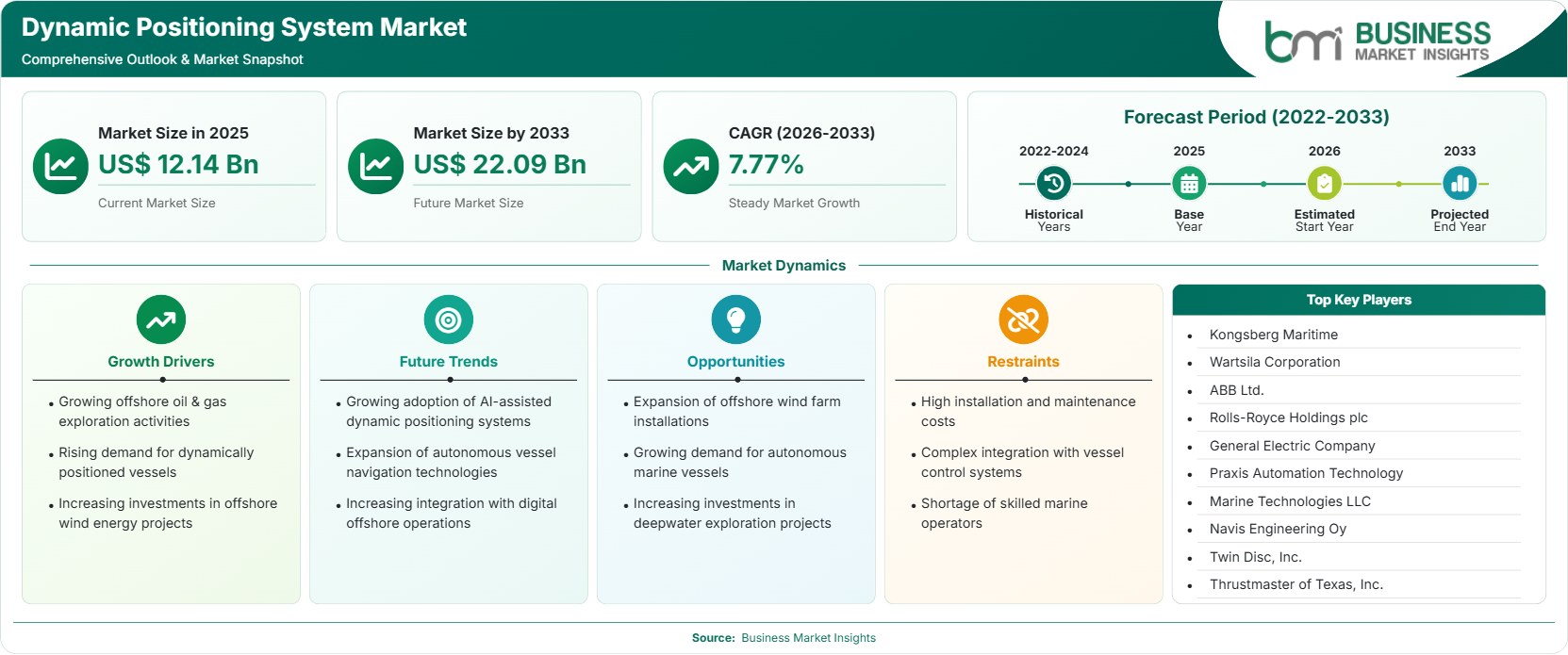
The Dynamic Positioning System size was valued at US$ 12.14 Billion in 2025 and is projected to reach US$ 22.09 Billion by 2033, growing at a CAGR of 7.77% from 2026 to 2033, supported by offshore energy expansion, vessel automation, deepwater exploration, offshore wind investments, and increasing demand for precise marine positioning solutions.

Report Coverage
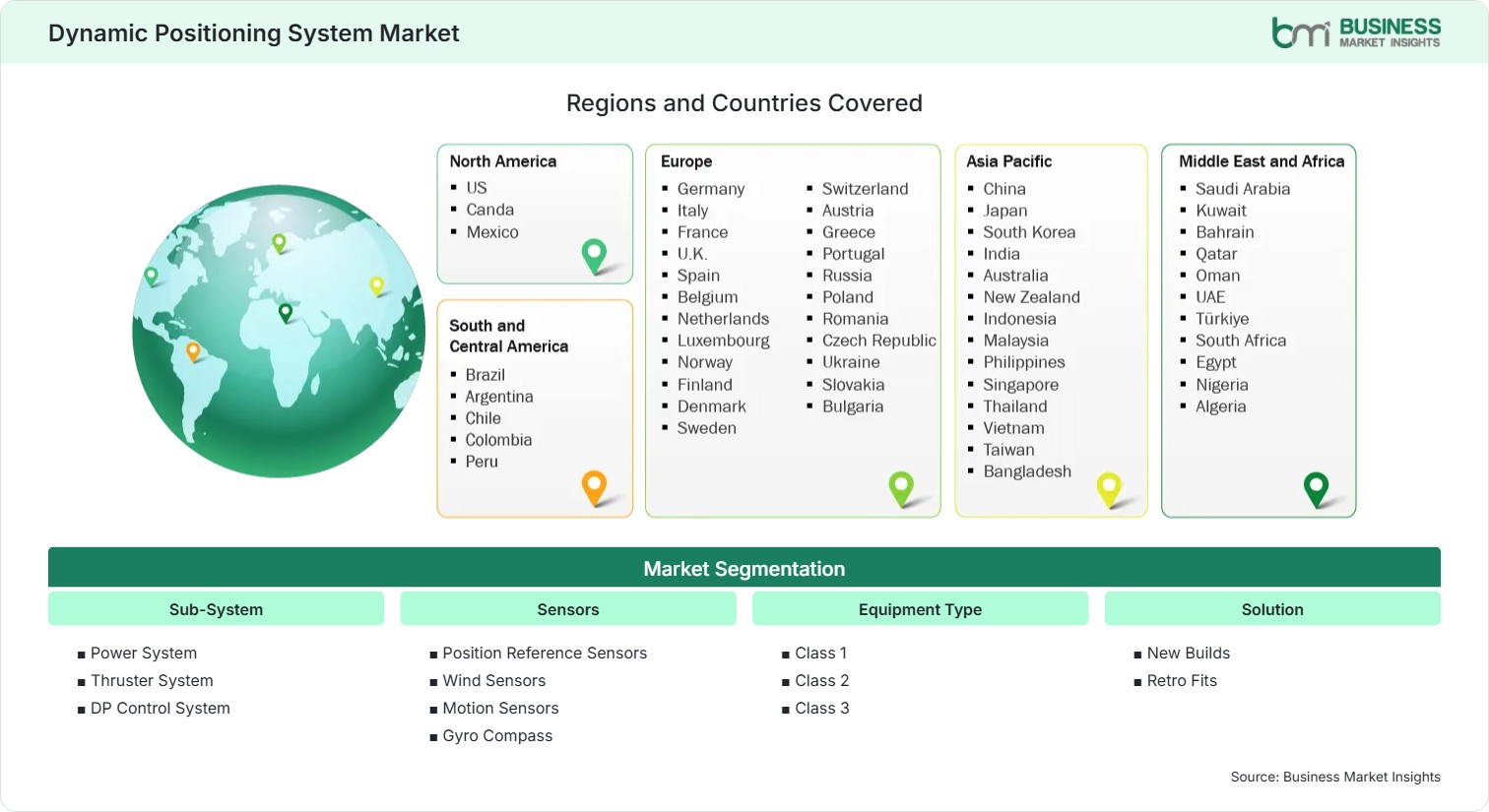
  • Sub-System: Power System, Thruster System, DP Control System
  • Sensors: Position Reference Sensors, Wind Sensors, Motion Sensors, Gyro Compass
  • Equipment Type: Class 1, Class 2, Class 3
  • Solution: New Builds, Retro Fits
  • Application: Commercial, Military
US$ 12.14 Bn Market size in 2025
US$ 22.09 Bn Market Size by 2033
7.77% CAGR, 2026 - 2033
2026-2033 Forecast Period

AI Overview

Dynamic Positioning System Market Summary

  • North America Region: North America holds 34%–37% share in 2025, growing at a CAGR of 7.20%–7.80% during 2026–2033, supported by offshore oil and gas activities, offshore wind development, marine fleet modernization, and defense investments. The US market is advancing at a CAGR of 7.30%–7.90% due to offshore energy projects, naval applications, and adoption of automated vessel technologies.
  • Fastest Growing Region: Asia Pacific accounts for 29%–32% share in 2025 and is expanding at a CAGR of 8.10%–8.70% from 2026–2033 due to offshore exploration, shipbuilding growth, offshore wind projects, maritime infrastructure development, and increasing adoption of advanced vessel automation solutions.
  • Leading Segment: DP Control System represents 35%–38% share in 2025 and is growing at a CAGR of 7.80%–8.30% through 2033 due to increasing automation requirements, improved vessel control accuracy, integration with navigation systems, and demand for reliable offshore operations.
  • High Growth Segment: Military application captures 20%–23% share in 2025 and is projected to grow at a CAGR of 8.50%–9.10% during 2026–2033 due to naval modernization programs, autonomous marine platforms, and demand for advanced positioning capabilities.
  • Key Market Opportunity: Offshore wind expansion, autonomous vessels, and deepwater exploration projects create opportunities for integrated positioning solutions, advanced automation systems, improved vessel efficiency, and next-generation marine control technologies.
  • Major Market Players: Kongsberg Maritime, Wärtsilä Corporation, ABB Ltd., Rolls-Royce Holdings plc, General Electric Company, Praxis Automation Technology, Marine Technologies LLC, Navis Engineering Oy, Twin Disc, Inc., and Thrustmaster of Texas, Inc.
Strategic Insights

Dynamic Positioning System Market: Strategic Insights

Dynamic Positioning System Market Strategic Framework
FREE PDF
Request your free sample
Request free sample
Stakeholder View

Key Takeaways

  • The market value chain is evolving through collaboration among marine equipment manufacturers, shipbuilders, offshore operators, and technology providers, creating integrated solutions for vessel positioning, automation, and operational control.
  • Offshore wind installation, deepwater exploration, and specialized marine services represent attractive growth areas due to increasing demand for vessels requiring precise positioning and enhanced operational reliability.
  • Technology development is moving toward intelligent control systems, advanced sensor integration, autonomous vessel capabilities, and software-based positioning solutions that improve marine operation efficiency.
  • Asia Pacific provides significant investment opportunities due to expanding shipbuilding activities, offshore renewable projects, and maritime infrastructure development across China, South Korea, Japan, and Southeast Asia.
  • Strategic partnerships and technology collaborations are becoming important competitive approaches as companies strengthen capabilities in automation, marine digitalization, and integrated vessel management.
  • Defense modernization programs are generating additional demand for advanced positioning technologies used in naval vessels, unmanned marine systems, and specialized military platforms.
Geographic Outlook

Dynamic Positioning System Market Regional Highlights

North America Dynamic Positioning System Market

North America accounted for 34%–37% share in 2025 and is projected to grow at a CAGR of 7.20%–7.80% from 2026–2033. The region maintains a strong position due to offshore energy activities, advanced maritime infrastructure, and adoption of automated vessel technologies. The Dynamic Positioning System Market share is supported by offshore operators, defense organizations, and marine technology companies investing in reliable positioning solutions for complex operations.

  • Offshore oil and gas exploration continues supporting demand for dynamically positioned drilling vessels and offshore support platforms.
  • Offshore wind development is increasing requirements for specialized vessels with accurate positioning and operational stability.
  • Marine technology companies are introducing integrated automation solutions to improve vessel safety and performance.
  • Defense investments are supporting adoption of advanced positioning systems for naval and specialized vessels.

US Dynamic Positioning System Market

The US represents 27%–30% share of North America in 2025 and is expected to expand at a CAGR of 7.30%–7.90% during 2026–2033. The country remains a major contributor due to offshore energy operations, defense modernization, and commercial vessel automation in Dynamic Positioning System Market. Strong marine technology capabilities and increasing offshore wind investments are supporting adoption of advanced positioning systems across multiple applications.

  • Offshore wind projects are creating demand for installation and service vessels equipped with advanced positioning capabilities.
  • The presence of technology providers supports innovation in marine automation and vessel control systems.
  • Naval modernization programs are encouraging deployment of precision positioning technologies for defense applications.

Europe Dynamic Positioning System Market

Europe held 25%–28% Dynamic Positioning System Market share in 2025 and is forecast to grow at a CAGR of 7.00%–7.60% between 2026–2033. The region benefits from established maritime industries, offshore wind expansion, and strong marine engineering capabilities. Norway, the United Kingdom, Germany, and Denmark are major contributors. Norway demonstrates a CAGR of 7.50%–8.00% due to offshore expertise, advanced vessel operations, and marine technology development.

  • Offshore wind expansion across Europe is increasing demand for dynamically positioned installation and maintenance vessels.
  • Maritime safety regulations are encouraging adoption of advanced control and navigation technologies.
  • Norway remains a leading contributor due to offshore energy expertise and marine technology capabilities.
  • European shipbuilders are integrating automation technologies into next-generation vessels.

Asia Pacific Dynamic Positioning System Market

Asia Pacific accounted for 29%–32% share in 2025 and is projected to grow at a CAGR of 8.10%–8.70% during 2026–2033. The region is experiencing rapid adoption due to offshore exploration, shipbuilding expansion, and renewable energy investments. China, South Korea, Japan, and Singapore are major contributors. China is estimated to achieve 8.20%–8.80% CAGR through offshore infrastructure development and maritime technology investments Dynamic Positioning System Market.

  • Expanding shipbuilding capacity is increasing integration of advanced positioning systems into commercial vessels.
  • Offshore wind projects are generating demand for specialized installation and maintenance vessels.
  • Energy companies are increasing offshore exploration activities requiring precise vessel positioning.
  • Government maritime programs are supporting adoption of automated marine technologies.

Rest of World Dynamic Positioning System Market

Rest of World accounted for 8%–10% share in 2025 and is expected to grow at a CAGR of 6.80%–7.40% from 2026–2033. South America is supported by offshore oil exploration, particularly in Brazil, while Middle East and Africa markets are developing through offshore energy investments. Increasing maritime infrastructure development is gradually improving adoption of advanced positioning solutions.

  • Brazil’s offshore exploration activities are increasing demand for dynamically positioned drilling and support vessels.
  • Middle Eastern offshore projects are encouraging investments in advanced marine control technologies.
  • African offshore energy developments are creating opportunities for specialized vessel equipment suppliers.
  • Regional maritime modernization initiatives are improving adoption of automated positioning systems.
Global Market Geography
FREE PDF
Request your free sample
Request free sample
Segment Analysis

Dynamic Positioning System Market Segmentation

Sub-System

The Sub-System segment includes Power System, Thruster System, and DP Control System, representing the core technologies required for vessel positioning and operational stability in Dynamic Positioning System Market. The segment accounted for complete market coverage in 2025 and is projected to grow at a CAGR of 7.50%–8.10% from 2026–2033. Increasing automation adoption and offshore operational requirements are supporting demand.

  • Power System: Power systems ensure continuous energy supply for positioning operations, supporting reliable vessel performance during offshore activities.
  • Thruster System: Thruster systems provide controlled vessel movement and improve positioning accuracy during complex marine operations.
  • DP Control System: DP Control System adoption is increasing due to advanced automation, improved control accuracy, and integration with marine navigation platforms.

Sensors

The Sensors segment supports vessel positioning accuracy through position reference, environmental monitoring, motion detection, and heading control technologies. Increasing requirements for operational reliability are supporting adoption across commercial, offshore, and military vessels in Dynamic Positioning System Market. The segment is expected to grow at a CAGR of 7.60%–8.20% from 2026–2033 due to increasing integration of intelligent marine control systems.

  • Position Reference Sensors: Position reference sensors provide real-time location information required for accurate vessel positioning and automated control.
  • Wind Sensors: Wind sensors measure environmental conditions and support positioning adjustments during offshore operations.
  • Motion Sensors: Motion sensors monitor vessel movement patterns and improve system response under changing marine conditions.
  • Gyro Compass: Gyro compass systems provide accurate heading information required for navigation and dynamic positioning operations.

Equipment Type

The Equipment Type segment includes Class 1, Class 2, and Class 3 systems, differentiated by redundancy levels, operational reliability, and application requirements. The segment is gaining importance as offshore operators and vessel owners prioritize safety, compliance, and uninterrupted operations. Increasing deployment of advanced vessels for offshore energy, marine construction, and defense applications is supporting demand for higher-class positioning systems in Dynamic Positioning System Market forecasts. The segment is projected to grow at a CAGR of 7.40%–8.00% from 2026–2033.

  • Class 1: Class 1 systems support basic positioning requirements and are generally used for operations where operational risks and redundancy requirements remain comparatively lower.
  • Class 2: Class 2 systems are widely adopted in offshore commercial vessels due to enhanced reliability, redundancy features, and suitability for complex marine operations.
  • Class 3: Class 3 systems serve high-risk applications requiring maximum redundancy, fault tolerance, and continuous positioning capability during critical offshore and military missions.

Solution

The Solution segment consists of New Builds and Retro Fits, reflecting adoption across newly constructed vessels and existing fleet modernization programs. Increasing demand for efficient vessel operations, improved automation, and extended fleet lifecycle management is supporting Dynamic Positioning System Market growth across both categories. Shipowners are investing in positioning upgrades to improve operational performance and comply with evolving maritime requirements. The segment is expected to expand at a CAGR of 7.70%–8.30% between 2026–2033.

  • New Builds: New build installations are increasing as shipyards integrate advanced positioning systems into offshore vessels, specialized ships, and next-generation marine platforms.
  • Retro Fits: Retro fit solutions are gaining traction as operators modernize existing fleets with upgraded control systems, improved sensors, and enhanced operational capabilities.

Application

The Application segment includes Commercial and Military categories, covering offshore energy, transportation, defense, and specialized marine operations. Commercial applications represent the larger installed base due to extensive use in offshore drilling, construction, and service vessels. Military adoption is increasing through naval modernization programs and autonomous marine platform development in Dynamic Positioning System Market. The segment is projected to grow at a CAGR of 7.80%–8.40% during 2026–2033.

  • Commercial: Commercial applications dominate due to offshore oil and gas activities, offshore wind projects, subsea operations, and specialized vessel requirements.
  • Military: Military applications are expanding through naval fleet modernization, unmanned vessel programs, and demand for high-precision positioning technologies.
Market Forces

Dynamic Positioning System Market Dynamics

Key Market Drivers

Growing offshore oil & gas exploration activities

The expansion of offshore oil and gas exploration activities is increasing demand for dynamically positioned vessels capable of operating in deepwater and challenging marine environments. Offshore drilling, subsea production, and floating production operations require precise vessel positioning to maintain safety and efficiency. Energy companies are investing in advanced vessels equipped with automated positioning technologies to support complex offshore projects. The growth is influenced by rising offshore investments, increasing subsea operations, and the requirement for reliable marine control solutions. The Dynamic Positioning System Market trends indicate increasing integration of propulsion management, environmental monitoring, and automated control technologies.

Rising demand for dynamically positioned vessels

Growing demand for dynamically positioned vessels across offshore construction, marine research, and specialized commercial activities is supporting adoption of advanced positioning systems. These vessels provide operational advantages by maintaining location without traditional anchoring, allowing operations in deeper waters and environmentally sensitive areas. Offshore service providers are increasingly adopting automated positioning technologies to improve efficiency, reduce downtime, and enhance operational safety. Shipbuilders are integrating advanced sensors, software controls, and propulsion coordination systems into new vessels. Increasing deployment of drillships, offshore support vessels, and floating production units is creating sustained demand for reliable positioning technologies.

Increasing investments in offshore wind energy projects

Increasing investments in offshore wind energy projects are creating new opportunities for positioning system suppliers as renewable energy developers expand marine infrastructure. Offshore wind installation, maintenance, and inspection activities require vessels capable of maintaining stable positions under changing weather and sea conditions. The development of larger wind farms farther offshore is increasing demand for advanced vessel control technologies. Governments and energy companies are investing in renewable capacity expansion, creating requirements for specialized marine vessels. Technology providers offering integrated positioning solutions with accurate sensors, propulsion controls, and automation capabilities are benefiting from growing offshore renewable energy activities.

Key Market Opportunities

Expansion of offshore wind farm installations

The expansion of offshore wind farm installations is creating significant opportunities for dynamic positioning technology providers as renewable energy developers increase investments in marine-based power generation. Offshore wind projects require specialized vessels for turbine transportation, foundation installation, cable laying, and maintenance operations. As projects move into deeper waters and larger offshore areas, accurate vessel positioning becomes essential for operational safety and efficiency. Companies offering integrated positioning solutions, advanced control software, and efficient propulsion technologies can benefit from increasing renewable energy investments. The development of offshore wind capacity across Europe, Asia Pacific, and North America is expected to support long-term demand for advanced marine positioning systems.

Growing demand for autonomous marine vessels

The growing adoption of autonomous marine vessels is opening new opportunities for dynamic positioning technology companies as maritime industries shift toward digital and automated operations. Autonomous vessels require accurate navigation, control, and positioning capabilities to operate safely with limited human intervention. Commercial shipping companies, defense organizations, and marine research institutions are investing in autonomous platforms to improve efficiency, reduce operational costs, and enhance mission capabilities. Advanced positioning systems are becoming an important component of autonomous vessels by enabling precise movement control and stable operation. Companies developing intelligent control platforms, artificial intelligence-based navigation solutions, and integrated sensor technologies are positioned to benefit from this emerging marine technology trend.

Increasing investments in deepwater exploration projects

Increasing investments in deepwater exploration projects are creating opportunities for advanced positioning system providers due to the technical complexity of offshore operations. Deepwater drilling and production activities require vessels capable of maintaining precise positions under strong currents, wind conditions, and challenging marine environments. Energy companies are expanding exploration activities in offshore regions with significant resource potential, increasing demand for high-reliability positioning solutions. Suppliers offering advanced redundancy features, improved control accuracy, and durable marine technologies can capture opportunities from these projects. Continued investment in deepwater exploration infrastructure will support adoption of next-generation positioning systems designed for demanding offshore applications.

Market Restraints and Challenges

High installation and maintenance costs

Factor: Dynamic positioning systems involve significant capital expenditure due to complex hardware components, advanced control software, propulsion integration, specialized sensors, and engineering requirements. Installation requires detailed vessel assessment, equipment configuration, system testing, and technical expertise, which increases project costs. Maintenance activities, including software upgrades, sensor calibration, system monitoring, and periodic performance checks, further contribute to lifecycle expenses. Impact: High installation and maintenance costs can restrict adoption among smaller vessel operators and companies with limited capital availability. These financial barriers may slow fleet modernization programs and reduce penetration in cost-sensitive maritime markets. Operators may delay system upgrades despite operational benefits, affecting adoption rates across certain commercial vessel categories.

Complex integration with vessel control systems

Factor: Complex integration between dynamic positioning systems, propulsion units, navigation equipment, power management platforms, and existing vessel automation systems creates technical challenges. Retrofit projects often require customized engineering solutions due to variations in vessel architecture, software compatibility, and equipment configurations. Successful deployment requires specialized expertise, extensive testing, and coordination among multiple technology providers. Impact: Integration complexity can increase installation timelines, raise deployment costs, and create operational challenges for vessel owners. Older fleets may require additional modifications before adopting advanced positioning technologies, delaying modernization efforts. Dependence on specialized marine engineering capabilities can also influence project schedules and increase implementation risks for operators.

Company Analysis

Competitive Landscape

The Dynamic Positioning System Market analysis highlights a competitive ecosystem involving marine automation providers, propulsion technology manufacturers, navigation specialists, and vessel control solution developers. Companies are focusing on integrated positioning platforms, digital vessel management technologies, advanced sensors, and automation capabilities to strengthen their market presence across offshore, commercial, and military applications.

Company Name

Overview

Products and Services relevant to this market

Kongsberg Maritime

Global marine technology provider specializing in automation, navigation, and vessel management solutions for offshore and commercial sectors.

Provides dynamic positioning systems, marine automation platforms, vessel control technologies, and integrated navigation solutions.

Wärtsilä Corporation

Marine technology company offering propulsion systems, digital solutions, and sustainable technologies for maritime operations.

Provides vessel automation, propulsion management, navigation technologies, and positioning solutions for marine applications.

ABB Ltd.

Technology company delivering automation, electrification, and digital solutions across industrial and marine sectors.

Offers marine control systems, power management solutions, automation platforms, and dynamic positioning technologies.

Rolls-Royce Holdings plc

Engineering company providing advanced propulsion and marine technology solutions globally.

Supplies propulsion control systems, marine automation technologies, and vessel management solutions.

General Electric Company

Industrial technology company providing advanced engineering solutions across multiple industries.

Offers power management technologies and control systems supporting marine vessel integration.

Praxis Automation Technology

Marine automation specialist developing integrated control systems for vessels and offshore applications.

Provides vessel automation systems, DP control solutions, and marine monitoring technologies.

Marine Technologies LLC

Marine technology provider focused on integrated navigation, control, and automation solutions.

Supplies dynamic positioning systems, vessel control platforms, and marine automation solutions.

Navis Engineering Oy

Finnish marine technology company specializing in automation and vessel positioning systems.

Provides dynamic positioning solutions, control software, and integrated marine automation technologies.

Twin Disc, Inc.

Manufacturer of marine propulsion systems and power transmission technologies.

Supplies propulsion components, control systems, and marine technologies supporting vessel operations.

Thrustmaster of Texas, Inc.

Marine equipment manufacturer specializing in propulsion and thruster technologies.

Provides thrusters, propulsion systems, and equipment used in dynamically positioned vessels.

Trust & Transparency

Research Methodology

The market analysis combines proprietary research with secondary data from government agencies, company disclosures, regulatory filings, industry databases and expert interviews. Market estimates are validated through data triangulation, cross-market benchmarking and analyst review.

View Full Research Methodology

Questions Answered

Frequently Asked Questions

How can stakeholders evaluate the Dynamic Positioning System Market Report?

The Report provides insights into market structure, technology trends, segment performance, competitive positioning, and future opportunities. Stakeholders can use this information to assess investment priorities, technology adoption patterns, and strategic growth areas within the marine industry.

What industries are creating future opportunities for positioning system providers?

Offshore renewable energy, autonomous marine transportation, defense modernization, and deepwater exploration are creating future opportunities. Increasing investment in specialized vessels and automated marine technologies is expanding the application scope of advanced positioning solutions.

What role do sensors play in dynamic positioning technologies?

Sensors provide critical information related to vessel location, movement, heading, and environmental conditions. Position reference sensors, motion sensors, wind sensors, and gyro compasses enable accurate system responses, improving reliability and operational performance during complex marine activities.

How do dynamic positioning systems improve vessel operational efficiency?

Dynamic positioning systems improve efficiency by automatically controlling propulsion and thruster systems to maintain vessel location without traditional anchoring. This capability enables faster operations, improved maneuverability, and reduced downtime during offshore activities where precise positioning is essential.

What factors are driving adoption of dynamic positioning system market in offshore industries?

The increasing complexity of offshore operations, deeper exploration activities, and demand for safer vessel operations are encouraging operators to adopt advanced positioning systems. These technologies improve vessel stability, reduce operational risks, and support specialized activities such as drilling, subsea construction, and offshore wind installation.

Access the Full Dynamic Positioning System Market Report

Get segment-level forecasts, regional estimates, competitive benchmarking, company profiles and downloadable Excel datasets.

Access the full Dynamic Positioning System Market Report
350 pages PDF & Excel | 2026-08-25