
Downstream Processing Market Outlook: Size, Share, Trends, Growth Analysis, Competitive Landscape & Forecast, 2026-2033

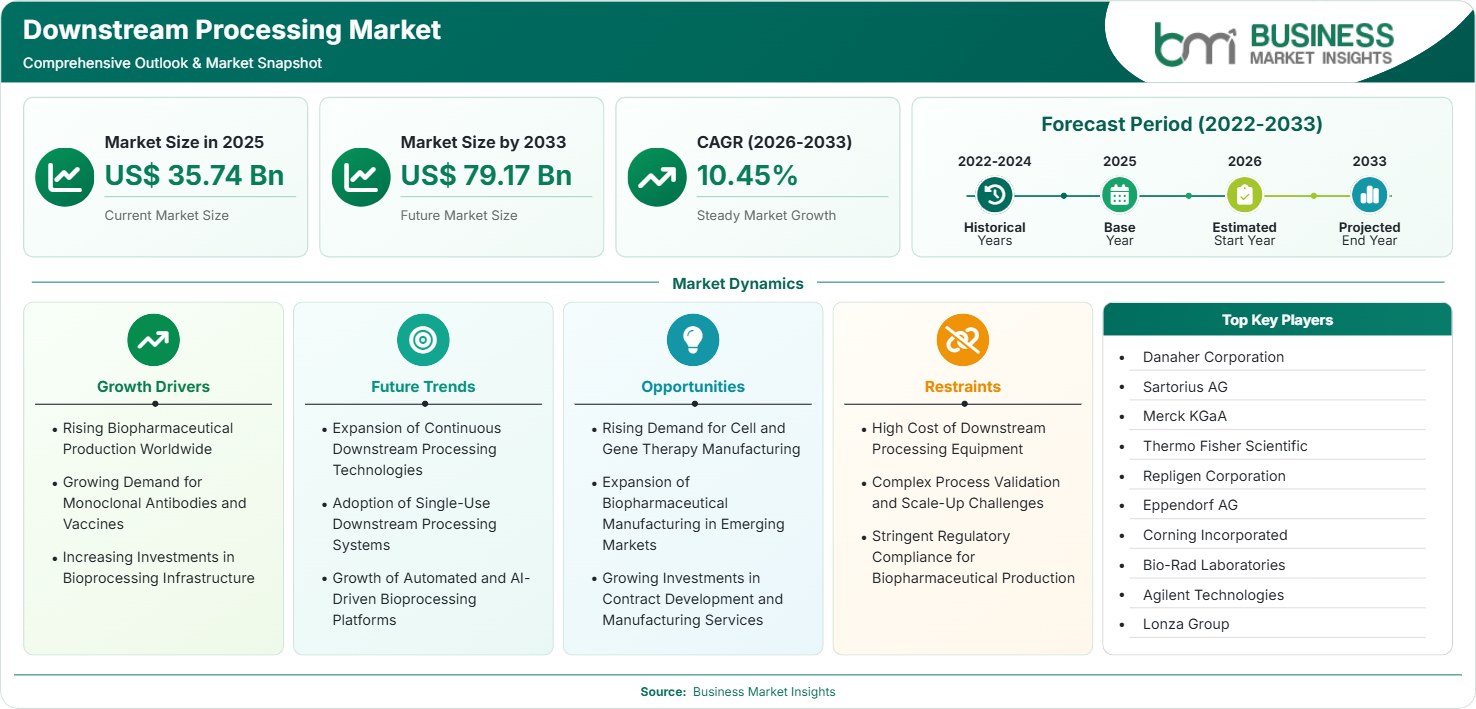
The Downstream Processing Market size was valued at US$ 35.74 Billion in 2025 and is projected to reach US$ 79.17 Billion by 2033, growing at a CAGR of 10.45% during 2026–2033. Rising biologics production, increasing demand for monoclonal antibodies, growing investments in biopharmaceutical manufacturing, and expanding cell and gene therapy development activities are supporting market growth globally.

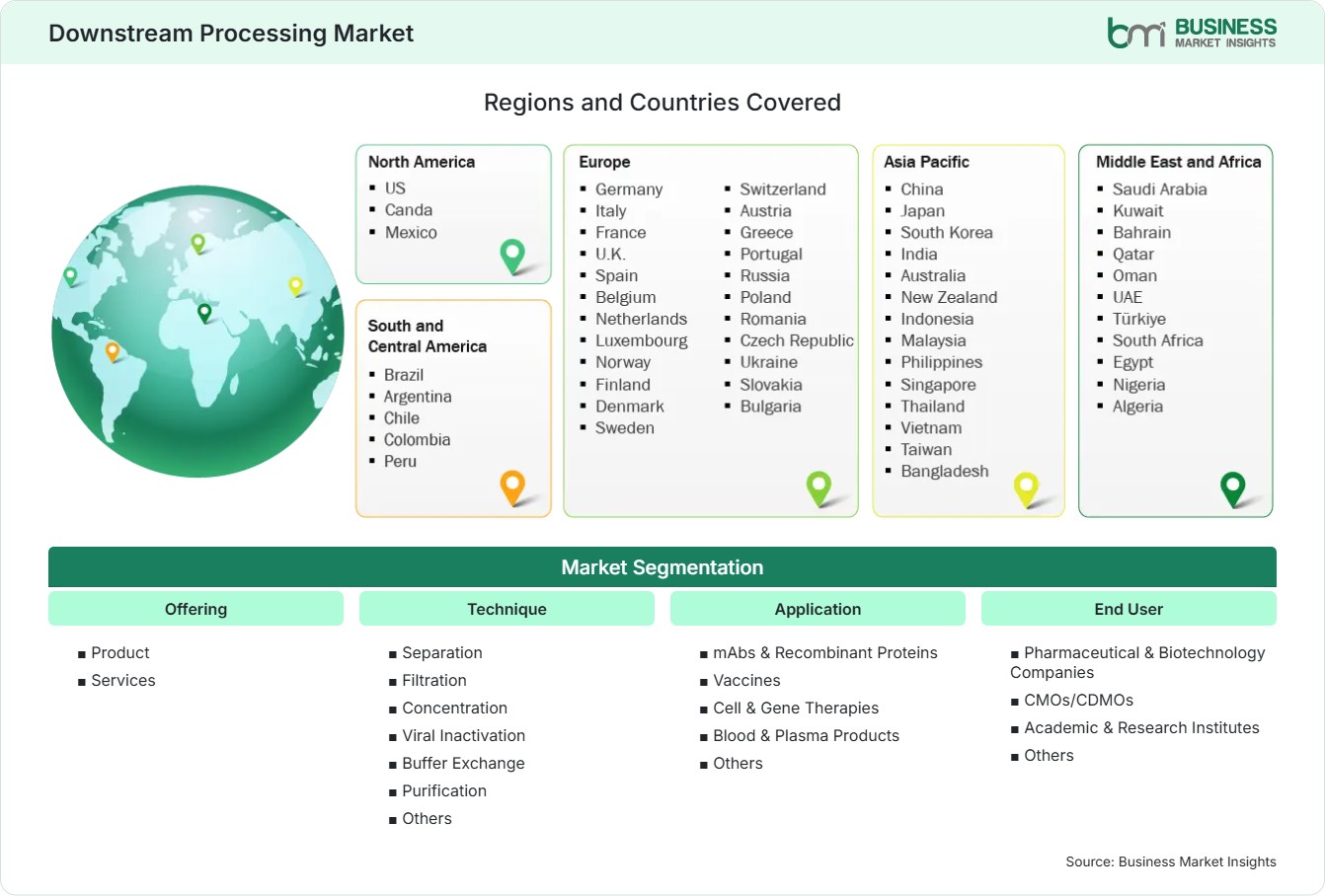
Report Coverage
  • Offering: Product, Services
  • Technique: Separation, Filtration, Concentration, Viral Inactivation, Buffer Exchange, Purification, Others
  • Application: mAbs & Recombinant Proteins, Vaccines, Cell & Gene Therapies, Blood & Plasma Products, Others
  • End User: Pharmaceutical & Biotechnology Companies, CMOs/CDMOs, Academic & Research Institutes, Others
US$ 35.74 Bn Market size in 2025
US$ 79.17 Bn Market Size by 2033
10.45% CAGR, 2026 - 2033
2026-2033 Forecast Period

AI Overview

Downstream Processing Market Summary

  • North America Region: North America holds a downstream processing market share of 38%–41% in 2025, growing with a CAGR of 9.9%–10.6% during 2026–2033. Strong biopharmaceutical manufacturing capabilities, advanced biotechnology infrastructure, and increasing biologics production continue supporting regional leadership. The U.S. market is expected to register a CAGR of 10.1%–10.8%.
  • Fastest Growing Region: Asia Pacific accounts for 27%–30% share in 2025 and is projected to grow at a CAGR of 11.2%–11.9% through 2033. Increasing biotechnology investments, expanding biomanufacturing facilities, and growing demand for biologic therapies continue driving regional growth.
  • Leading Segment: Product represents 58%–61% share in 2025 and is expected to grow at a CAGR of 10.4%–11.1% through 2033. Growing demand for chromatography systems, filtration technologies, and purification solutions continues supporting segment dominance.
  • High Growth Segment: mAbs & Recombinant Proteins account for 43%–46% share in 2025 and are forecast to grow at a CAGR of 10.9%–11.6% during 2026–2033. Expanding biologics pipelines and increasing therapeutic antibody production continue accelerating segment growth.
  • Key Market Opportunity: Expansion of biologics manufacturing capacity, growth of cell and gene therapy production, and increasing adoption of single-use downstream processing technologies are creating substantial growth opportunities.
  • Major Market Players: Merck KGaA, Sartorius Stedim Biotech S.A., Thermo Fisher Scientific Inc., Danaher, Repligen, 3M Company, Corning Corporation, Lonza Group Ltd, Dover Corporation, and Eppendorf AG.
Strategic Insights

Downstream Processing Market: Strategic Insights

Downstream Processing Market Strategic Framework
FREE PDF
Request your free sample
Request free sample
Stakeholder View

Key Takeaways

  • Downstream processing remains a critical component of biologics and advanced therapy manufacturing.
  • Product offerings dominate the downstream processing market due to widespread usage of filtration, chromatography, and purification technologies.
  • mAbs & recombinant proteins continue leading application demand driven by expanding biologics pipelines.
  • Single-use technologies are increasingly improving operational efficiency and manufacturing flexibility.
  • Biopharmaceutical manufacturers continue investing in advanced purification and recovery solutions.
  • North America remains the leading market due to strong biotechnology and pharmaceutical manufacturing capabilities.
  • Asia Pacific is projected to witness the fastest growth owing to increasing investments in bioprocessing infrastructure.
  • Cell and gene therapies are expected to generate significant future opportunities for market participants.
Geographic Outlook

Downstream Processing Market Regional Highlights

North America Downstream Processing Market

North America accounts for 38%–41% Downstream Processing Market share in 2025 and is projected to grow at a CAGR of 9.9%–10.6% through 2033. The region benefits from advanced biopharmaceutical manufacturing infrastructure, strong biotechnology research activities, significant healthcare investments, and a robust biologics development ecosystem. Increasing production of monoclonal antibodies, vaccines, and advanced therapies continues supporting regional market leadership.

  • Biopharmaceutical manufacturers continue increasing investments in advanced downstream processing technologies to improve manufacturing efficiency, product quality, and production scalability.
  • Strong biologics pipelines are supporting demand for chromatography systems, filtration technologies, and purification solutions across commercial manufacturing facilities.
  • Adoption of single-use bioprocessing technologies continues expanding as companies seek greater flexibility, faster turnaround times, and lower contamination risks.
  • Research institutions and biotechnology companies continue generating demand for advanced separation and purification platforms used in biologics development programs.
  • Regulatory focus on product quality and manufacturing consistency continues encouraging upgrades of downstream processing infrastructure.
  • Growing production of cell therapies, gene therapies, and recombinant proteins continues creating additional opportunities for solution providers.

US Downstream Processing Market

The United States contributes approximately 87%–91% of North American revenue and is expected to register a CAGR of 10.1%–10.8% through 2033. The country remains the largest market due to its leadership in biotechnology innovation, biologics manufacturing, pharmaceutical research, and advanced therapy development. Continuous investments in manufacturing capacity expansion, process automation, and biologics commercialization continue strengthening downstream processing market growth across the country.

  • Biopharmaceutical companies continue expanding production facilities to support growing demand for biologics and advanced therapeutics.
  • Monoclonal antibody manufacturing remains a major contributor to demand for large-scale purification and recovery technologies.
  • Increasing adoption of automation and digital bioprocessing solutions is improving operational efficiency and process consistency.
  • Cell and gene therapy development programs continue driving investment in specialized downstream processing technologies.
  • Government and private-sector funding continue supporting biotechnology innovation and manufacturing expansion initiatives.

Europe Downstream Processing Market

Europe represents 23%–26% of global revenue in 2025 and is anticipated to expand at a CAGR of 10.3%–11.0% through 2033. Strong pharmaceutical manufacturing capabilities, increasing biologics production, and growing investments in advanced therapy medicinal products continue supporting regional growth. Germany remains the leading market while Poland demonstrates stronger growth momentum.

  • Germany continues leading regional demand through its strong biopharmaceutical manufacturing base, research ecosystem, and biologics production capabilities.
  • Poland is among the fastest-growing markets and is estimated to register a CAGR of 11.2%–11.9% during the forecast period, supported by healthcare and biotechnology investments.
  • Downstream processing automation continues gaining traction as manufacturers seek greater productivity, consistency, and regulatory compliance.
  • Demand for purification technologies remains strong due to increasing production of therapeutic proteins, vaccines, and biosimilars.
  • Advanced therapy manufacturing initiatives continue creating opportunities for next-generation filtration and separation technologies.
  • Bioprocessing facility expansion projects are supporting long-term demand for downstream processing equipment and consumables.

Asia Pacific Downstream Processing Market

Asia Pacific accounts for 27%–30% of global revenue in 2025 and is expected to achieve the fastest CAGR of 11.2%–11.9% through 2033. Expanding biotechnology industries, rising healthcare investments, increasing biosimilar manufacturing activities, and growing government support for life sciences innovation continue supporting strong regional growth. The region is becoming an important hub for biopharmaceutical production and contract manufacturing activities.

  • China remains the largest regional downstream processing market due to substantial investments in biologics manufacturing, biotechnology research, and healthcare infrastructure.
  • India is projected to achieve approximately 12.0%–12.7% CAGR, supported by increasing biosimilar production, expanding pharmaceutical manufacturing, and biotechnology development initiatives.
  • Contract development and manufacturing organizations continue investing in downstream processing capabilities to support global biologics demand.
  • Bioprocessing facility expansion projects are creating significant demand for purification, filtration, and concentration technologies.
  • Government initiatives continue supporting biotechnology innovation, manufacturing localization, and healthcare modernization programs.
  • Increasing adoption of advanced processing technologies is improving production efficiency and quality across regional manufacturing facilities.

Rest of World Downstream Processing Market

Rest of World accounts for 8%–11% of global revenue in 2025 and is projected to expand at a CAGR of 9.6%–10.3% through 2033. Growing pharmaceutical manufacturing activities, increasing biotechnology investments, and improving healthcare infrastructure are supporting market development across Latin America, the Middle East, and Africa. Rising focus on biopharmaceutical production and healthcare self-sufficiency is creating favorable conditions for downstream processing market growth.

  • Brazil continues generating demand through expanding pharmaceutical manufacturing activities and increasing investments in biotechnology capabilities.
  • The UAE is witnessing growing adoption of advanced bioprocessing technologies as healthcare and life sciences sectors continue expanding.
  • Saudi Arabia is expected to achieve approximately 10.5%–11.2% CAGR through 2033, supported by biotechnology investments and healthcare sector modernization initiatives.
  • Governments continue investing in local pharmaceutical production capabilities to strengthen healthcare resilience and supply chain security.
  • Demand for vaccine production infrastructure and biologics manufacturing technologies continues supporting downstream processing investments.
  • Increasing awareness regarding advanced biomanufacturing capabilities is creating long-term opportunities across emerging economies.
Global Market Geography
FREE PDF
Request your free sample
Request free sample
Segment Analysis

Downstream Processing Market Segmentation

Offering

The offering segment represents the products and services utilized throughout downstream processing workflows for the recovery, purification, and concentration of biologic products. This segment accounts for approximately 58%–61% share in 2025 and is projected to grow at a CAGR of 10.4%–11.1% through 2033. The expanding market scope is supported by increasing biologics production, rising adoption of advanced purification technologies, and growing investments in biopharmaceutical manufacturing infrastructure. Current Downstream Processing Market Trends indicate strong demand for automated systems, single-use technologies, and high-efficiency bioprocessing solutions.

  • Product: Products dominate the market due to widespread use of chromatography systems, filters, membranes, and purification equipment. Rising biologics manufacturing continues driving demand.
  • Services: Services include process development, validation, optimization, and technical support activities. Growing outsourcing trends in biopharmaceutical manufacturing continue supporting segment growth.

Technique

The technique segment highlights the major downstream processing methods used to separate, purify, and prepare biological products for commercial use. This segment accounts for approximately 36%–39% share in 2025 and is expected to register a CAGR of 10.8%–11.5% through 2033. Increasing complexity of biologics and stricter quality standards continue driving adoption of advanced processing techniques.

  • Separation: Separation technologies are widely used for isolating target biomolecules from production streams. Increasing biologics complexity continues supporting demand.
  • Filtration: Filtration remains a critical processing step for removing impurities and contaminants. Single-use filtration technologies are witnessing significant adoption.
  • Concentration: Concentration techniques help increase product yield and process efficiency. Growth in biologics manufacturing continues driving utilization.
  • Viral Inactivation: Viral inactivation processes are essential for ensuring product safety and regulatory compliance. Stringent quality requirements support segment demand.
  • Buffer Exchange: Buffer exchange technologies enhance product formulation and purification efficiency. Increasing biologics production is contributing to growth.
  • Purification: Purification remains one of the most important downstream processing stages. Demand is driven by requirements for high-purity biological products.
  • Others: Other techniques include flocculation, precipitation, and advanced recovery technologies. Continuous innovation is supporting adoption.

Application

The application segment reflects the therapeutic and biological products manufactured using downstream processing technologies. This segment accounts for approximately 43%–46% share in 2025 and is projected to grow at a CAGR of 10.9%–11.6% through 2033. Rising biologics approvals and expanding advanced therapy pipelines continue supporting application growth.

  • mAbs & Recombinant Proteins: This segment leads the downstream processing market due to increasing production of therapeutic antibodies and recombinant biologics. Growing biologics pipelines continue supporting demand.
  • Vaccines: Vaccine manufacturing continues generating significant demand for purification and filtration solutions. Investments in vaccine production capacity remain strong.
  • Cell & Gene Therapies: Cell and gene therapy manufacturing requires advanced downstream processing technologies. Expanding clinical and commercial pipelines are supporting growth.
  • Blood & Plasma Products: Blood and plasma products depend on highly efficient purification and separation systems. Increasing therapeutic applications continue driving demand.
  • Others: Other applications include biosimilars, enzymes, and specialty biological products. Rising biopharmaceutical innovation is creating new opportunities.

End User

The end-user segment highlights the organizations utilizing downstream processing technologies to develop and manufacture biologics and advanced therapies. This segment accounts for approximately 47%–50% share in 2025 and is forecast to grow at a CAGR of 10.7%–11.4% through 2033. Increasing biologics production volumes and manufacturing investments continue supporting adoption across end-user groups.

  • Pharmaceutical & Biotechnology Companies: These companies represent the largest end-user segment due to extensive biologics development and production activities. Rising R&D spending continues supporting demand.
  • CMOs/CDMOs: Contract manufacturers are expanding capacity to support outsourced biologics production. Growing outsourcing trends continue accelerating segment growth.
  • Academic & Research Institutes: Research institutions utilize downstream processing solutions for biologics research and process development. Increasing life sciences funding supports adoption.
  • Others: Other end users include government laboratories, healthcare organizations, and specialty manufacturing facilities. Expanding biotechnology ecosystems continue supporting demand.
Market Forces

Downstream Processing Market Dynamics

Key Market Drivers

Rising Biopharmaceutical Production Worldwide

The rapid expansion of global biopharmaceutical manufacturing is significantly driving demand for downstream processing technologies. Increasing development and commercialization of biologics, biosimilars, recombinant proteins, and advanced therapeutic products are generating substantial requirements for efficient purification and recovery systems. Manufacturers are expanding production facilities and investing in advanced processing technologies to enhance productivity and maintain product quality. As biologics continue gaining importance in the treatment of chronic, rare, and complex diseases, the need for reliable downstream processing solutions is increasing across both commercial and clinical-scale manufacturing operations. This trend is expected to remain a major catalyst for market expansion throughout the forecast period.

Growing Demand for Monoclonal Antibodies and Vaccines

Monoclonal antibodies and vaccines continue to represent some of the most important categories within the biopharmaceutical industry. Increasing demand for targeted therapies, immunotherapies, and preventive healthcare solutions is encouraging manufacturers to expand production capacity and improve manufacturing efficiency. Downstream processing plays a critical role in ensuring product purity, consistency, and safety for these complex biological products. Additionally, governments and healthcare organizations continue investing in vaccine development and production infrastructure to strengthen healthcare preparedness. As therapeutic antibodies and vaccines remain central to modern healthcare strategies, downstream processing demand is expected to experience sustained long-term growth.

Increasing Investments in Bioprocessing Infrastructure

Biopharmaceutical companies, contract manufacturers, and governments are increasing investments in bioprocessing infrastructure to meet growing healthcare demand and enhance supply chain resilience. New manufacturing facilities, capacity expansion projects, and modernization initiatives are creating strong demand for advanced downstream processing equipment and technologies. Companies are increasingly integrating automated systems, continuous manufacturing approaches, and single-use platforms to optimize efficiency and reduce production costs. Furthermore, regulatory requirements related to product quality and process reliability continue encouraging investment in advanced infrastructure. These developments are expected to support robust market growth during the forecast period.

Key Market Opportunities

Rising Demand for Cell and Gene Therapy Manufacturing

The rapid growth of cell and gene therapies is creating significant opportunities for downstream processing solution providers. These therapies require highly specialized purification, concentration, and separation technologies capable of maintaining product integrity while meeting stringent regulatory requirements. As clinical development pipelines continue expanding and more therapies progress toward commercialization, manufacturers are increasingly investing in advanced downstream processing infrastructure. The unique production requirements associated with these therapies are driving demand for innovative and flexible processing solutions, creating attractive opportunities for market participants.

Expansion of Biopharmaceutical Manufacturing in Emerging Markets

Emerging economies are investing heavily in biotechnology, pharmaceutical manufacturing, and healthcare infrastructure to strengthen domestic production capabilities and reduce dependence on imports. Governments are encouraging local manufacturing through supportive policies, funding initiatives, and infrastructure development programs. As biopharmaceutical production capacities continue expanding across Asia, Latin America, and other developing regions, demand for advanced downstream processing technologies is expected to increase substantially. These markets offer considerable opportunities for equipment suppliers, service providers, and technology developers seeking geographic expansion.

Growing Investments in Contract Development and Manufacturing Services

The increasing reliance on contract development and manufacturing organizations (CDMOs) is creating new growth opportunities across the downstream processing industry. Biopharmaceutical companies are increasingly outsourcing manufacturing activities to improve operational flexibility, reduce capital expenditures, and accelerate product commercialization timelines. CDMOs are responding by expanding facilities and investing in advanced purification, filtration, and recovery technologies to support diverse customer requirements. The continued expansion of outsourced biologics manufacturing is expected to generate sustained demand for downstream processing systems and services. Long-term Downstream Processing Market Forecast projections remain highly favorable as outsourcing trends and biologics production continue accelerating globally.

Market Restraints and Challenges

High Cost of Downstream Processing Equipment

Factor: Advanced downstream processing systems such as chromatography equipment, filtration platforms, purification technologies, and automation solutions require substantial capital investment. In addition, ongoing maintenance, validation, and operational expenses contribute significantly to total ownership costs.

Impact: High equipment and infrastructure costs can create financial barriers for smaller biotechnology companies and research organizations. Budget constraints may delay technology adoption and limit manufacturing upgrades, potentially affecting overall market growth.

Complex Process Validation and Scale-Up Challenges

Factor: Scaling downstream processes from laboratory development to commercial manufacturing while maintaining product quality, yield, and regulatory compliance is highly complex. Manufacturers must manage process variability, validation requirements, and evolving regulatory expectations throughout the product lifecycle.

Impact: Scale-up and validation challenges can increase development timelines, raise operational costs, and delay product commercialization. Organizations often require significant resources and technical expertise to optimize processes and ensure consistent commercial-scale production.

Company Analysis

Competitive Landscape

The Downstream Processing Market Analysis is characterized by strong competition among bioprocessing technology providers, life sciences equipment manufacturers, filtration specialists, and biopharmaceutical manufacturing solution companies. Market participants are focusing on chromatography systems, single-use technologies, advanced filtration platforms, continuous bioprocessing solutions, and automated purification systems to strengthen their market positions. Rising biologics production, increasing monoclonal antibody manufacturing, and expanding cell and gene therapy pipelines continue driving innovation across the market. Companies are investing in process optimization technologies, scalable purification solutions, and digital bioprocessing capabilities to improve manufacturing efficiency, product quality, and regulatory compliance.

Company Name

Overview

Products and Services relevant to this market

Merck KGaA

Science and technology company serving pharmaceutical, biotechnology, and life sciences industries.

Chromatography systems, filtration technologies, purification solutions, bioprocessing consumables, and downstream processing platforms.

Sartorius Stedim Biotech S.A.

Bioprocess solutions provider focused on biopharmaceutical manufacturing applications.

Filtration systems, single-use technologies, purification platforms, bioprocessing equipment, and downstream processing solutions.

Thermo Fisher Scientific Inc.

Global provider of scientific instruments and biopharmaceutical manufacturing technologies.

Chromatography products, filtration systems, purification technologies, bioprocessing solutions, and manufacturing support services.

Danaher

Life sciences and biotechnology company serving biopharmaceutical production markets.

Bioprocessing equipment, purification technologies, filtration solutions, chromatography systems, and manufacturing platforms.

Repligen

Biotechnology company specializing in bioprocessing technologies and process optimization solutions.

Filtration products, chromatography technologies, protein purification systems, and downstream processing equipment.

3M Company

Diversified technology company providing healthcare and bioprocessing solutions.

Filtration systems, separation technologies, purification products, and biopharmaceutical processing solutions.

Corning Corporation

Technology company serving life sciences, biotechnology, and laboratory markets.

Bioprocess vessels, filtration technologies, cell culture products, and downstream processing solutions.

Lonza Group Ltd

Global manufacturing partner serving pharmaceutical and biotechnology industries.

Bioprocess development services, purification technologies, manufacturing solutions, and downstream processing capabilities.

Dover Corporation

Industrial technology company providing precision equipment and bioprocessing solutions.

Pumps, filtration systems, fluid management technologies, and downstream processing equipment.

Eppendorf AG

Life sciences company specializing in laboratory and bioprocessing technologies.

Bioprocess equipment, filtration products, process development systems, and downstream processing solutions.

Trust & Transparency

Research Methodology

The market analysis combines proprietary research with secondary data from government agencies, company disclosures, regulatory filings, industry databases and expert interviews. Market estimates are validated through data triangulation, cross-market benchmarking and analyst review.

View Full Research Methodology

Questions Answered

Frequently Asked Questions

How are single-use technologies influencing downstream processing?

Single-use technologies help improve manufacturing flexibility, reduce contamination risks, shorten changeover times, lower capital investments, and enhance operational efficiency, making them increasingly attractive for modern biopharmaceutical production facilities.

What does this Downstream Processing Market Report cover?

This report covers offering analysis, technique assessment, application evaluation, end-user analysis, regional trends, competitive landscape analysis, market drivers, opportunities, restraints, challenges, and future growth prospects through 2033.

Why do mAbs & Recombinant Proteins represent the leading application segment?

mAbs & recombinant proteins lead the market because of growing therapeutic antibody adoption, expanding biologics pipelines, increasing regulatory approvals, and rising production volumes across global pharmaceutical markets.

Which offering segment dominates the market?

Product dominates the market due to extensive utilization of chromatography systems, filtration platforms, purification equipment, and consumables throughout biologics manufacturing processes.

What is driving growth in the Downstream Processing market?

Rising biopharmaceutical production worldwide, growing demand for monoclonal antibodies and vaccines, increasing investments in bioprocessing infrastructure, and expanding development of advanced biologic therapies are major factors driving market growth.

Access the Full Downstream Processing Market Report

Get segment-level forecasts, regional estimates, competitive benchmarking, company profiles and downloadable Excel datasets.

Access the full Downstream Processing Market Report
350 pages PDF & Excel | 2026-08-31
Similar Research

Related Market Reports