
Digital Power Utility Market Size, Share, Trends & Forecast Report, 2026–2033

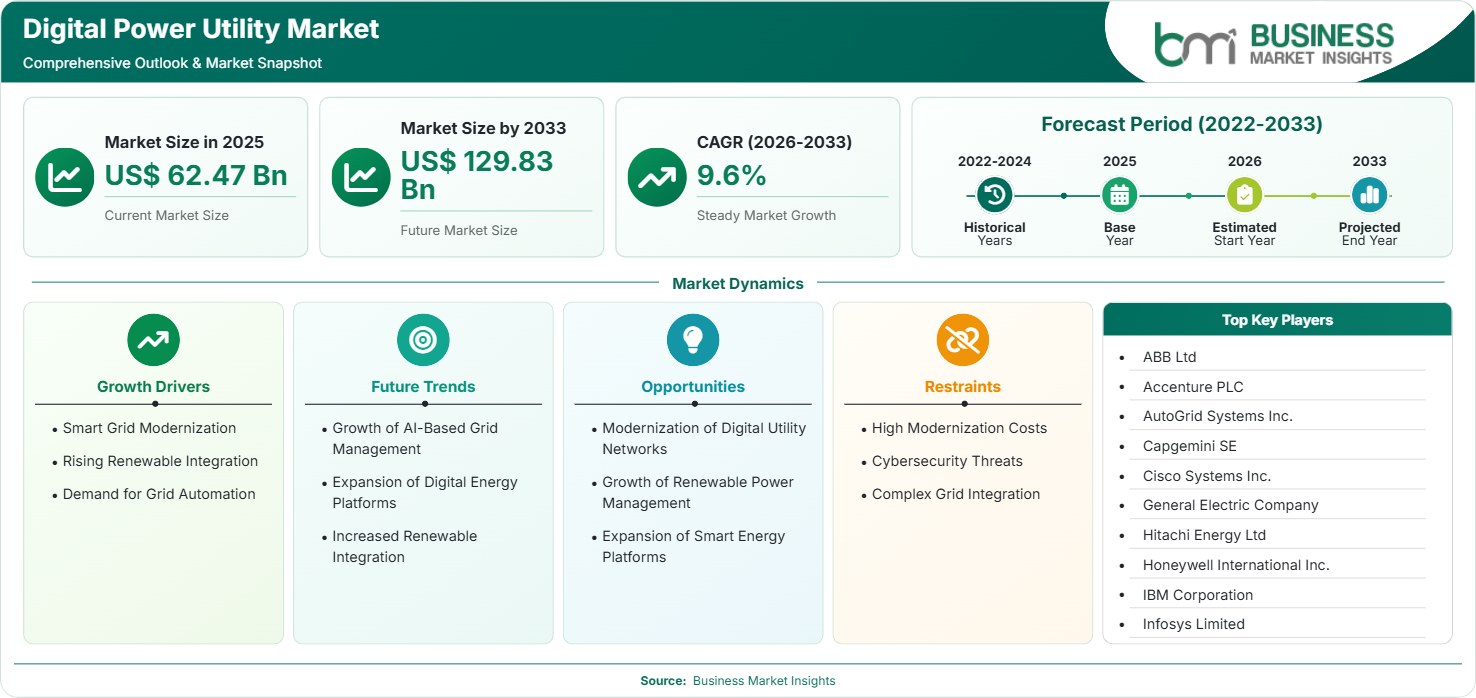
The Digital Power Utility Market size was valued at US$ 62.47 Billion in 2025 and is projected to reach US$ 129.83 Billion by 2033, growing at a CAGR of US$ 9.6% during 2026–2033, driven by smart grid modernization, renewable integration, automation adoption, and advanced energy management opportunities.

Report Coverage
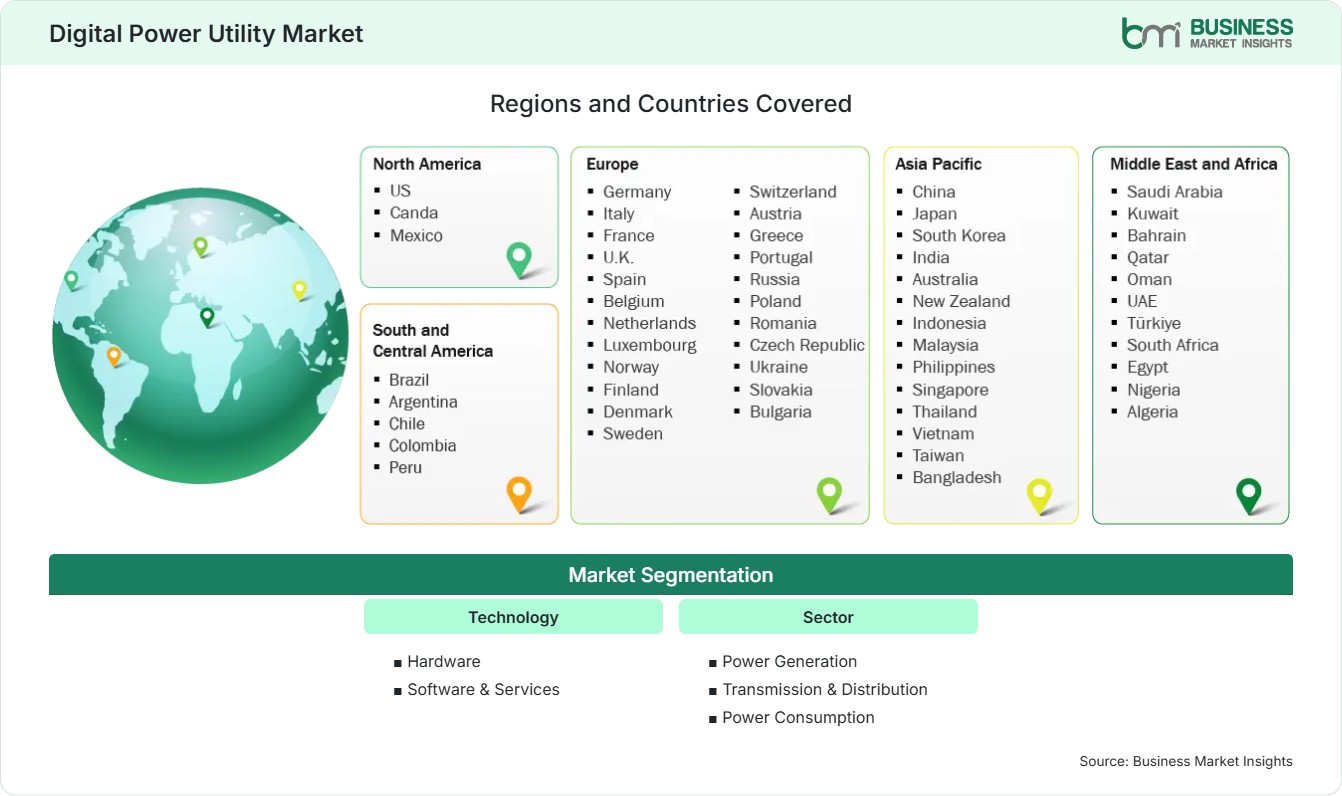
  • Technology: Hardware, Software & Services
  • Sector: Power Generation, Transmission & Distribution, Power Consumption
US$ 62.47 Bn Market size in 2025
US$ 129.83 Bn Market Size by 2033
9.6% CAGR, 2026 - 2033
2026-2033 Forecast Period

AI Overview

Digital Power Utility Market Summary

  • North America Region: North America holds a 34%–36% share in 2025, growing at a CAGR of 8.8%–9.4%, supported by grid modernization, digital infrastructure upgrades, renewable integration, and utility automation investments. The US market advances through smart grid programs and distributed energy adoption with a CAGR of 9.0%–9.5% during 2026–2033.
  • Fastest Growing Region: Asia Pacific accounts for a 30%–32% share in 2025, expanding at a CAGR of 11.0%–11.6%, driven by electricity demand growth, renewable capacity additions, digital grid initiatives, and government-led infrastructure transformation across developing economies.
  • Leading Segment: Software & Services represents a 52%–54% share in 2025, growing at a CAGR of 10.0%–10.6%, influenced by utility analytics, cloud platforms, artificial intelligence integration, and demand management solutions improving operational efficiency.
  • High Growth Segment: Power Consumption sector captures a 24%–26% share in 2025, advancing at a CAGR of 10.8%–11.3%, supported by smart meters, consumer energy platforms, demand response systems, and personalized energy management applications.
  • Key Market Opportunity: Digital utility transformation creates opportunities through artificial intelligence-based grid optimization, renewable forecasting, distributed energy management, cybersecurity platforms, and integrated digital ecosystems enabling resilient and efficient power networks.
  • Major Market Players: ABB Ltd, Accenture PLC, AutoGrid Systems Inc., Capgemini SE, Cisco Systems Inc., General Electric Company, Hitachi Energy Ltd, Honeywell International Inc., IBM Corporation, and Infosys Limited.
Strategic Insights

Digital Power Utility Market: Strategic Insights

Digital Power Utility Market Strategic Framework
FREE PDF
Request your free sample
Request free sample
Stakeholder View

Key Takeaways

  • Utilities are transitioning from asset-centric operations toward data-driven ecosystems where sensors, communication networks, analytics platforms, and automation tools create integrated value chains across generation, transmission, distribution, and consumption activities.
  • Growth opportunities are concentrated in software-enabled utility operations, including artificial intelligence platforms, predictive maintenance systems, energy analytics, and distributed resource management solutions that support increasingly complex electricity networks.
  • Technology innovation is moving toward cloud-based utility platforms, digital twins, cybersecurity architectures, and interoperable grid management systems that enhance operational efficiency while supporting renewable energy integration.
  • Asia Pacific presents a strong investment opportunity due to rapid electricity demand growth, expanding renewable installations, urbanization, and government programs focused on modernizing transmission and distribution infrastructure.
  • Strategic investments and partnerships are increasing as technology companies, consulting firms, and energy solution providers collaborate to deliver comprehensive digital transformation capabilities for utilities worldwide.
  • Utilities are prioritizing customer-focused energy platforms as consumer participation, smart metering adoption, and flexible demand management become important components of future electricity ecosystems.
Geographic Outlook

Digital Power Utility Market Regional Highlights

North America Digital Power Utility Market

North America maintains a leading position with a 34%–36% share in 2025 and is projected to expand at a CAGR of 8.8%–9.4% during 2026–2033. Strong investments in grid modernization, renewable integration, and advanced utility management platforms support regional expansion. The Digital Power Utility Market share reflects high adoption across the US and Canada, where utilities prioritize reliability, cybersecurity, and automation.

  • Utilities are accelerating smart grid investments through advanced metering infrastructure, automated distribution systems, and analytics platforms that improve outage management, operational visibility, and energy efficiency across regional power networks.
  • The US remains the dominant contributor, supported by federal modernization initiatives, renewable integration targets, and increasing deployment of digital platforms for transmission and distribution optimization.
  • Canada is expanding digital utility adoption through clean energy programs, grid resilience investments, and technology upgrades supporting remote monitoring and renewable energy management capabilities.
  • Utility partnerships with technology providers are increasing as energy companies seek scalable solutions for predictive maintenance, asset management, and real-time operational intelligence.

US Digital Power Utility Market

The US represents a 28%–30% share in 2025 and is expected to grow at a CAGR of 9.0%–9.5% between 2026–2033. The country benefits from extensive utility modernization programs, renewable power expansion, and digital infrastructure investments. The Digital Power Utility Market share in the US is strengthened by demand for grid resilience, distributed energy management, and advanced cybersecurity solutions.

  • Utilities are using artificial intelligence and machine learning technologies to increase forecast accuracy, optimize generation assets, and make better operational decisions across the complex electricity grid.
  • The growth in renewable energy is contributing to a higher need for platforms that will help manage intermittent energy generation sources, battery storage facilities, and distributed generation.
  • Investments in smart meters and customer platforms are enabling utilities to build stronger demand response capabilities and adopt more interactive energy management models.

Europe Digital Power Utility Market

Europe holds a market share of 22% to 24% in 2025 and is forecasted to have a CAGR of 8.5% to 9.1% during 2026-2033. Germany, the UK, and France are making efforts to digitize their grids through renewable integration and decarbonization. The Digital Power Utility Market growth is driven by regulatory activities, smart infrastructure, and energy-efficiency goals in European power grids.

  • Germany has been promoting the use of digital utilities by integrating renewables into the energy mix, meeting grid balancing needs, and upgrading transmission infrastructure for clean energy transitions.
  • The UK is developing smart grids and flexible energy systems to ensure network resilience and integrate increasing amounts of renewable electricity generation.
  • France is expanding digital energy solutions through utility modernization programs, advanced monitoring systems, and infrastructure upgrades supporting nuclear and renewable power management.
  • European utilities are adopting cybersecurity-focused digital solutions to protect increasingly connected electricity networks from operational and data-related risks.

Asia Pacific Digital Power Utility Market

The Asia Pacific region accounts for 30%–32% of the market, the largest share of all regions, and is projected to grow 11.0%–11.6% from 2026 to 2033. In addition, the region is growing faster than other regions owing to adoption driven by investments in renewable power capacity, urbanization, and digital infrastructure. The Digital Power Utility Market share reflects increasing demand for intelligent grids, automated distribution, and energy optimization platforms.

  • China drives regional development through substantial investments in smart grids, renewable energy integration, and digital technologies to modernize the power system nationwide.
  • India develops digital utilities by implementing projects such as smart metering, transmission, renewable energy goals, and electricity distribution reform.
  • Japan and South Korea develop their digital energy systems using automation, monitoring technologies, and grid management solutions.
  • The Southeast Asian nations develop digital utilities for improved electrification, reliability, and renewable energy integration.

Rest of World Digital Power Utility Market

The Rest of World region represents an 8%–10% share in 2025 and is expected to expand at a CAGR of 8.9%–9.5% from 2026–2033. South America, the Middle East, and Africa are adopting digital utility solutions to improve electricity reliability, integrate renewable resources, and modernize aging infrastructure. Brazil, Saudi Arabia, and the UAE are emerging markets supporting regional expansion.

  • Brazil is adopting digital grid technologies to improve renewable power management, distribution efficiency, and electricity reliability across expanding urban and industrial regions.
  • Middle Eastern countries are investing in smart energy platforms as part of diversification strategies and renewable energy expansion programs.
  • Saudi Arabia and the UAE are implementing advanced utility technologies to support large-scale renewable projects and modern electricity infrastructure.
  • African markets are gradually adopting digital solutions to strengthen grid monitoring, expand electrification, and improve operational efficiency in developing electricity networks.
Global Market Geography
FREE PDF
Request your free sample
Request free sample
Segment Analysis

Digital Power Utility Market Segmentation

Technology

Technology Segmentation is the fundamental building block of any Digital Transformation effort, with Software & Services dominating adoption owing to increased demand for analytics and cloud-based utility platforms. This segment accounted for 52%-54% of market share in 2025 and is forecast to grow at a CAGR of 10.0%-10.6% during 2026-2033. The Digital Power Utility Market size increases as utilities leverage intelligent platforms, automation systems, and data management technologies.

  • Hardware: Hardware solutions support grid digitization through sensors, smart meters, communication technologies, and automation systems.
  • Software & Services: Software & services platforms provide solutions such as analytics, asset management, digital twin technology, and cybersecurity for utility transformation efforts.

Sector

Sector segmentation shows differences in adoption rates among electricity value chain segments, with Transmission & Distribution having the largest market share due to the need for upgrades. The segment held a 45%-47% market share in 2025 and is projected to grow at an annual rate of 9.5%-10.1% during 2026-2033. Digital technology solutions have improved grid reliability, efficiency, and automation in utility companies.

  • Power Generation: Digital technologies enable predictive maintenance, forecasting for renewables, and optimization of production processes in both traditional and renewable generation facilities.
  • Transmission & Distribution: Transmission and distribution utilities implement digital automation, monitoring, and analytics systems to increase reliability, reduce losses, and improve network management.
  • Power Consumption: Consumer-focused solutions enable smart energy management, demand response, connected devices, and personalized electricity usage optimization for residential and commercial users.
Market Forces

Digital Power Utility Market Dynamics

Key Market Drivers

Smart Grid Modernization

The modernization of the smart grid is a key factor, as it requires replacing old infrastructure with interconnected technologies, automation, and analytics. As noted by the International Energy Agency, there is an urgent need for investment in the electricity network to facilitate the electrification and integration of renewables worldwide. Market growth is being propelled by demand for real-time monitoring, outage minimization, and asset management. The utilities have adopted sensors, digital substations, and AI-driven analytics. The Digital Power Utility Market trends indicate increased adoption of integrated grid management systems that facilitate flexible energy distribution and distributed generation.

Rising Renewable Integration

With the growth of renewable energy capacity, there is an increased need for digital management of electricity grids. Solar and wind power sources create a need for sophisticated production forecasting and automated adjustment of grid operations. There was record growth in global renewable energy capacity additions, according to the International Energy Agency. The Digital Power Utility Market growth is determined by technologies that integrate distributed energy resources, storage, and demand-response programs. Digital platforms allow utilities to maintain grid stability while incorporating higher volumes of renewable electricity.

Demand for Grid Automation

Grid automation technology is on the rise, driven by a need to achieve better reliability, faster fault detection, and decreased complexity in operations. Advanced distribution management systems, remote monitoring devices, and intelligent controls have become mandatory for future power grids. The Digital Power Utility Market trends indicate growing investments in automation technologies, which will result in increased service quality and lower maintenance efforts. AI, machine learning, and advanced communication systems are being used by utilities to optimize their networks. These technologies enable predictive maintenance strategies, enhance workforce efficiency, and support increasingly complex energy ecosystems.

Key Market Opportunities

Modernization of Digital Utility Networks

Modernization programs present numerous opportunities, as power utilities revamp their legacy systems through cloud computing platforms, advanced monitoring capabilities, and digital architecture integration. According to Digital Power Utility Market Forecasts, investment opportunities for power utilities seeking to improve resilience and enable informed decision-making through data analysis are rising. Modernization programs are increasing in both developed and developing nations, as power utilities focus on minimizing transmission losses, offering better services to consumers, and improving network visibility. Technology providers can capture opportunities by delivering scalable platforms that integrate hardware, software, analytics, and cybersecurity solutions for comprehensive utility modernization.

Growth of Renewable Power Management

Power management via renewable energy offers potential in forecasting platforms, distribution energy resource management systems, and automated balancing grid technologies. More installation of renewables necessitates that utilities have ways to synchronize them with storage capabilities and adaptable usage levels. Technology enables enhanced accuracy in energy forecasting, operations, and network adjustments. Businesses that design AI-based renewable energy management systems will be able to meet utilities' increased demand for clean energy integration. The potential is further boosted by decarbonization goals in different nations.

Expansion of Smart Energy Platforms

Smart energy platforms have created opportunities to connect utilities, customers, and distributed energy resources within a digital ecosystem. The platforms support demand response, energy-efficiency schemes, customer engagement, and flexible electricity consumption models. Opportunities are arising for utilities that have shifted towards service-oriented energy management methods. Personalized energy solutions are made possible by advanced analytics, cloud computing, and Internet of Things technologies, which also improve operational transparency. Service providers with secure and scalable platforms can capitalize on the growing need for connected energy solutions.

Market Restraints and Challenges

High Modernization Costs

High investment requirements can restrict adoption of advanced digital utility technologies, particularly among smaller utilities and developing regions. Factor: Digital transformation requires significant expenditure on infrastructure upgrades, communication networks, software platforms, cybersecurity systems, and workforce training. Impact: Elevated modernization costs can delay implementation timelines, limit technology adoption, and reduce investment capacity for utilities operating under financial constraints. Although digital solutions provide long-term efficiency benefits, utilities must balance capital allocation between modernization initiatives, grid expansion, and routine infrastructure maintenance. Cost optimization strategies and phased deployment approaches are becoming important for managing transformation expenses.

Cybersecurity Threats

Increasing connectivity across power networks creates cybersecurity challenges as utilities integrate digital platforms and remote operational systems. Factor: Expanded use of connected devices, cloud platforms, and communication networks increases exposure to cyber threats, unauthorized access, and potential operational disruptions. Impact: Security vulnerabilities can affect grid reliability, compromise sensitive operational data, and increase regulatory compliance requirements. Utilities are investing in cybersecurity frameworks, threat monitoring systems, and secure communication architectures to reduce risks. Strong protection measures are becoming essential as digital transformation expands across generation, transmission, distribution, and consumer-facing energy platforms.

Company Analysis

Competitive Landscape

The competitive environment, tech companies, energy solutions firms, consultancy firms, and digital infrastructure experts developing solutions to transform utilities. According to the Digital Power Utility Market Analysis, there is growing cooperation between traditional energy companies and tech companies that provide services in artificial intelligence, cloud computing, automation, cybersecurity, and grid management platforms.

Company Name

Overview

Products and Services relevant to this market

ABB Ltd

Global technology company providing electrification, automation, and digital energy solutions.

Smart grid systems, digital substations, energy management platforms, automation technologies, and analytics solutions.

Accenture PLC

Global consulting and technology services company supporting digital transformation initiatives.

Utility consulting, cloud solutions, artificial intelligence platforms, digital transformation services, and analytics.

AutoGrid Systems Inc.

Energy software provider specializing in distributed energy resource management solutions.

Virtual power plants, energy management software, demand response platforms, and grid optimization tools.

Capgemini SE

Technology consulting company delivering digital solutions for energy organizations.

Utility transformation services, cloud platforms, data analytics, automation, and smart energy solutions.

Cisco Systems Inc.

Networking technology company supporting connected utility infrastructure.

Industrial networking, cybersecurity solutions, IoT platforms, and communication technologies for utilities.

General Electric Company

Industrial technology company providing energy infrastructure and digital solutions.

Grid software, power management systems, monitoring technologies, and utility optimization solutions.

Hitachi Energy Ltd

Energy technology provider focused on grid modernization and sustainable electricity systems.

Digital substations, grid automation, energy management software, and renewable integration solutions.

Honeywell International Inc.

Technology company offering automation and industrial digital solutions.

Energy automation systems, control platforms, cybersecurity, and operational management technologies.

IBM Corporation

Technology company providing artificial intelligence and digital transformation solutions.

AI analytics, cloud platforms, asset management, and utility data solutions.

Infosys Limited

Digital services company supporting technology modernization across industries.

Utility consulting, cloud migration, automation services, and digital energy platforms.

Industry Activity

Recent Developments

May 2026

Siemens AG launched the latest evolution of its Gridscale X digital grid platform with AI-powered capabilities for system operations and transmission planning. The upgraded platform enables utilities to integrate applications, improve grid visibility, and use digital twin-based planning to manage increasing complexity from renewables, electrification, and large power consumers.

May 2026

ABB Ltd. announced a US$200 million investment across Europe to expand manufacturing capacity for medium-voltage technologies, including grid automation products and next-generation distribution solutions. The investment supports utilities and industries modernizing electrical infrastructure through digitalization and grid transformation.

November 2025

Siemens AG launched Gridscale X Flexibility Manager, a software solution designed to help distribution system operators (DSOs) optimize existing grid capacity by forecasting congestion and activating flexibility from distributed energy resources (DERs). The solution was developed with European utility partners including KNG, Alliander, and Elvia to support more autonomous grid management.

July 2025

Siemens AG partnered with ACEREZ (ACCIONA, COBRA, and Endeavour Energy partnership) to deploy Siemens’ cloud-based grid simulation software and digital substation technology for Australia’s Central-West Orana Renewable Energy Zone (REZ). The project uses Siemens’ PSS®E software within the Gridscale X portfolio to support large-scale renewable integration and advanced transmission network planning.

Trust & Transparency

Research Methodology

The market analysis combines proprietary research with secondary data from government agencies, company disclosures, regulatory filings, industry databases and expert interviews. Market estimates are validated through data triangulation, cross-market benchmarking and analyst review.

View Full Research Methodology

Questions Answered

Frequently Asked Questions

Why are renewable energy projects increasing demand for digital utility solutions?

Renewable energy sources create variable power generation patterns requiring advanced forecasting, balancing, and monitoring systems. Digital utility platforms help operators integrate renewable resources while maintaining grid stability and operational efficiency.

What does the Digital Power Utility Market Report cover?

The market report evaluates market dynamics, technology adoption, segmentation trends, regional developments, competitive strategies, investment opportunities, and challenges shaping the transformation of global electricity infrastructure.

How does artificial intelligence support digital utility transformation?

Artificial intelligence enables predictive maintenance, demand forecasting, asset monitoring, fault detection, and automated decision-making. These capabilities help utilities improve reliability, optimize resources, and manage complex electricity networks with greater operational accuracy.

Which technology segment has the highest growth potential?

Software and Services demonstrate strong growth potential because utilities increasingly require analytics, cloud platforms, artificial intelligence tools, and digital management systems to optimize operations and improve decision-making across power networks.

What is driving adoption of digital technologies in utilities?

Utilities are adopting digital technologies due to rising electricity demand, renewable energy integration, grid reliability requirements, and the need for predictive maintenance. Digital platforms help operators improve efficiency, reduce outages, and manage increasingly decentralized energy systems.

Access the Full Digital Power Utility Market Report

Get segment-level forecasts, regional estimates, competitive benchmarking, company profiles and downloadable Excel datasets.

Access the full Digital Power Utility Market Report
350 pages PDF & Excel | 2026-08-04
Similar Research

Related Market Reports