
Digital Pathology Market Outlook: Size, Share, Trends, Growth Analysis, Competitive Landscape & Forecast, 2026-2033

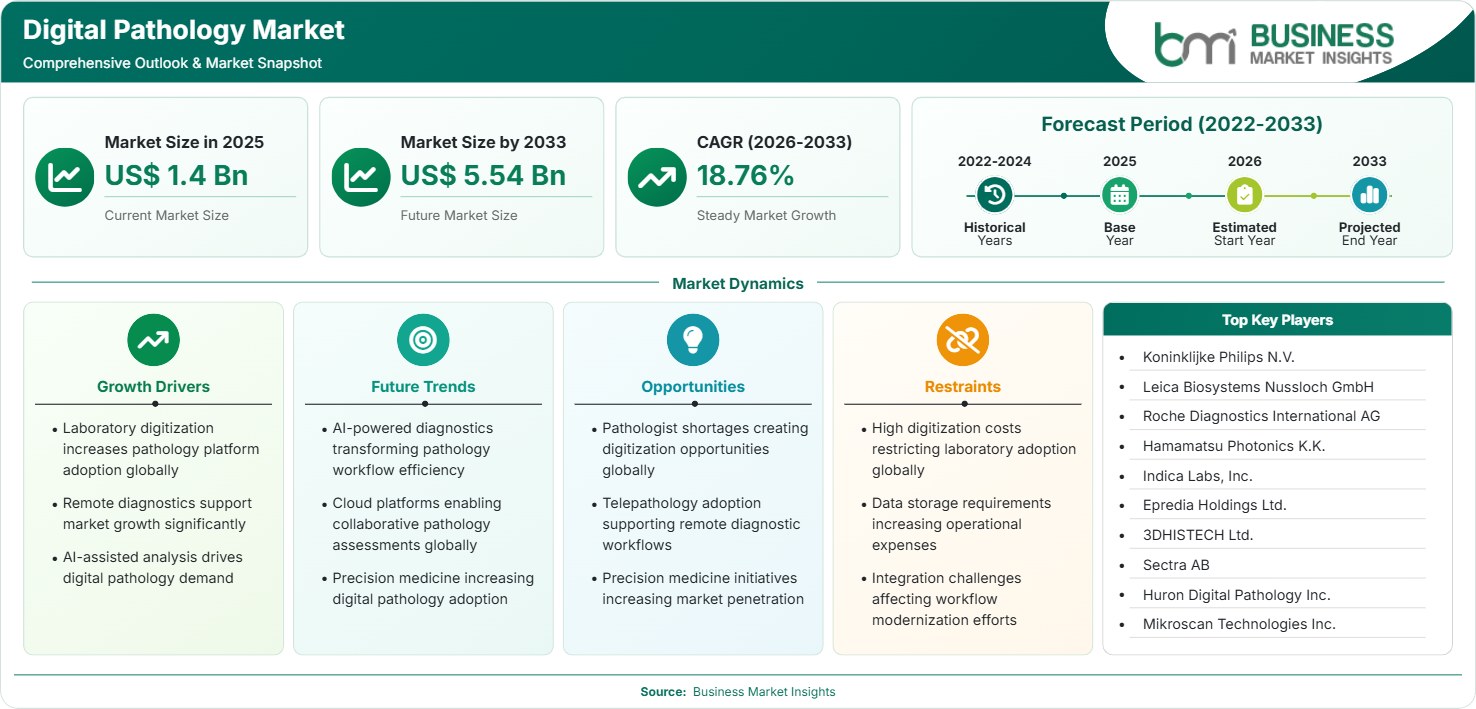
The Digital Pathology Market size was valued at US$ 1.4 Billion in 2025 and is projected to reach US$ 5.54 Billion by 2033, growing at a CAGR of 18.76% during 2026–2033. Key growth drivers include expanding cancer diagnostics, increasing laboratory digitization, AI-enabled image analysis adoption, and growing precision medicine initiatives. Opportunities are emerging across telepathology networks and cloud-based pathology platforms.

Report Coverage
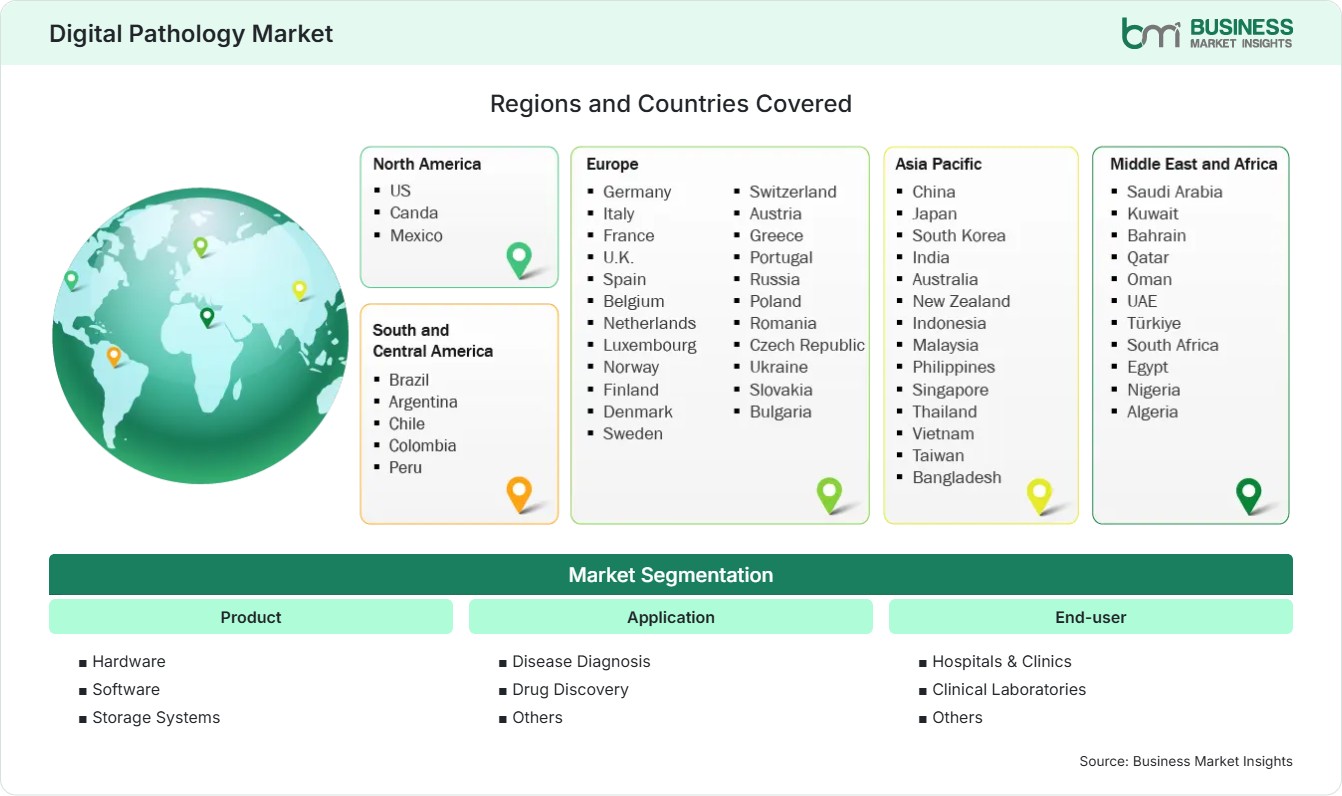
  • Product: Hardware , Software , Storage Systems
  • Application: Disease Diagnosis, Drug Discovery, Others
  • End-user: Hospitals & Clinics, Clinical Laboratories, Others
US$ 1.4 Bn Market size in 2025
US$ 5.54 Bn Market Size by 2033
18.76% CAGR, 2026 - 2033
2026-2033 Forecast Period

AI Overview

Digital Pathology Market Summary

  • North America Region: North America holds a market share of 38%–41% in 2025, growing at a CAGR of 17.5%–19.0% during 2026–2033, supported by extensive pathology digitization programs, favorable reimbursement environments, advanced healthcare IT infrastructure, increasing cancer screening volumes, expanding AI-based diagnostics adoption, academic research investments, and strong regulatory support across healthcare institutions. US demand benefits from integrated laboratory networks and digital workflow modernization, advancing at approximately 18.0%–19.5% CAGR.
  • Fastest Growing Region: Asia Pacific accounts for 24%–27% share in 2025, expanding at 20.5%–22.5% CAGR during 2026–2033, driven by healthcare infrastructure expansion, growing pathology workloads, accelerating laboratory automation investments, government digitization initiatives, increasing oncology prevalence, expanding biopharmaceutical research, and rising adoption of telepathology platforms across developing healthcare systems.
  • Leading Segment: Disease Diagnosis represents 60%–64% Digital Pathology Market share in 2025 and advances at 18.0%–19.5% CAGR through 2033, supported by rising cancer incidence, increasing biopsy volumes, demand for rapid diagnostic turnaround, workflow standardization requirements, AI-assisted image interpretation, quality control enhancements, and broader clinical acceptance across pathology departments.
  • High Growth Segment: Software contributes a 32%–36% share in 2025 while progressing at 20.0%–22.0% CAGR during 2026–2033, driven by artificial intelligence integration, cloud deployment models, advanced analytics capabilities, interoperability requirements, remote collaboration needs, growing data volumes, and expanding utilization of automated diagnostic support tools.
  • Key Market Opportunity: Expansion of enterprise-wide digital pathology ecosystems connecting hospitals, laboratories, pharmaceutical companies, and research organizations enables scalable diagnostics, collaborative interpretation, decentralized expertise access, real-world evidence generation, and enhanced clinical decision-making workflows.
  • Major Market Players: Koninklijke Philips N.V., Leica Biosystems Nussloch GmbH, Roche Diagnostics International AG, Hamamatsu Photonics K.K., Indica Labs, Inc., Epredia Holdings Ltd., 3DHISTECH Ltd., Sectra AB, Huron Digital Pathology Inc., Mikroscan Technologies Inc.
Strategic Insights

Digital Pathology Market: Strategic Insights

Digital Pathology Market Strategic Framework
FREE PDF
Request your free sample
Request free sample
Stakeholder View

Key Takeaways

  • The value chain is evolving from hardware-centric procurement toward integrated ecosystems that combine scanners, image management software, cloud storage, AI analytics, and laboratory workflow optimization services.
  • Drug discovery and companion diagnostics applications present substantial upside as pharmaceutical companies increasingly rely on image-driven pathology data to accelerate biomarker identification and clinical development programs.
  • Artificial intelligence is shifting product development priorities toward algorithm-assisted diagnosis, automated quantification, image triaging, and predictive pathology capabilities that enhance pathologist productivity.
  • Asia-Pacific offers a compelling investment case due to increasing healthcare expenditure, expanding oncology screening initiatives, and ongoing deployment of digital healthcare infrastructure across major economies.
  • Venture capital activity, strategic partnerships, and acquisitions continue reshaping competition as technology providers seek broader portfolios spanning imaging, analytics, cloud infrastructure, and clinical workflow platforms.
  • Workforce shortages in pathology departments are accelerating demand for remote consultation models, creating opportunities for telepathology service providers and enterprise software developers.
Geographic Outlook

Digital Pathology Market Regional Highlights

North America Digital Pathology Market

North America accounts for approximately 38%–41% of global revenue in 2025 and is expected to expand at a CAGR of 17.5%–19.0% through 2033. Digitization of the healthcare sector, the use of advanced diagnostic solutions, and investments in AI-assisted pathology help it remain in the top position. The region has an advantage due to a large number of cancer tests, a developed laboratory system, a reimbursement scheme, and the involvement of technology providers. Leadership in the Digital Pathology market share is maintained by regulatory acceptance and modernization.

  • Healthcare providers increasingly implement enterprise pathology platforms integrating imaging, analytics, and laboratory information systems to improve efficiency and diagnostic consistency.
  • Academic medical centers continue leading validation studies for AI-assisted pathology workflows, encouraging broader deployment across community healthcare facilities.
  • Biopharmaceutical research organizations prioritize image-driven biomarker assessment, supporting sustained demand for advanced digital imaging infrastructure.
  • Cloud-based pathology networks facilitate collaborative diagnostics and specialist consultations across geographically dispersed healthcare institutions.

US Digital Pathology Market

The United States accounts for around 78%-82% of revenue in the region and is expected to grow at a CAGR of 18.0%-19.5% through 2033. The demand in the country is driven by the rising incidence of cancer, laboratory consolidation, and the adoption of artificial intelligence applications. Major players in the diagnostic services segment keep implementing enterprise imaging platforms in line with the priorities of health systems.

  • Major healthcare systems continue investing in digital transformation strategies that enable integrated pathology interpretation and efficient case management.
  • AI-enabled image analysis adoption expands across oncology-focused diagnostic workflows, improving productivity and supporting complex case evaluations.
  • Research institutions increasingly collaborate with technology providers to develop and validate machine learning algorithms for pathology applications.
  • Laboratory consolidation accelerates demand for centralized image repositories and scalable diagnostic workflow management platforms.

Europe Digital Pathology Market

The Europe market is expected to command 28%–31% market share by 2025 and to witness a CAGR of 17.0%–18.5% during the forecast period. The robust adoption of solutions in Western Europe's healthcare system contributes to market expansion in the region. Germany dominates the national market, whereas Poland and other Central European countries are emerging investment markets due to the increasing digitization of the healthcare industry.

  • National digitization programs promote broader deployment of pathology imaging technologies across public healthcare systems.
  • Germany leads regional implementation due to advanced healthcare infrastructure and strong research participation in precision medicine initiatives.
  • Nordic countries demonstrate notable adoption of remote pathology networks supporting distributed healthcare delivery models.
  • Central and Eastern European healthcare investments create opportunities for laboratory modernization and digital workflow deployment.

Asia Pacific Digital Pathology Market

Asia Pacific region accounts for 24%–27% of total revenues in 2025 and is projected to have the fastest growth rate, with a CAGR of 20.5%–22.5%. China is set to be the dominant region in terms of demand, driven by infrastructure investments in healthcare and the development of oncology diagnostics, while India shows strong growth prospects due to lab digitization. A higher burden of pathology cases and biopharmaceutical research contribute to market growth in the region.

  • Government healthcare modernization initiatives accelerate digital diagnostics utilization and laboratory automation adoption.
  • China maintains leadership through large-scale investments in hospital infrastructure and advanced diagnostic technologies.
  • India exhibits strong growth momentum supported by expanding private diagnostic networks and telepathology deployment.
  • Rising pharmaceutical and biotechnology research activity increases demand for digital pathology platforms in translational medicine.

Rest of World Digital Pathology Market

Rest of World accounts for 7%-10% of total sales in 2025 and is forecasted to grow at a CAGR of 18.5%-20.5% through 2033. South & Central America continues to benefit from healthcare modernization efforts and increasing investment in diagnostic infrastructure. On the other hand, the Middle East & Africa markets continue to drive growth through digital health efforts, hospital construction projects, and increased adoption of diagnostics technology.

  • Brazil remains the largest regional market due to expanding healthcare investments and increasing pathology digitization initiatives.
  • Saudi Arabia benefits from large-scale healthcare transformation programs focused on advanced diagnostic technologies.
  • Telepathology adoption supports specialist access across underserved areas with limited pathology expertise availability.
  • Private healthcare investments contribute to laboratory modernization and broader implementation of enterprise imaging technologies.
Global Market Geography
FREE PDF
Request your free sample
Request free sample
Segment Analysis

Digital Pathology Market Segmentation

Product

Product Solutions constitute about 48%–52% of the overall market value in 2025 and are expected to grow at a CAGR of 18.5%–20.0% by 2033. Growth factors include the rise in lab digitalization, the need for more imaging data, AI-based workflow integration, and growing demand for pathology infrastructure systems. The Digital Pathology Market size continues to expand in scope as healthcare organizations adopt comprehensive diagnostic ecosystems.

  • Scanners: Whole-slide scanners remain foundational for workflow digitization, enabling high-resolution image capture, remote consultations, research applications, and standardized pathology assessment across distributed healthcare and laboratory settings.
  • Tissue Microarrayer: Increasing biomarker evaluation and translational research activities support adoption, particularly within academic institutions and pharmaceutical laboratories focused on multiplex tissue analysis and precision medicine development.
  • Pathology Management: These platforms streamline case management, workflow orchestration, image accessibility, reporting integration, and collaboration among pathology teams operating across multiple facilities and healthcare networks.
  • Digital Microscopy Viewers: Growing utilization of remote diagnostic workflows and collaborative pathology reviews supports demand for intuitive viewing software with advanced navigation and annotation capabilities.
  • Image Analyzers: AI-powered image analytics solutions gain momentum by supporting quantitative assessment, biomarker detection, workflow efficiency improvements, and diagnostic standardization across pathology operations.
  • Storage Systems: Rapid growth in whole-slide image generation necessitates scalable storage infrastructure capable of supporting secure archiving, retrieval efficiency, interoperability, and regulatory compliance requirements.

Application

The application market is driven by demand from diagnostic use of the test, accounting for 62%-65% of market share in 2025 and growing at a CAGR of 18.0%-19.5% until 2033. The rising incidence of cancer, the high volume of pathology tests performed, and the need for precise diagnostics are the main drivers of market expansion.

  • Disease Diagnosis: Adoption continues accelerating as healthcare systems prioritize diagnostic efficiency, faster case turnaround, specialist collaboration, and standardized image interpretation across oncology and chronic disease management.
  • Drug Discovery: Pharmaceutical companies increasingly leverage digitized pathology datasets for biomarker discovery, toxicology assessments, companion diagnostics development, and translational research initiatives supporting precision therapeutics.

End-user

The end-user market will be dominated by the institutional healthcare sector, generating revenues of around 55% - 58% in 2025, with an estimated CAGR of 18.0% - 19.0%. Rising pathology workload, digitization initiatives, and laboratory efficiency needs drive market adoption. Trends in the Digital Pathology Market show growth within the hospital setting and centralized diagnostic services.

  • Hospitals & Clinics: Healthcare providers increasingly deploy integrated pathology platforms to improve operational efficiency, diagnostic consistency, multidisciplinary collaboration, and pathology service accessibility across broader patient populations.
  • Clinical Laboratories: Consolidated laboratory networks invest in advanced imaging and workflow automation technologies to manage increasing specimen volumes while maintaining quality standards and operational productivity.
Market Forces

Digital Pathology Market Dynamics

Key Market Drivers

Rising Global Cancer Burden Driving Diagnostic Digitization

Based on various international organizations dedicated to global health, it is known that the number of cancer cases continues to grow around the world. This places considerable pressure on the pathology department due to the increased number of specimens to be handled. Digital pathology solutions contribute to increased efficiency in image search, remote consultation, standardization, and cooperation between experts. As more oncology screening services emerge in developed and developing countries, the need for diagnosis becomes greater. The  Digital Pathology Market growth is directly related to the increased demand for scalable diagnostics.

Artificial Intelligence Integration Improving Clinical Efficiency

AI-powered technologies are transforming pathological procedures through automated quantification, image triage, pattern recognition, and biomarker analysis. AI technologies are useful to pathologists for selecting difficult cases, avoiding routine tasks, and standardizing the image interpretation process. Regulatory approval of AI-enabled diagnostic solutions lends them credibility among health practitioners. There is considerable investment in developing algorithms for applications such as oncology, immunohistochemistry, and molecular pathology. The increasing pace of software development is one of the most relevant Digital Pathology Market trends affecting procurement. The convergence of machine learning and digital imaging technologies is driving greater efficiency and enabling advanced applications.

Expansion of Precision Medicine and Biomarker Research

Modern precision medicine programs tend to rely on sophisticated analyses of tissues, biomarkers, and image-based data. Drug makers leverage digital pathology datasets to accelerate drug discovery and patient stratification. The increasing use of companion diagnostics necessitates highly standardized image management and interpretation processes. In addition, research firms need scalable platforms that allow them to integrate pathology data with other genomics and molecular datasets. Such factors enhance demand for pathology solutions across the academic, clinical, and commercial sectors. There is also increased focus on evidence-based treatment decisions, making healthcare organizations consider upgrading their pathology systems.

Key Market Opportunities

Expansion of Cloud-Based Pathology Platforms

Cloud deployment models offer many advantages, including making pathology images easily accessible, simplifying infrastructure management, and fostering collaboration among experts across different geographic locations. Scalability is becoming a requirement for healthcare systems as they look to develop infrastructure that can handle larger amounts of images in a highly secure manner. Cloud-based processes enable remote consultation, second opinions, and centralized diagnostic activities. IT companies are building ecosystems incorporating image management and analysis capabilities. Advancements in internet connectivity and digitalization of healthcare services in emerging economies make the prospects even better. Companies building cloud-based environments in a compliant way will benefit from increasing demand.

Growing Adoption in Emerging Healthcare Markets

Healthcare modernization investments in countries across Asia, Latin America, and the Middle East continue to increase. The increase in laboratory construction, growth in oncology programs, and integration of healthcare IT make it possible to implement new technologies. Public and private healthcare providers look for technologies that will help them make effective use of resources and access specialists from remote areas. Digital pathology offers several practical advantages through remote reading capabilities and workflow standardization. Digital pathology market forecasts are increasingly tied to opportunities related to infrastructure investments, rising healthcare spending, and growing support for healthcare digitization projects.

Integration with Pharmaceutical Research Ecosystems

Pathology systems that can support toxicology, biomarker assessment, translational medicine, and clinical trials are now becoming a necessity for biopharmaceutical firms. With digitization, there will be improved access to data, more collaborative analysis, and better management of big image datasets. Technology vendors are developing customized solutions that meet the needs of pharmaceutical companies, and there is room to expand beyond clinical use. Increased interest in personalized medicines adds to the importance of image-based research tools. Companies offering comprehensive software, analytics, storage, and workflow solutions can gain significantly from working with pharmaceutical companies.

Market Restraints and Challenges

High Implementation Costs and Infrastructure Requirements

Factor: The use of enterprise-level deployment requires significant investment in scanners, storage systems, software licensing, process integration, cybersecurity, and staff training. Impact: A high capital outlay will tend to delay implementation, especially for small hospitals and laboratories operating on limited budgets. There are also procurement and implementation complexities to address. Maintenance costs and technology upgrades are other considerations organizations must address. Although increased efficiency over the long run can help justify the investments, cost considerations remain an issue. They are even more apparent in emerging healthcare markets where competing infrastructure priorities can limit technology acquisition and slow broader deployment of advanced pathology solutions.

Data Management and Regulatory Compliance Complexity

Factor: Whole slide imaging produces massive amounts of data that need to be stored securely, managed through proper archival, and be interoperable and cyber-secure. Impact: The compliance issue with respect to privacy regulations and other healthcare data governance adds to the operational challenges for the healthcare industry. There is a need to ensure that the organization properly facilitates data transmission, storage, and access across various platforms. There could be additional complexities in implementing whole slide imaging technologies for multinational corporations due to regulatory variations across regions.

Company Analysis

Competitive Landscape

The Digital Pathology Market analysis highlights competition focused on imaging innovation, artificial intelligence integration, workflow optimization, and enterprise-wide pathology ecosystem development.

Company Name

Overview

Products and Services relevant to this market

Koninklijke Philips N.V.

Global healthcare technology provider with extensive diagnostic imaging and pathology workflow capabilities.

Digital pathology scanners, image management platforms, clinical workflow solutions, interoperability systems, and diagnostic software.

Leica Biosystems Nussloch GmbH

Major pathology solutions provider serving clinical laboratories, hospitals, and research organizations worldwide.

Aperio scanners, pathology imaging systems, digital workflow platforms, staining solutions, and laboratory technologies.

Roche Diagnostics International AG

Global diagnostics leader integrating pathology technologies with precision medicine initiatives.

Navify digital pathology solutions, companion diagnostics support, image analytics, and laboratory informatics platforms.

Hamamatsu Photonics K.K.

Imaging technology specialist recognized for advanced pathology scanning solutions.

Whole-slide imaging systems, slide scanners, image acquisition technologies, and pathology research solutions.

Indica Labs, Inc.

Software-focused company specializing in pathology image analysis applications.

AI-powered image analysis, pathology management platforms, biomarker quantification, and workflow software.

Epredia Holdings Ltd.

Global provider of anatomical pathology technologies and laboratory solutions.

Digital imaging products, pathology workflows, tissue processing technologies, and diagnostic laboratory equipment.

3DHISTECH Ltd.

Developer of advanced digital microscopy and pathology imaging platforms.

Whole-slide scanners, pathology software, digital imaging systems, and research workflow solutions.

Sectra AB

Medical imaging company offering enterprise imaging and pathology applications.

Digital pathology modules, image management platforms, enterprise visualization, and healthcare IT systems.

Huron Digital Pathology Inc.

Specialized pathology technology developer serving clinical and research laboratories.

Whole-slide scanners, telepathology solutions, image repositories, and pathology workflow platforms.

Mikroscan Technologies Inc.

Digital pathology innovator focused on imaging and diagnostic workflow technologies.

Pathology scanning systems, image management solutions, and digital diagnostic workflow applications.

Trust & Transparency

Research Methodology

The market analysis combines proprietary research with secondary data from government agencies, company disclosures, regulatory filings, industry databases and expert interviews. Market estimates are validated through data triangulation, cross-market benchmarking and analyst review.

View Full Research Methodology

Questions Answered

Frequently Asked Questions

Which regions present the strongest long-term investment opportunities?

Asia Pacific offers the strongest growth prospects owing to healthcare modernization programs, expanding diagnostic infrastructure, increasing oncology testing demand, and government-supported healthcare digitization initiatives across major economies.

What does the Digital Pathology Market Report indicate about future technology development?

The Market Report highlights increasing integration of cloud computing, AI algorithms, enterprise imaging platforms, and precision medicine applications. These technologies are expected to enhance collaboration, scalability, and diagnostic accuracy across healthcare ecosystems.

How does artificial intelligence impact pathology workflows?

Artificial intelligence supports automated image assessment, biomarker quantification, case prioritization, and workflow optimization. These capabilities help pathologists handle growing case volumes while improving consistency and operational efficiency in diagnostic laboratories.

Which application segment generates the highest revenue contribution?

Disease diagnosis remains the dominant application area because pathology departments increasingly rely on digitized imaging for oncology diagnostics, workflow optimization, quality assurance, and multidisciplinary clinical decision-making across healthcare institutions.

What is driving adoption of digital pathology solutions worldwide?

Increasing cancer testing volumes, laboratory workforce shortages, growing demand for remote diagnostics, AI-assisted image analysis, and healthcare digitization initiatives are accelerating adoption. Digital workflows improve efficiency, standardization, collaboration, and diagnostic accessibility across healthcare systems.

Access the Full Digital Pathology Market Report

Get segment-level forecasts, regional estimates, competitive benchmarking, company profiles and downloadable Excel datasets.

Access the full Digital Pathology Market Report
350 pages PDF & Excel | 2026-11-03
Similar Research

Related Market Reports