Market Summary
Executive Summary and Global Market Analysis
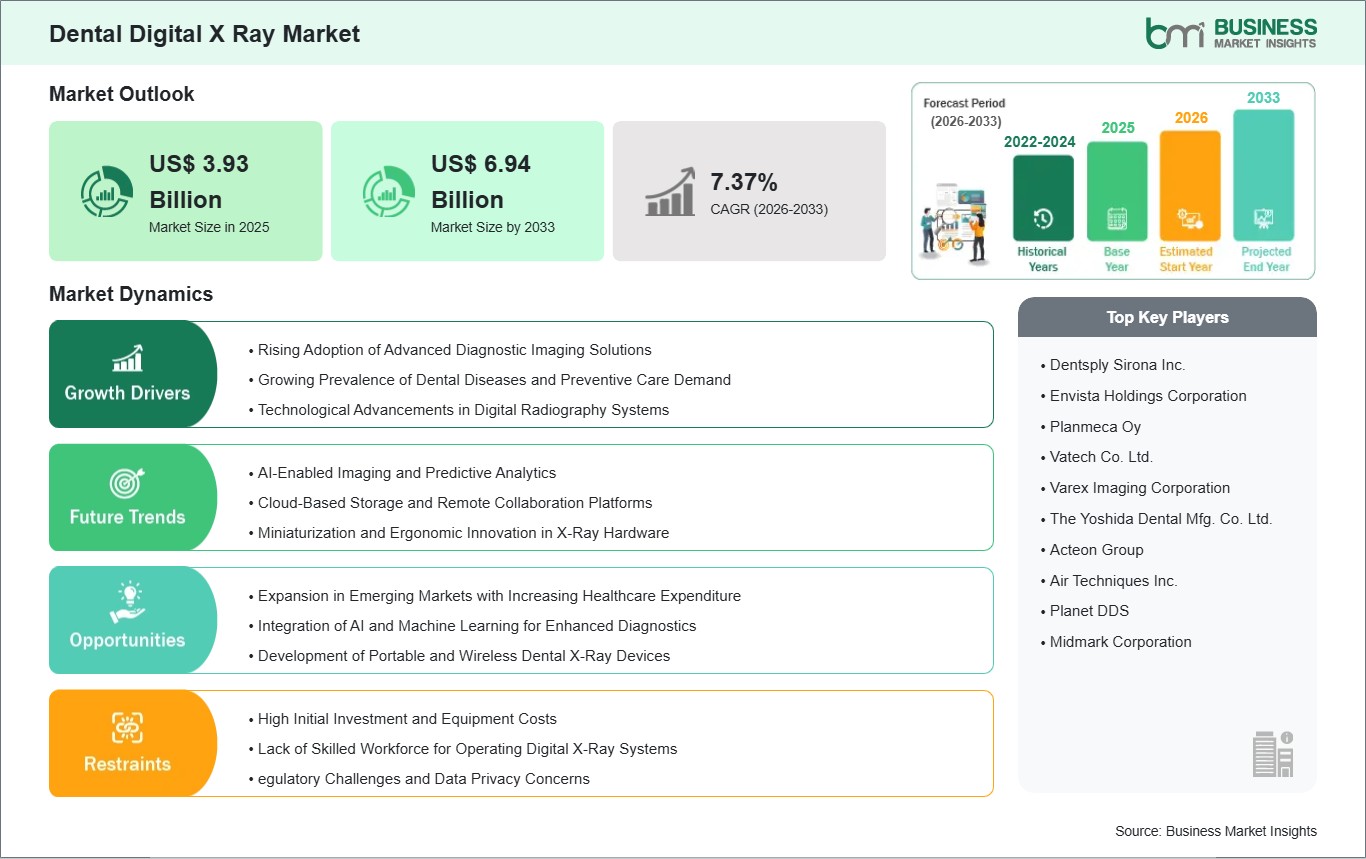
Dental digital X ray is an innovative imaging tool that is widely used in dentistry and captures very detailed images of the dental area using digital detectors instead of the conventional method of using photographic films. These units transform X ray signals into digital photos that can be viewed immediately, modified, backed up, and even sent electronically. This has all made possible quicker diagnoses, lesser radiation exposure, more patient comfort, and smoother clinical processes. Among the many applications of dental digital X rays are detection of cavities, assessment of gums, planning of implants, orthodontics, and root canal (endodontic) treatment which are all found in the respective dental clinics, hospitals, and schools of dentistry.
The global dental digital X ray market is showing steadily rising growth which is being caused by the higher occurrence rate of dental problems, the greater public awareness of the need to maintain oral health, and the worldwide trend of shifting to digital-based dentistry. New technologies such as cone beam computed tomography (CBCT), imaging assisted by artificial intelligence, and connection to practice management software are greatly improving both diagnostic precision and productivity. Furthermore, the rising appeal of aesthetic dentistry, the growing proportion of elderly people, and the greater uptake of non-invasive dental procedures are also factors that contribute to the market's growth. The developed world not only has powerful healthcare systems but also its regions have gone through the earliest phases of technology adoption whereas, on the other hand, the emerging markets are experiencing faster growth due to better access to dental care, increasing disposable incomes, and healthcare modernization investments. Overall, the market is characterized by continuous innovation, emphasis on patient safety, and a gradual transition from analog to fully digital dental imaging solutions worldwide.
Segment Analysis
Dental Digital X Ray Market Segmentation
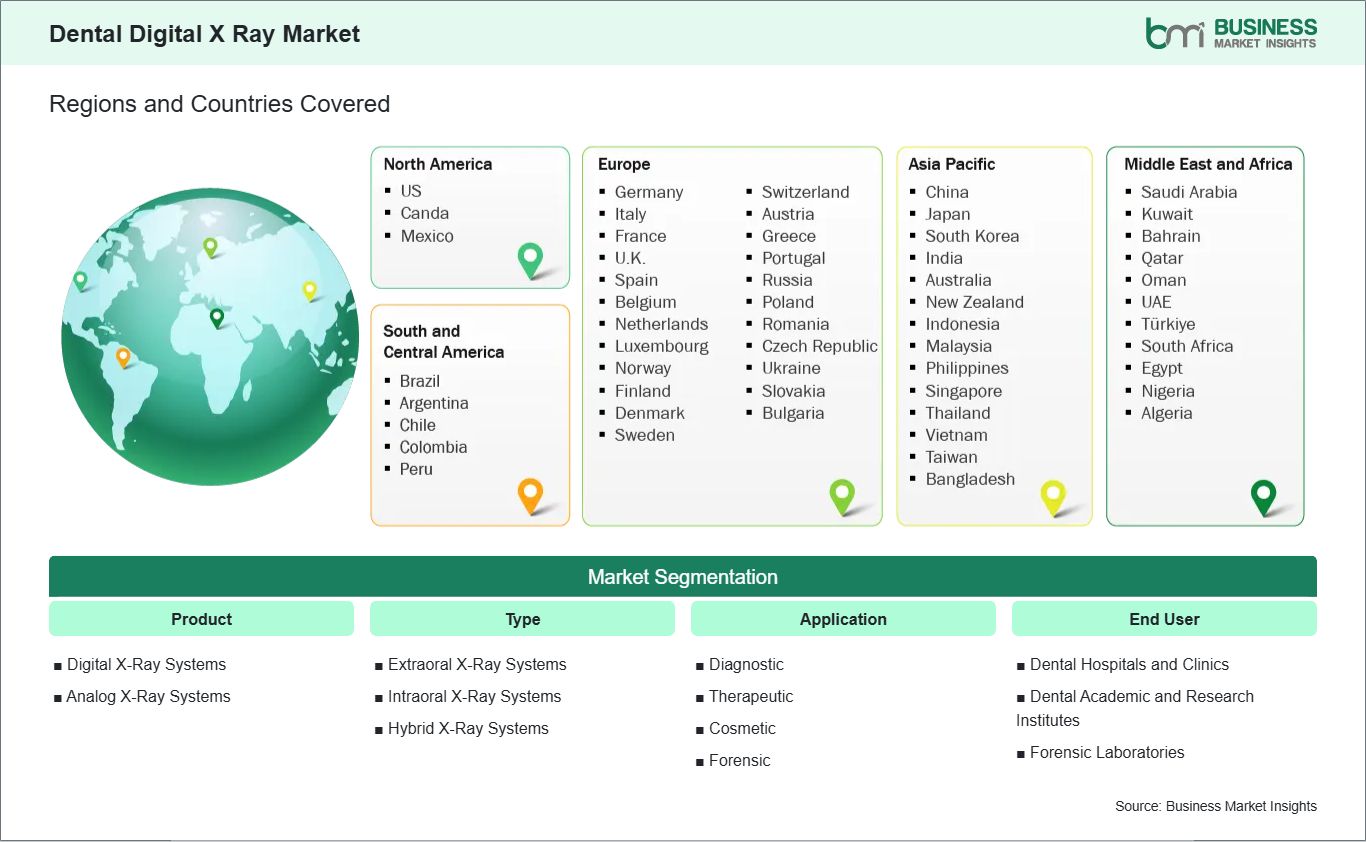
Key segments that contributed to the derivation of the dental digital X ray market analysis are product, type, application, and end user.
- By product, the dental digital X ray market is bifurcated into digital X-ray systems, analog X-ray systems. The digital X-ray systems segment dominated the market in 2025.
- By type, the market is categorized into extraoral X-ray systems, intraoral X-ray systems, hybrid X-ray systems. The intraoral X-ray systems segment held the largest share of the market in 2025.
- By application, the market is segmented into diagnostic, therapeutic, cosmetic, forensic. The diagnostic segment held the largest share of the market in 2025.
- By end user, the dental digital X ray market is segmented into dental hospitals and clinics, dental academic and research institutes, forensic laboratories. The dental hospitals and clinics segment dominated the market in 2025.
Market Forces
Dental Digital X Ray Market Drivers and Opportunities
Rising Prevalence of Dental Diseases and Demand for Advanced Diagnostics
The growing prevalence of dental disorders across the globe is one of the most important factors driving the dental digital X ray market and, thus, the demand for accurate diagnostic imaging. The mention of dental caries, periodontal disease, and oral infections is enough to indicate their widespread distribution around the globe; for instance, dental caries alone is a problem of about 2.3 billion people all around the world while severe periodontal disease causes trouble for 1 billion individuals, as per the World Health Organization. This high incidence of disease pushes the dental community to go for digital X-ray systems which offer high-speed, high-resolution imaging with the least amount of radiation, thus making early detection and treatment planning the more likely events. The older population is another reason why dental intervention is more frequent and complex, and in turn, this leads to a greater dependence on advanced imaging solutions. Digital system integration goes hand in hand with preventive care trends, as it allows for the continuous monitoring of disease progression and better patient outcomes. Increased oral health awareness leads to a situation where both the patient and the clinician prefer digital X-ray technologies to traditional film methods, which further cements their integration into routine practice.
Integration of Artificial Intelligence and Advanced Imaging Technologies
One of the biggest chances for the dental digital X ray market is combining artificial intelligence (AI) and the new imaging technologies that are changing the way diagnosis is performed in terms of both efficiency and accuracy. Companies are more and more incorporating AI algorithms into X-ray systems to carry out such tasks as detecting cavities, measuring the loss of bone, and identifying the location of anatomical landmarks, thus time-saving interpretation and reducing errors in diagnosing by quite a margin. For example, solutions offered by Dentsply Sirona such as DS Core already bring in AI powered analysis for both 2D and 3D pictures, increasing the quality of decision-making in dental practices all over the world. Not only that, the use of Cone Beam Computed Tomography (CBCT) and Cloud-based imaging solutions is also open for comprehensive 3D visualization and very easy access to the patient's data which is good for tele-dentistry and increases the service capabilities. All these technology improvements are unlocking new product development, strategic cooperation as well as market penetrations into emerging markets where the digital infrastructure is swiftly improving thus making advanced dental imaging technology more accessible and customizable for different clinical needs.
Size and Share Analysis
Dental Digital X Ray Market Size and Share Analysis
By product, the dental digital X ray market is bifurcated into digital X-ray systems, analog X-ray systems. The digital X-ray systems segment dominated the market in 2025. Digital X-ray systems lead because they offer superior image quality, faster processing, lower radiation, and easier storage/sharing compared with analog systems. Their integration with digital workflows and diagnostic software drives adoption among modern dental practices.
By type, the market is categorized into extraoral X-ray systems, intraoral X-ray systems, hybrid X-ray systems. The intraoral X-ray systems segment held the largest share of the market in 2025. Intraoral X-ray systems dominate as they are widely used for routine diagnostics like cavity detection and root assessment. They are cost-effective, provide high-resolution images with lower radiation, and are essential in everyday dental check-ups.
By application, the market is segmented into diagnostic, therapeutic, cosmetic, forensic. The diagnostic segment held the largest share of the market in 2025. Diagnostic applications lead because dental X-rays are primarily used to detect and evaluate oral diseases, fractures, periodontal issues, and treatment needs. High frequency of diagnostic imaging in general dentistry underscores this dominance.
By end user, the dental digital X ray market is segmented into dental hospitals and clinics, dental academic and research institutes, forensic laboratories. The dental hospitals and clinics segment dominated the market in 2025. Dental hospitals and clinics are the largest end-user segment due to their volume of patient visits, advanced infrastructure, and investment in technology to support accurate diagnostics and comprehensive treatments.
Report Coverage
Dental Digital X Ray Market Report Coverage and Deliverables
The " Dental Digital X Ray Market Size and Forecast (2022-2033)" report provides a detailed analysis of the market covering below areas:
- Dental digital X ray market size and forecast at global, regional, and country levels for all the key market segments covered under the scope
- Dental digital X ray market trends, as well as market dynamics such as drivers, restraints, and key opportunities
- Dental digital X ray market analysis covering key market trends, global and regional framework, major players, regulations, and recent market developments
- Industry landscape and competition analysis covering market concentration, heat map analysis, prominent players, and recent developments for the dental digital X ray market
- Detailed company profiles, including SWOT analysis
Geographic Insights
Dental Digital X Ray Market Geographic Insights
The geographical scope of the dental digital X ray market report is divided into five regions: North America, Asia Pacific, Europe, Middle East and Africa, and South and Central America. The dental digital X ray market in Asia Pacific is expected to grow significantly during the forecast period.
The Asia-Pacific dental digital X ray market is segmented into China, Japan, South Korea, India, Australia, New Zealand, Indonesia, Malaysia, the Philippines, Singapore, Thailand, Vietnam, Taiwan, Bangladesh, and the Rest of Asia. The Asia-Pacific dental digital X ray market is experiencing robust growth, due to increased awareness of oral health and a rising number of dental procedures as populations become more educated about preventive care, driving demand for advanced diagnostic tools. The countries like China, India, Japan, and the Southeast Asian nations are heavily pouring money into healthcare and dental infrastructure which leads to more clinics adopting digital X-ray technologies. The growing elderly population in these countries who needs to be attended at the dental office frequently is reinforcing the uptake of digital imaging systems. Moreover, dental tourism is booming in countries like Vietnam, Thailand, and India where patients from developed regions come for dental services that are of high quality and yet very affordable, thus, modern imaging equipment demand is increased. Technological breakthroughs like CBCT and AI-enhanced image processing are also being widely adopted in the Asia-Pacific region, providing the practitioners with better diagnostic accuracy and higher workflow productivity. Besides, the governments in the region are promoting oral health by coming up with initiatives and channeling funds that aid the modernization of dental practices thus, accelerating the growth of the market even more.
Industry Activity
Recent Developments
The dental digital X ray market is evaluated by gathering qualitative and quantitative data post primary and secondary research, which includes important corporate publications, association data, and databases. A few of the key developments in the dental digital X ray market are:
- In March 2025, Align Technology, Inc., which is a worldwide major player in the medical device sector, announced to the public its new software-based (CADe) computerized detection solution called Align X-ray Insights that will be available in the European Union countries and the United Kingdom. The new product uses artificial intelligence (AI) to automatically analyze 2D radiographs, therefore enhancing the accuracy of the detection done by the radiologists.
- In March 2025, Planmeca rejoices in revealing its first portable intraoral X-ray device. The Planmeca ProX GO promises the same quality of chair-side work that is time-saving and space-efficient, especially for practices dealing with mobile dental clinics, nursing homes, and emergencies. Also, the device's intuitive user interface and balanced design have made it easy, convenient, and accurate to use, hold, and aim. The device's beautiful design conveys the elegant and sleek look and feel that is a hallmark of Planmeca.
Trust & Transparency
Research Methodology
The market analysis combines proprietary research with secondary data from government agencies, company disclosures, regulatory filings, industry databases and expert interviews. Market estimates are validated through data triangulation, cross-market benchmarking and analyst
review.
View Full Research Methodology
Key Sources Referred:
World Health Organization (WHO)Centers for Disease Control and Prevention (CDC)United Nations Children's Fund (UNICEF)World Bank - Health Nutrition and Population DataOECD Health StatisticsCompany websitesCompany annual reportsCompany investor presentations