
Dental Implants Market Outlook: Size, Share, Trends, Growth Analysis, Competitive Landscape & Forecast, 2026-2033

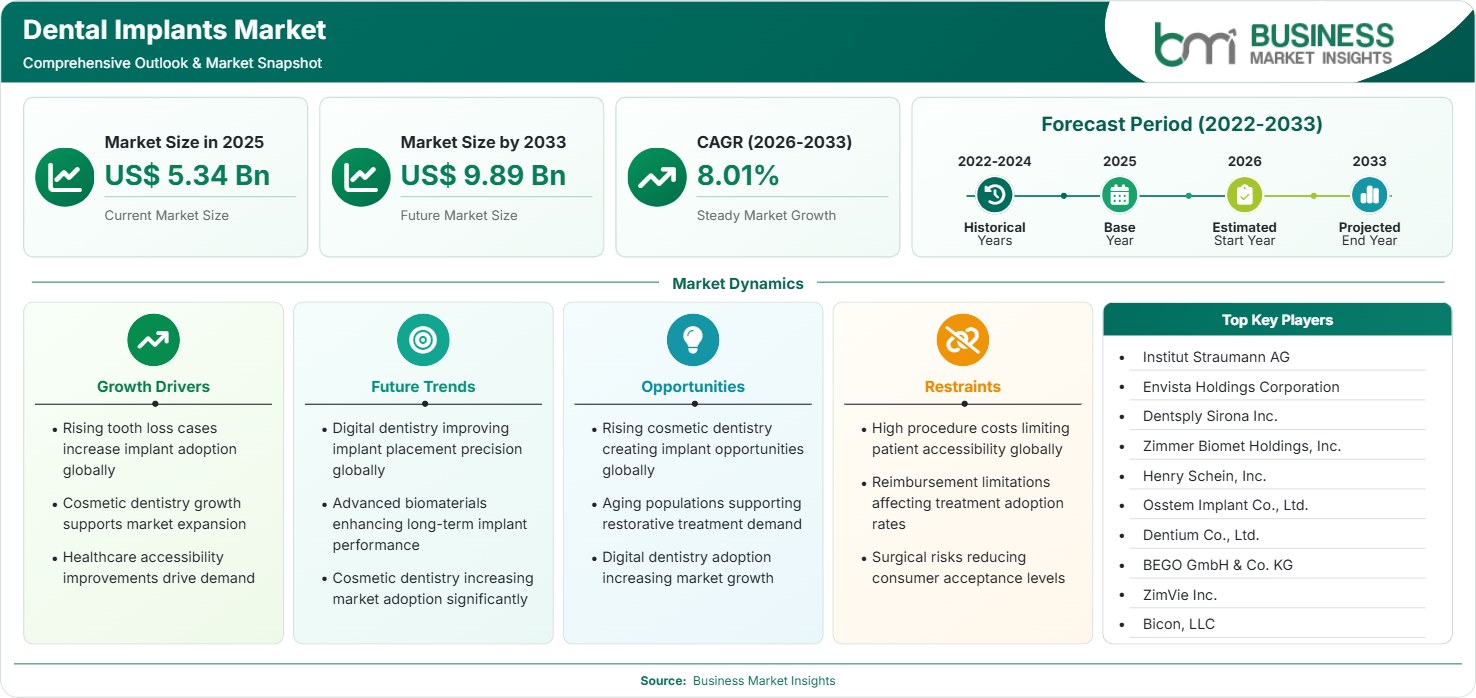
The Dental Implants Market size was valued at US$ 5.34 Billion in 2025 and is projected to reach US$ 9.89 Billion by 2033, growing at a CAGR of 8.01% during 2026–2033, driven by rising tooth-loss treatment needs, digital dentistry adoption, premium implant materials, and expanding access to restorative dental care.

Report Coverage
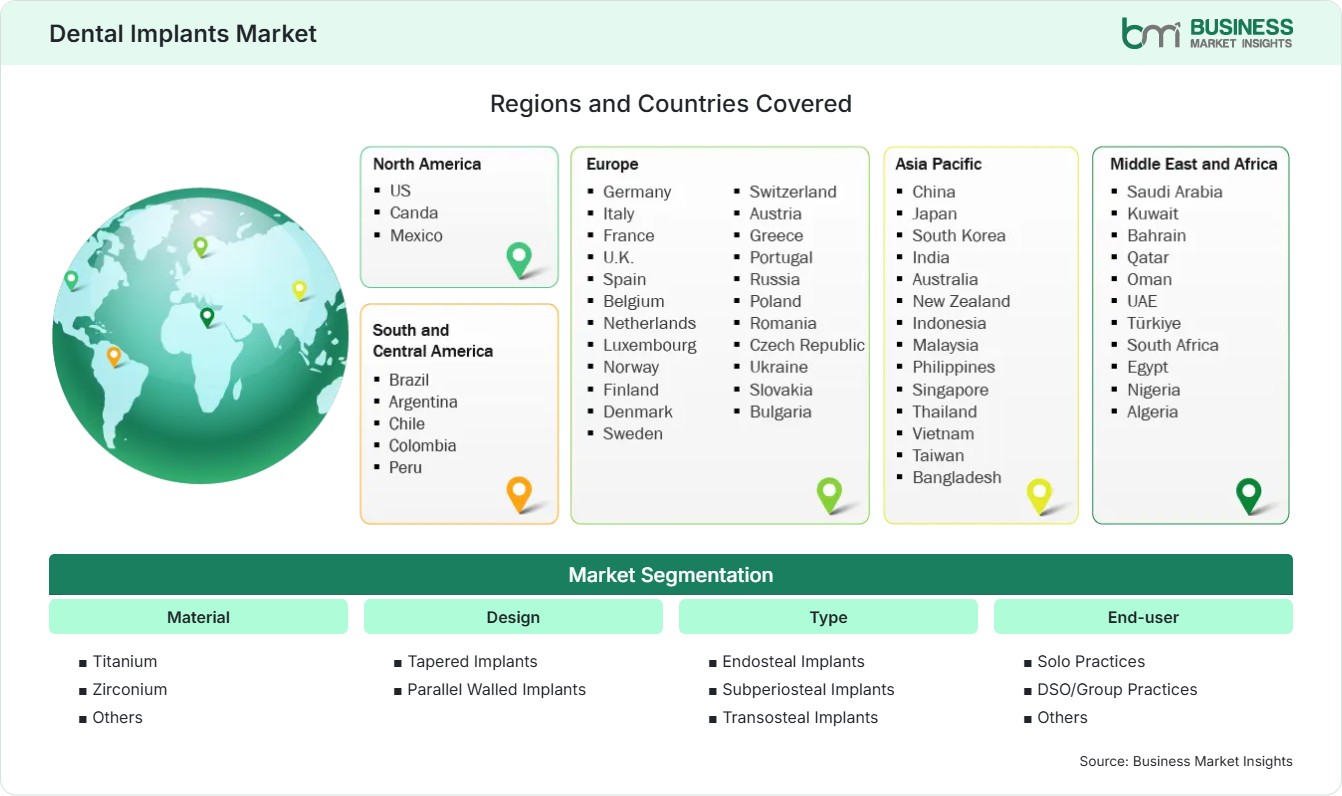
  • Material: Titanium, Zirconium, Others
  • Design: Tapered Implants, Parallel Walled Implants
  • Type: Endosteal Implants, Subperiosteal Implants, Transosteal Implants
  • End-user: Solo Practices, DSO/Group Practices, Others
US$ 5.34 Bn Market size in 2025
US$ 9.89 Bn Market Size by 2033
8.01% CAGR, 2026 - 2033
2026-2033 Forecast Period

AI Overview

Dental Implants Market Summary

  • North America Region: North America holds an estimated 34%–38% Dental Implants Market share in 2025, advancing at a 7.2%–8.2% CAGR through 2033 as restorative care demand, specialist expertise, digital workflows, and premium implant adoption strengthen commercial opportunities. The United States benefits from established implantology training, advanced clinics, and broad access to specialist dental services, although patient financing remains important for elective procedures.
  • Fastest Growing Region: Asia Pacific accounts for an estimated 23%–27% share in 2025, with a projected 9.0%–10.5% CAGR through 2033. Rising disposable incomes, expanding private dental networks, domestic manufacturing, medical tourism, and growing awareness of permanent tooth replacement support regional adoption.
  • Leading Segment: Titanium implants account for an estimated 78%–84% share in 2025, with a projected 7.0%–8.0% CAGR. Established clinical evidence, favorable biocompatibility, mechanical strength, extensive product availability, and compatibility with established surgical protocols sustain their commercial leadership.
  • High Growth Segment: Zirconium implants represent an estimated 8%–13% Dental Implants Market share in 2025, with a projected 9.5%–11.5% CAGR. Interest in metal-free restorations, favorable aesthetics, tissue compatibility, and advances in ceramic manufacturing encourage adoption among patients seeking alternatives to conventional titanium systems.
  • Key Market Opportunity: Integrated digital workflows, lower-cost implant systems, and expanding dental service networks can broaden access. Manufacturers can capture demand through clinician training, restorative partnerships, predictable treatment protocols, and localized distribution.
  • Major Market Players: Institut Straumann AG, Envista Holdings Corporation, Dentsply Sirona Inc., Zimmer Biomet Holdings, Inc., Henry Schein, Inc., Osstem Implant Co., Ltd., Dentium Co., Ltd., BEGO GmbH & Co. KG, ZimVie Inc., and Bicon, LLC.
Strategic Insights

Dental Implants Market: Strategic Insights

Dental Implants Market Strategic Framework
FREE PDF
Request your free sample
Request free sample
Stakeholder View

Key Takeaways

  • Commercial success depends on more than fixture sales. Manufacturers must coordinate implant bodies, abutments, restorative components, surgical instruments, digital planning software, and compatible laboratory services. Reliable component availability and long-term compatibility can improve clinic retention and recurring revenue.
  • Zirconia systems and advanced titanium surface technologies provide differentiated product opportunities. Suppliers should target clinical indications where aesthetics, bone conditions, restorative requirements, and patient preferences support a clear product advantage rather than competing solely on price.
  • Digital implant planning is becoming a workflow capability rather than an isolated software purchase. Companies that connect imaging, treatment planning, guided surgery, and prosthetic production can improve coordination between clinicians and dental laboratories.
  • Asia Pacific offers opportunities to expand through distributor partnerships, professional education, and locally appropriate product portfolios. Growth strategies should account for differences in purchasing power, regulatory pathways, reimbursement, and specialist availability between individual countries.
  • Strategic partnerships and acquisitions can extend product portfolios into regenerative dentistry, digital scanning, and guided procedures. Investors should assess recurring component revenue, clinical evidence, geographic exposure, and integration costs alongside headline sales growth.
  • Training and aftercare can distinguish suppliers in a competitive market. Programs that improve case selection, surgical technique, prosthetic maintenance, and management of peri-implant complications can strengthen professional confidence and support durable customer relationships.
Geographic Outlook

Dental Implants Market Regional Highlights

North America Dental Implants Market

North America is expected to account for 34%-38% of the world's total Dental Implants Market in 2025, with a forecasted CAGR of 7.2%-8.2% from 2026-2033. Existing specialist practices, higher uptake of restorative treatments, and availability of advanced imaging drive demand. The US will continue to dominate the regional market, whereas Canada will also contribute via private dentistry. Purchase considerations in the region are becoming increasingly holistic, covering surgery planning, prosthetics, and maintenance. Premium solutions maintain their edge when compatibility and proven clinical record are valued by the practitioner.

  • United States: A large base of implant-trained clinicians and specialist facilities supports demand for advanced systems. Practice investment in imaging, guided surgery, and laboratory connectivity can improve workflow efficiency, although out-of-pocket treatment costs remain a barrier for some patients.
  • Canada: Demand benefits from specialist dentistry and patient interest in durable tooth replacement. Manufacturers can strengthen distribution by supporting clinician education, dependable component supply, and restorative partnerships across urban centers and less densely served communities.
  • Digital treatment planning: Cone-beam computed tomography, intraoral scanning, and surgical guidance help clinicians coordinate implant placement with restorative requirements. Integrated platforms can differentiate suppliers, particularly when software and physical components work across the treatment pathway.
  • Premium implant systems: Established clinical protocols and comprehensive prosthetic portfolios support premium positioning. Competition increasingly depends on the ability to demonstrate product reliability, manage complex cases, and provide responsive technical support rather than relying on implant fixture pricing alone.

US Dental Implants Market

It is estimated that the US market share will contribute 78% - 84% to the North American dental implants revenue by 2025, at a CAGR of 7.2%-8.3% over the period 2026-2033. This is because of the size of the country’s large-scale private dental care industry, and its specialists and distribution channels. The use of the technology depends on the restorative needs of older people and those seeking alternatives to removable dentures. Payment systems and treatment plans influence the decision to proceed after consultations.

  • Private dental spending: Patients often weigh implant durability against the upfront cost of surgery and restoration. Flexible payment arrangements and transparent treatment plans can influence uptake without reducing the clinical assessment required for safe treatment.
  • Group practice expansion: Larger dental organizations can standardize implant protocols, procurement, and training across locations. Vendors that offer consistent product availability, compatible prosthetic components, and dependable technical support can compete for multi-site purchasing agreements.
  • Regulatory compliance: FDA requirements make appropriate device authorization, labeling, and safety documentation important commercial considerations. Manufacturers must align market access with applicable regulatory pathways and maintain systems for complaint handling and post-market monitoring.
  • Complex restorative cases: Full-arch rehabilitation and cases requiring bone augmentation create demand for coordinated surgical and prosthetic solutions. Clinicians continue to assess anatomical suitability, patient health, and maintenance requirements before selecting treatment.

Europe Dental Implants Market

Europe Dental Implants Market is expected to constitute 27%–31% share of total global revenue by 2025, with CAGR of 7.0%–8.0% up to 2033. Europe possesses well-established implant manufacturers, specialized dental laboratories, and well-developed restorative dentistry practices. Such countries as Germany, Switzerland, France, Italy, and the UK are significant business regions, yet their use of dental products depends on local dental expenditure and reimbursement policies. Compliance with regulations and traceability affect the choice of suppliers. Companies with an evidence-based product range, clinical training, and reliable prosthetics support are likely to maintain professional connections across different nations.

  • Germany: A developed dental laboratory ecosystem and established restorative care support implant adoption. Suppliers can differentiate through engineering quality, prosthetic compatibility, and technical support for clinicians managing routine and complex restorations.
  • Switzerland: Strong dental technology expertise and the presence of established manufacturers support innovation and premium positioning. Research, clinical education, and international distribution relationships help companies extend product reach beyond the domestic market.
  • France and Italy: Private dental clinics and specialist practitioners create opportunities for differentiated implant systems. Local professional education and efficient laboratory coordination can support adoption, while patient affordability continues to shape treatment choices.
  • United Kingdom: Demand is influenced by private restorative dentistry and access to specialist implant services. Suppliers can build relationships through clinical training, predictable component availability, and support for treatment planning and maintenance.
  • Regulatory and quality requirements: European medical-device compliance encourages structured documentation, traceability, and quality management. These obligations can raise market-entry costs for smaller manufacturers but reinforce the value of established regulatory and distribution capabilities.

Asia Pacific Dental Implants Market

Asia-Pacific is anticipated to account for 23%–27% of revenues in the global market in 2025, growing at a 9.0%–10.5% CAGR through 2033. Dental Implants Market growth in private dental facilities, increased awareness of dental treatment, and advances in specialist training contribute to rising demand. China, Japan, South Korea, and India are key markets in this region, each with distinct competitive environments. Domestic players will compete on pricing and distribution, whereas foreign players will compete in premium applications.

  • China: A large patient base and developing specialist services create opportunities for both domestic and international suppliers. Manufacturers must balance competitive pricing with quality assurance, regulatory compliance, and dependable access to prosthetic components.
  • India: Private dental clinics, expanding urban demand, and interest in aesthetic restoration support long-term opportunity. An estimated 11.5% CAGR for the country's broader implant market has been reported for 2026–2033, although this external forecast is separate from the regional model used here.
  • Japan: Established dental care infrastructure and demand for functional restoration support implant use. Suppliers can compete through clinically documented products, precision engineering, and maintenance services for patients requiring long-term restorative care.
  • South Korea: Domestic implant manufacturing and export-oriented suppliers contribute to regional competition. Companies with broad product portfolios and international distribution can combine competitive pricing with training and prosthetic solutions for overseas clinics.
  • Southeast Asia: Private clinics and dental tourism create opportunities in selected urban centers. Market development depends on clinician availability, patient purchasing power, reliable imported or locally distributed products, and access to appropriate diagnostic facilities.

Rest of World Dental Implants Market

Rest of World Dental Implants Market is estimated at 7%-11% of worldwide sales in 2025 and is expected to have a CAGR of 8.0%-10.0% during 2026-2033. The rest of the world comprises Latin America, the Middle East, and Africa, where income levels and the availability of specialists vary. Private dental clinics in Brazil and Mexico cater to demand in Latin America, whereas countries like the UAE and Saudi Arabia present opportunities in advanced clinics and medical tourism.

Latin America can benefit from the presence of well-established laboratories and dental clinics in major cities, while high costs prevent consumers from accessing the best systems. The Middle East is an opportunity region that will benefit from investment in private healthcare institutions that can drive demand for implant rehabilitation. Africa represents a long-term opportunity for companies as specialist services expand in urban regions, but cost constraints limit near-term market penetration.

  • Brazil: Private dental clinics and domestic dental technology capabilities create opportunities for a range of implant systems. Suppliers need dependable component availability, clinician training, and pricing structures suited to the local market.
  • Mexico: Urban dental networks and cross-border dental travel support selected restorative applications. Manufacturers can build reach through distributor partnerships and laboratory coordination while maintaining appropriate quality and follow-up arrangements.
  • United Arab Emirates and Saudi Arabia: Investment in specialist healthcare and medical tourism can support premium implant procedures. Integrated diagnostic, surgical, and prosthetic workflows may appeal to clinics serving local and international patients.
  • South Africa: Established private dental services provide a platform for implant adoption, particularly in major urban centers. Cost-sensitive product options and professional education can support access beyond premium specialist practices.
  • Regional distribution: Importers and local distributors influence product availability, inventory, and technical support. Suppliers that maintain traceable components and consistent post-sale service can reduce friction for clinics operating across fragmented healthcare markets.
Global Market Geography
FREE PDF
Request your free sample
Request free sample
Segment Analysis

Dental Implants Market Segmentation

Material

Titanium continues to be the material of choice, with an estimated market share of 78%–84% in the Dental Implants Market in 2025 and a CAGR of 7.0%–8.0% through 2033. Its mechanical characteristics, proven clinical performance, and broad adaptability across implant systems make it a suitable choice for adoption. Patients and dentists who prefer metal-free options choose zirconia implants for aesthetic regions. Materials used depend on bone quality, restoration, the dentist's experience, and prosthesis components.

  • Titanium: Titanium implants benefit from established osseointegration evidence, strength, and extensive clinical familiarity. Broad product availability and compatibility with established surgical protocols support use in single-tooth replacement and more complex restorative procedures.
  • Zirconium: Zirconia implants appeal to patients seeking metal-free restorative options and favorable aesthetics. Continued material engineering and clinical evaluation influence adoption, while long-term evidence, fracture resistance, and prosthetic compatibility remain important purchasing considerations.
  • Others: Alternative materials and specialized ceramic or alloy solutions address narrower clinical requirements. Their commercial relevance depends on biocompatibility, mechanical performance, regulatory compliance, and the availability of reliable evidence supporting the intended indication.

Design

It is estimated that tapered dental implants will account for 55%-65% of the Dental Implants Market revenue in 2025, with a CAGR of 8.0%-9.0% between 2026 - 2033. Their shape enables the creation of primary stability in proper bone conditions and different anatomical circumstances. Parallel-walled implants remain important in cases where a cylindrical design and corresponding surgery are appropriate. It all depends on bone density, implant placement depth, loading concept, and restoration needs.

  • Tapered Implants: Tapered designs narrow toward the apical region and may support primary stability in selected clinical situations. They are used for a variety of indications, with selection guided by bone quality, surgical technique, and implant system specifications.
  • Parallel Walled Implants: Parallel-walled designs provide a consistent cylindrical profile and remain useful within established surgical protocols. Their adoption reflects clinician familiarity, anatomical suitability, and compatibility with restorative systems and treatment-planning requirements.

Type

Endosteal implants are estimated to account for 90%–95% of the revenue generated by the 2025 Dental Implants Market, with a forecast CAGR of 7.5%–8.5% through 2033. Because they are implanted into the jawbone, they may be used in a variety of restoration cases in accordance with anatomic and clinical criteria. Subperiosteal and transosteal implants are used only in special cases, such as certain bone-restriction cases.

  • Endosteal Implants: Placed within the jawbone, these implants support crowns, bridges, and implant-retained dentures. Their established clinical use, broad product selection, and compatibility with conventional restorative workflows sustain their leading position.
  • Subperiosteal Implants: Positioned over the jawbone beneath the periosteum, these systems may be considered in selected cases with limited bone support. Their use depends on anatomical assessment, clinician expertise, and the suitability of alternative procedures.
  • Transosteal Implants: Transosteal systems pass through the jawbone and have a specialized role in selected complex cases. Their limited adoption reflects surgical complexity, narrower indications, and the availability of other implant or reconstructive approaches.

End-user

The estimated share of solo practices in the 2025 Dental Implants Market revenue is likely to be 40%-48%, with a forecasted CAGR of 7.0%-8.0% till 2033. The importance of independent practitioners lies in the fact that dental implants depend on practitioners' experience and judgment, and their relationship with patients. DSO and group practices are likely to benefit from their centralized procurement and training programs. Other end users are hospitals and specialized institutions for complicated cases.

  • Solo Practices: Independent dental clinics value dependable implant systems, manageable inventory, clinical education, and responsive supplier support. Product selection often reflects clinician experience, patient budgets, laboratory relationships, and the ability to coordinate surgery with restorative treatment.
  • DSO/Group Practices: Multi-site dental organizations can standardize procurement and training across locations. Suppliers offering broad portfolios, predictable pricing, reliable distribution, and consistent technical support may be better positioned to secure group-level purchasing relationships.
  • Others: Hospitals, academic institutions, and specialist centers contribute through complex treatment, professional training, and clinical research. Their purchasing decisions may emphasize multidisciplinary support, documented performance, specialist instrumentation, and compatibility with institutional procurement requirements.
Market Forces

Dental Implants Market Dynamics

Key Market Drivers

Growing Need for Functional Tooth Replacement

Missing teeth pose functional, cosmetic, and social challenges, leading to increased demand for restorations. According to a WHO report released in March 2025, oral conditions affect about 3.7 billion individuals globally, whereas tooth loss is much more common among older adults. This data provides an idea of the overall impact of oral health conditions, rather than of those who are eligible to undergo dental implants. A dental implant procedure requires both clinical appropriateness and the patient's resource availability. Nonetheless, increased awareness regarding fixed restorations, improved diagnostics, and specialized dental care facilitates the use of dental implants.

Integration of Digital Planning and Guided Surgery

Workflows in digital technologies link imaging, implant planning, surgical procedures, and prosthetic fabrication. The intraoral scanner reduces reliance on traditional impressions when possible, and three-dimensional imaging can help a dentist evaluate anatomical limitations before the implant is inserted. Guided and navigation surgery can also be used to place an implant according to the pre-surgical plan, but neither method eliminates the risks associated with surgery. Moreover, digital technologies make communication between the dentist and the laboratory easier through software. These features contribute to the Dental Implants Market trends in dental implants, particularly in workflow and restoration planning.

Established Clinical Evidence for Titanium Systems

Titanium maintains a strong position because clinicians have extensive experience with its biocompatibility, mechanical properties, and integration with bone. The US FDA describes titanium and zirconium oxide as substances used in the manufacture of dental implant systems and emphasizes the importance of material safety and device evaluation. Knowledge of titanium implant systems plays a key role in increasing clinicians' confidence in application techniques and in the systems' compatibility. The manufacturers have continuously developed new technologies in surface treatments, connections, and implant design to meet specific clinical needs. Innovations in the Dental Implants Market prevent manufacturers from competing on material.

Key Market Opportunities

Expanding Access Through Value-Oriented Implant Systems

There are ways for manufacturers to meet the needs of underserved patient populations, namely by creating dependable, competitively priced solutions that are efficiently distributed and provide readily available professional education. Cutting down the purchase cost alone will not suffice, as the overall cost of treatment includes expenses such as imaging, surgical procedures, prosthetic materials, laboratory tests, and follow-up procedures. Health care providers who can help streamline inventory and make clinic work more efficient may make an important contribution to the economics of treatment. This becomes even more significant when one considers new markets where the number of patients undergoing private dental treatments is rising, but who cannot afford these services. Thus, the Dental Implants Market Forecasts should be analyzed alongside affordability and clinician capacity.

Metal-Free Restorations and Advanced Ceramic Development

It is worth noting that zirconia offers a solution for patients who prefer no metal in their teeth or who want to achieve specific aesthetic goals. In terms of investments, the emphasis could be on material stability, connection technology, fracture resistance, and research demonstrating the material’s long-term performance. The firms cannot talk about the superiority of all-ceramic systems because the materials to be used depend on many factors, including anatomy, occlusal loads, restoration design, and even the personal preferences of the dentist. It can be helpful for companies to collaborate with research institutions and dental experts to assess their products and assist with treatment planning. Firms with credible data and a reliable prosthetic system can establish themselves in this market.

Digital Ecosystems and Full-Arch Treatment Solutions

Integrative implant systems present possibilities for imaging, planning software, navigation, prosthesis design, and lab fabrication. Manufacturers could form alliances with scanning companies and printing firms to streamline workflows for dental clinics serving patients needing complex restorative solutions. The need for coordinated surgical planning, provisional restorations, and proper follow-ups may necessitate technical assistance for full-arch implantations for commercial reasons. Technology is also beneficial for streamlining processes and training staff across practices operating at various sites. Key investments would be interoperability, data security, clinician education, and validated workflows.

Market Restraints and Challenges

High Total Treatment Costs and Uneven Affordability

Factor: The implant procedure includes the fixture, consultation, diagnosis, surgery, abutments, crowns, lab work, and aftercare. The cost could also increase due to bone augmentation or any other procedure. Impact: Patients who must bear high costs may delay treatment, opt for removable devices, or place fewer implants. This is especially true for those areas where restorative dentistry is not much reimbursed by public funds. Manufacturers and practitioners can do their part to improve affordability through proper treatment planning and streamlined operations, but not at the expense of good clinical practice, sterilization, product quality, and aftercare.

Clinical Complexity and Risk of Implant Complications

Factor: Successful insertion is contingent on bone quality, oral health, periodontal condition, overall health, surgical skills, and follow-up in accordance with the recommended procedures. Possible complications include infection, injury to adjacent structures, implant loss, and the need for additional treatments. Impact: Uncertainty about clinical performance can reduce the number of eligible candidates, increase treatment costs, and affect patient confidence. According to the FDA, problems related to implant insertion can occur immediately after the procedure or later, requiring another procedure. The manufacturer should provide adequate directions, quality records, and training, and the physician bears responsibility for patient selection and treatment.

Company Analysis

Competitive Landscape

The Dental Implants Market analysis indicates that competition extends across implant fixtures, restorative components, digital treatment planning, and professional education. Established multinational suppliers compete with Asian manufacturers and specialist implant companies on clinical evidence, product breadth, pricing, distribution, and service. The following companies represent an indicative group of active market participants; their inclusion does not imply identical market shares or independently verified rankings.

Company Name

Overview

Products and Services relevant to this market

Institut Straumann AG

Swiss dental technology company with a broad international presence in implant dentistry and restorative solutions.

Dental implant systems, prosthetic components, digital dentistry solutions, regenerative products, and professional education.

Envista Holdings Corporation

Dental products group with implant, orthodontic, and specialist dental technology businesses.

Implant solutions through Nobel Biocare and other brands, guided surgery, restorative components, and digital treatment workflows.

Dentsply Sirona Inc.

Global dental technology company supplying products to dental professionals and laboratories.

Implant systems, restorative materials, digital imaging, CAD/CAM equipment, and integrated dental technology solutions.

Zimmer Biomet Holdings, Inc.

Medical technology company with a portfolio of dental implant and restorative products.

Dental implants, prosthetic components, surgical instruments, and supporting restorative solutions.

Henry Schein, Inc.

Healthcare products distributor serving dental practices and other healthcare providers.

Dental implant products from multiple suppliers, clinical consumables, equipment, and practice-support services.

Osstem Implant Co., Ltd.

South Korean implant manufacturer with international distribution and professional training activities.

Titanium implant systems, prosthetic components, surgical instruments, and implantology education.

Dentium Co., Ltd.

South Korean dental implant company serving domestic and international markets.

Implant fixtures, abutments, surgical kits, prosthetic components, and related dental equipment.

BEGO GmbH & Co. KG

German dental technology company with implantology and laboratory-related expertise.

Implant systems, prosthetic components, laboratory materials, and digital dental manufacturing solutions.

ZimVie Inc.

Dental and spine technology company with an established dental implant portfolio.

Implant systems, prosthetics, biomaterials, and digital restorative workflows.

Bicon, LLC

Specialist dental implant company known for a distinctive implant design and restorative approach.

Short dental implants, abutments, prosthetic components, surgical instruments, and clinician education.

Trust & Transparency

Research Methodology

The market analysis combines proprietary research with secondary data from government agencies, company disclosures, regulatory filings, industry databases and expert interviews. Market estimates are validated through data triangulation, cross-market benchmarking and analyst review.

View Full Research Methodology

Questions Answered

Frequently Asked Questions

What information can a Dental Implants Market Report provide to investors?

A Market Report can help investors evaluate material and design preferences, regional demand, end-user purchasing behavior, competitive positioning, and technology adoption. Commercial assessments should distinguish verified company disclosures from modelled market estimates and consider regulatory, clinical, and affordability risks.

What should buyers consider when comparing titanium and zirconia systems?

Buyers should compare intended indications, mechanical properties, aesthetic requirements, clinical evidence, and compatibility with the planned restoration. Titanium has an extensive clinical history, while zirconia may suit selected metal-free applications. Neither material is appropriate for every patient or clinical situation.

Why do implant maintenance services matter after placement?

Implants require ongoing professional monitoring and appropriate oral hygiene. Follow-up helps clinicians assess tissue health, prosthetic integrity, and potential complications. Maintenance needs can affect the lifetime cost of treatment and should be discussed with patients before surgery.

How does digital dentistry influence implant treatment planning?

Digital imaging and intraoral scanning help clinicians assess anatomy, plan implant position, and coordinate restorations with dental laboratories. Guided or navigated surgery can support execution of the plan, but clinical judgment and patient-specific assessment remain essential.

What factors should a clinic evaluate before choosing a dental implant system?

Clinics should assess clinical evidence, material properties, implant geometry, prosthetic compatibility, component availability, training, and supplier support. The system must suit the intended indications and the clinician's experience. Total treatment economics and the availability of compatible restorative components also matter.

Access the Full Dental Implants Market Report

Get segment-level forecasts, regional estimates, competitive benchmarking, company profiles and downloadable Excel datasets.

Access the full Dental Implants Market Report
350 pages PDF & Excel | 2026-10-22
Similar Research

Related Market Reports