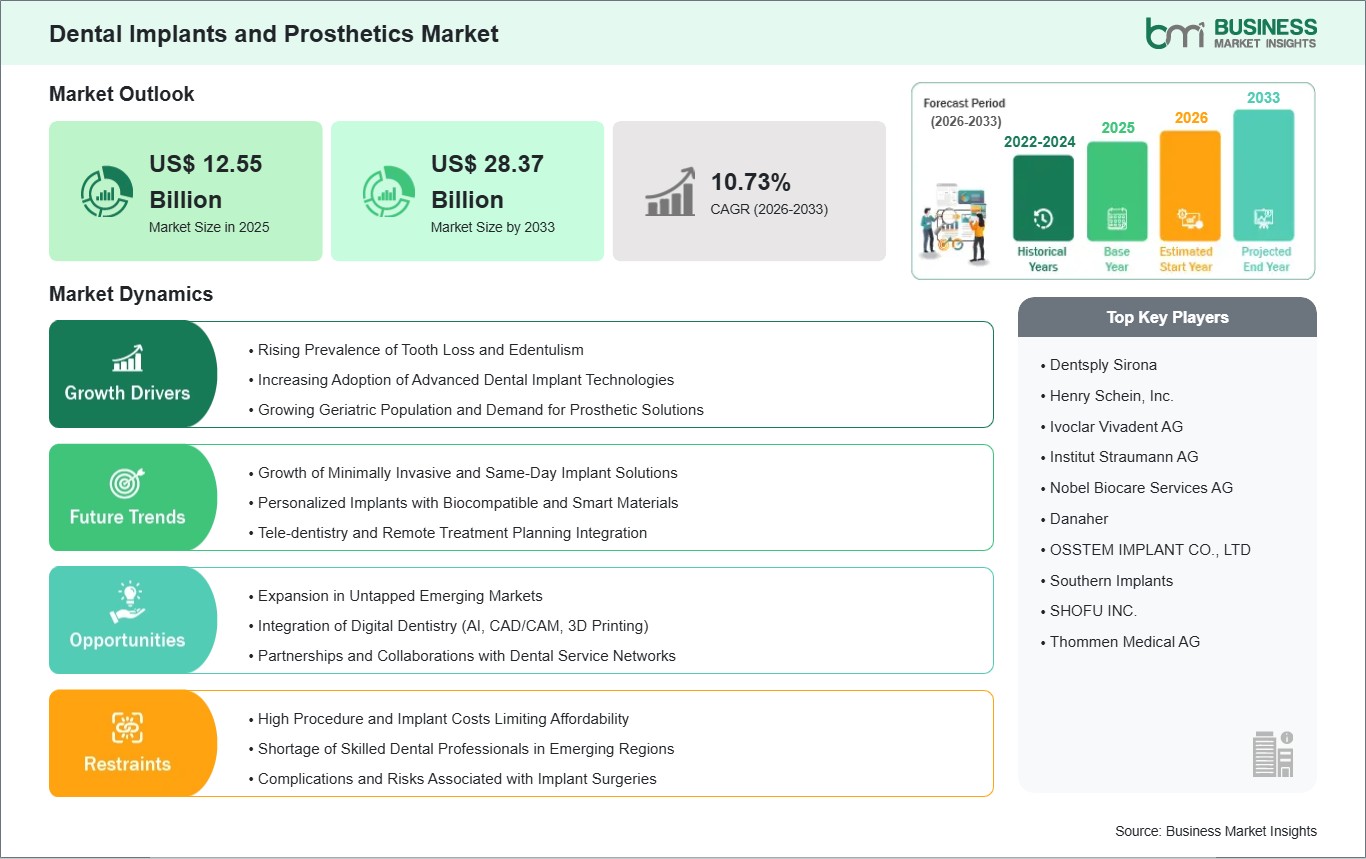
The Dental Implants and Prosthetics Market size is expected to reach US$ 28.37 billion by 2033 from US$ 12.55 billion in 2025. The market is estimated to record a CAGR of 10.73% from 2026 to 2033.
Dental implants and prosthetics function as advanced restorative solutions which restore missing teeth while enabling patients to regain their oral function and appearance and self-assurance. Dentals implants function as titanium or ceramic posts which dental professionals surgically insert into the jawbone for supporting dental prosthetics that include crowns and bridges and dentures, while dental prosthetics include all types of artificial dental replacements that dentists use. The solutions treat tooth loss which results from aging or trauma or periodontal disease or congenital conditions because they have become essential dental treatments through their better biocompatibility and extended treatment results.
The global dental implants and prosthetics market is dynamic and driven by multiple factors. The market expands because people become more aware of oral health while the world's population ages and people in developing countries gain more income. The sector benefits from technological progress because computer-aided design/manufacturing (CAD/CAM) and 3D printing and minimally invasive surgical methods improve accuracy and decrease operational duration and make medical services more reachable. The need for cosmetic dentistry together with patient demand for long-lasting dental solutions that resemble natural teeth drives the trend of solution adoption among different population groups. Emerging markets will drive industry growth through development of dental systems and adoption of digital methods which enable dental practices to maintain their competitive edge.

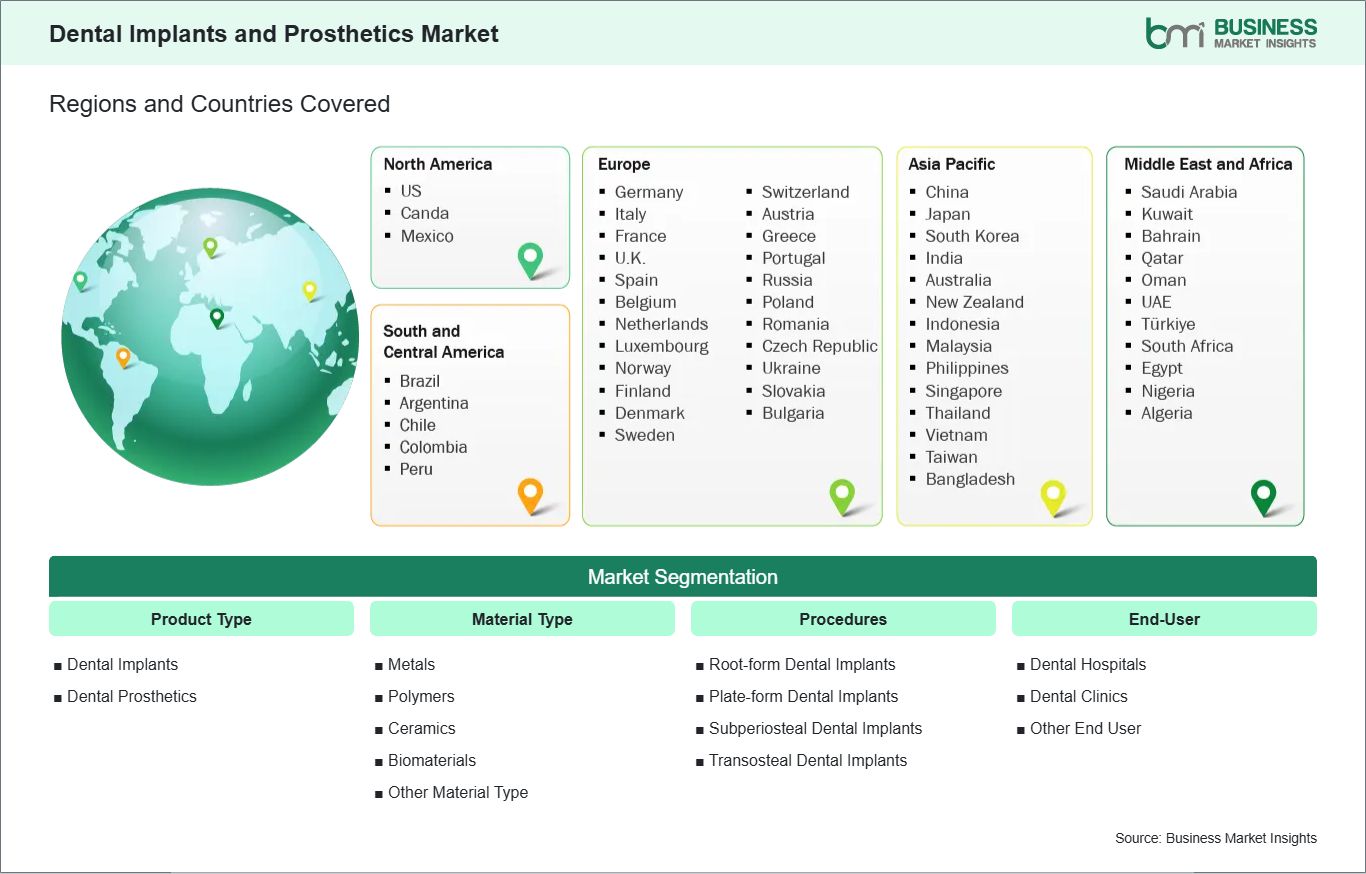
Key segments that contributed to the derivation of the dental implants and prosthetics market analysis are product type, material type, procedures, and end-user.
The dental implants and prosthetics market experiences growth because more people worldwide develop dental disorders which result in tooth loss and caries and periodontal disease. According to the World Health Organization's 2025 oral health data approximately 7% of adults aged 20 and older and about 23% of adults aged 60 and older experience complete tooth loss which creates a need for restorative solutions such as implants and prosthetics. The trend has become more pronounced because aging populations throughout the world face a higher prevalence of dental problems which are typical for their age group. Less developed regions of the world currently experience a major dental crisis because people practice poor oral hygiene and lack access to basic preventive dental care which leads to untreated dental caries that affect almost all adults. Patients increasingly choose implant-supported restorations because they provide better long-term functional and aesthetic benefits which creates higher demand for advanced dental implant operations and prosthetic solutions.
The dental implants and prosthetics market identifies digital dentistry technologies together with advanced manufacturing methods which include 3D printing and CAD/CAM design and AI-driven workflows as its most important business opportunity. The technologies provide their benefits because they allow creation of exact patient-specific implants together with prosthetics which provide faster production times and better clinical results. The dental 3D printing market shows rapid growth according to SNS Insider because almost 60% of dental laboratories worldwide have started using additive manufacturing for better precision and customization of crowns and bridges and dentures. The introduction of multi-material printing for monolithic dentures together with cloud-based digital platforms from Straumann enables dental professionals to enhance their operational productivity and service delivery. The developments in technology create two advantages because they simplify production processes and they enable businesses to operate in existing markets while entering new markets through decreased expenses and the ability to produce products locally.
By product type, the dental implants and prosthetics market is bifurcated into dental implants, dental prosthetics. The dental implants segment dominated the market in 2025. Dental implants lead due to their long-term durability, superior functional performance, and ability to closely mimic natural teeth. Unlike removable or fixed prosthetics alone, implants provide strong anchorage, prevent jawbone resorption, and offer higher success rates. Increasing patient preference for permanent tooth replacement, rising cosmetic dentistry demand, and technological advances such as immediate-load implants and improved surface coatings further reinforce the dominance of dental implants globally.
By material type, the market is categorized into metals, polymers, ceramics, biomaterials, other material type. The metals segment held the largest share of the market in 2025. Metals, particularly titanium and titanium alloys, dominate owing to their exceptional biocompatibility, strength, corrosion resistance, and proven osseointegration properties. These characteristics make metals ideal for long-term implantation in the human jaw. Titanium-based implants have decades of clinical success, strong regulatory acceptance, and wide practitioner familiarity. Additionally, continuous innovations in surface modification techniques enhance implant stability, further solidifying metals as the preferred material.
By procedures, the market is segmented into root-form dental implants, plate-form dental implants, subperiosteal dental implants, transosteal dental implants. The root-form dental implants segment held the largest share of the market in 2025. Root-form dental implants are the most widely adopted procedure type because they closely resemble the shape of natural tooth roots, enabling better stability and load distribution. They are suitable for a broad range of patients with adequate bone structure and are compatible with modern minimally invasive surgical techniques. High clinical success rates, extensive research validation, and compatibility with advanced imaging and digital planning tools make root-form implants the standard choice.
By end-user, the dental implants and prosthetics market is segmented into dental hospitals, dental clinics, other end user. The dental clinics segment dominated the market in 2025. Dental clinics lead due to their high patient footfall, specialized focus, and widespread availability across urban and semi-urban regions. Clinics are often equipped with advanced diagnostic tools, digital dentistry systems, and trained implantologists, enabling efficient outpatient implant procedures. Additionally, patients prefer clinics for convenience, shorter wait times, and personalized care. The growth of private dental practices and cosmetic dentistry services further strengthens this segment's dominance.

| Report Attribute | Details |
|---|---|
| Market size in 2025 | US$ 12.55 Billion |
| Market Size by 2033 | US$ 28.37 Billion |
| Global CAGR (2026 - 2033) | 10.73% |
| Historical Data | 2022-2024 |
| Forecast period | 2026-2033 |
| Segments Covered | By Product Type
|
|
Regions and Countries Covered
| |
| North America | US, Canada, Mexico |
| Europe | Belgium, Austria, Finland, Denmark, Greece, Poland, Romania, Russia, Ukraine, Czech Republic, Slovakia, Bulgaria, Italy, Luxembourg, Germany, Switzerland, France, Netherlands, Norway, Portugal, Spain, Sweden, United Kingdom |
| Asia-Pacific | Australia, China, India, Japan, South Korea, Indonesia, Malaysia, Philippines, Singapore, Thailand, Vietnam, Bangladesh, New Zealand, Taiwan |
| South and Central America | Brazil, Argentina, Peru, Chile, Colombia |
| Middle East and Africa | Bahrain, Kuwait, Oman, Qatar, Saudi Arabia, United Arab Emirates, Turkiye, South Africa, Egypt, Algeria, Nigeria |
| Market leaders and key company profiles |
|
The " Dental Implants and Prosthetics Market Size and Forecast (2022-2033)" report provides a detailed analysis of the market covering below areas:
The geographical scope of the dental implants and prosthetics market report is divided into five regions: North America, Asia Pacific, Europe, Middle East & Africa, and South & Central America. The dental implants and prosthetics market in Asia Pacific is expected to grow significantly during the forecast period.
The Asia-Pacific dental implants and prosthetics market is segmented into China, Japan, South Korea, India, Australia, New Zealand, Indonesia, Malaysia, the Philippines, Singapore, Thailand, Vietnam, Taiwan, Bangladesh, and the Rest of Asia. The Asia-Pacific dental implants and prosthetics market is experiencing robust growth, due to multiple interconnected factors that drive market expansion. Patients now prefer permanent dental restorations over traditional removable dentures because economic progress and increased disposable income levels enable more people to access advanced dental treatment. The aging population in Japan, China, and South Korea has led to higher rates of edentulism and periodontal disease, which creates demand for dental implants and fixed prosthetics that deliver better functional and esthetic results. Urbanization together with digital media and preventive health campaigns has increased public awareness about oral health and cosmetic dentistry, which causes patients to select implant treatment options. Dental infrastructure development through specialized clinic expansion and international dental service provider partnerships has created better access to skilled practitioners and modern technology in both metropolitan areas and tier-2/3 cities. The region sees increasing adoption of digital dentistry technologies, which include CAD/CAM systems and 3D imaging, because these technologies improve accuracy in procedures while decreasing treatment duration to attract more patients. Investments by global dental companies in localized manufacturing and training programs further strengthen service quality and affordability, reinforcing market growth throughout Asia-Pacific.

The dental implants and prosthetics market is evaluated by gathering qualitative and quantitative data post primary and secondary research, which includes important corporate publications, association data, and databases. A few of the key developments in the dental implants and prosthetics market are:
The Dental Implants and Prosthetics Market is valued at US$ 12.55 Billion in 2025, it is projected to reach US$ 28.37 Billion by 2033.
As per our report Dental Implants and Prosthetics Market, the market size is valued at US$ 12.55 Billion in 2025, projecting it to reach US$ 28.37 Billion by 2033. This translates to a CAGR of approximately 10.73% during the forecast period.
The Dental Implants and Prosthetics Market report typically cover these key segments-
The historic period, base year, and forecast period can vary slightly depending on the specific market research report. However, for the Dental Implants and Prosthetics Market report:
The Dental Implants and Prosthetics Market is populated by several key players, each contributing to its growth and innovation. Some of the major players include:
The Dental Implants and Prosthetics Market report is valuable for diverse stakeholders, including:
Essentially, anyone involved in or considering involvement in the Dental Implants and Prosthetics Market value chain can benefit from the information contained in a comprehensive market report.
Please tell us your area of interest
(Market Segments/ Regions and Countries/ Companies)