Market Summary
Executive Summary and Global Market Analysis
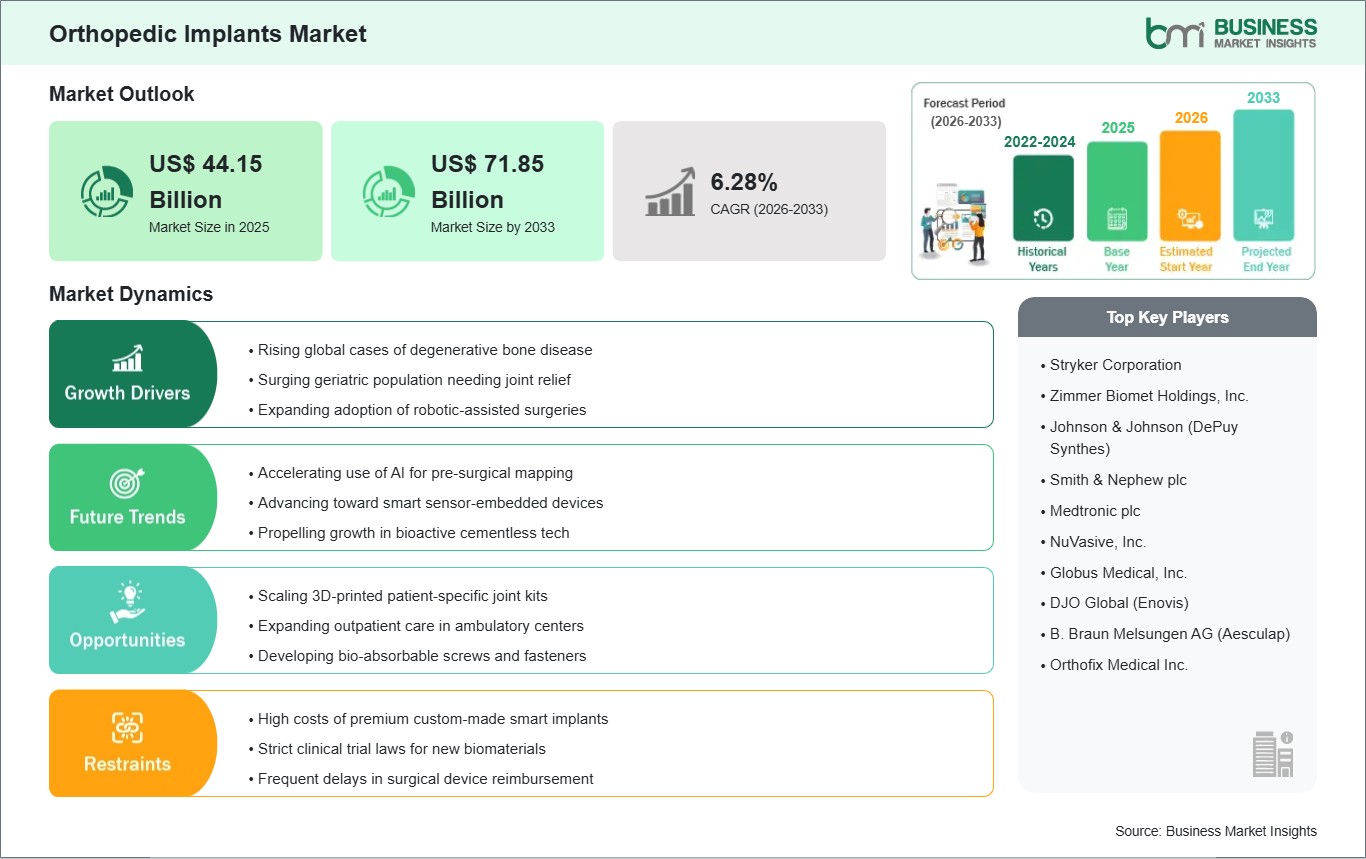
Orthopedic implants are meticulously engineered medical devices used to replace or support damaged bones and joints, restore mobility, and improve functionality. These implants are essential for treating various musculoskeletal conditions, including trauma, degenerative joint diseases like osteoarthritis and osteoporosis, and spinal deformities.
The Orthopedic Implants Market is experiencing steady growth, driven primarily by the rapidly increasing global geriatric population, as this demographic is highly susceptible to age-related joint and bone disorders. Furthermore, the market is continually boosted by technological advancements in implant materials, surgical techniques, and the growing adoption of minimally invasive procedures, all of which contribute to better patient outcomes and faster recovery times.
Segment Analysis
Orthopedic Implants Market Segmentation
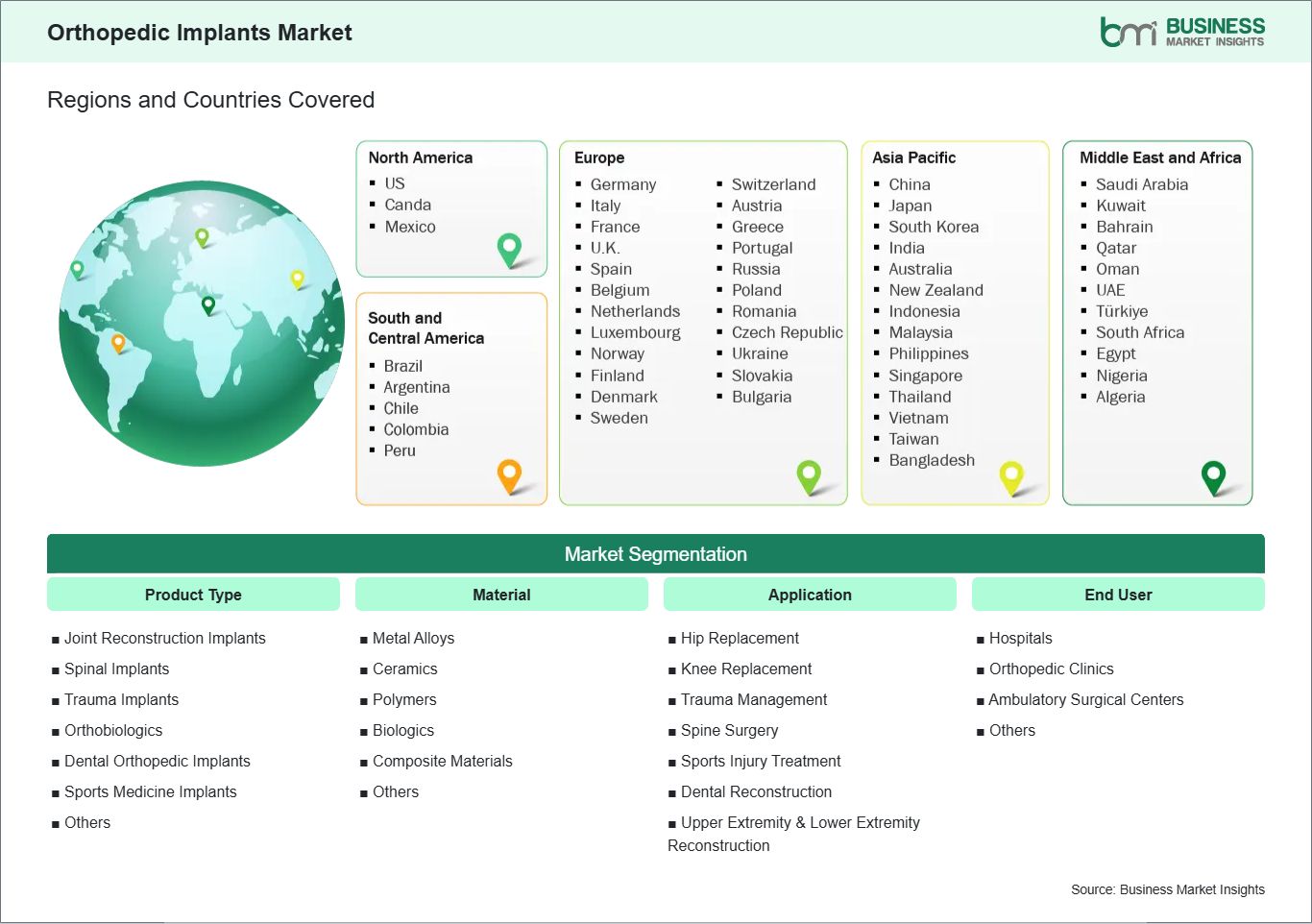
Key segments that contributed to the derivation of the Orthopedic Implants Market analysis are product type, material, application, and end user.
- By Product Type, the market is segmented into Joint Reconstruction Implants, Spinal Implants, Trauma Implants, Orthobiologics, Dental Orthopedic Implants, Sports Medicine Implants, and Others.
- By Material, the market is segmented into Metal Alloys, Ceramics, Polymers, Biologics, Composite Materials, and Others.
- By Application, the market is segmented into Hip Replacement, Knee Replacement, Trauma Management, Spine Surgery, Sports Injury Treatment, Dental Reconstruction, and Upper Extremity & Lower Extremity Reconstruction.
- By End User, the market is segmented into Hospitals, Orthopedic Clinics, Ambulatory Surgical Centers, and Others.
Market Forces
Orthopedic Implants Market Drivers and Opportunities
Growing Geriatric Population and Rising Prevalence of Orthopedic Disorders
The most significant factor propelling the Orthopedic Implants Market is the continuous increase in the global geriatric population, coupled with a surge in the prevalence of associated musculoskeletal and degenerative joint disorders, particularly osteoarthritis and osteoporosis. As life expectancy improves worldwide, the number of individuals over 60 years old is rising sharply, and this demographic is far more prone to conditions that necessitate orthopedic interventions like hip, knee, and spinal replacements. For instance, degenerative conditions lead to joint deterioration, requiring surgical reconstruction to restore mobility and quality of life. This demographic shift provides a sustained, long-term patient base, ensuring consistent demand for various orthopedic implants.
Integration of Smart Implants and Advanced Technologies
A significant opportunity for market growth lies in the advancements and commercialization of Smart Implants, 3D Printing, and Robotic-Assisted Surgery. Smart implants, embedded with micro-sensors, allow for real-time post-operative monitoring of critical parameters such as load distribution, mobility, and temperature. This data enables surgeons to closely track patient recovery, detect potential complications early (like infection or loosening), and personalize rehabilitation protocols, leading to superior patient outcomes. Concurrently, 3D printing technology allows for the creation of patient-specific, customized implants with complex porous structures that enhance osseointegration (bone growth into the implant), offering a better fit and potentially reducing revision rates. The increasing adoption of robotic-assisted surgical systems also contributes by offering greater precision, smaller incisions, and less intraoperative error, further accelerating the demand for the implants used in these advanced procedures.
Size and Share Analysis
Orthopedic Implants Market Size and Share Analysis
The orthopedic implants market demonstrates steady growth, with size and share analysis revealing evolving trends and competitive positioning among key players. The report further examines subsegments categorized within product type, material, application, and end user, offering insights into their contribution to overall market performance.
The orthopedic implants market exhibits steady growth, with reconstructive joint replacements, particularly Knee Implants, accounting for a significant share due to the high incidence of osteoarthritis. Hospitals remain the dominant end-user segment, as complex joint and spinal reconstruction procedures require extensive infrastructure, highly skilled surgical teams, and comprehensive post-operative care, which hospitals are best equipped to provide.
Report Coverage
Orthopedic Implants Market Report Coverage and Deliverables
The "Orthopedic Implants Market Size and Forecast (2022 - 2033)" report provides a detailed analysis of the market covering below areas:
- Orthopedic Implants Market size and forecast at global, regional, and country levels for all the key market segments covered under the scope
- Orthopedic Implants Market trends, as well as market dynamics such as drivers, restraints, and key opportunities
- Orthopedic Implants Market analysis covering key market trends, global and regional framework, major players, regulations, and recent market developments
- Industry landscape and competition analysis covering market concentration, heat map analysis, prominent players, and recent developments for the Orthopedic Implants Market
- Detailed company profiles, including SWOT analysis
Geographic Insights
Orthopedic Implants Market Geographic Insights
The geographical scope of the Orthopedic Implants Market report is divided into five regions: North America, Asia Pacific, Europe, Middle East & Africa, and South & Central America.
North America is the dominant region in the Orthopedic Implants Market, holding the largest revenue share, driven by a highly developed healthcare infrastructure, high healthcare expenditure, the presence of major market players, and a high volume of advanced surgical procedures.
Asia Pacific is projected to be the fastest-growing region, owing to rapid growth in the elderly population, increasing disposable incomes, improving access to advanced healthcare, and rising awareness about joint replacement procedures.
Industry Activity
Recent Developments
The Orthopedic Implants Market is evaluated by gathering qualitative and quantitative data post-primary and secondary research, which includes important corporate publications, association data, and databases. A few of the key developments in the Orthopedic Implants Market are:
- In November 2025, Zimmer Biomet Holdings, Inc., a global medical technology leader, announced U.S. Food and Drug Administration (FDA) 510(k) clearance of ROSA® Knee with OptimiZe™, an enhanced version of its ROSA® Knee System that offers a more customized experience for surgeons to help deliver accurate and reproducible outcomes in robotic-assisted total knee replacement surgery.
- In April 2025, Stryker, a global leader in medical technologies, announced that it had completed the sale of its U.S. spinal implants business to Viscogliosi Brothers, LLC, as part of the newly formed company VB Spine, LLC.
Trust & Transparency
Research Methodology
The market analysis combines proprietary research with secondary data from government agencies, company disclosures, regulatory filings, industry databases and expert interviews. Market estimates are validated through data triangulation, cross-market benchmarking and analyst
review.
View Full Research Methodology
Key Sources Referred:
World Bank - Global Trade IndicatorsWorld Trade Organization (WTO)International Monetary Fund (IMF)International Trade Administration (ITA)Company WebsitesCompany Annual ReportsCompany Investor Presentations