
Delayed Coker Unit Process Technology Market Outlook: Size, Share, Trends, Growth Analysis, Competitive Landscape & Forecast, 2026-2033

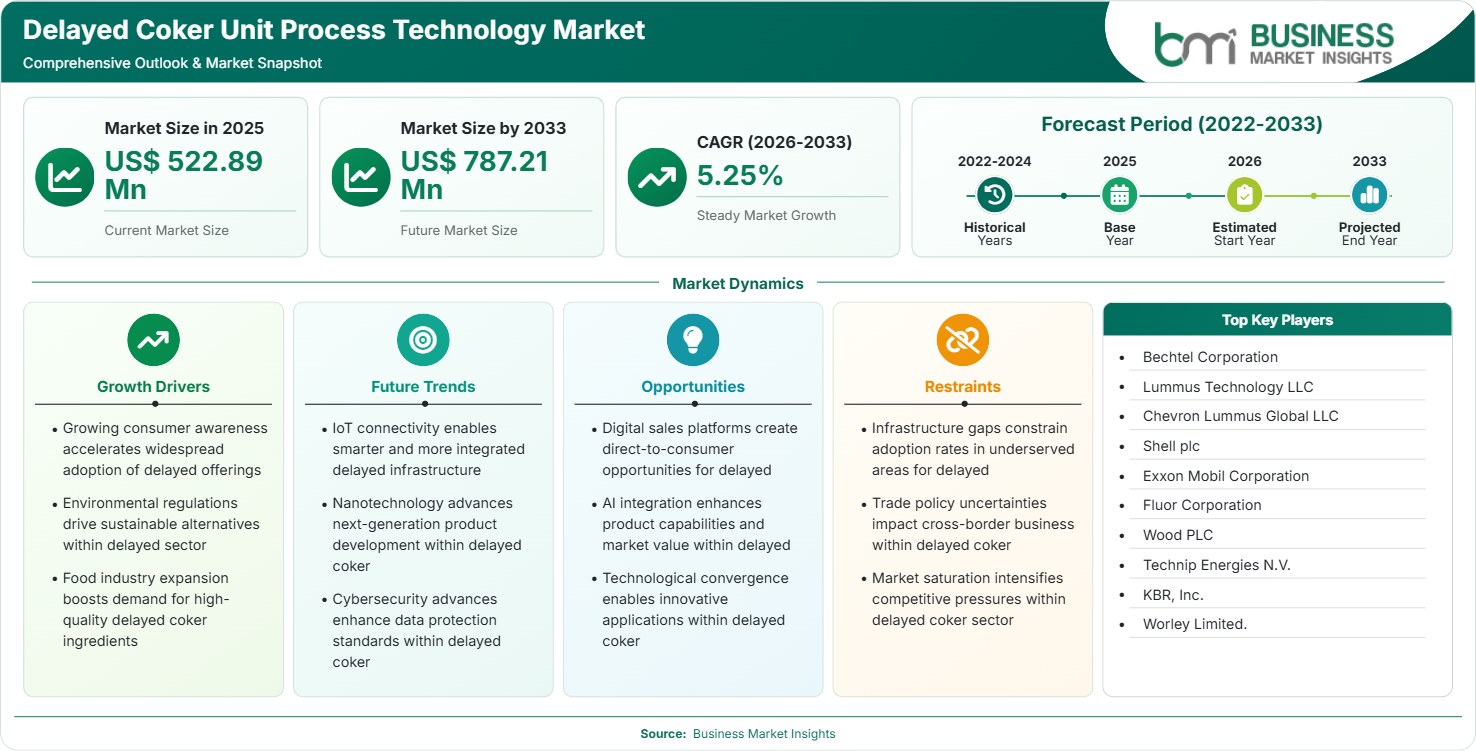
The Delayed Coker Unit Process Technology Market size was valued at US$ 522.89 Million in 2025 and is projected to reach US$ 787.21 Million by 2033, growing at a CAGR of 5.25% during 2026–2033, supported by refinery residue upgrading, rising heavy crude processing, refinery modernization, cleaner fuel requirements, and investments in high-conversion downstream infrastructure.

Report Coverage
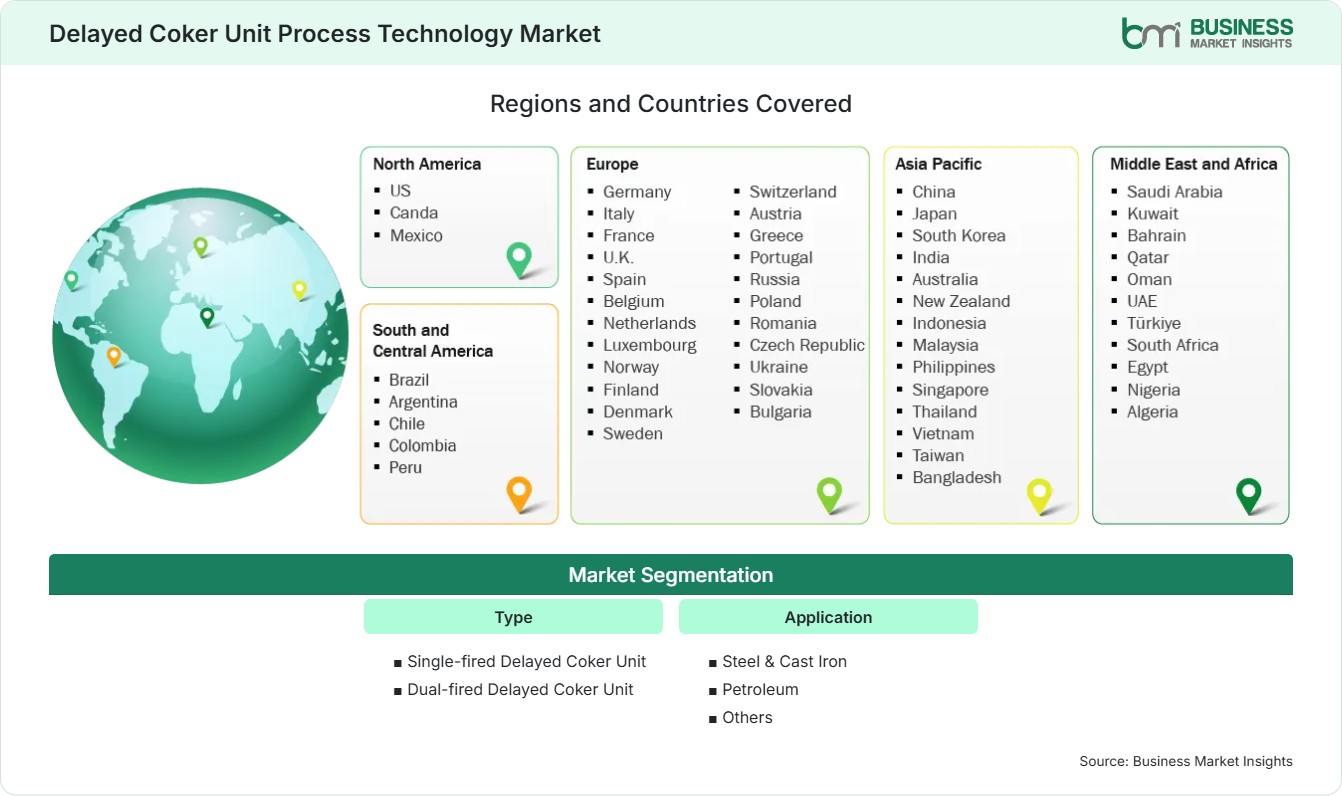
  • Type: Single-fired Delayed Coker Unit, Dual-fired Delayed Coker Unit
  • Application: Steel & Cast Iron, Petroleum, Others
US$ 522.89 Mn Market size in 2025
US$ 787.21 Mn Market Size by 2033
5.25% CAGR, 2026 - 2033
2026-2033 Forecast Period

AI Overview

Delayed Coker Unit Process Technology Market Summary

  • North America Region: Holds a market share of 34%–37% in 2025, growing with a CAGR of 4.6%–5.0% through 2033. Growth is supported by refinery complexity upgrades, residue conversion optimization, petroleum coke exports, advanced automation adoption, improved asset reliability, modernization projects, high heavy-crude processing requirements, cleaner-fuel compliance, integrated refining economics, and operational efficiency investments. The U.S. remains the dominant regional market, supported by Gulf Coast refining capacity and residue-conversion investments, with a CAGR of 4.7%–5.1%.
  • Fastest Growing Region: Asia Pacific holds 29%–32% share in 2025 and expands at 6.3%–6.8% CAGR. Expansion is driven by refinery additions, rising transportation fuel demand, heavier crude utilization, advanced conversion technologies, petrochemical integration, strategic energy security initiatives, industrialization, export refining, infrastructure spending, and technology licensing activity.
  • Leading Segment: Dual-fired Delayed Coker Unit accounts for 56%–60% share in 2025, advancing at 5.4%–5.8% CAGR. Adoption benefits from higher throughput capability, improved furnace efficiency, reduced downtime, longer operating cycles, enhanced flexibility, better residue conversion, stronger economics, operational reliability, emission optimization, and large-refinery deployment.
  • High Growth Segment: Petroleum holds 50%–54% share in 2025 and records 5.8%–6.3% CAGR. Demand is supported by upgrading heavy residues, maximizing distillate production, increasing refinery margins, rising transportation fuel requirements, coking integration strategies, feedstock flexibility, export opportunities, and refining modernization programs.
  • Key Market Opportunity: Growing investments in residue-upgrading complexes across Asia, the Middle East, and Latin America create opportunities for licensors, equipment suppliers, automation providers, and engineering firms delivering efficient coking technologies.
  • Major Market Players: Bechtel Corporation, Lummus Technology LLC, Chevron Lummus Global LLC, Shell plc, Exxon Mobil Corporation, Fluor Corporation, Wood PLC, Technip Energies N.V., KBR, Inc., and Worley Limited.
Strategic Insights

Delayed Coker Unit Process Technology Market: Strategic Insights

Delayed Coker Unit Process Technology Market Strategic Framework
FREE PDF
Request your free sample
Request free sample
Stakeholder View

Key Takeaways

  • Global value creation increasingly depends on technologies that convert vacuum residue into higher-value transportation fuels and petroleum coke, improving refinery margins across complex refining configurations.
  • Petroleum applications offer the strongest commercial upside as operators seek greater distillate yield, enhanced feedstock flexibility, and reduced dependence on low-value residual fuel streams.
  • Automation of coke drum switching, intelligent furnace monitoring, and predictive maintenance platforms are accelerating technology differentiation among licensors and engineering firms.
  • Asia Pacific presents the most compelling capacity expansion opportunity due to refinery additions, rising fuel demand, and investment in integrated refining-petrochemical complexes.
  • Strategic partnerships between technology licensors, EPC contractors, and refinery developers are increasing, reflecting growing emphasis on project execution efficiency and lifecycle performance support.
  • Sustainability-focused investments aimed at energy efficiency, emissions control, and water-management improvements are becoming important differentiators for technology suppliers.
Geographic Outlook

Delayed Coker Unit Process Technology Market Regional Highlights

North America Delayed Coker Unit Process Technology Market

North America represents the largest regional market with a Delayed Coker Unit Process Technology Market share of 34%–37% in 2025 and a CAGR of 4.6%–5.0% through 2033. The region benefits from a high concentration of complex refineries capable of processing heavy crude and residual feedstocks. Refiners continue investing in operational reliability, automation systems, and residue-conversion assets to improve profitability. Strong petroleum coke export infrastructure and ongoing refinery modernization support demand for technology upgrades and replacement projects.

  • Gulf Coast refineries continue adopting advanced residue-conversion technologies to improve distillate yields while processing heavier crude blends economically.
  • Automation upgrades reduce cycle times, improve worker safety, and enhance operational efficiency across mature coking infrastructure.
  • Strong petroleum coke export networks support continued utilization of large-capacity coking operations.
  • Energy-security priorities encourage maintenance, expansion, and performance optimization of existing refining assets.
  • EPC and technology licensing partnerships remain active across refinery modernization programs.

US Delayed Coker Unit Process Technology Market

The United States accounts for 72%–76% of North American demand and records a CAGR of 4.7%–5.1%. Major refining hubs along the Gulf Coast and Midwest continue investing in residue upgrading and advanced process control systems. Capacity utilization remains strongly linked to transportation fuel demand and export opportunities. Technology providers benefit from retrofit projects designed to extend equipment lifecycles, enhance safety performance, and improve furnace efficiency while supporting long-term residue conversion strategies.

  • Gulf Coast investments continue prioritizing throughput optimization and reliability enhancement in large delayed coking facilities.
  • Digital monitoring technologies improve maintenance planning and reduce unplanned shutdowns.
  • Refiners increasingly target improved distillate recovery through process optimization programs.
  • Operational efficiency initiatives support continued technology upgrades across aging assets.

Europe Delayed Coker Unit Process Technology Market

Europe accounts for 21%–24% market share in 2025 and expands at 4.1%–4.6% CAGR. Regional demand focuses on refinery competitiveness, residue minimization, and production efficiency. Mature refining systems encourage modernization projects rather than greenfield installations. Italy and Spain remain leading markets, while Eastern European countries exhibit comparatively stronger growth rates near the upper end of the regional range. Decarbonization targets also encourage energy-efficient technology upgrades within coking operations.

  • Refiners focus on maximizing conversion efficiency to remain competitive against imported refined products.
  • Advanced process controls and emissions-management solutions gain traction across modernization initiatives.
  • Italy leads regional deployment through established refining infrastructure and residue-conversion capacity.
  • Eastern European operators increasingly evaluate upgrading projects to improve product value recovery.
  • Integrated refinery-petrochemical strategies support selective investment activity.

Asia Pacific Delayed Coker Unit Process Technology Market

Asia Pacific holds 29%–32% share in 2025 and is the fastest-growing region with a CAGR of 6.3%–6.8%. China and India dominate installations due to refinery expansions and heavy crude processing requirements. Growth is supported by rising transportation fuel consumption, refining self-sufficiency initiatives, and large-scale downstream investments. New integrated refining complexes increasingly incorporate advanced delayed coking technologies to maximize distillate production, improve feedstock flexibility, and strengthen export competitiveness.

  • China maintains regional leadership through continued downstream investment and upgrading projects.
  • India exhibits the strongest expansion momentum supported by refinery modernization and capacity additions.
  • Integrated refining and petrochemical projects create significant licensing opportunities.
  • Operators prioritize technologies delivering higher throughput and lower operating costs.
  • Export-oriented refining strategies enhance long-term technology demand.

Rest of World Delayed Coker Unit Process Technology Market

The Rest of World region accounts for 12%–15% share and advances at 5.4%–5.9% CAGR. South and Central America benefit from heavy crude resources and refinery upgrading requirements, particularly in Brazil. In the Middle East and Africa, investments in downstream diversification support adoption of advanced residue-conversion technologies. Regional growth is increasingly linked to export-focused refining, value-added fuel production, and efforts to maximize hydrocarbon resource utilization through modern conversion infrastructure.

  • Brazil remains a leading Latin American market due to refinery upgrade investments and heavy feedstock processing needs.
  • Saudi Arabia and the UAE support growth through integrated refining and petrochemical developments.
  • Residue-conversion projects improve value extraction from heavy crude resources.
  • Export-oriented refining expansion increases demand for advanced process technologies.
  • Greater private-sector participation supports long-term project activity.
Global Market Geography
FREE PDF
Request your free sample
Request free sample
Segment Analysis

Delayed Coker Unit Process Technology Market Segmentation

Type

This segment accounts for the largest revenue contribution within the industry. The Delayed Coker Unit Process Technology Market scope continues expanding as refiners seek higher conversion rates and lower residual fuel output. Type-based solutions collectively represent 56%–60% share in 2025 and are projected to expand at 5.4%–5.8% CAGR due to modernization programs, throughput requirements, and efficiency-focused investments.

  • Single-fired Delayed Coker Unit: Preferred in selected medium-capacity applications where capital efficiency and operating simplicity remain priorities. Adoption continues across existing facilities pursuing targeted residue conversion improvements and controlled expansion strategies.
  • Dual-fired Delayed Coker Unit: Increasingly deployed in large-scale refineries requiring enhanced throughput, improved thermal performance, longer operating cycles, and stronger economics associated with complex heavy-feedstock processing operations.

Application

Application demand is shaped by refinery residue upgrading priorities and industrial consumption patterns. The petroleum segment remains dominant with 50%–54% share and a CAGR of 5.8%–6.3%. Current Delayed Coker Unit Process Technology Market trends indicate stronger deployment in facilities focused on maximizing distillate production and processing challenging feedstock streams.

  • Steel & Cast Iron: Petroleum coke generated through delayed coking remains an important carbon source for selected metallurgical processes. Demand is supported by industrial production, infrastructure spending, and manufacturing activity.
  • Petroleum: Represents the largest application category due to direct integration with refinery operations. Growth stems from increasing residue conversion requirements, fuel-production optimization, and investments in advanced refining configurations.
Market Forces

Delayed Coker Unit Process Technology Market Dynamics

Key Market Drivers

Rising Heavy Crude Processing and Residue Upgrading Needs

Global refiners are moving towards the use of heavier and high-sulfur content crudes to optimize feedstocks cost-wise. This trend increases the need for delayed cokers that can convert residues into lighter transportation fuel products and petroleum coke. Based on energy-sector analyses by the IEA, refineries remain focused on improving their conversion capabilities as needs change. The Delayed Coker Unit Process Technology Market benefits from operators seeking stronger yield performance, improved profitability, and greater flexibility. As heavier feedstock utilization expands in Asia, the Middle East, and the Americas, investment in advanced residue-conversion infrastructure remains a strategic priority for both national and private refining companies.

Expansion of Complex Refinery Infrastructure

New refining investments increasingly incorporate high-complexity configurations that maximize value recovery from every barrel processed. Delayed coking units are central to these configurations because they transform residual streams into marketable products. Large-scale integrated refining developments across Asia and the Middle East are supporting long-term technology demand. The Delayed Coker Unit Process Technology Market growth is reinforced by capacity additions, modernization projects, and operational productivity programs. Technology licensors that offer advanced furnace designs, automated drum systems, and digital monitoring capabilities are particularly well positioned as operators prioritize reliability, throughput, and lifecycle optimization.

Advancements in Automation and Operational Reliability

Refinery operators continue adopting digital technologies to improve safety, reduce downtime, and enhance asset performance. The introduction of unheating automation systems, predictive maintenance packages, and process control packages has greatly enhanced the process of delayed coking. The above-mentioned changes have facilitated the reduction of maintenance costs and the increase in availability. Equipment design improvements are increasing the lifetime of the coke drums and minimizing process risks. The investments made in technology platforms that can deliver productivity gains are thus becoming more common.

Key Market Opportunities

Integrated Refinery-Petrochemical Expansion Projects

Large integrated facilities are opening up many opportunities for technology suppliers and engineering firms. Such facilities require highly converting refining facilities to facilitate effective feedstock management and maximize liquid outputs. Delayed coking technologies can be well-suited to such an integrated approach since they help in better utilization of residues. Future Delayed Coker Unit Process Technology Market Forecasts indicate stronger demand from Asia and Middle Eastern projects emphasizing export competitiveness. Suppliers that provide turnkey solutions, long-term technical support, and operational optimization services are expected to secure a larger share of upcoming project awards and modernization contracts.

Retrofit Opportunities Across Mature Refineries

Many established refineries are pursuing targeted upgrades rather than entirely new construction. The retrofitting process creates opportunities to implement advanced furnace technology, automation, environmental control technology, and reliability enhancements. Technology suppliers can earn a steady income from programs aimed at upgrading their technologies in order to increase throughput and extend useful lives. Countries having high installation bases, such as North America and Europe, have promising chances for implementing performance-based upgrades. Investments in projects that promise to provide noticeable gains without interfering with operations become more appealing.

Growth in Emerging Refining Economies

Countries seeking greater fuel self-sufficiency continue investing in downstream infrastructure. Developing countries in South Asia, Southeast Asia, the Middle East, and Latin America are considering high-conversion technologies to optimize their refinery economics and minimize import dependence. Delayed Cokers are critical components in optimizing the yield from residual streams. There is great potential for technology licensors, EPC Contractors, and equipment suppliers. High population growth, increased transport requirements, and industrialization, among other factors, combine to favor investment programs aimed at increasing conversion and refining capabilities.

Market Restraints and Challenges

High Capital Intensity of Delayed Coking Projects

Factor: Delayed coking installations require substantial investment in furnaces, drums, automation systems, emissions controls, and supporting infrastructure. Impact: The high initial costs could result in project delays, especially when there is refining margin volatility in the market. The small refineries may prefer incremental projects instead of installing new projects. Lack of financing may be another hindrance to project implementation, especially in emerging countries. The economics of the project would still be affected by factors such as crude quality, product differentials and utilization rates.

Environmental Compliance and Operational Complexity

Factor: Delayed coking operations involve energy-intensive processes and must meet increasingly stringent environmental and safety regulations. Impact: Compliance can be costly, leading to higher operational costs and greater project execution complexity. Refineries will have added costs concerning their emissions control, water treatment, and monitoring systems. Operational costs can also be affected by workforce needs and maintenance costs. Technology providers should continue innovating in order to improve energy efficiency and environmental impact. This could be a problem because operators may think that the cost of compliance outweighs the economic benefit.

Company Analysis

Competitive Landscape

The competitive environment is shaped by technology licensing, engineering expertise, refinery integration capabilities, and proprietary equipment designs. Current Delayed Coker Unit Process Technology Market analysis highlights the importance of automation, yield optimization, drum reliability, and furnace efficiency.

Company Name

Overview

Products and Services relevant to this market

Bechtel Corporation

Global engineering and project management company with strong delayed coking technology licensing capabilities.

ThruPlus delayed coking technology, refinery engineering, modernization support, project execution services.

Lummus Technology LLC

Process technology provider serving refining and petrochemical sectors worldwide.

Delayed coking heaters, process licensing, furnace solutions, operational support services.

Chevron Lummus Global LLC

Joint technology venture focused on advanced refining technologies and conversion processes.

Delayed coking technology licensing, process optimization, engineering support, advanced refining solutions.

Shell plc

Integrated energy company with refining and process technology expertise.

Refining technologies, heavy-oil processing solutions, operational optimization programs.

Exxon Mobil Corporation

Major refining operator with experience in conversion technologies and complex refinery systems.

Refinery technologies, residue upgrading expertise, process integration services.

Fluor Corporation

Engineering and construction company supporting large downstream energy projects.

EPC services, refinery infrastructure development, technology implementation support.

Wood PLC

Global consulting and engineering specialist serving energy and process industries.

Refinery engineering, operational improvement, project management solutions.

Technip Energies N.V.

Technology and engineering provider supporting refinery modernization and expansion projects.

Process design, technology integration, EPC execution, digital optimization solutions.

KBR, Inc.

Industrial technology and engineering company active in refining projects.

Process consulting, engineering design, project delivery and optimization services.

Worley Limited

Energy infrastructure and project execution specialist with global refinery experience.

Refinery project development, engineering services, operational improvement programs.

Trust & Transparency

Research Methodology

The market analysis combines proprietary research with secondary data from government agencies, company disclosures, regulatory filings, industry databases and expert interviews. Market estimates are validated through data triangulation, cross-market benchmarking and analyst review.

View Full Research Methodology

Questions Answered

Frequently Asked Questions

What does a Delayed Coker Unit Process Technology Market Report typically evaluate?

It commonly assesses technology adoption, regional demand patterns, competition, refinery investment activity, capacity trends, growth drivers, challenges, and long-term commercial opportunities.

What regions are expected to generate the strongest new project activity?

Asia Pacific, the Middle East, and selected Latin American countries are expected to lead project activity due to refining expansion, energy-security priorities, and industrial growth.

How does petroleum coke creation benefit refiners?

Petroleum coke provides an additional revenue stream while enabling conversion of low-value residue into commercially useful products, improving overall refinery economics.

What distinguishes single-fired and dual-fired configurations?

Dual-fired units generally offer higher throughput potential, improved thermal efficiency, and greater suitability for large-scale complex refining operations compared with single-fired designs.

What factors are increasing adoption of delayed coking technologies?

Growing use of heavy crude feedstocks, refinery complexity upgrades, residue conversion requirements, and demand for higher-value transportation fuels are encouraging broader technology deployment.

Access the Full Delayed Coker Unit Process Technology Market Report

Get segment-level forecasts, regional estimates, competitive benchmarking, company profiles and downloadable Excel datasets.

Access the full Delayed Coker Unit Process Technology Market Report
350 pages PDF & Excel | 2026-08-31