Contraceptive Pills Market Regional Highlights
North America Contraceptive Pills Market
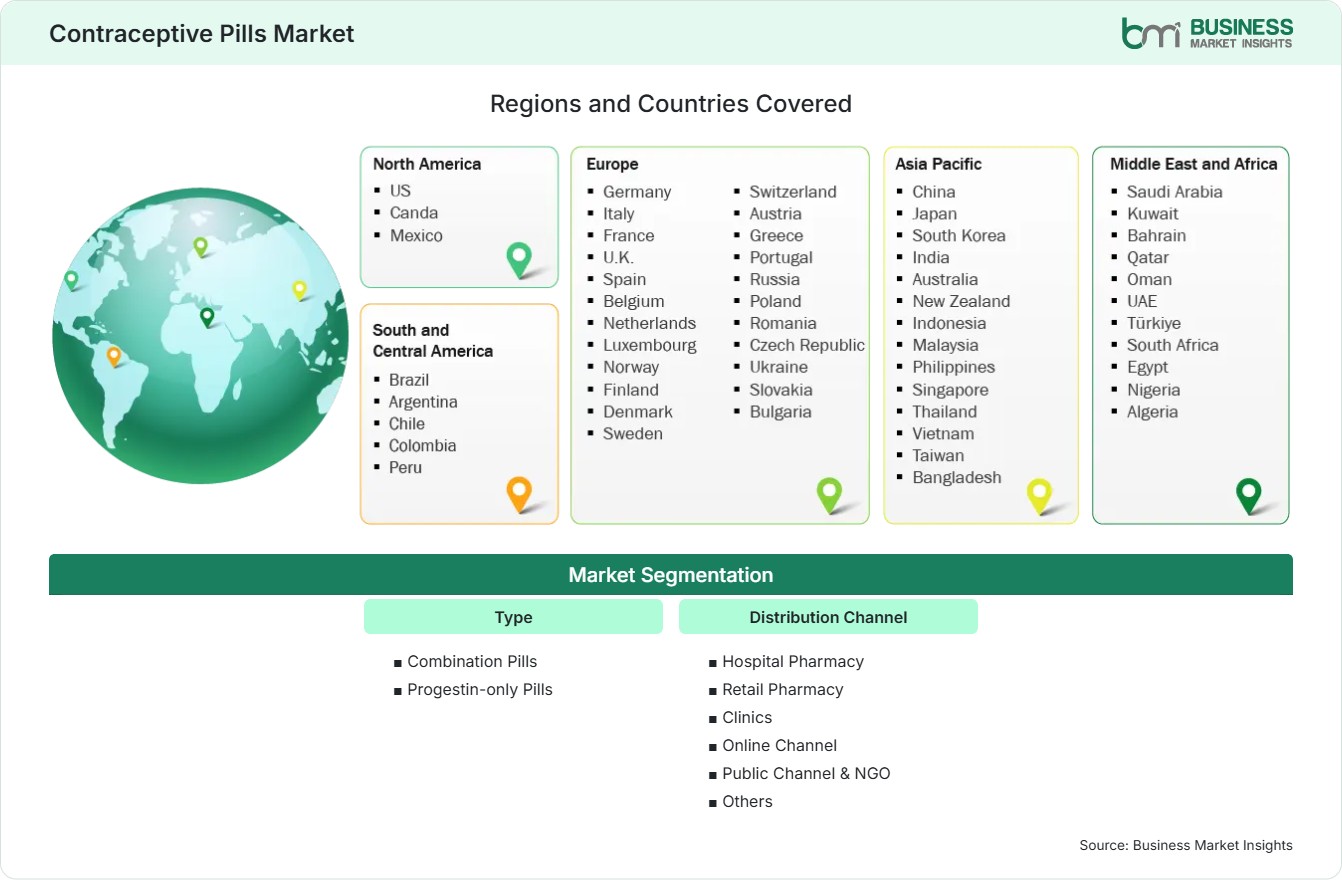
North America represents 27%–31% of contraceptive pills market share in 2025 and records a 3.80%–4.40% CAGR through 2033. The region benefits from mature pharmaceutical distribution, high awareness, strong healthcare infrastructure, and expanding consumer healthcare channels. The US dominates regional demand, while Canada contributes through established public and private healthcare systems.
- Pharmacy access is becoming strategically important as consumers seek convenient reproductive healthcare services without relying exclusively on traditional clinic appointments, supporting retail pharmacy and digitally connected fulfillment models.
- Nonprescription access creates a new commercial pathway for eligible oral contraceptives. Opill's US availability demonstrates how regulatory decisions can broaden access beyond conventional prescription channels.
- Canada and the US maintain strong manufacturer and distributor ecosystems, although reimbursement policies, state-level regulations, and differences in healthcare coverage continue influencing purchasing behavior.
US Contraceptive Pills Market
The US represents 21%–25% of global demand in 2025 and US contraceptive pills market forecast to grow at a 3.70%–4.30% CAGR through 2033. Demand is supported by broad awareness, extensive pharmacy infrastructure, established prescription channels, and growing digital healthcare adoption.
- Nonprescription oral contraception creates additional retail and online distribution opportunities, potentially expanding access for consumers who face appointment, transportation, or provider availability barriers.
- Telehealth is strengthening online channel growth by connecting consumers with licensed providers and enabling digital prescriptions, discreet delivery, and automated refill services.
- Retail pharmacies remain critical because they provide geographically accessible dispensing infrastructure and can support counseling, medication guidance, and recurring prescription fulfillment.
Europe Contraceptive Pills Market
Europe contraceptive pills market accounts for 25%–29% of global demand in 2025 and expands at a 3.50%–4.20% CAGR through 2033. The UK, Germany, France, Italy, and Spain represent leading markets because of established reproductive healthcare systems and broad contraceptive awareness. The UK and France offer attractive growth opportunities through pharmacy-based services and expanded access models. Germany and Italy remain significant because of established pharmaceutical distribution and physician-led care.
- The UK provides a strong opportunity for pharmacy-led contraceptive services, supporting broader access and reducing dependence on conventional primary-care appointments.
- France and Germany benefit from established healthcare infrastructure and high pharmacy density, creating strong channels for prescription and repeat contraceptive dispensing.
- Southern European markets, including Italy and Spain, offer opportunities through improved reproductive health education, digital healthcare, and broader consumer access to modern contraception.
Asia Pacific Contraceptive Pills Market
Asia Pacific Contraceptive Pills Market holds 24%–28% of global demand in 2025 and records the fastest regional growth at 6.20%–7.00% through 2033. China, India, Japan, and Australia are leading markets, while India, Indonesia, Vietnam, and the Philippines provide higher-growth opportunities. Large reproductive-age populations, expanding healthcare infrastructure, improving awareness, and government family planning initiatives support demand.
- India offers substantial potential because of its large population and continuing need to address reproductive health inequalities. Rural access, affordability, and awareness remain central commercial considerations.
- China remains a major opportunity because of its healthcare scale and expanding digital health ecosystem, although demographic changes and evolving reproductive health preferences influence long-term demand.
- Indonesia, Vietnam, and the Philippines provide high-growth opportunities as family planning services expand and private healthcare distribution improves across urban and semi-urban areas.
- Japan and Australia offer mature markets where product differentiation increasingly depends on convenience, adherence support, pharmacy access, and digital healthcare integration.
Rest of World Contraceptive Pills Market
Latin America and the Middle East and Africa represent a combined 19%–23% share in 2025 and grow at a 5.30%–6.20% CAGR through 2033. Brazil, Mexico, Argentina, Colombia, South Africa, Saudi Arabia, and the UAE are leading markets, while selected African economies provide higher-growth opportunities. In Africa, access barriers remain more pronounced, particularly in rural areas, where stockouts, affordability constraints, transportation challenges, and limited healthcare capacity restrict consistent contraceptive availability. Community health programs and NGO partnerships can therefore become important routes for manufacturers seeking sustainable expansion.
- Brazil and Mexico remain major commercial markets, supported by large populations, established private healthcare networks, and increasing consumer awareness of reproductive health choices.
- Colombia and Argentina provide additional opportunities through urban healthcare expansion, pharmacy networks, and digital services supporting reproductive health access.
- South Africa offers a strategic gateway for regional expansion, while Kenya, Nigeria, and Ethiopia present longer-term opportunities through public programs and NGO-supported distribution.
- Middle Eastern markets offer opportunities where healthcare modernization, private hospital investment, and expanding pharmacy networks improve access to reproductive health products.