
Concrete Reinforcing Fiber Market Outlook: Size, Share, Trends, Growth Analysis, Competitive Landscape & Forecast, 2026-2033

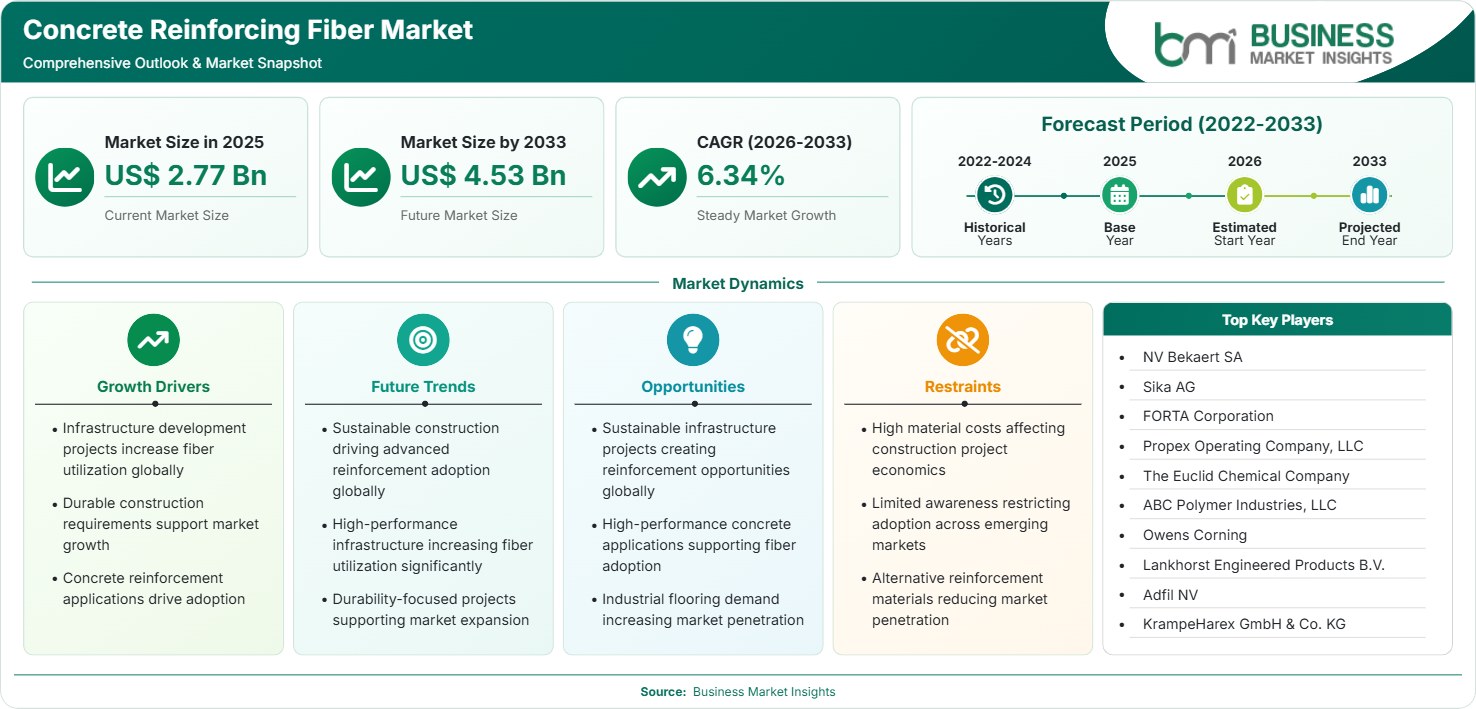
The Concrete Reinforcing Fiber Market size was valued at US$ 2.77 Billion in 2025 and is projected to reach US$ 4.53 Billion by 2033, growing at a CAGR of 6.34% during 2026–2033, driven by infrastructure renewal, lightweight reinforcement, construction productivity, durability requirements, and lower-carbon structural design.

Report Coverage
  • Fiber Type: Polymers, Steel, Glass, Others
  • End-use Industry: Building & Construction, Transportation Infrastructure, Mining & Tunnel, Industrial Flooring, Others
US$ 2.77 Bn Market size in 2025
US$ 4.53 Bn Market Size by 2033
6.34% CAGR, 2026 - 2033
2026-2033 Forecast Period

AI Overview

Concrete Reinforcing Fiber Market Summary

  • North America Region: North America holds a market share of 30%–32% in 2025, growing with a CAGR of 6.2%–6.8%, influenced by infrastructure rehabilitation, industrial flooring, construction productivity, replacement of reinforcement mesh, and durable pavement requirements. The US market benefits from infrastructure renewal, warehouse construction, precast adoption, and labor-saving reinforcement systems.
  • Fastest Growing Region: Asia Pacific holds a market share of 36%–38% in 2025, growing with a CAGR of 6.7%–7.3%, supported by urban infrastructure, transport corridors, industrial construction, tunnel development, precast manufacturing, and rising demand for efficient structural reinforcement.
  • Leading Segment: Building & Construction holds a Concrete Reinforcing Fiber Market share of 40%–44% in 2025, growing with a CAGR of 6.1%–6.5%, supported by residential construction, commercial buildings, warehouses, slabs, precast elements, construction speed, crack control, and reduced reinforcement handling requirements.
  • High Growth Segment: Mining & Tunnel holds a market share of 11%–14% in 2025, growing with a CAGR of 7.0%–7.6%, supported by underground infrastructure, shotcrete applications, tunnel lining, faster installation, ground support requirements, reduced reinforcement congestion, and enhanced post-cracking performance.
  • Key Market Opportunity: Adoption is expanding where fiber reinforcement reduces reinforcement handling, construction time, congestion, cracking, and maintenance requirements, creating opportunities for engineered dosages, digital design tools, sustainable fibers, and application-specific solutions.
  • Major Market Players: NV Bekaert SA, Sika AG, FORTA Corporation, Propex Operating Company, LLC, The Euclid Chemical Company, ABC Polymer Industries, LLC, Owens Corning, Lankhorst Engineered Products B.V., Adfil NV, and KrampeHarex GmbH & Co. KG.
Strategic Insights

Concrete Reinforcing Fiber Market: Strategic Insights

Concrete Reinforcing Fiber Market Strategic Framework
FREE PDF
Request your free sample
Request free sample
Stakeholder View

Key Takeaways

  • The distinction in the supply chain is now extending from the availability of fiber to include formulation consistency, dispersion performance, testing capability, support for technical specifications, and reliable delivery to customers who deal with ready-mix, precast, shotcrete, and flooring products.
  • The most significant potential benefit is to be found in the areas of industrial flooring, transportation infrastructure, mining, tunnels, precast construction, and in those projects where reinforcement congestion or the labor required for installation has a material impact on the project's economics.
  • Advancement is taking place in the area of high-performance macro synthetic fibers, recycled-content polymers, low-carbon steel fibers, bio-based fibers, hybrid reinforcement systems, and software-assisted dosage optimization for specific structural applications.
  • The Asia Pacific region presents a great opportunity for expansion since it has large infrastructure projects alongside manufacturing scale, urbanization, industrial facilities, transport investment, and a growing use of high-performance construction materials.
  • Investment activity is becoming more associated with testing laboratories, sustainable product development, technical centers, and strategic ownership. The latest developments show that companies are now competing on the basis of application engineering and sustainability as well as product capacity.
  • Sustainable reinforcement is now becoming an important commercial specification because more customers are taking into account, when making their evaluations, the embodied carbon, material efficiency, durability, construction productivity, and end-of-life considerations, as well as the initial cost of the material.
Geographic Outlook

Concrete Reinforcing Fiber Market Regional Highlights

North America Concrete Reinforcing Fiber Market

North America represents 30%–32% Concrete Reinforcing Fiber Market share in 2025, with a 6.2%–6.8% CAGR through 2033. Demand is supported by infrastructure rehabilitation, warehouse construction, industrial flooring, pavement renewal, and labor-saving reinforcement.

  • The need to repair infrastructure is leading to continued demand for reinforcement systems, which enhance durability, crack control, impact resistance, and construction productivity on roads, bridges, pavements, and public facilities.
  • Industrial warehouses and logistics facilities are increasingly making use of macrofibres in slabs to improve the economics of construction through faster installation, joint optimization, resistance to abrasion, and less handling of the reinforcement.
  • It is still important to have a technical qualification since engineers need the residual strength, dispersion, dosage, fire behavior, and compatibility with concrete mix designs to be documented before they specify fiber reinforcement.
  • As project owners assess the lifecycle performance, the amount of recycled material used, the reduction in materials, and lower-carbon alternatives, together with traditional structural reinforcement, sustainable reinforcement is becoming more noteworthy.

US Concrete Reinforcing Fiber Market

The US represents 76%–79% of the North American Concrete Reinforcing Fiber Market demand in 2025, with a 6.4%–7.0% CAGR through 2033. Infrastructure renewal, industrial construction, distribution facilities, pavement rehabilitation, and commercial development support adoption. Fiber systems are particularly relevant where contractors seek reduced reinforcement placement and faster slab installation.

  • Because construction schedules prefer reinforcement systems that reduce the need for manual placement and cause less congestion, there is a continuous demand for fiber-reinforced slabs in large warehouse and distribution projects.
  • Transportation projects carried out by the state provide opportunities for the use of fibers in pavements, overlays, precast components, and in repair work, since durability and lifecycle performance affect the choice of materials.
  • Instead of just competing on the price of the commodity, US suppliers are now becoming more distinct through offering laboratory testing, design assistance, project support, and specific recommendations regarding the use of fibers.

Europe Concrete Reinforcing Fiber Market

Europe represents 22%–24% Concrete Reinforcing Fiber Market share in 2025, with a 5.5%–6.1% CAGR through 2033. Germany, Italy, France, the United Kingdom, and Spain remain important markets, while Germany is positioned toward the upper end of regional growth at approximately 6.0%–6.5%.

  • Germany has a capability in the area of industrial flooring, in precast production, in tunneling, and in advanced engineering, and this leads to a demand for steel and polymer fiber systems, which have documented structural performance.
  • In France and the United Kingdom, there are opportunities in the field of infrastructure rehabilitation, in transport projects, in commercial construction, and in respect of sustainable building practices, provided that reinforcement efficiency supports the carbon objectives at the project level.
  • In the southern European markets, durability and the efficiency of labor are factors that affect the choice of reinforcement for flooring, for residential construction, for transport infrastructure, and for renovation projects.
  • European suppliers are enhancing their sustainability credentials by using lower-carbon production methods, incorporating recycled materials, carrying out lifecycle assessments, and applying engineering techniques that support the design of concrete, which is highly material efficient.

Asia Pacific Concrete Reinforcing Fiber Market

Asia Pacific represents 36%–38% Concrete Reinforcing Fiber Market share in 2025, with a 6.7%–7.3% CAGR through 2033. China, India, Japan, South Korea, and Southeast Asia provide the principal demand base. China remains the largest regional contributor, while India and Southeast Asia provide strong expansion opportunities through transport infrastructure, industrial facilities, urban development, and tunneling.

  • Even though property activity has been uneven, China is still of strategic importance since investment in infrastructure, manufacturing, transport, energy, and industry is still leading to demand for engineered concrete reinforcement.
  • India is consolidating its standing by means of local manufacturing and technical development, covering areas such as steel fiber reinforcement and the use of sprayed concrete.
  • There are opportunities in Southeast Asia for industrial parks, ports, airports, transport corridors, commercial buildings, and for mining infrastructure, which needs durable and rapidly installed concrete systems.
  • Both Japan and South Korea place great importance on high-performance construction, the maintenance of infrastructure, the use of precast components, and engineered material solutions, and they support premium fiber systems with their proven performance characteristics.

Rest of World Concrete Reinforcing Fiber Market

The rest of the world accounts for approximately 7%–11% Concrete Reinforcing Fiber Market in 2025, with a 5.2%–5.8% CAGR through 2033. South and Central America are supported by transportation, industrial, mining, energy, and commercial construction, while Brazil represents an important demand center. Middle Eastern markets benefit from major infrastructure, logistics, airports, tunnels, and industrial developments.

  • Brazil has a wide variety of applications covering the areas of transportation, industrial flooring, mining, commercial construction, and the rehabilitation of infrastructure.
  • Saudi Arabia and the United Arab Emirates provide opportunities for the use of high-performance fibres in large-scale infrastructure, in precast construction, in industrial flooring, at airports, and in tunnel projects.
  • South Africa is still important in the fields of mining and underground construction, since the use of shotcrete reinforcement and impact-resistant concrete can simplify the need for reinforcement.
  • Increasingly, suppliers from Latin America and Africa rely on distributors and technical partners who are able to provide support with dosage selection, specifications, testing, and the carrying out of projects.
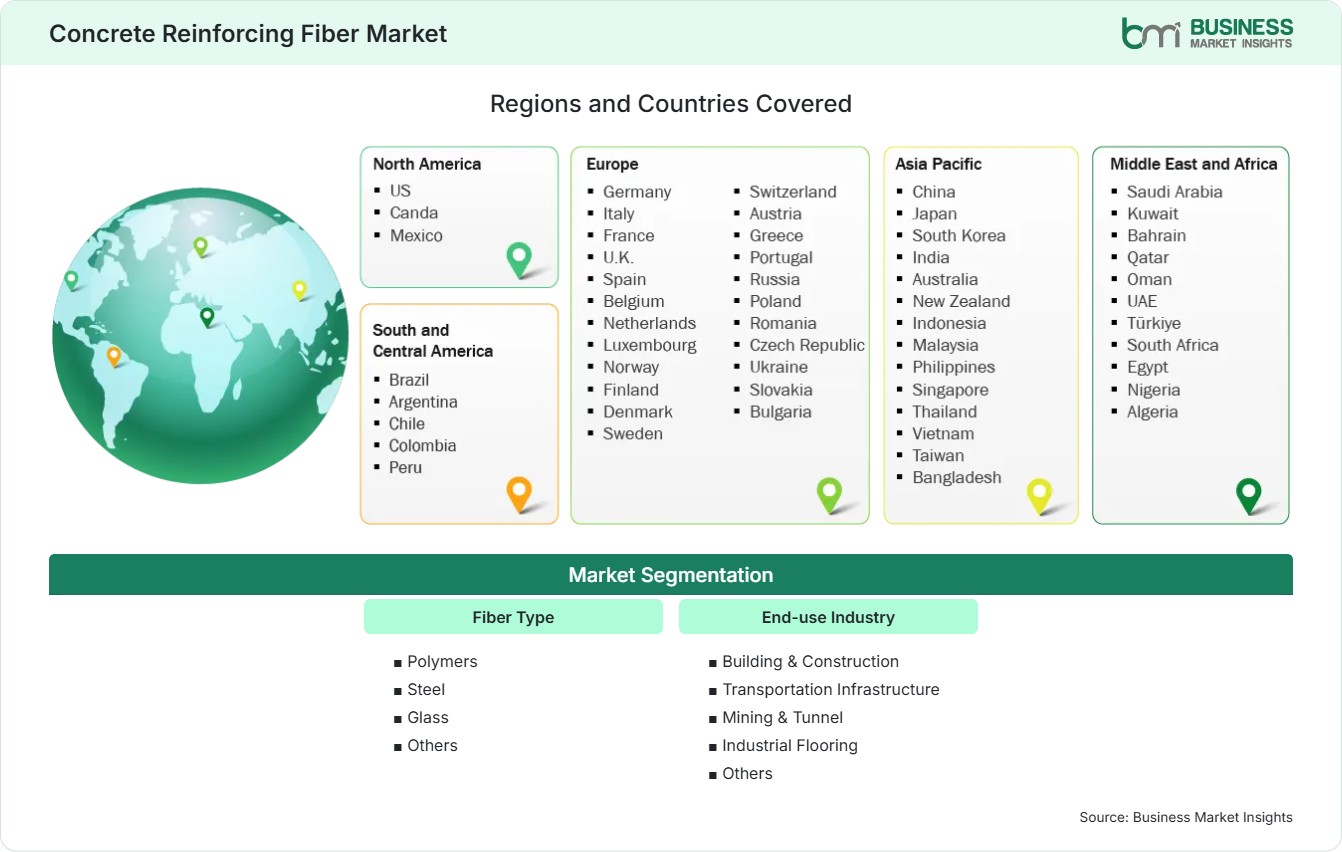
Global Market Geography
FREE PDF
Request your free sample
Request free sample
Segment Analysis

Concrete Reinforcing Fiber Market Segmentation

Fiber Type

Fiber Type represents a core technology segmentation, with polymers, steel, glass, and other materials addressing different performance requirements. The Concrete Reinforcing Fiber Market segment structure reflects a transition from basic crack control toward engineered structural reinforcement, durability, fire performance, and lifecycle efficiency.

  • Polymers: Polymer fibers provide lightweight reinforcement, corrosion resistance, crack control, and easier handling. Demand is expanding in slabs, shotcrete, precast systems, pavements, and construction applications seeking productivity and durable performance.
  • Steel: Steel fibers deliver high residual strength, toughness, impact resistance, and structural reinforcement capability. They remain important for heavy industrial floors, tunnels, precast elements, pavements, and high-load applications.
  • Glass: Glass fibers serve specialized cementitious applications where dimensional stability, crack control, lightweight reinforcement, and resistance to selected environmental conditions are required.

End-use Industry

End-use Industry demand is led by Building & Construction, while transportation, mining, tunneling, and industrial flooring provide important application diversity. The Concrete Reinforcing Fiber Market scope increasingly encompasses structural and nonstructural reinforcement, including slabs, pavements, precast components, shotcrete, tunnel linings, and specialized concrete systems.

  • Building & Construction: Residential, commercial, warehouse, and institutional construction use fibers for crack control, slab reinforcement, durability, and reduced reinforcement handling. Demand benefits from faster construction cycles and standardized mix designs.
  • Transportation Infrastructure: Roads, bridges, airports, pavements, and transport structures use fibers to improve toughness, crack resistance, durability, and reinforcement efficiency under repeated loading conditions.
  • Mining & Tunnel: Shotcrete and tunnel lining applications require high energy absorption, toughness, impact resistance, and reliable ground support, supporting premium steel and synthetic macrofiber solutions.
  • Industrial Flooring: Industrial floors require abrasion resistance, crack control, impact performance, and efficient installation. Fiber systems can reduce reinforcement congestion across warehouses, factories, logistics centers, and heavy-duty facilities.
Market Forces

Concrete Reinforcing Fiber Market Dynamics

Key Market Drivers

Infrastructure Rehabilitation and Durable Concrete Requirements

Infrastructure rehabilitation is supporting the Concrete Reinforcing Fiber Market growth because owners increasingly prioritize durability, crack control, repair reduction, and construction efficiency. North America remains particularly relevant as aging roads, bridges, pavements, and public facilities require rehabilitation. Asia Pacific adds demand through transport corridors and urban infrastructure. Fiber-reinforced concrete can distribute reinforcement throughout the matrix, improve post-cracking behavior, and reduce reinforcement congestion. Current industry data shows regional market structures vary materially, but infrastructure and construction applications remain recurring demand centers.

Construction Productivity and Reduced Reinforcement Handling

Construction productivity is strengthening adoption, where reinforcement placement creates labor, scheduling, congestion, and logistics constraints. Synthetic macrofibers and steel fibers can be introduced into concrete mixes, allowing reinforcement to be distributed during mixing rather than manually positioned as mesh or conventional reinforcement in selected applications. This trend is especially relevant to industrial flooring, warehouses, pavements, precast elements, shotcrete, and slabs. Suppliers increasingly support mix design, dosage optimization, structural calculations, and field implementation. The Concrete Reinforcing Fiber Market trends, therefore, increasingly connect material selection with project productivity, rather than evaluating fiber purely through material price per kilogram.

Shift Toward Engineered High-Performance Fiber Systems

Fiber technology is moving toward engineered products differentiated by geometry, tensile performance, surface characteristics, dispersion behavior, dosage requirements, and application-specific structural response. Manufacturers increasingly offer microfibers for early-age crack control, macrofibers for structural reinforcement, steel fibers for demanding loads, and hybrid systems for combined performance. Sika describes macrofibers as solutions for residual flexural performance, while steel fibers support demanding structural loading applications. The Concrete Reinforcing Fiber Market growth outlook is consequently influenced by higher-value products capable of replacing or partially replacing conventional reinforcement under appropriate engineering designs.

Key Market Opportunities

Low-Carbon and Circular Fiber Reinforcement

Low-carbon reinforcement provides a commercial opportunity because project owners increasingly evaluate material efficiency and embodied emissions alongside structural performance. Bekaert launched Dramix Loop in January 2026 using steel recovered from end-of-life tire cords, positioning circular feedstock as part of concrete reinforcement development. The company states that existing Dramix solutions can enable material reductions compared with traditional reinforcement in suitable designs. Similar opportunities exist for recycled polymer fibers, bio-based fibers, and hybrid systems. The Concrete Reinforcing Fiber Market Forecasts can therefore increasingly incorporate sustainability-linked product differentiation rather than relying only on volume expansion.

Mining, Tunneling, and Shotcrete Applications

Mining and tunneling offer a promising chance for expansion since underground construction needs reinforcement that has toughness, impact resistance, a fast installation rate, and reliable performance after cracking. In cases where conventional mesh causes congestion or hinders the construction process, fiber-reinforced shotcrete can make the installation of reinforcement easier. To address these applications, suppliers are establishing dedicated technical centers, conducting testing programs, and providing support for structural design.

Digital Design, Testing, and Application Engineering

Digital design and application engineering can promote greater fiber uptake by reducing uncertainty in dosage, structural performance, mix compatibility, and the product's economics over its lifecycle. Engineering tools can link the properties of the fiber with the geometry of the slab, the loading conditions, the required residual strength, the design of the joints, and the construction constraints. Suppliers who combine testing laboratories with software, technical documentation, field support, and help with specifications can boost customer confidence and lower the barriers to adoption at the project level. The design guidance developed by ACI shows the industry's shift towards viewing fibers as engineered reinforcement rather than just as additives.

Market Restraints and Challenges

Raw Material and Product Cost Volatility

The cost of steel, polymers, glass, energy, and transportation can vary, thus influencing the price of fiber and the decisions of contractors regarding purchases. Since steel fibers are subject to the economics of metallic raw materials, polymer fibers rely on petrochemical feedstocks and the costs of manufacturing. As a result, price fluctuations may lead to delays in changing specifications, promote the use of cheaper alternatives, and put pressure on supplier margins, especially in cases where the fiber is assessed mainly on the initial cost. This problem is more severe in construction markets that are sensitive to price, and in the case of imported products.

Specification Complexity and Limited Technical Familiarity

The performance of fiber depends on its type, shape, amount, the concrete mix, the degree of dispersion, the structural design, the method of testing, and the way it is installed, which results in a high level of technical difficulty for contractors and engineers. The effect is that a lack of consistent understanding may cause inappropriate choice of dosage, poor specifications, substitutions during procurement, or hesitation to replace conventional reinforcement. Although industry guidelines and testing standards help to reduce this risk, specific engineering based on the application is still required.

Company Analysis

Competitive Landscape

The competitive environment is characterized by global construction-material groups, specialist fiber manufacturers, steel reinforcement producers, and application-focused suppliers. Concrete Reinforcing Fiber Market analysis indicates that differentiation increasingly depends on product performance, application engineering, testing capabilities, sustainability credentials, regional production, and project support rather than product availability alone.

Company Name

Overview

Products and Services relevant to this market

NV Bekaert SA

Global reinforcement technology company with extensive steel-fiber expertise and growing emphasis on sustainable reinforcement systems.

Dramix steel fibers, Synmix synthetic fibers, technical engineering, concrete reinforcement solutions, testing, and application development.

Sika AG

Global construction-material supplier with broad fiber-reinforced concrete capabilities across multiple application categories and geographies.

SikaFiber microfibers, macrofibers, steel fibers, shotcrete reinforcement, slab solutions, structural guidance, and technical support.

FORTA Corporation

Specialist reinforcement manufacturer focused on concrete, asphalt, pavement, flooring, and infrastructure performance.

Macro synthetic fibers, microfibers, blended systems, specialty fibers, fiber feeders, design support, and testing services.

Propex Operating Company, LLC

Engineered materials supplier with established expertise in synthetic reinforcement technologies for concrete applications.

Synthetic fiber reinforcement, engineered polymer systems, concrete reinforcement solutions, and application-focused technical support.

The Euclid Chemical Company

Construction-material supplier serving concrete producers, contractors, engineers, and infrastructure projects.

Concrete fibers, reinforcement products, admixtures, technical guidance, testing support, and concrete performance solutions.

ABC Polymer Industries, LLC

Integrated fiber manufacturer supplying multiple synthetic, steel, and blended reinforcement products for concrete applications.

Micro synthetic fibers, macro synthetic fibers, steel fibers, blends, engineering support, dosage guidance, and application solutions.

Owens Corning

Global materials company with expertise spanning composites and engineered materials used across construction applications.

Glass and composite reinforcement technologies, engineered material solutions, technical support, and construction-related reinforcement products.

Lankhorst Engineered Products B.V.

Engineered polymer specialist serving infrastructure and industrial markets with recycled and high-performance material technologies.

Synthetic reinforcement solutions, engineered polymer fibers, composite technologies, and application-focused material development.

Adfil NV

Specialist synthetic fiber manufacturer with extensive experience in concrete reinforcement and international construction applications.

Micro and macro synthetic fibers for floors, tunnels, precast, paving, marine structures, and specialized concrete applications.

KrampeHarex GmbH & Co. KG

German specialist focused on steel fibers and engineered reinforcement solutions for demanding concrete applications.

Hooked, straight, corrugated, stainless, melt-extract, and synthetic fibers for industrial floors, tunnels, precast, UHPC, and specialized concrete.

Trust & Transparency

Research Methodology

The market analysis combines proprietary research with secondary data from government agencies, company disclosures, regulatory filings, industry databases and expert interviews. Market estimates are validated through data triangulation, cross-market benchmarking and analyst review.

View Full Research Methodology

Questions Answered

Frequently Asked Questions

What is driving interest in sustainable concrete reinforcement?

The Concrete Reinforcing Fiber Market Report highlights that Sustainability objectives are encouraging manufacturers and project owners to consider recycled steel, recycled polymers, bio-based fibers, material reduction, durability, and lifecycle performance. Product development is increasingly connecting reinforcement efficiency with embodied-carbon reduction and circular-material strategies.

Why are tunnels and mines important applications for fiber reinforcement?

Underground construction requires rapid installation, impact resistance, toughness, and reliable crack control. Fiber-reinforced shotcrete can reduce reinforcement congestion and improve installation efficiency, particularly where conventional mesh placement is difficult or creates additional labor and equipment requirements.

Can fiber reinforcement completely replace conventional reinforcement?

Fiber systems can replace or partially replace conventional reinforcement in selected applications when engineering calculations, structural requirements, testing, and applicable standards support the design. They are not universally interchangeable with reinforcing bars or mesh across all structural applications.

How do synthetic macrofibers differ from steel fibers?

Synthetic macrofibers generally offer corrosion resistance, low weight, and easier handling, while steel fibers provide high stiffness, toughness, and strong residual load-bearing performance. Selection depends on structural requirements, exposure conditions, fire performance, installation constraints, and lifecycle economics.

What factors determine the appropriate fiber dosage for concrete applications?

The dosage depends on structural loading, required residual strength, fiber geometry, concrete mix design, placement method, crack-control objectives, and applicable design standards. Engineers should validate dosage through project-specific calculations and testing rather than relying on a universal dosage.

Access the Full Concrete Reinforcing Fiber Market Report

Get segment-level forecasts, regional estimates, competitive benchmarking, company profiles and downloadable Excel datasets.

Access the full Concrete Reinforcing Fiber Market Report
350 pages PDF & Excel | 2026-10-22
Similar Research

Related Market Reports