
Cloud Based Contact Center Market Outlook: Size, Share, Trends, Growth Analysis, Competitive Landscape & Forecast, 2026-2033

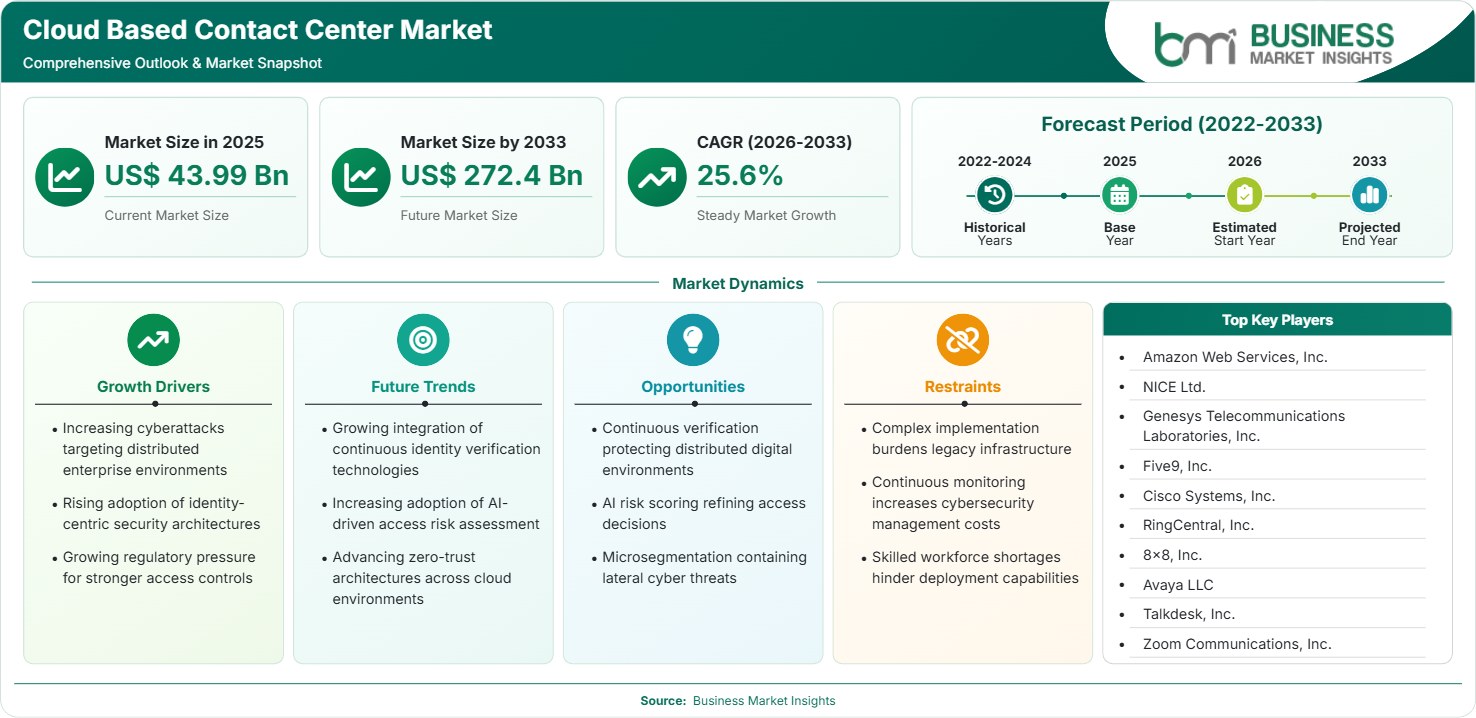
The Cloud Based Contact Center Market size was valued at US$ 43.99 Billion in 2025 and is projected to reach US$ 272.4 Billion by 2033, growing at a CAGR of 25.60% during 2026–2033, driven by AI automation, omnichannel engagement, workforce optimization, cloud migration, and demand for scalable customer-service infrastructure.

Report Coverage
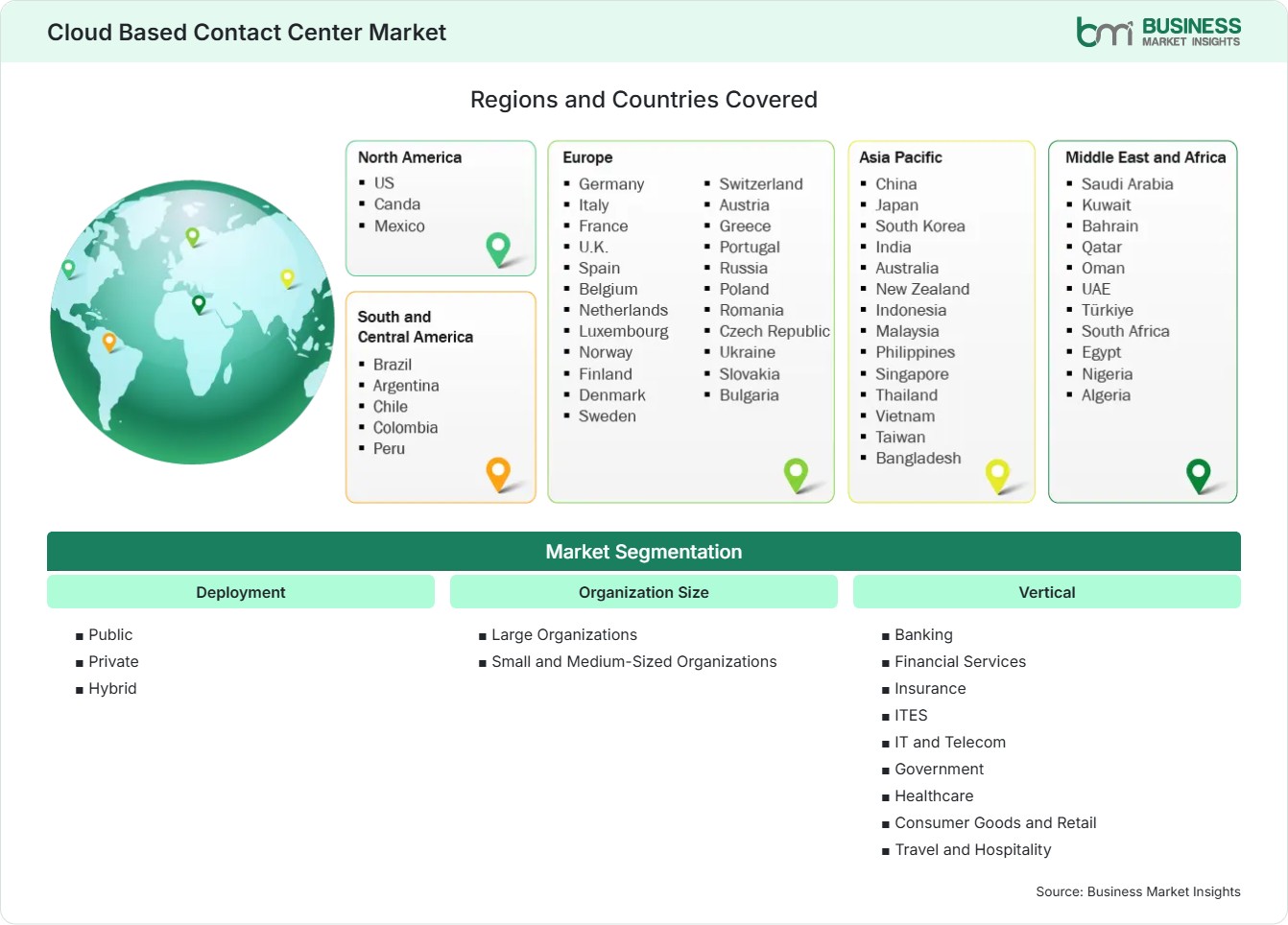
  • Deployment: Public, Private, Hybrid
  • Organization Size: Large Organizations, Small and Medium-Sized Organizations
  • Vertical: Banking, Financial Services, Insurance, ITES, IT and Telecom, Government, Healthcare, Consumer Goods and Retail, Travel and Hospitality
US$ 43.99 Bn Market size in 2025
US$ 272.4 Bn Market Size by 2033
25.6% CAGR, 2026 - 2033
2026-2033 Forecast Period

AI Overview

Cloud Based Contact Center Market Summary

  • North America Region: North America holds a 32%–34% share in 2025, growing at a 23.5%–24.5% CAGR during 2026–2033, supported by enterprise cloud migration, AI adoption, mature SaaS ecosystems, regulatory readiness, and strong vendor investment across customer experience platforms. The US market benefits from deep enterprise SaaS adoption, AI investments, mature CRM integration, and demand for scalable omnichannel customer-service infrastructure, supporting approximately 23.8%–24.8% CAGR during 2026–2033.
  • Fastest Growing Region: Asia Pacific represents a 22%–24% Cloud Based Contact Center Market share in 2025, expanding at a 27.0%–29.0% CAGR during 2026–2033, driven by digital transformation, expanding customer-service operations, rising cloud penetration, growing e-commerce, multilingual AI, mobile-first engagement, and increasing investments across India, China, Japan, and Southeast Asia.
  • Leading Segment: Solutions account for approximately 68%–71% share in 2025, with a 24.8%–25.8% CAGR during 2026–2033, supported by omnichannel routing, analytics, workforce optimization, conversational AI, CRM integration, programmable workflows, and increasing replacement of fragmented legacy contact-center architectures.
  • High Growth Segment: Hybrid deployment holds around 16%–19% Cloud Based Contact Center Market share in 2025, while recording approximately 27.5%–28.5% CAGR during 2026–2033, as regulated enterprises combine cloud scalability with controlled workloads, data residency, legacy integration, business continuity, and phased modernization strategies.
  • Key Market Opportunity: AI agents, vertical-specific automation, sovereign cloud architectures, programmable customer journeys, and outcome-based pricing create attractive opportunities for vendors targeting complex service workflows, multilingual markets, and enterprises modernizing legacy environments.
  • Major Market Players: Amazon Web Services, Inc.; NICE Ltd.; Genesys Telecommunications Laboratories, Inc.; Five9, Inc.; Cisco Systems, Inc.; RingCentral, Inc.; 8x8, Inc.; Avaya LLC; Talkdesk, Inc.; and Zoom Communications, Inc.
Strategic Insights

Cloud Based Contact Center Market: Strategic Insights

Cloud Based Contact Center Market Strategic Framework
FREE PDF
Request your free sample
Request free sample
Stakeholder View

Key Takeaways

  • The value chain is moving from standalone contact-center software toward integrated customer-experience ecosystems. Platform vendors, hyperscalers, CRM providers, system integrators, AI developers, and telecommunications operators increasingly share delivery responsibilities.
  • The strongest upside exists in solutions combining intelligent routing, conversational AI, workforce engagement, analytics, and automated workflows. Enterprises increasingly prioritize measurable resolution outcomes instead of isolated automation features.
  • Agentic AI represents the next product-development frontier. Vendors are progressing from recommendation and summarization toward systems that interpret intent, execute actions, coordinate workflows, and operate under enterprise governance.
  • Asia Pacific provides an attractive investment case because cloud migration, digital commerce, mobile engagement, multilingual service requirements, and expanding business-process outsourcing ecosystems are converging across high-growth economies.
  • Investment activity is increasingly concentrated around AI capabilities, data integration, workflow orchestration, and ecosystem expansion. Strategic partnerships can strengthen distribution and implementation capacity without requiring vendors to build every capability internally.
  • Enterprises are likely to maintain mixed architectures during migration, creating demand for integration, orchestration, security, compliance, and managed services even as public-cloud adoption accelerates.
Geographic Outlook

Cloud Based Contact Center Market Regional Highlights

North America Cloud Based Contact Center Market

North America represented approximately 32%–34% Cloud Based Contact Center Market share in 2025 and is projected to expand at 23.5%–24.5% CAGR during 2026–2033. The region benefits from established SaaS infrastructure, mature CRM ecosystems, high enterprise AI investment, and strong vendor concentration. The US remains the principal regional market, while Canada contributes through financial services, telecommunications, government modernization, and distributed customer-service operations. Enterprise replacement cycles increasingly favor cloud platforms capable of integrating AI, workforce management, analytics, and customer-data systems within unified operating environments.

  • Enterprise modernization is shifting budgets from legacy ACD infrastructure toward scalable cloud platforms, particularly where organizations require rapid capacity changes and distributed agent operations.
  • AI adoption is strengthening platform differentiation as businesses prioritize automated quality management, agent assistance, intelligent routing, and self-service across high-volume customer interactions.
  • Financial services and healthcare remain attractive verticals because secure data handling, compliance workflows, and specialized customer journeys support higher-value deployments.
  • US enterprises continue to influence regional innovation through hyperscaler ecosystems, SaaS investment, and partnerships connecting cloud infrastructure with CRM and enterprise applications.

US Cloud Based Contact Center Market

The US represented approximately 25%–27% of global revenue in 2025, equivalent to most North American demand, and is expected to register 23.8%–24.8% CAGR during 2026–2033. Large enterprises increasingly combine AI agents, analytics, CRM integration, and workforce orchestration. Technology providers are expanding domestic capabilities while customers seek lower infrastructure complexity, faster deployment, and stronger operational visibility. Competition remains intense among hyperscalers and specialist CCaaS vendors, encouraging rapid feature development and increasingly flexible consumption models.

  • Banking, retail, healthcare, and telecommunications enterprises are prioritizing AI-enabled service environments that integrate customer history, workflow systems, and compliance controls.
  • The growing use of agentic AI is shifting purchasing criteria toward governance, action execution, integration reliability, and measurable resolution rates.
  • Vendor ecosystems increasingly influence purchasing decisions because implementation partners can reduce migration complexity and accelerate integration with existing enterprise technology.

Europe Cloud Based Contact Center Market

Europe held a market share of around 24%-26% in 2025 in the Cloud-Based Contact Center Market and is expected to grow at a CAGR of 24.5%-25.5% during 2026-2033. The UK and Germany are leading regions, fueled by the adoption of enterprise digitalization and technology ecosystems. Spain is one of the fastest-growing regions, fueled by the outsourcing of customer service and digital commerce. Data protection, AI governance, and sovereignty affect the architecture of cloud-based contact centers.

  • The UK remains a major adoption center because financial services, telecommunications, retail, and outsourced service providers have extensive experience with cloud-based customer operations.
  • Germany emphasizes secure modernization, data governance, and integration with enterprise applications, creating opportunities for hybrid and private deployment architectures.
  • Spain and Southern European markets benefit from multilingual customer-service operations, tourism, digital commerce, and expanding nearshore service capabilities.
  • European regulation encourages vendors to embed governance, transparency, access controls, and data-management capabilities directly into AI-enabled customer-service platforms.

Asia Pacific Cloud Based Contact Center Market

Asia Pacific had a market share of approximately 22%-24% in 2025 and is expected to witness the fastest regional growth, at a 27.0%-29.0% CAGR, from 2026 to 2033. The major markets in this region include China and Japan, whereas India, Southeast Asia, and Australia present lucrative growth prospects. Growing digital commerce, mobile use, adoption of cloud computing, demand for multilingual services, and process outsourcing drive market growth. India is among the fastest-growing markets due to the modernization of customer engagement through digital service delivery.

  • India combines cloud adoption with a large technology-services ecosystem, creating opportunities for multilingual AI, omnichannel platforms, and distributed agent management.
  • China benefits from extensive digital consumer engagement and enterprise automation, supporting investment in intelligent customer-service infrastructure.
  • Japan emphasizes reliability, workforce productivity, automation, and integration with established enterprise systems as demographic pressures encourage operational efficiency.
  • Southeast Asian economies provide attractive greenfield opportunities because enterprises can adopt cloud architectures without replicating large legacy infrastructure estates.

Rest of World Cloud Based Contact Center Market

South and Central America together had approximately 9%-11% market share in the Cloud Based Contact Center Market in 2025, while the Middle East and Africa combined for about 7%-9%. The joint RoW demand is forecast to grow at 24.0%-26.0% CAGR in 2026-2033. Brazil and Mexico are the front-runners in Latin America, whereas the UAE and Saudi Arabia dominate Gulf demand. Digitally enabled banking services, e-commerce, telecommunications, government sector digitization, and multilingual needs drive investments.

Latin American companies are increasingly deploying cloud-based solutions to increase service capacity and keep infrastructure costs under control. The Gulf nations are investing in digital public services and in digitizing financial and customer-experience infrastructure as part of economic diversification programs.

  • Brazil offers the largest Latin American opportunity through banking, retail, telecommunications, and digitally mature consumer-service operations.
  • Mexico benefits from nearshore service delivery, cross-border commerce, and increasing cloud adoption among large enterprises and service providers.
  • The UAE and Saudi Arabia are developing advanced digital-service ecosystems, creating demand for secure cloud platforms, AI automation, and multilingual customer engagement.
  • South Africa provides an important African adoption center through telecommunications, financial services, business-process outsourcing, and technology-enabled service operations.
Global Market Geography
FREE PDF
Request your free sample
Request free sample
Segment Analysis

Cloud Based Contact Center Market Segmentation

Component

Solutions accounted for 68%-71% of the market share in 2025, while the services segment accounted for the rest. Solutions remain significant as businesses prioritize integrated routing, analytics, AI, workforce optimization, and omnichannel capabilities. On the other hand, services are becoming increasingly important because migration complexity, customization, integration, security, and managed operations require specialist expertise. The Cloud Based Contact Center Market scope increasingly encompasses both platform subscriptions and implementation ecosystems.

  • Solutions: Platforms consolidate routing, voice, digital channels, analytics, AI, workforce engagement, and reporting, enabling enterprises to replace fragmented legacy environments with integrated customer-service operations.
  • Services: Implementation, consulting, integration, training, and managed services reduce migration complexity, accelerate deployment, and support enterprises lacking internal cloud-contact-center expertise.

Deployment

Public deployment accounted for about 58%–61% of the share in 2025 due to factors such as scalability, faster deployment, and lower infrastructure needs. Both private and hybrid clouds remain essential for regulatory compliance, compatibility with legacy systems, and data ownership. The Cloud Based Contact Center Market trends are shifting from the idea of migration to just one type of deployment to architectural adaptability.

  • Public: Public cloud provides elastic capacity, rapid feature deployment, broad geographic availability, and access to hyperscaler AI services without extensive infrastructure ownership.
  • Private: Private environments support organizations requiring tighter infrastructure control, specialized security policies, predictable workloads, and stricter data-management arrangements.
  • Hybrid: Hybrid models connect cloud-native capabilities with controlled or legacy environments, enabling phased migration while protecting critical workloads and maintaining operational continuity.

Organization Size

Larger firms accounted for 61%-64% of market share as of 2025, due to more complex customer experiences, dispersed business presence, and increased IT budgets. Midsize and small firms are adopting solutions more often due to subscription-model pricing, reducing the need for IT infrastructure. The platform's modularity and consumption-based pricing enable small firms to access advanced capabilities.

  • Large Organizations: Large enterprises require advanced routing, analytics, governance, workforce management, integration, and multi-region capabilities across complex customer-service operations.
  • Small and Medium-Sized Organizations: SMEs favor scalable subscriptions, faster implementation, unified communications, and AI-enabled automation that can improve service capacity without extensive technology teams.

Vertical

The Banking, Financial Services & Insurance industry contributed around 20-23% to the 2025 Cloud Based Contact Center Market share, backed by a high number of interactions, compliance needs, and intricate customer journeys. ITES, IT & Telecom, government, healthcare, consumer goods & retail, and travel & hospitality industries each have unique case studies for Cloud Contact Center adoption. The vertical specialization will play an increasing role in differentiating platforms.

  • Banking, Financial Services, and Insurance: Secure customer verification, transaction support, fraud-related inquiries, and regulatory workflows create strong demand for integrated cloud contact-center capabilities.
  • ITES: Service providers require scalable multilingual operations, workforce optimization, analytics, and flexible capacity to manage diverse customer programs efficiently.
  • IT and Telecom: High interaction volumes, technical support requirements, service upgrades, billing queries, and network incidents favor automation and intelligent routing.
  • Government: Digital public services require accessible omnichannel engagement, secure identity workflows, multilingual support, and scalable infrastructure for citizen-facing operations.
  • Healthcare: Appointment management, patient inquiries, billing support, and care coordination encourage secure cloud adoption with strict access and data controls.
  • Consumer Goods and Retail: E-commerce growth increases demand for order support, returns management, loyalty services, personalized engagement, and rapid seasonal scaling.
  • Travel and Hospitality: Reservations, disruptions, cancellations, loyalty programs, and multilingual assistance create strong demand for AI-enabled omnichannel service orchestration.
Market Forces

Cloud Based Contact Center Market Dynamics

Key Market Drivers

AI-Powered Automation Is Redefining Customer-Service Economics

AI is shifting customer-service platforms from reactive routing toward predictive and autonomous workflows. The Cloud Based Contact Center Market growth will continue to be influenced by conversational AI, AI assistance, automatic quality management, AI summaries, sentiment analysis, and task execution with AI. In February 2026, Genesys launched a virtual agent capable of understanding customer intent and completing tasks for them in front-office and back-office environments. This is one example of how vendors are competing beyond chatbot capabilities alone. AI can also help supervisors be more productive by automatically scoring interactions and identifying operational exceptions. Buyers look at more than just AI presence in the solution set.

Omnichannel Customer Engagement Is Replacing Voice-Centric Architectures

Customer interactions increasingly move between voice, messaging, chat, email, social channels, and self-service journeys. The Cloud Based Contact Center Market trends, therefore, favor platforms that maintain customer context across channels instead of treating each interaction as a separate event. Retail organizations demand the consistency of their online orders and service interactions, while banks require seamless handovers from digital interactions to assisted ones. Telecommunication companies also use automated troubleshooting coupled with human escalation. Through unified routing and customer data, multiple authentications are avoided, and agents get context about the interactions. As a result, platform architectures are becoming increasingly dependent on API connectivity, CRM integration, analytics, identity management, and workflow orchestration. Those vendors that can integrate multiple interaction channels without data silos are more relevant to enterprises.

Enterprise Cloud Migration Is Expanding Addressable Workloads

Cloud migration continues to broaden the addressable base of customer-service technology because enterprises can modernize their infrastructure without replacing every business system simultaneously. The cloud based contact center market growth is supported by phased migrations that migrate the routing, analytics, workforce management, and digital channels incrementally. Hybrid systems present a pragmatic approach to companies with legacy PBX systems, custom apps, or stringent data needs. In June 2026, AWS added to its ecosystem by introducing the Customer Services Competency program, which recognizes partners who have demonstrated competence in transforming contact centers through AI-powered customer experiences.

Key Market Opportunities

Agentic AI Creates New Revenue Models and Service Workflows

Agentic AI provides an opportunity to automate multi-step processes rather than merely answer customer questions. Vendors can monetize task execution, AI consumption, premium automation, and outcome-based services as enterprises adopt autonomous workflows. Cloud based contact center market forecasts will have to be made on the efficiency of the connections between AI Agents and CRM, billing, scheduling, identity, and other enterprise application management systems. Agentic Virtual Agents have been positioned by Genesys as autonomous, end-to-end resolution agents, while AI Agents and Assistants have been developed in Cisco's Webex Contact Center. This is not only an opportunity to reduce costs but also to have workflows running around the clock and handle any surge in demand.

Verticalized Platforms Can Capture High-Value Enterprise Workloads

Industry-specific contact center solutions can improve acceptance by eliminating the need for customization and by incorporating workflows suited to highly regulated, complex environments. For instance, the healthcare contact center may feature patient services process flows, and the financial services contact center may emphasize authentication and fraud prevention. In the case of the retail contact center, order fulfillment and returns may be other elements. Government contact centers could have a focus on identity management and multilingual support. Vendor differentiation can be achieved through pre-built connections, industry expertise, special analytics, and limited AI models. Ecosystems can profit even further from these contact center offerings through migration, customization, management, and governance services.

Asia Pacific Expansion Can Accelerate Greenfield Adoption

Asia Pacific offers substantial greenfield potential because enterprises across several economies can adopt cloud architectures without the same depth of legacy infrastructure as in mature markets. Digital commerce, mobile customers, technology services, and multilingual customer engagement are available in India, Southeast Asia, and certain countries in the Middle East. These include investments in cloud and data center technologies in the region, artificial intelligence services, partnering and implementation, and managed customer services. Vendors can leverage language capabilities, regional compliance, price sensitivity, and cooperation with telecommunications companies to improve their market position. The greatest opportunity lies in cases where companies require quick service expansion but lack the budget or capability to implement contact centers.

Market Restraints and Challenges

Data Privacy and AI Governance Complexity and Slower Deployment

Factor: Data privacy issues, AI governance issues, cybersecurity, and data residency concerns can present obstacles to using cloud contact centers. Impact: Companies may postpone their move to cloud-based contact centers if customer data, call recordings, payment information, or medical information requires specific controls. Issues related to AI add to governance needs regarding AI transparency, hallucinations, human supervision, access control, and auditability. All these factors can make the move more costly, as companies will have to conduct security assessments and take other necessary actions. The situation is even more complicated for multinational companies, since laws may vary across countries. Thus, vendors should implement governance in their platforms rather than use it as an additional layer.

Integration Complexity and Higher Migration Costs

Factor: The level of integration complexity among old PBXs, CRMs, ERPs, workforce management systems, data warehouses, and custom workflows can complicate the migration process. Impact: Firms may choose to expand their existing infrastructure rather than pursue a rapid cloud migration. Contact centers are usually regarded as critical systems where any mistake or interruption might affect their revenues and clients' experience. Consequently, it is important to conduct the following activities during migration: testing, data mapping, API development, agent training, security assessment, and business continuity planning. Small firms do not necessarily have specialists capable of performing these activities, while large enterprises might have lengthy, complex procurement procedures.

Company Analysis

Competitive Landscape

The Cloud Based Contact Center Market analysis indicates a moderately concentrated competitive environment where hyperscalers, specialist CCaaS providers, communications platforms, and enterprise technology companies compete through AI, omnichannel capabilities, analytics, integration depth, and ecosystem reach. Major providers increasingly differentiate through agentic automation, workforce optimization, industry-specific workflows, and programmable architectures.

Company Name

Overview

Products and Services relevant to this market

Amazon Web Services, Inc.

AWS provides scalable cloud infrastructure and customer-experience capabilities, positioning Amazon Connect as a programmable platform for organizations modernizing contact-center operations.

Amazon Connect supports voice, chat, routing, analytics, workforce capabilities, AI assistance, case management, and integration with AWS services.

NICE Ltd.

NICE is a major customer-experience technology provider with extensive enterprise reach across contact-center, workforce, analytics, and AI applications.

CXone, workforce engagement, analytics, interaction management, conversational AI, quality management, and automation capabilities.

Genesys Telecommunications Laboratories, Inc.

Genesys specializes in cloud customer-experience orchestration, serving enterprises requiring sophisticated routing, engagement, analytics, and AI.

Genesys Cloud, AI-powered virtual agents, workforce engagement, journey orchestration, analytics, digital channels, and integrations.

Five9, Inc.

Five9 focuses on cloud contact-center software and provides scalable capabilities for enterprises seeking integrated customer-service operations.

Intelligent CX, digital engagement, analytics, workforce optimization, virtual agents, CRM integrations, and cloud contact-center software.

Cisco Systems, Inc.

Cisco combines communications infrastructure with Webex customer-experience capabilities, supporting enterprises seeking integrated collaboration and contact-center environments.

Webex Contact Center, AI Agent, AI Assistant, quality management, analytics, digital channels, integrations, and enterprise communications.

RingCentral, Inc.

RingCentral provides cloud communications and customer-engagement technologies, serving organizations seeking unified communications and contact-center capabilities.

RingCX: cloud communications, omnichannel engagement, AI capabilities, analytics, routing, workforce tools, and business communications.

8x8, Inc.

8x8 integrates communications and customer engagement, targeting organizations requiring unified cloud communication and contact-center operations.

8x8 Contact Center, voice, digital channels, analytics, quality management, AI, workforce engagement, and unified communications.

Avaya LLC

Avaya serves large enterprises transitioning from traditional communications infrastructure toward cloud-enabled customer-experience architectures.

Avaya Experience Platform, contact-center routing, digital engagement, analytics, workforce optimization, AI, and hybrid deployment support.

Talkdesk, Inc.

Talkdesk specializes in cloud customer-experience software, with strong emphasis on industry solutions, automation, and configurable workflows.

Talkdesk CX Cloud, AI, digital engagement, workforce management, analytics, integrations, automation, and industry-specific contact-center applications.

Zoom Communications, Inc.

Zoom extends its communications portfolio into customer experience, leveraging its collaboration ecosystem to support cloud-based customer engagement.

Zoom Contact Center, voice, digital channels, analytics, AI Companion capabilities, routing, workforce tools, and collaboration integration.

Trust & Transparency

Research Methodology

The market analysis combines proprietary research with secondary data from government agencies, company disclosures, regulatory filings, industry databases and expert interviews. Market estimates are validated through data triangulation, cross-market benchmarking and analyst review.

View Full Research Methodology

Questions Answered

Frequently Asked Questions

What should buyers examine in a Cloud Based Contact Center Market Report?

Buyers should examine component economics, deployment models, organization size, vertical demand, regional adoption, AI capabilities, integration requirements, vendor ecosystems, security architecture, implementation complexity, and evolving pricing models. These factors determine technology fit and long-term operating economics.

Why is Asia Pacific becoming an important investment region?

Digital commerce, mobile-first customer engagement, cloud migration, technology-services ecosystems, multilingual requirements, and expanding business-process outsourcing are creating strong demand. India and Southeast Asia also provide substantial greenfield opportunities for cloud-native customer-service architectures.

Which deployment model is suitable for regulated enterprises?

Hybrid deployment can provide a practical balance by combining cloud scalability with controlled workloads. Organizations can retain sensitive or legacy processes within restricted environments while moving customer-facing applications, analytics, and automation to cloud platforms.

How is agentic AI changing contact-center operations?

Agentic AI extends beyond conversational responses by interpreting customer objectives, selecting actions, interacting with enterprise systems, and completing multi-step workflows. This can reduce manual handling while increasing the importance of governance, authentication, escalation, and auditability.

What factors will influence Cloud Based Contact Center Market adoption through 2033?

AI-enabled automation, CRM integration, omnichannel engagement, workforce optimization, cloud migration, regulatory requirements, and demand for flexible operating models will influence adoption. Enterprises increasingly evaluate platforms based on resolution quality, integration depth, governance, and measurable customer-service outcomes.

Access the Full Cloud Based Contact Center Market Report

Get segment-level forecasts, regional estimates, competitive benchmarking, company profiles and downloadable Excel datasets.

Access the full Cloud Based Contact Center Market Report
350 pages PDF & Excel | 2026-09-10
Similar Research

Related Market Reports