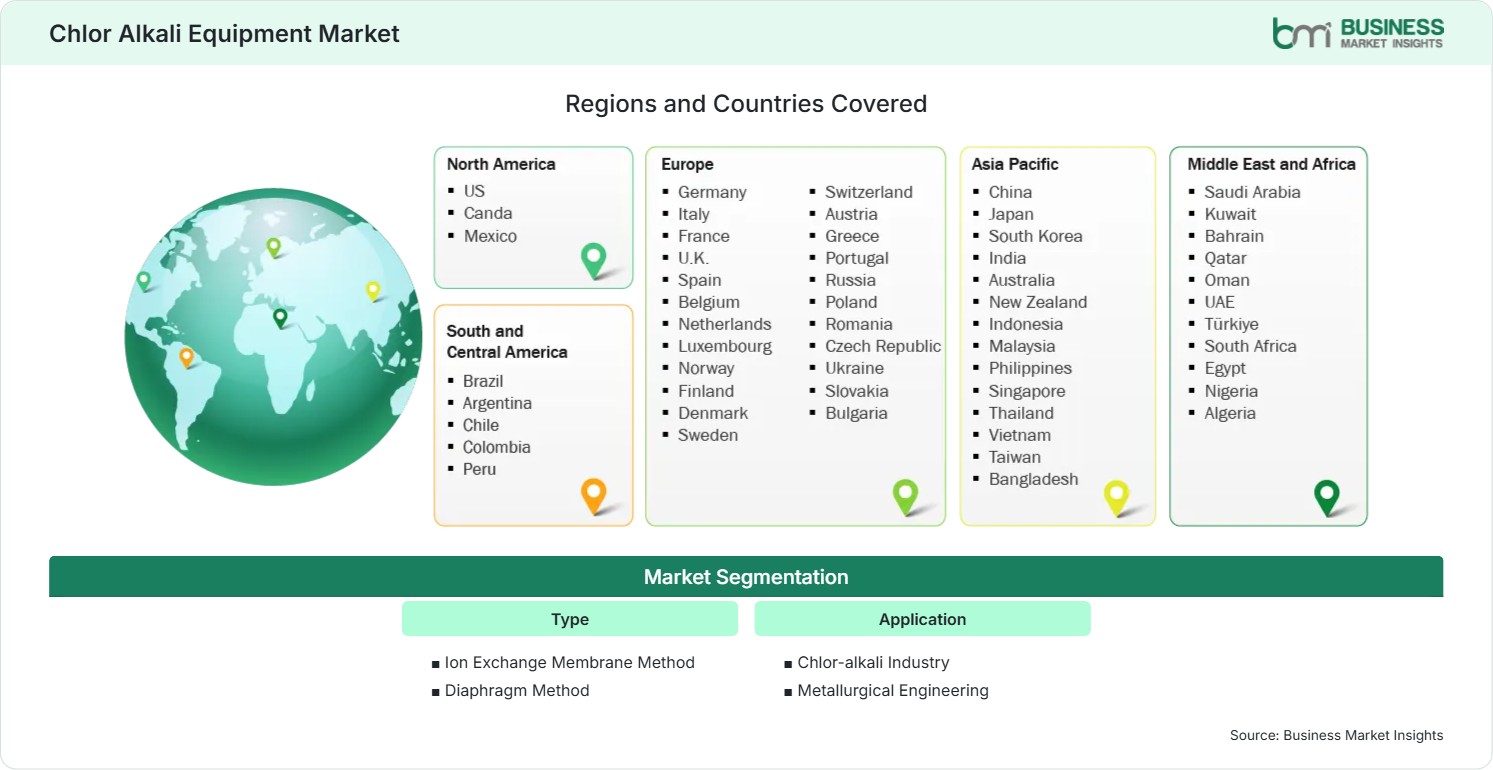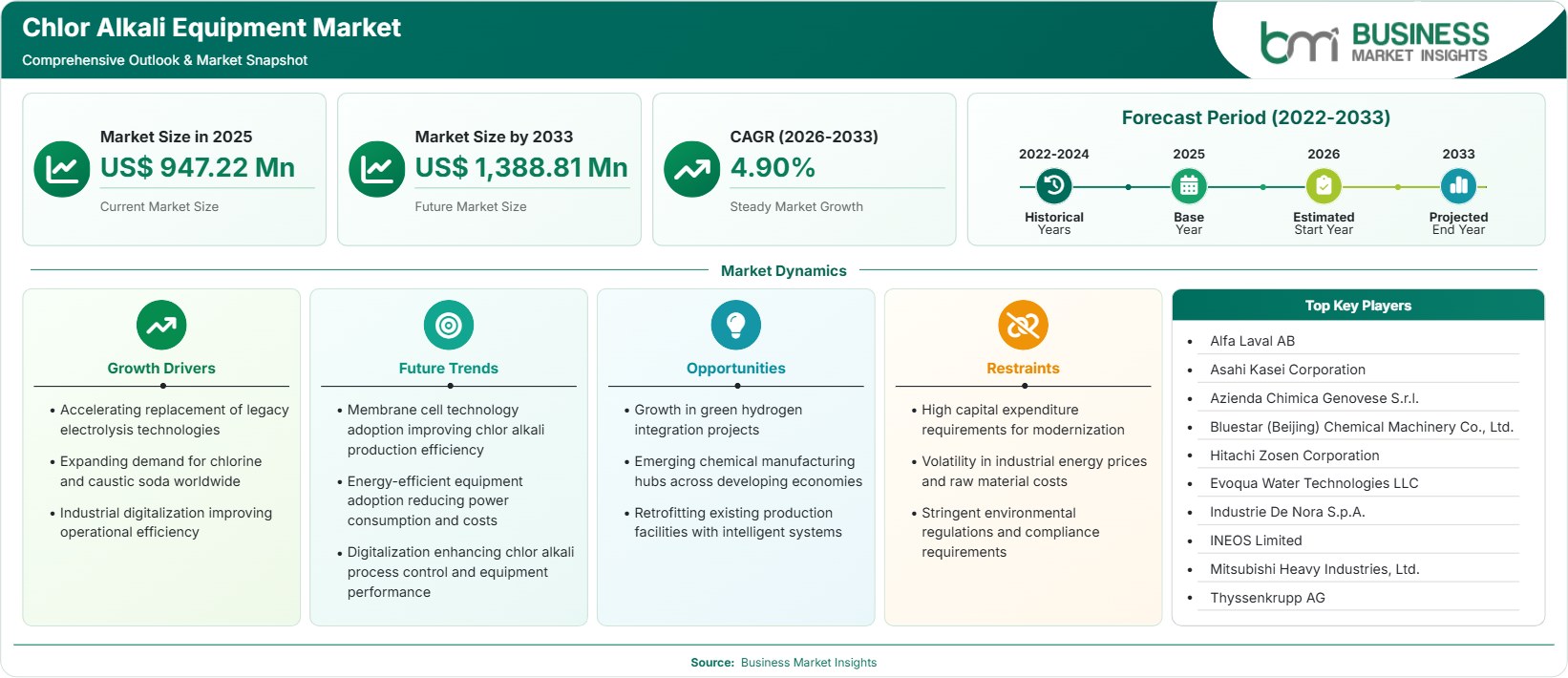
Chlor Alkali Equipment Market Regional Highlights
North America Chlor Alkali Equipment Market
North America accounts for 31% – 34% of the global Chlor Alkali Equipment Market share in 2025 and is projected to expand at a 4.2% – 4.6% CAGR through 2026–2033. Benefits of the region include having established chlor-alkali manufacturing plants, upgrading of old electrolysis equipment, and the adoption of stringent environmental laws that encourage use of membrane technology. The investments made in automation, utilization of hydrogen and efficient energy production ensure competitive operations while maintaining a market for advanced electrolysis equipment.
- New regulations by agencies such as the United States Environmental Protection Agency continue promoting the use of membrane cell technology instead of the electrolysis technologies to increase efficiency in terms of reduced electricity usage, improved chlorine purity, and lower emissions from industry.
- The trend toward automation in industry has continued within the chemical manufacturing industry where automation leads to better predictability of maintenance needs and digital optimization leading to greater operational efficiency and longer service life of equipment and reduced maintenance costs.
- The rising investments in the treatment of wastewater and municipal water treatment are creating demand for chlorine products, which in turn creates demand for systems which can optimize production processes.
- The hydrogen by-product of chlor-alkali production process is becoming increasingly valuable in terms of efforts towards industrial decarbonization.
US Chlor Alkali Equipment Market
The United States represents approximately 74% – 77% of North American demand in 2025 and advances at a 4.3% – 4.7% CAGR through 2026–2033. Strong domestic PVC, water treatment, pulp and paper, and chemical manufacturing industries continue supporting investments in membrane electrolysis systems. Federal infrastructure initiatives, industrial decarbonization programs, and increased digitalization of manufacturing facilities further reinforce replacement demand for energy-efficient equipment with enhanced automation and predictive maintenance capabilities.
- The growth of domestic manufacturing through industrial reshoring leads to increased modernization of chemicals manufacturing facilities and enhances operational resiliency, energy efficiency, and adherence to higher levels of environmental performance standards.
- Digitalization of manufacturing technologies promotes the faster implementation of sensors, industrial analytics, and diagnostic capabilities that help optimize electrolysis processes and minimize equipment downtime.
- Strong demand from PVC, disinfectant chemicals, and industrial water treatment continues supporting capital expenditure on advanced electrolysis technologies designed to improve production efficiency and operational flexibility across diverse manufacturing applications in chlor alkali equipment market.
- Engineering contractors increasingly deliver turnkey modernization projects integrating electrolysis cells, electrical systems, automation, and maintenance services, enabling chemical producers to accelerate commissioning while minimizing operational disruptions during plant upgrades.
Europe Chlor Alkali Equipment Market
Europe captures 26% – 29% of global market revenue in 2025 and is anticipated to grow at a 4.4% – 4.9% CAGR during 2026–2033. Decarbonization strategies, carbon reduction targets, and strict industrial emission standards continue accelerating adoption of advanced membrane technologies across regional chlor-alkali facilities. Germany remains the leading market, while Italy and the Netherlands sustain significant investments in modernization. Spain demonstrates one of the fastest expansion rates, supported by industrial efficiency initiatives and chemical production upgrades.
- Germany maintains regional leadership through its advanced engineering capabilities, established chemical production infrastructure, and sustained investments in energy-efficient electrolysis technologies.
- Italy continues benefiting from specialized equipment manufacturers supplying membrane technologies, corrosion-resistant materials, and process engineering solutions serving domestic production facilities as well as export-oriented industrial projects across international markets.
- Spain records one of Europe's strongest expansion trajectories with an estimated 5.0% – 5.4% CAGR in chlor alkali equipment market, supported by industrial modernization programs, renewable electricity integration, and increasing investment in efficient chemical manufacturing infrastructure.
- European producers continue emphasizing circular economy objectives by improving resource efficiency, optimizing brine purification processes, and integrating advanced automation systems.
- Collaborative research programs involving chemical producers, equipment manufacturers, and engineering institutions accelerate commercialization of next-generation electrolysis technologies.
Asia Pacific Chlor Alkali Equipment Market
Asia Pacific represents 29% – 32% of global revenue in 2025 and records the fastest expansion with a 5.8% – 6.3% CAGR through 2026–2033. Rapid industrialization, chemical manufacturing expansion, infrastructure development, and government-supported manufacturing initiatives continue stimulating demand for advanced chlor-alkali production systems. China dominates regional installations owing to extensive production capacity, while India demonstrates the strongest growth momentum through expanding chemical investments, infrastructure projects, and modernization of domestic manufacturing facilities.
- China continues leading regional equipment demand through large-scale chlor-alkali production, significant investment in advanced membrane technologies.
- India is projected to register approximately 6.2% – 6.7% CAGR, driven by expanding chemical production capacity, industrial infrastructure development, water treatment investments, and government initiatives encouraging advanced manufacturing technologies across strategic industries.
- Japan focuses on premium engineering solutions emphasizing automation, operational efficiency, corrosion-resistant materials, and advanced process control technologies in chlor alkali equipment market.
- Southeast Asian economies continue expanding investments in chemical processing, industrial parks, and export manufacturing, creating additional opportunities for suppliers.
- Regional manufacturers increasingly emphasize localized production, supply-chain resilience, and technology partnerships to reduce project costs while accelerating deployment of energy-efficient chlor-alkali production infrastructure.
Rest of World Chlor Alkali Equipment Market
The Rest of the World contributes 10% – 13% of global revenue during 2025 and is forecast to grow at a 4.8% – 5.2% CAGR through 2026–2033. South and Central America continue investing in industrial chemicals and water treatment capacity, while Middle Eastern countries strengthen downstream chemical integration supported by abundant feedstocks and industrial diversification strategies.
Across Africa and the Gulf region, expanding infrastructure, desalination projects, and industrial development create steady demand for modern electrolysis systems. Brazil leads South and Central America, whereas Saudi Arabia records the strongest regional expansion through integrated petrochemical investments.
- Brazil remains the leading South and Central American market owing to expanding chemical manufacturing, industrial modernization projects, and sustained investments supporting chlorine and caustic soda production across domestic industries.
- Saudi Arabia records the highest regional growth with an estimated 5.4% – 5.8% CAGR, driven by downstream petrochemical expansion, industrial diversification strategies, and increasing deployment of efficient electrolysis technologies throughout integrated chemical complexes.
- Desalination capacity expansion across Gulf countries increases chlorine demand for water treatment applications, encouraging investments in reliable electrolysis systems capable of delivering high operational efficiency under continuous production conditions.
- Mining, metallurgy, and industrial processing sectors across selected African economies gradually increase demand for chlor-alkali products, supporting future installation opportunities for durable process equipment and integrated engineering services.
- International engineering companies increasingly collaborate with regional chemical producers through technology licensing, EPC contracts, and long-term maintenance agreements, strengthening project execution capabilities while accelerating modernization across emerging industrial markets.