
Casing Centralizer Market Outlook: Size, Share, Trends, Growth Analysis, Competitive Landscape & Forecast, 2026-2033

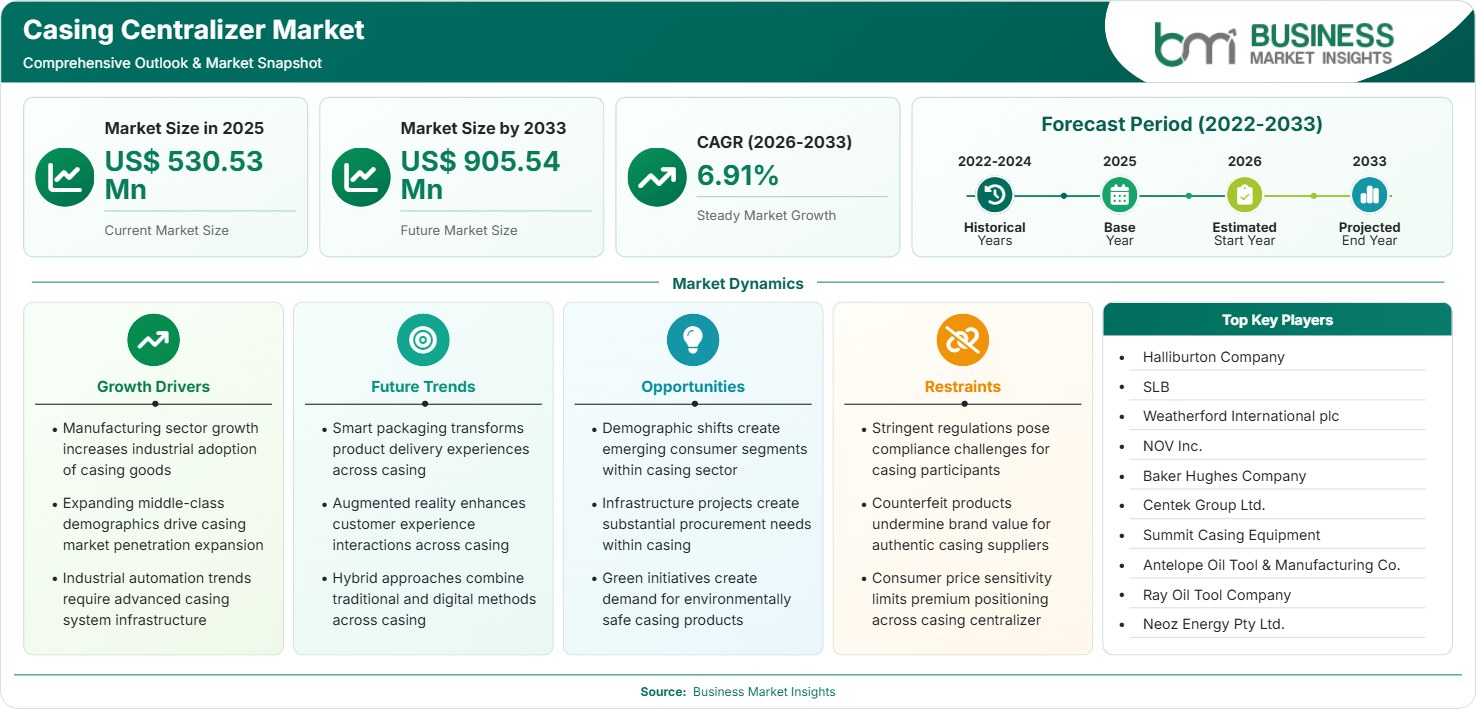
The Casing Centralizer Market size was valued at US$ 530.53 Million in 2025 and is projected to reach US$ 905.54 Million by 2033, growing at a CAGR of 6.91% during 2026–2033. Growth is supported by rising onshore and offshore drilling activity, increasing well integrity requirements, expansion of horizontal wells, and opportunities linked to deepwater exploration and advanced centralizer materials.

Report Coverage
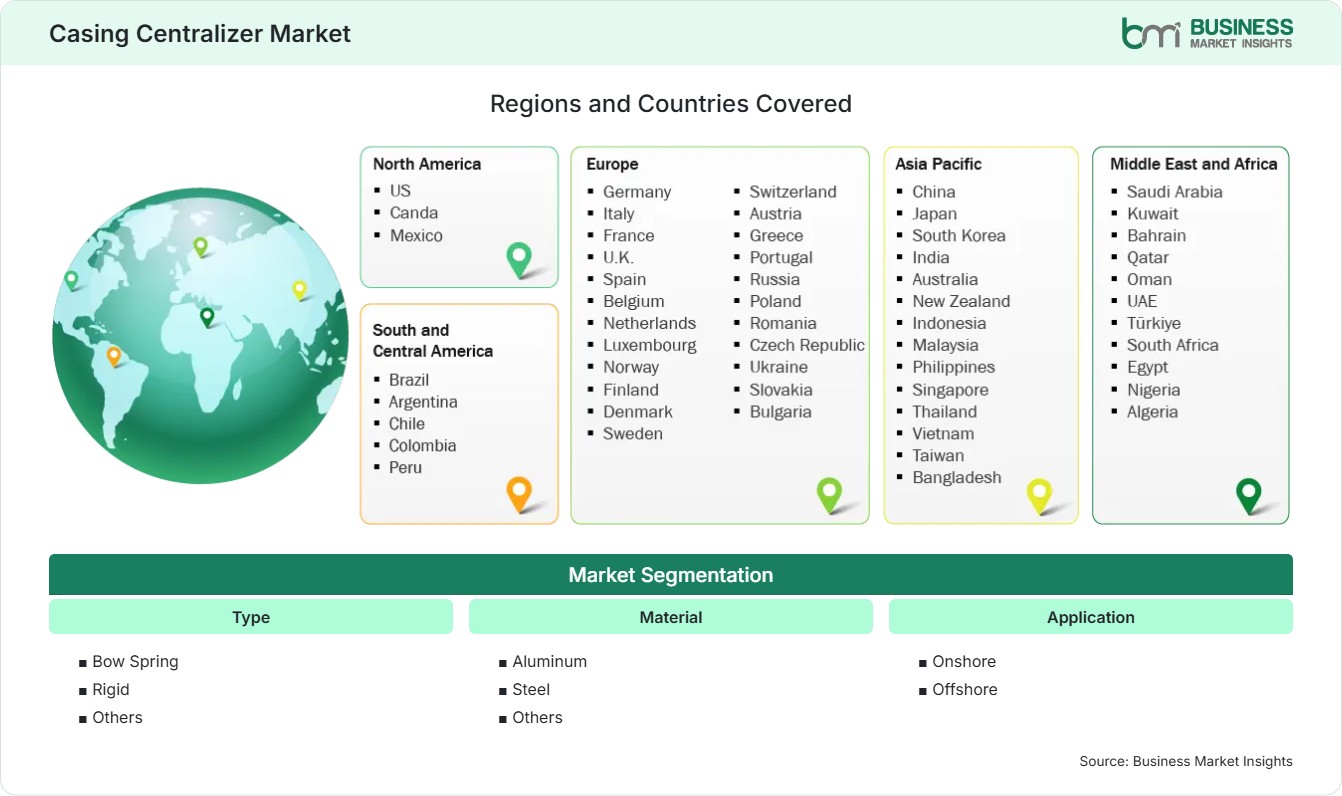
  • Type: Bow Spring , Rigid , Others
  • Material: Aluminum, Steel, Others
  • Application: Onshore, Offshore
US$ 530.53 Mn Market size in 2025
US$ 905.54 Mn Market Size by 2033
6.91% CAGR, 2026 - 2033
2026-2033 Forecast Period

AI Overview

Casing Centralizer Market Summary

  • North America Region: North America holds a market share of 34%–37% in 2025, growing with a CAGR of 6.3%–6.7% during 2026–2033. Key drivers include shale drilling intensity, cementing optimization, well integrity regulations, enhanced recovery projects, offshore developments, centralizer technology upgrades, operational efficiency requirements, deeper wells, digital well planning, and energy security investments. The U.S. remains the regional anchor, supported by shale basins and offshore Gulf projects, advancing at 6.4%–6.8% CAGR.
  • Fastest Growing Region: Asia Pacific holds a Casing Centralizer Market share of 25%–28% in 2025, growing with a CAGR of 7.8%–8.4% during 2026–2033. Key drivers include national exploration programs, offshore investment expansion, LNG-linked developments, energy consumption growth, deepwater projects, localization initiatives, drilling fleet additions, modern cementing standards, and upstream capital expenditure increases.
  • Leading Segment: Bow Spring holds a market share of 46%–49% in 2025, growing with a CAGR of 6.6%–7.0% during 2026–2033. Key drivers include flexibility, broad casing compatibility, cost efficiency, high adoption across onshore projects, simple installation, established supply chains, reliable standoff performance, and suitability for conventional wells.
  • High Growth Segment: Offshore applications hold a market share of 22%–25% in 2025, growing with a CAGR of 8.0%–8.7% during 2026–2033. Key drivers include deepwater investments, subsea developments, higher well complexity, premium cementing requirements, greater centralization precision, offshore redevelopment programs, improved materials, and expanding drilling campaigns.
  • Key Market Opportunity: Increasing deployment in deepwater, HPHT, extended-reach, and carbon storage wells is creating demand for premium centralizers capable of improving annular cement distribution, reducing remediation costs, and enhancing long-term well integrity.
  • Major Market Players: Halliburton Company, SLB, Weatherford International plc, NOV Inc., Baker Hughes Company, Centek Group Ltd., Summit Casing Equipment, Antelope Oil Tool & Manufacturing Co., Ray Oil Tool Company, Neoz Energy Pty Ltd.
Strategic Insights

Casing Centralizer Market: Strategic Insights

Casing Centralizer Market Strategic Framework
FREE PDF
Request your free sample
Request free sample
Stakeholder View

Key Takeaways

  • The industry value chain is strongly integrated with drilling, cementing, casing equipment, and oilfield service ecosystems, making supplier collaboration critical for project success.
  • Offshore and deepwater projects present the most attractive growth opportunity because centralization accuracy has a direct influence on cement placement quality and long-term well integrity.
  • Product innovation is moving toward non-welded designs, corrosion-resistant alloys, lightweight aluminum variants, and digitally optimized centralizer placement engineering.
  • Asia Pacific provides a compelling investment case due to expanding offshore activity in China, India, Malaysia, and Indonesia alongside increasing domestic energy production targets.
  • Strategic partnerships between equipment manufacturers and oilfield service providers are accelerating product commercialization and strengthening aftermarket support capabilities.
  • Emerging carbon capture and storage well developments represent a new demand avenue for high-performance centralization technologies requiring long-term zonal isolation reliability.
Geographic Outlook

Casing Centralizer Market Regional Highlights

North America Casing Centralizer Market

North America accounted for 34%–37% of the Casing Centralizer Market share in 2025 and is projected to expand at 6.3%–6.7% CAGR through 2033. The region benefits from active shale development, advanced drilling technologies, mature service infrastructure, and continuous well integrity investments. Operators increasingly deploy engineered centralization programs to enhance cement placement and reduce remediation risks. Major activity centers include the Permian Basin, Eagle Ford, Bakken, and offshore Gulf developments. Regulatory expectations for safe well construction also support adoption of premium centralizer technologies.

  • Shale drilling programs continue generating demand for bow spring and rigid products designed for horizontal well trajectories.
  • Offshore Gulf of Mexico developments require advanced centralization systems supporting complex cementing operations.
  • Digital well planning tools are enhancing placement optimization and operational efficiency.
  • Strong oilfield service presence strengthens technology adoption and aftermarket support.
  • Recompletion and enhanced recovery projects increase replacement and maintenance demand.

US Casing Centralizer Market

The United States represented approximately 78%–82% of North American demand in 2025 and is expected to grow at 6.4%–6.8% CAGR through 2033. High drilling intensity, widespread horizontal well deployment, and advanced completion practices support market expansion. Operators increasingly emphasize cement bond quality and regulatory compliance, encouraging use of premium centralization solutions across unconventional and offshore projects.

  • Permian Basin remains the primary demand center for drilling consumables and casing accessories.
  • Deepwater Gulf investments support higher-value engineered centralizer installations.
  • Technology adoption favors durable designs capable of operating under high-temperature conditions.
  • Focus on operational efficiency encourages optimized centralizer placement strategies.

Europe Casing Centralizer Market

Europe held a 21%–24% share in 2025 and is expected to advance at 5.7%–6.1% CAGR during 2026–2033. Norway leads regional demand, while the United Kingdom represents a significant mature market. Redevelopment of North Sea assets, carbon storage projects, and selective offshore investments support utilization. Operators emphasize reliability, environmental compliance, and lifecycle performance. High-growth opportunities are emerging from CCS-related well construction where centralization quality directly influences long-term containment integrity.

  • Norway leads regional consumption, supported by offshore field development programs.
  • The United Kingdom demonstrates steady replacement demand from mature basin operations.
  • Carbon capture projects create emerging requirements for advanced centralization tools.
  • Engineering-driven procurement favors premium and certified products.
  • High-growth countries include Norway and the UK, with growth near regional averages.

Asia Pacific Casing Centralizer Market

Asia Pacific accounted for 25%–28% of the Casing Centralizer Market share in 2025 and is forecast to register the fastest CAGR of 7.8%–8.4% through 2033. China remains the leading market, while India represents one of the fastest-expanding opportunities. Offshore exploration, domestic production goals, LNG-linked investments, and deepwater projects are driving procurement. Regional manufacturers are expanding capacity to support localization strategies and reduce import dependence across important energy-producing nations.

  • China leads demand through extensive onshore and offshore exploration initiatives.
  • India exhibits strong growth supported by energy security programs and upstream investments.
  • Southeast Asian offshore developments enhance requirements for premium centralizers.
  • Localization efforts encourage regional manufacturing expansion.
  • Increasing deepwater activity supports adoption of specialized rigid designs.

Rest of World Casing Centralizer Market

Rest of World accounted for 15%-18% of the market in 2025 and is expected to exhibit a 7.0%-7.6% CAGR during 2023-2033. ME continues to be the largest revenue generator owing to extensive drilling operations and production growth plans. SA and CA receive boosts through offshore projects and energy developments by their respective nations. Increasing demand is favoring robust products that can perform under high-pressure and corrosive conditions, along with ideal standoff capability.

  • Saudi Arabia and the UAE lead Middle East demand through upstream capacity investments.
  • Brazil remains a key South American market due to offshore pre-salt development.
  • National oil company spending supports procurement stability.
  • Deep and extended-reach wells require higher-specification centralization solutions.
  • Regional manufacturing partnerships improve product availability.
Global Market Geography
FREE PDF
Request your free sample
Request free sample
Segment Analysis

Casing Centralizer Market Segmentation

Type

The Type Segmentation is dominated by the Bow Spring products, with 46%-49% market share in 2025, and a 6.6%-7.0% CAGR over the forecast period. The Casing Centralizer Market scope is continually expanding, depending on the selected technology, well shape, cementing needs, and operating conditions. Rigid designs gain traction in challenging wells, while customized products support increasingly complex drilling environments.

  • Hinged Welded Bow Spring Centralizer: Widely used in conventional drilling programs due to installation convenience, dependable restoring force, and compatibility with diverse casing dimensions encountered across onshore oil and gas developments.
  • Slip-On Welded Bow Spring Centralizer: Preferred where robust retention characteristics and cost-effective deployment are essential, supporting efficient casing running operations and improved cement distribution performance.
  • Slip-On Welded Positive Casing Centralizer: Gains adoption in challenging wells requiring enhanced standoff assurance and stronger positioning control throughout cementing processes.
  • Hinged Non-Welded Bow Spring Centralizer: Increasingly selected for reduced risk of weld-related weaknesses while offering favorable flexibility, handling ease, and durability.
  • Straight/Spiral Vane Solid Centralizer: Utilized in deviated and horizontal wells where rigid support and controlled casing positioning are critical.
  • Straight/Spiral Roller Solid Centralizer: Supports reduced friction during casing deployment, enhancing operational efficiency in extended-reach drilling projects.
  • Straight/Spiral Vane Aluminum Solid Centralizer: Benefits from lightweight construction, corrosion resistance, and easier handling during installation activities.

Material

Steel held a market share of around 61% to 64% in 2025 and is projected to grow at a 6.5% to 6.9% CAGR through 2033. The choice of material varies depending on the downhole conditions, corrosion concerns, budgetary constraints, and mechanical specifications. Casing Centralizer Market trends indicate a growing preference for lightweight materials, while steel remains dominant due to its strength and reliability.

  • Aluminum: Increasingly utilized where weight reduction, corrosion resistance, and easier transportation provide operational advantages in offshore and remote drilling locations.
  • Steel: Remains the preferred material because of high mechanical strength, established supply availability, and suitability for demanding drilling environments.

Application

Onshore applications hold 74%–77% market share in 2025 and are forecast to grow at a 6.4%–6.8% CAGR. A growing number of unconventional drilling projects support demand, while offshore applications are seeing faster growth, aided by deepwater investments. Growing application demands are for accurate centralization, proper cementation, and low-cost intervention.

  • Onshore: Extensive drilling programs, shale developments, and cost-focused operations make this the largest application segment worldwide.
  • Offshore: Premium specifications, deepwater complexity, and stringent well integrity requirements support accelerated adoption and higher average selling prices.
Market Forces

Casing Centralizer Market Dynamics

Key Market Drivers

Expansion of Horizontal and Directional Drilling

Horizontal and directional wells require effective casing centralization systems to optimize cement placement and ensure well integrity. Increased drilling operations in shale formations and hard-to-reach reservoirs should stimulate demand for technologically advanced products. The International Energy Agency has highlighted the need for continued investment in the upstream sector to ensure supply, which will favor the adoption of technologically advanced well-completion systems. Difficult, longer wellbores make it even more important to ensure proper centralizer performance. Consequently, operators prioritize solutions that deliver greater standoff, lower drag, and more consistent cement distribution.

Greater Focus on Well Integrity and Zonal Isolation

Regulators and contractors emphasize the importance of wellbore lifecycle integrity, making centralization a key factor in ensuring high-quality cement. Annular cement under-coverage may lead to higher remediation costs and increased risks of failure. Standards advocate for optimal positioning of centralizers to ensure good results during zonal isolation operations. As drilling operations become more complex and deeper, centralization programs help operators avoid future problems. These factors reinforce demand across both mature and developing oil-producing regions.

Growth in Offshore and Deepwater Development

Offshore wells often involve complex drilling processes and higher performance requirements. The deepwater operation calls for reliable casing placement to ensure effective cementing and durability. Higher levels of investment in Brazil, the Middle East, West Africa, and the Asia Pacific region foster demand for top-quality products. Advanced rigid and specialty designs are increasingly used where traditional solutions may not provide sufficient performance under extreme operating conditions.

Key Market Opportunities

Advanced Materials and Lightweight Designs

Innovations in materials open new possibilities for suppliers to develop corrosion-resistant, lightweight products. There may be advantages to using aluminum products and alloy solutions that could help increase efficiency and effectiveness. In an effort to reduce lifecycle costs and increase productivity, more differentiated product solutions are desirable. Casing Centralizer Market Forecasts show rising demand for engineered solutions that meet performance requirements across extended-reach, deepwater, and environmentally challenging applications.

Expansion of Carbon Capture and Storage Wells

Carbon capture and storage initiatives require long-term well integrity and dependable zonal isolation. Centralizers play a critical role in supporting effective cement placement within storage wells. Growing government support for decarbonization infrastructure creates a new end-use segment for specialized products. Suppliers capable of demonstrating durability, reliability, and compliance with evolving standards may benefit from expanding project pipelines.

Localization of Manufacturing and Supply Chains

Regional energy development programs increasingly favor localized procurement and domestic manufacturing capabilities. This creates opportunities for capacity expansion, partnerships, and technology transfer arrangements. Suppliers with regional production networks can reduce lead times and improve responsiveness to customer requirements. Localization strategies are particularly attractive across Asia Pacific and the Middle East where upstream investment activity remains strong.

Market Restraints and Challenges

Volatile Upstream Investment Cycles Creating Demand Uncertainty

Factor: Fluctuations in upstream oil and gas investment remain a persistent challenge for the industry, as drilling activity and capital expenditure are highly dependent on commodity price movements. During periods of weaker oil and gas prices, operators frequently postpone exploration and production projects while reducing procurement of equipment and related components.

Impact: This cyclicality creates significant demand uncertainty for equipment manufacturers, making production planning and capacity utilization more complex. Suppliers must continuously balance inventory levels, manufacturing schedules, and pricing strategies while responding to rapidly changing customer procurement patterns. The lack of consistent order visibility also increases margin pressure and limits long-term operational planning, making investment cycles a structural challenge across the market.

Intense Supplier Competition Driving Margin Compression

Factor: The market is characterized by the presence of numerous global and regional manufacturers competing across standardized product categories. Limited product differentiation, particularly in mature onshore applications, intensifies price-based competition and reduces suppliers' ability to command premium pricing.

Impact: Sustained pricing pressure compresses profit margins, restricting manufacturers' capacity to invest in research, product innovation, and operational expansion. Smaller market participants are particularly vulnerable to profitability challenges, while larger suppliers increasingly focus on engineered solutions, value-added services, and aftermarket support to differentiate their offerings and reduce the effects of product commoditization.

Company Analysis

Competitive Landscape

The competitive environment reflects a combination of multinational oilfield service providers and specialized manufacturers. This Casing Centralizer Market analysis highlights companies with broad product portfolios and strong distribution capabilities.

Company Name

Overview

Products and Services relevant to this market

Halliburton Company

Global oilfield services leader with extensive well construction operations.

Bow spring, rigid, and specialty centralizers, casing equipment, cementing solutions.

SLB

International technology provider serving upstream drilling and completion markets.

Centralization solutions, drilling technologies, well construction services.

Weatherford International plc

Major provider of well construction and cementing equipment.

Welded, non-welded, one-piece centralizers and related accessories.

NOV Inc.

Energy equipment manufacturer serving global drilling operations.

Centralizers, casing accessories, drilling and completion equipment.

Baker Hughes Company

Integrated energy technology company with global presence.

Well construction technologies and drilling support solutions.

Centek Group Ltd.

Specialist in centralization and downhole technology products.

Advanced centralizers and engineered wellbore solutions.

Summit Casing Equipment

Focused provider of casing and cementing equipment.

Bow spring and rigid centralization systems.

Antelope Oil Tool & Manufacturing Co.

Oilfield equipment supplier with casing accessory expertise.

Centralizers, stop collars, and casing products.

Ray Oil Tool Company

Manufacturer serving drilling and completion operations.

Centralizers and well construction accessories.

Neoz Energy Pty Ltd.

Specialized technology company supporting cementing efficiency.

Centralizer solutions and related well integrity products.

Trust & Transparency

Research Methodology

The market analysis combines proprietary research with secondary data from government agencies, company disclosures, regulatory filings, industry databases and expert interviews. Market estimates are validated through data triangulation, cross-market benchmarking and analyst review.

View Full Research Methodology

Questions Answered

Frequently Asked Questions

What does the Casing Centralizer Market Report indicate about future demand?

The industry outlook remains positive due to expanding exploration activity, well integrity requirements, offshore developments, and adoption of advanced drilling technologies.

How are materials evolving in this industry?

Manufacturers are increasingly developing lightweight and corrosion-resistant solutions, including aluminum-based designs, to improve durability and operational efficiency.

Which application is growing the fastest?

Offshore applications are expanding fastest because deepwater and complex wells require higher-performance centralization systems to support effective cementing outcomes.

Which region currently leads market demand?

North America leads due to extensive shale drilling, mature oilfield infrastructure, advanced completion practices, and significant spending on well construction technologies.

What is the primary function of a casing centralizer?

Casing centralizers position casing strings near the center of a wellbore, helping achieve uniform cement distribution, stronger zonal isolation, and improved long-term well integrity.

Access the Full Casing Centralizer Market Report

Get segment-level forecasts, regional estimates, competitive benchmarking, company profiles and downloadable Excel datasets.

Access the full Casing Centralizer Market Report
350 pages PDF & Excel | 2026-08-31
Similar Research

Related Market Reports