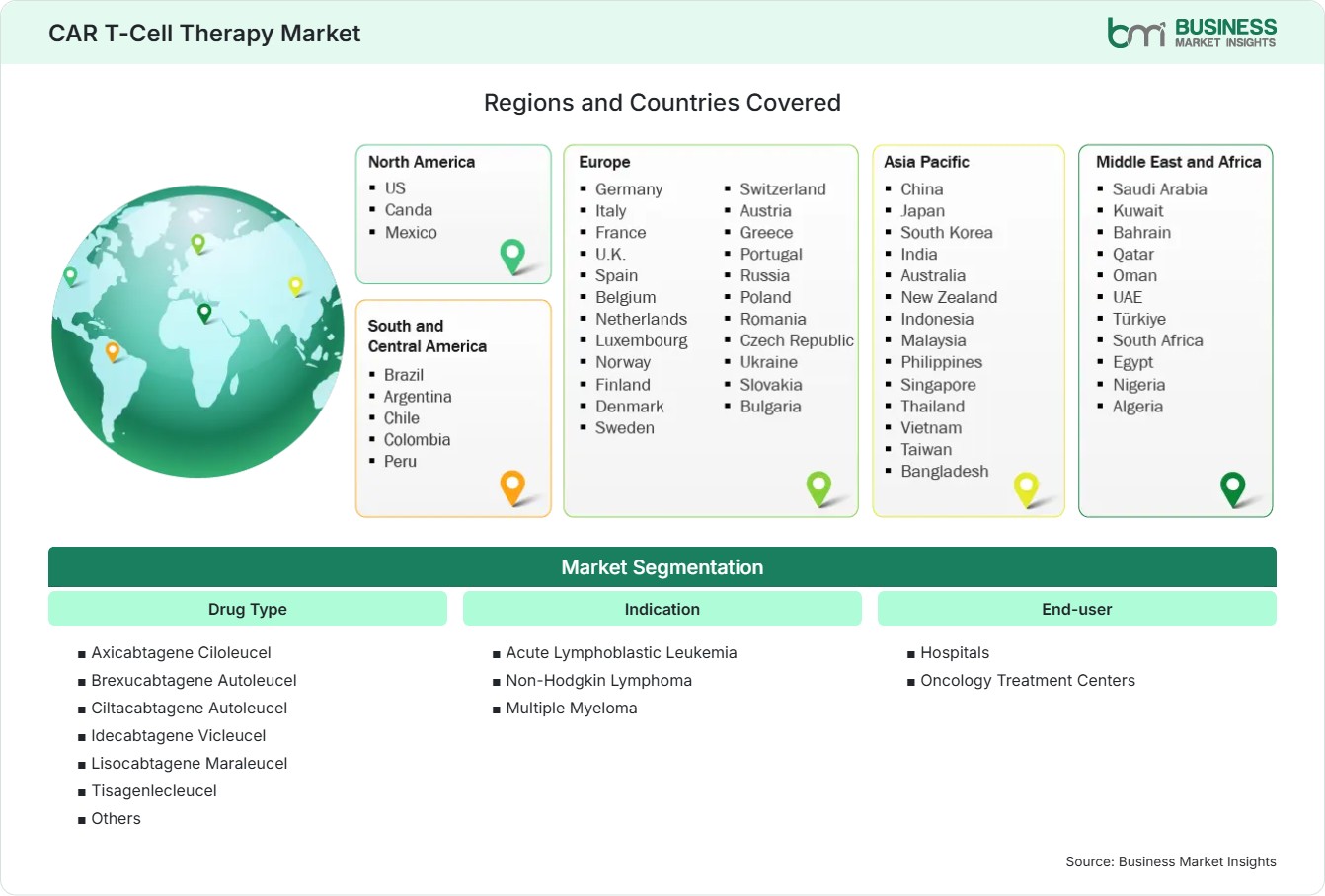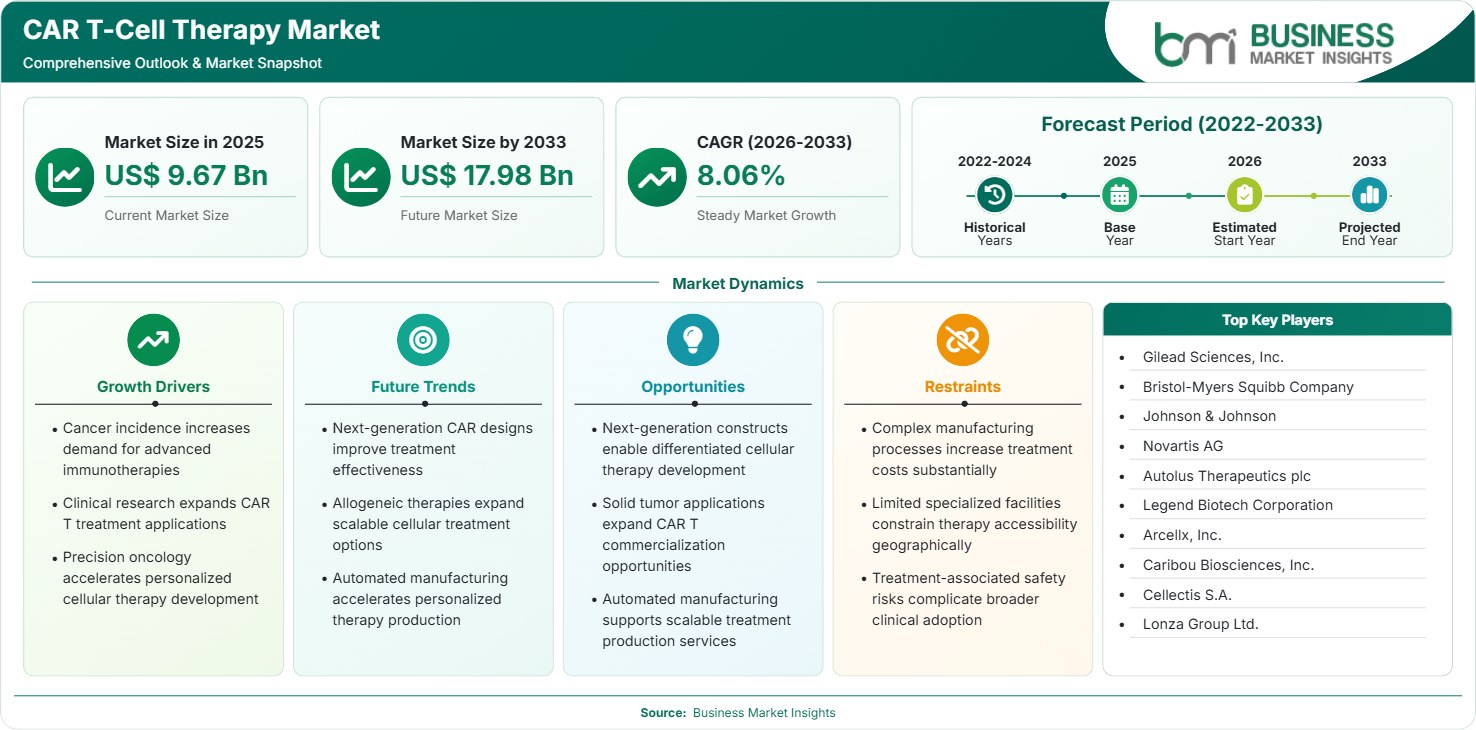
CAR T-Cell Therapy Market Regional Highlights
North America CAR T-Cell Therapy Market
North America CAR T-Cell Therapy Market held a 47%–51% share in 2025 and is projected to grow at a 7.7%–8.3% CAGR through 2033. The region benefits from established therapies, advanced oncology infrastructure, specialist hospitals, clinical research, reimbursement systems, and extensive pharmaceutical investment. The U.S. remains the principal contributor, while Canada provides incremental opportunities through specialized hematology programs. Treatment-center expansion and manufacturing improvements should support higher throughput as earlier-line indications increase patient eligibility.
· Established products support standardized referral and treatment pathways while competition increasingly focuses on durability, indication breadth, manufacturing reliability, and treatment-center relationships.
· Automated manufacturing and improved logistics are being adopted to shorten production timelines, reduce scheduling uncertainty, and strengthen coordination between collection facilities and hospitals.
· Specialist oncology centers continue investing in cellular therapy teams, intensive monitoring capabilities, and multidisciplinary protocols required for complex treatment administration.
· Regulatory modernization can reduce selected operational barriers, allowing qualified centers to improve workflow flexibility while retaining rigorous safety and long-term monitoring requirements.
US CAR T-Cell Therapy Market
The U.S. CAR T-Cell Therapy Market accounted for approximately 41%–45% of global value in 2025 and is projected to grow at 7.8%–8.4% through 2033. Its leadership reflects established product availability, leading academic hospitals, specialist treatment centers, manufacturing capabilities, clinical research, and pharmaceutical investment. Earlier-line treatment strategies are expanding commercial opportunities beyond heavily pretreated populations. The country also has the strongest ecosystem of specialized logistics providers, cellular therapy personnel, reimbursement expertise, and integrated oncology networks.
- Established hospitals provide leukapheresis, lymphodepletion, infusion, intensive monitoring, and post-treatment follow-up, creating a strong foundation for increasing treatment volumes.
- Earlier-line positioning can increase eligible populations and improve patient fitness at treatment, strengthening the commercial case for lifecycle expansion and manufacturing capacity.
- Safety management remains a central consideration because acute toxicities and long-term surveillance require specialized personnel, hospital resources, structured protocols, and continuous clinical oversight.
Europe CAR T-Cell Therapy Market
Europe CAR T-Cell Therapy Market represented a 21%–25% share in 2025 and is projected to grow at 7.4%–8.1% through 2033. Germany leads regional capacity, followed by France, the United Kingdom, Italy, and Spain. Germany and France provide established specialist infrastructure, while the United Kingdom remains important for research and advanced oncology expertise. Italy and Spain offer higher expansion potential as treatment centers increase operational experience. Reimbursement, health-economic evidence, manufacturing resilience, and specialist workforce availability remain important adoption determinants.
- Germany benefits from established hematology centers, experienced clinical teams, and strong infrastructure supporting complex cellular therapy administration.
- France and the United Kingdom combine specialist healthcare systems with strong research capabilities, supporting clinical development and structured adoption of innovative therapies.
- Italy and Spain offer attractive expansion opportunities as referral networks mature and more specialist centers develop experience with cellular immunotherapies.
- European manufacturers increasingly emphasize process standardization, supply resilience, automation, and regional capacity to reduce dependence on complex international logistics.
Asia Pacific CAR T-Cell Therapy Market
Asia Pacific CAR T-Cell Therapy Market captured a 15%–19% share in 2025 and is projected to achieve the fastest regional CAGR of 9.4%–10.2% through 2033. China represents the largest opportunity, while Japan and South Korea provide sophisticated healthcare and regulatory environments. Australia offers a smaller but advanced treatment ecosystem. India provides substantial long-term potential because of its patient population and growing oncology specialization. Local manufacturing, affordability initiatives, and expanding clinical research should strengthen regional adoption.
- China combines large patient demand with domestic biotechnology investment, expanding research activity, and growing manufacturing capabilities, creating a competitive regional ecosystem.
- Japan provides mature healthcare infrastructure and regulatory expertise, while South Korea combines biotechnology investment with advanced hospitals and growing cellular therapy capabilities.
- India offers significant long-term potential through its large cancer population, expanding specialist hospitals, domestic development programs, and efforts to improve treatment affordability.
- Regional manufacturers are pursuing localized production to improve supply resilience, reduce transportation complexity, and strengthen control over personalized treatment scheduling.
Rest of World CAR T-Cell Therapy Market
South and Central America CAR T-Cell Therapy Market accounted for approximately 5%–7% of global value in 2025 and should grow at 7.0%–7.8% through 2033. Brazil represents the leading opportunity because of population scale and specialist oncology infrastructure, while Mexico offers additional potential through private healthcare networks. The Middle East and Africa represented approximately 4%–6% of value and are projected to grow at 7.2%–8.0%, led by Saudi Arabia, the United Arab Emirates, and South Africa.
- Brazil can support broader adoption as specialist hospitals increase cellular therapy experience, although affordability, reimbursement, and treatment-center concentration remain important constraints.
- Mexico provides opportunities through private oncology networks and specialized hospitals capable of concentrating complex cellular therapy within major metropolitan healthcare markets.
- Gulf countries are developing advanced oncology infrastructure, creating opportunities for regional cellular therapy hubs serving domestic and selected international referral populations.
- South Africa provides the strongest Sub-Saharan platform, although broader access requires financing mechanisms, specialist workforce development, and dependable product logistics.