
Calcium Phosphate Market Outlook: Size, Share, Trends, Growth Analysis, Competitive Landscape & Forecast, 2026-2033

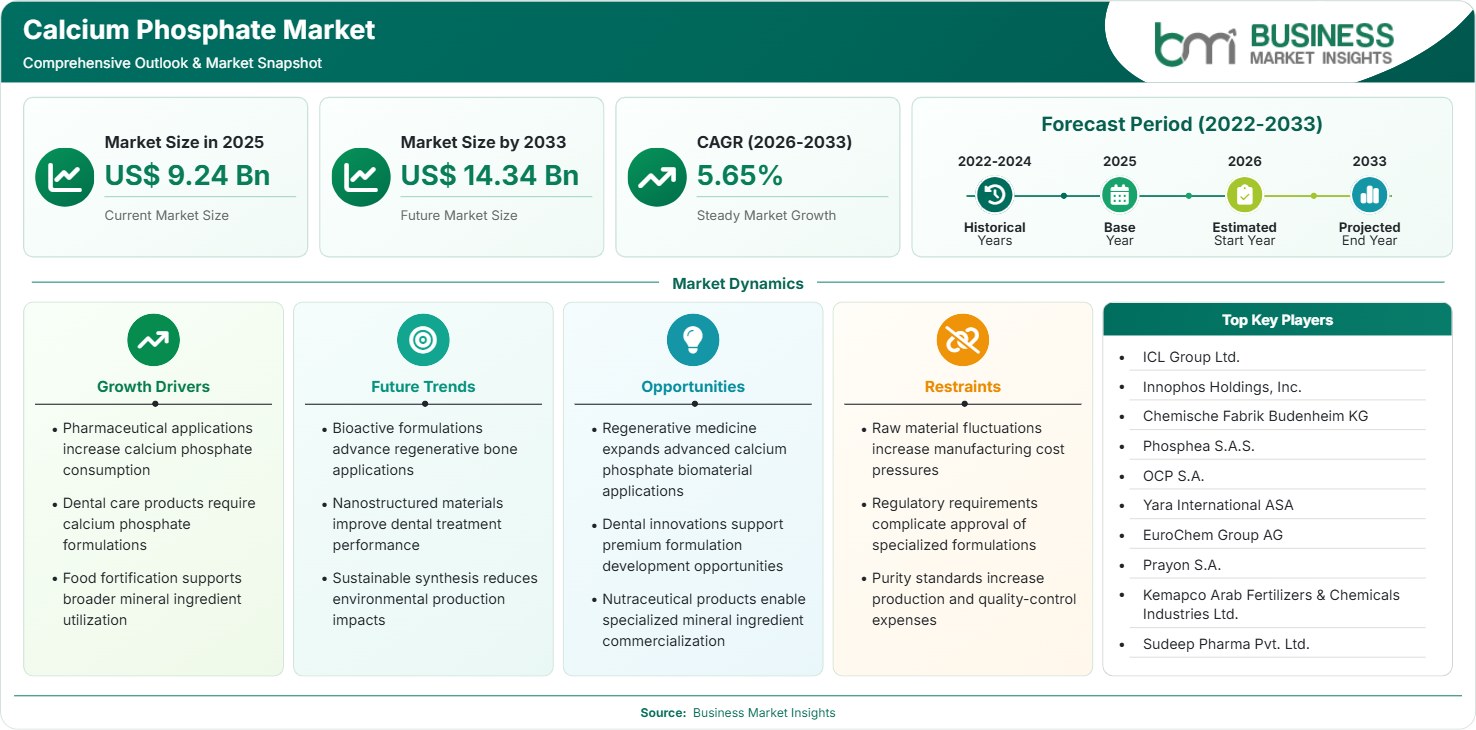
The Calcium Phosphate Market size was valued at US$ 9.24 Billion in 2025 and is projected to reach US$ 14.34 Billion by 2033, growing at a CAGR of 5.65% during 2026–2033, driven by pharmaceutical excipients, animal nutrition, food fortification, dental formulations, and specialty applications.

Report Coverage
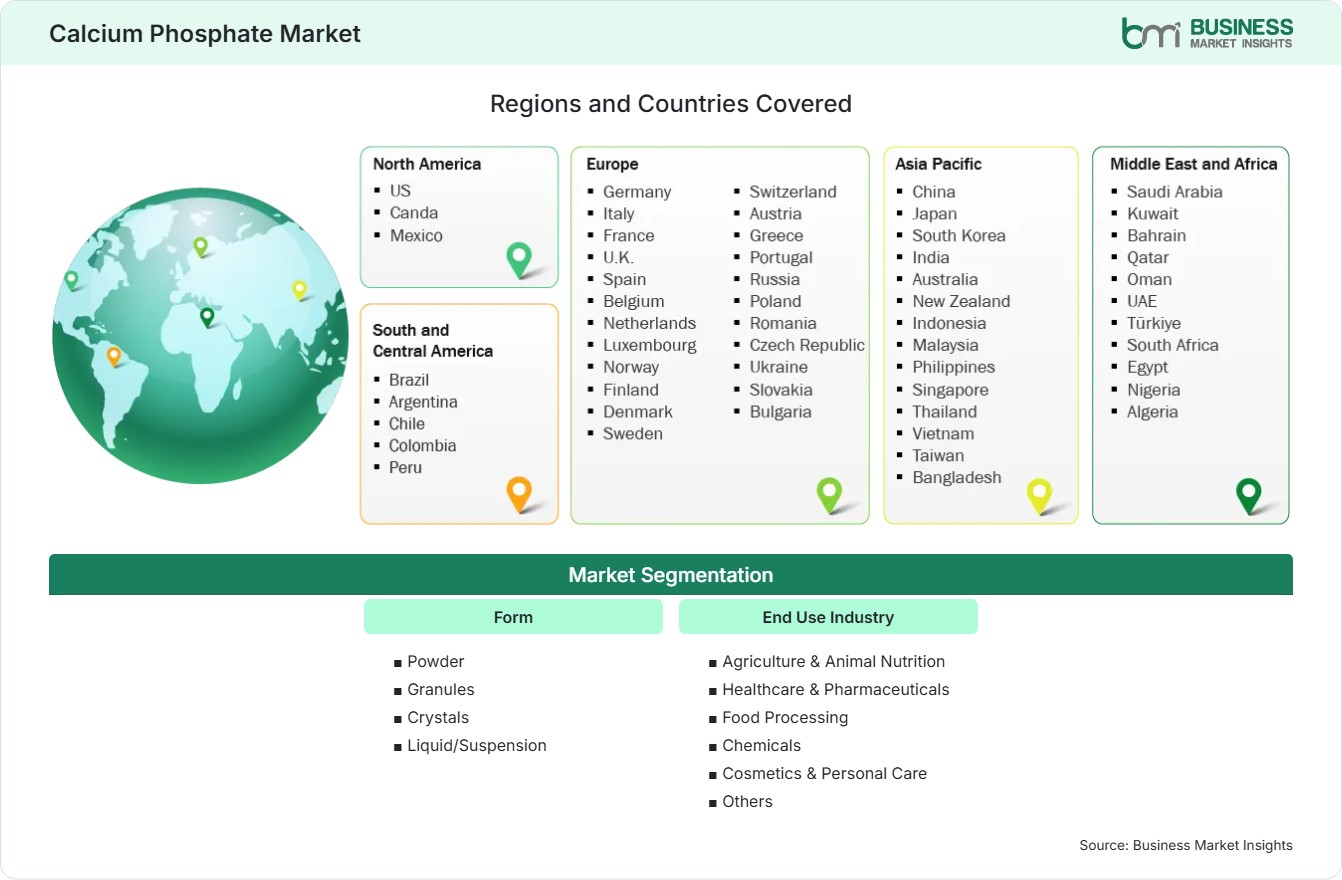
  • Form: Powder, Granules, Crystals, Liquid/Suspension
  • End Use Industry: Agriculture & Animal Nutrition, Healthcare & Pharmaceuticals, Food Processing, Chemicals, Cosmetics & Personal Care, Others
US$ 9.24 Bn Market size in 2025
US$ 14.34 Bn Market Size by 2033
5.65% CAGR, 2026 - 2033
2026-2033 Forecast Period

AI Overview

Calcium Phosphate Market Summary

  • North America Region: North America holds market share of 26%–29% in 2025, growing with a CAGR of 5.0%–5.4%, influenced by pharmaceutical manufacturing, dietary supplements, fortified foods, animal nutrition, and specialty ingredients. The US market is application-intensive, with a CAGR of 5.1%–5.5%, supported by pharmaceutical, nutrition, food, dental, and specialty chemical manufacturing.
  • Fastest Growing Region: Asia Pacific holds market share of 34%–38% in 2025, growing with a CAGR of 6.3%–6.8%, supported by livestock nutrition, agricultural inputs, pharmaceutical manufacturing, food processing, urbanization, rising nutritional consumption, and expanding specialty chemical capacity.
  • Leading Segment: Powder holds market share of 46%–50% in 2025, growing with a CAGR of 5.5%–5.9%, supported by pharmaceutical excipients, food fortification, animal feed, blending efficiency, controlled dosing, storage stability, and industrial compatibility.
  • High Growth Segment: Healthcare & Pharmaceuticals holds market share of 20%–24% in 2025, growing with a CAGR of 6.4%–6.9%, driven by mineral supplementation, direct-compression excipients, dental formulations, nutraceuticals, and high-purity pharmaceutical requirements.
  • Key Market Opportunity: High-purity excipients, clean-label food ingredients, advanced biomaterials, and mineral-enriched nutrition products create differentiated opportunities where functionality, compliance, traceability, and formulation performance support premium positioning.
  • Major Market Players: ICL Group Ltd., Innophos Holdings, Inc., Chemische Fabrik Budenheim KG, Phosphea S.A.S., OCP S.A., Yara International ASA, EuroChem Group AG, Prayon S.A., Kemapco Arab Fertilizers & Chemicals Industries Ltd., and Sudeep Pharma Pvt. Ltd.
Strategic Insights

Calcium Phosphate Market: Strategic Insights

Calcium Phosphate Market Strategic Framework
FREE PDF
Request your free sample
Request free sample
Stakeholder View

Key Takeaways

  • The value chain extends from phosphate rock and phosphoric acid producers to processors, specialty-grade manufacturers, distributors, formulators, and regulated end users. Feedstock integration remains strategically relevant because raw-material volatility can influence delivered costs and customer qualification.
  • Healthcare and pharmaceutical applications provide attractive value density because high-purity excipients offer greater technical differentiation than commodity grades. Direct-compression systems, mineral supplements, dental formulations, nutraceutical tablets, and fortified products broaden the application base.
  • Product development is moving toward multifunctional ingredients providing nutritional, processing, sensory, stability, or appearance benefits. Particle engineering, controlled purity, improved dispersibility, and application-specific grades are becoming important differentiators.
  • Asia Pacific combines large agricultural and livestock bases with expanding pharmaceutical and food-processing capacity. China and India are important demand centers, while Southeast Asia provides opportunities through feed, food, agriculture, and nutrition applications.
  • Competitive positioning increasingly depends on capacity optimization, specialty-grade manufacturing, geographic distribution, and strategic partnerships. Collaboration between manufacturers and distributors can expand access to specialized phosphate ingredients while improving regional availability.
  • Pharmaceutical and food customers increasingly evaluate suppliers on documentation, batch consistency, traceability, regulatory conformity, and technical support in addition to price. This raises entry barriers for producers targeting high-value applications.
Geographic Outlook

Calcium Phosphate Market Regional Highlights

North America Calcium Phosphate Market

North America represented 26%–29% share in 2025 and is projected to grow at 5.0%–5.4% CAGR through 2033. The region benefits from mature pharmaceutical manufacturing, dietary supplementation, animal nutrition, food processing, and oral-care industries. The United States accounts for most regional demand, while Canada contributes through nutrition, agriculture, and food applications. Calcium Phosphate Market share is supported by established specialty-ingredient supply chains. Market growth is increasingly linked to multifunctional ingredients, clean-label reformulation, and high-purity excipients.

  • Pharmaceutical excipient demand remains important as manufacturers seek direct-compression materials offering compressibility, flow, mineral functionality, and consistent tablet performance across specialized dosage forms.
  • Food reformulation is creating demand where manufacturers require whitening, leavening, buffering, mineral fortification, or texture functionality without substantially redesigning production processes.
  • Animal nutrition remains resilient because calcium and phosphorus are essential minerals in livestock and poultry diets, supporting skeletal development, productivity, reproductive performance, and balanced-feed formulation.
  • Technical service and regulatory documentation increasingly influence supplier selection among pharmaceutical and food customers requiring validated specifications and consistent manufacturing.

US Calcium Phosphate Market

The US Calcium Phosphate Market accounts for 72%–76% of North American demand in 2025 and is projected to expand at 5.1%–5.5% CAGR through 2033. Demand is distributed across pharmaceutical excipients, food ingredients, dietary supplements, animal nutrition, and dental products. Food reformulation is influencing specialty demand, while established ingredient manufacturers provide technical capabilities. The US also supports innovation because formulators can commercialize differentiated calcium-phosphate products through established food, nutrition, pharmaceutical, and personal-care channels.

  • Food manufacturers are evaluating calcium phosphate for mineral fortification, appearance, buffering, leavening, and processing functionality, creating opportunities for application-specific grades.
  • Pharmaceutical customers emphasize compressibility, flow, tablet hardness, dissolution behavior, and particle consistency, creating opportunities for suppliers with formulation-development capabilities.
  • Dietary supplements provide recurring demand because calcium and phosphorus remain established nutritional ingredients, while tablets, capsules, powders, and fortified beverages broaden formulation requirements.

Europe Calcium Phosphate Market

Europe Calcium Phosphate Market held a 24%-27% share in 2025 and is anticipated to register a CAGR of 4.7%-5.1% during 2033. Major demand hotspots include Germany, France, the UK, and Italy, with Germany and France being key countries from a pharmaceutical and food processing perspective. Stringent standards across the food, pharmaceutical, chemical, and environmental sectors define the European calcium phosphate market. As such, calcium phosphate suppliers compete on purity, documentation, application knowledge, and compliance.

  • Germany remains a major specialty-chemical and pharmaceutical manufacturing center, supporting demand for high-purity phosphate ingredients and functional excipients.
  • France benefits from animal nutrition and food-processing activity, supporting demand for phosphate-based mineral nutrition products and specialty ingredients.
  • The United Kingdom supports pharmaceutical, nutraceutical, food, and dental formulation demand, favoring suppliers capable of meeting stringent quality requirements.
  • European growth remains measured at 4.7%–5.1% CAGR, while premium applications provide opportunities for specification-driven suppliers.

Asia Pacific Calcium Phosphate Market

The Asia Pacific Calcium Phosphate Market held a share of around 34% - 38% in 2025 and is anticipated to register a 6.3% - 6.8% CAGR during the forecast period from 2026 to 2033. China, India, Japan, and South Korea are key demand regions, while India and Southeast Asia hold lucrative prospects. Rising output in livestock, farming, food processing, pharmaceutical manufacturing, and urban consumption drives demand in the region.

  • China combines fertilizer, animal-feed, food-processing, pharmaceutical, and chemical manufacturing capacity, creating diversified demand and opportunities for domestic specialty-grade production.
  • India offers high-growth potential as pharmaceutical manufacturing, food processing, animal nutrition, and agriculture expand across multiple industrial channels.
  • Japan and South Korea emphasize high-quality pharmaceutical, food, dental, and specialty chemical applications, supporting demand for tightly controlled grades.
  • Southeast Asia provides incremental demand through poultry, aquaculture, food manufacturing, agricultural inputs, and fortified nutrition products.

Rest of World Calcium Phosphate Market

Rest of World Calcium Phosphate Market share stood at 10%-13% in 2025 and is expected to expand at 5.2%-5.7% CAGR till 2033. South and Central America capitalize on agriculture, livestock, food processing, and fertilizer. Meanwhile, the growth in the Middle East & Africa depends on nutrition, food security, agriculture, and pharmaceuticals. Brazil emerges as one of the top opportunities, while Saudi Arabia and the chosen Gulf markets provide lucrative applications.

  • Brazil's agricultural and livestock economy supports calcium-phosphate demand across mineral nutrition and fertilizer-related applications, while food processing creates additional specialty-ingredient opportunities.
  • Mexico provides demand from food manufacturing, animal nutrition, and industrial applications, supported by proximity to North American supply chains.
  • Saudi Arabia is developing pharmaceutical and food-processing capabilities, creating opportunities for high-purity ingredients and specialty mineral suppliers.
  • South Africa and other African markets offer longer-term opportunities through livestock nutrition, agricultural productivity, food fortification, and pharmaceutical-sector development.
Global Market Geography
FREE PDF
Request your free sample
Request free sample
Segment Analysis

Calcium Phosphate Market Segmentation

Form

The form category will be headed by powder, accounting for 46%-50% market share in 2025 and growing at 5.5%-5.9% CAGR until 2033. The reason for powder’s success lies in its wide applicability in pharmaceutical, food, feed, chemical, and cosmetic formulations, due to its ability to enable blending, dosing, and formulation. Granules, crystals, and liquid/suspension products cater to specific processing needs, such as dust control, controlled dissolution, dispersibility, and handling efficiency. Calcium Phosphate Market trends increasingly favor grades engineered for downstream processes.

  • Powder: Powder dominates because fine particle material supports blending, tableting, fortification, feed premixes, and industrial processing while offering flexibility in dosage control and formulation design.
  • Granules: Granules improve flowability, reduce dust generation, and simplify automated handling, making them useful for pharmaceutical tableting, feed manufacturing, premixes, and consistent material distribution.
  • Crystals: Crystalline forms provide defined physical characteristics and controlled processing behavior, supporting pharmaceutical, chemical, laboratory, and nutritional applications where purity and consistency influence performance.
  • Liquid/Suspension: Liquid and suspension formats facilitate dispersion in beverages, coatings, formulations, and process streams where uniform mineral distribution and simplified downstream processing are important.

End Use Industry

The Healthcare and Pharmaceuticals sector is expected to account for 20%-24% of the market share in 2025 and to grow at a 6.4%-6.9% CAGR from 2025 through 2033. The Healthcare and Pharmaceuticals sector gains from pharmaceutical excipients, mineral supplements, dental products, and nutraceutical production. Agriculture and animal nutrition continue to be important volume-driven application markets, while food processing constitutes a range of functional applications. The chemicals, cosmetics, personal care, and industrial sectors ensure revenue diversification and reduce dependence on the individual application market cycle. Therefore, the Calcium Phosphate Market scope spans both commodity-volume and specialty-value applications.

  • Agriculture & Animal Nutrition: Demand is anchored by calcium and phosphorus requirements in livestock and poultry diets, alongside agricultural applications supporting productivity, mineral balance, skeletal development, and feed efficiency.
  • Healthcare & Pharmaceuticals: High-purity calcium phosphates serve as mineral sources, direct-compression excipients, diluents, and formulation components in tablets, capsules, nutraceuticals, and dental products.
  • Food Processing: Food manufacturers use calcium phosphates for mineral fortification, leavening, anticaking, buffering, texture management, and selected appearance-related applications.
  • Chemicals: Chemical applications rely on controlled composition and reactivity for specialty formulations, industrial intermediates, laboratory materials, and processing systems.
  • Cosmetics & Personal Care: Oral-care formulations use phosphate-based materials for remineralization, whitening, stain removal, tartar control, and sensitivity-related applications.
Market Forces

Calcium Phosphate Market Dynamics

Key Market Drivers

Expansion of Pharmaceutical and Nutraceutical Manufacturing

Pharmaceutical and nutraceutical manufacturing is strengthening Calcium Phosphate Market growth because calcium phosphate combines mineral functionality with excipient performance. Formulations of dicalcium and tricalcium phosphate grades find applications in direct compression, nutrition, dental, and pharmaceutical products. Increasing use of tablets, capsules, powders, gummies, premixes, and fortifications creates a growing need for predictability in flow properties, compressibility, dissolution, and mineral contribution. Significant consumption areas are found in the United States, Europe, India, China, and Japan. The pharmaceutical qualification process encourages further interaction with suppliers after approval. This enhances the premiumization of validated grades and aligns with market trends that emphasize purity, particle engineering, and formulation performance.

Rising Demand for Mineral-Enriched Animal Nutrition

Animal nutrition remains an integral driver of demand due to the need for calcium and phosphorus, key minerals for building and maintaining bone structure, supporting growth and reproduction, and promoting overall animal well-being. Feed phosphates are produced for the livestock, poultry, swine, dairy, and fish farming industries, which require minerals to improve their production capacity. An increase in commercial animal production leads to the demand for balanced feed. The Calcium Phosphate Market will further profit from the increased interest in efficient feeding and nutritional accuracy, especially in intensive feeding processes. This will be more so in the Asia-Pacific region, where large numbers of livestock and feed manufacturing capacities are located.

Clean-Label and Functional Food Reformulation

Food formulation has emerged as one of the innovation-driven drivers of demand, with food companies seeking multifunctional ingredients. Calcium phosphate can help provide minerals, leavening, anticaking, buffering, texturizing, and certain appearance-related functionalities. The current trend toward reformulation has created a growing need for multifunctional ingredients that help eliminate certain conventional additives without compromising processability. The multifunctionality drives greater demand for bakery products, confectionery, beverages, processed foods, and nutrition products. Suppliers can capitalize by doing application tests and providing technical literature. This trend is especially applicable when there is a need to simplify ingredient systems and improve nutrition or product appearance.

Key Market Opportunities

High-Purity Ingredients for Biopharmaceutical and Advanced Formulations

The high-purity demand for ingredients provides an opportunity to extend beyond traditional food and feed manufacturing applications into more sophisticated healthcare manufacturing. The manufacturing of biopharmaceuticals requires well-controlled raw materials, documentation, microbiology, and logistics. Suppliers capable of qualifying their materials for grades, technical information, and particle behavior would be able to supply their clients much earlier in the product development process and support them throughout commercial production. This is because it allows for premium pricing, as the demands involved are a strong barrier to quick switching. Logistical concepts based on regional stockholding and logistics partnerships will provide a high level of service to North American, European, and traditional Asian biopharmaceutical customers.

Specialty Food Ingredients for Waste Reduction

Reducing food waste opens up opportunities for phosphate-based functional ingredients, whose roles in preservation, texture stabilization, and shelf-life management can help decrease the amount of food product wasted. Calcium phosphates and other phosphate compounds could contribute to food-processing functionality by providing stability and improved processing efficiency. Given the need to reduce waste generation during manufacturing and distribution, functional ingredients that ensure stable product properties would provide additional economic benefits beyond procurement costs. In such cases, opportunities will be more relevant when shelf-life extension adds to either transportation capabilities or to reduced retail waste.

Regional Manufacturing and Application Development in Asia Pacific

Asia Pacific offers an investment opportunity because demand growth spans several end-use industries simultaneously. India combines pharmaceutical manufacturing, agriculture, animal nutrition, and food processing, while China provides large-scale chemical, fertilizer, feed, pharmaceutical, and food-processing ecosystems. Local manufacturing reduces logistics risk, improves lead time, and enables customer grades. Investments in granulation, particle engineering, purification, and application labs will help regional players move towards more value-added product lines. The Calcium Phosphate Market forecasts that technical sales teams will enable the localization of formulations due to differences in food, pharmaceutical, and nutritional demands across markets. Regional manufacturing, therefore, provides volume growth and margin growth through specialized grades.

Market Restraints and Challenges

Feedstock Volatility and Supply-Chain Exposure

Factor: The production of calcium phosphate relies on the availability of phosphate rock, phosphoric acid, sources of calcium, energy, and processing chemicals, as well as transport, whose prices may vary depending on geopolitical conditions and production capacity at the source. Impact: Variability in input costs may reduce the producer's profit margins and increase the consumer's purchase costs; this may lead consumers to maintain multiple sources and hold larger inventories. Larger, integrated producers of phosphate products can hedge against input risk by having their own upstream sources and geographic diversification, whereas smaller producers may be more susceptible to variability in input prices. Pharmaceutical and food industry consumers can be highly affected by disruptions due to the qualifications involved in sourcing.

Regulatory and Environmental Constraints on Phosphate Applications

Factor: Phosphate usage is governed by regulations that pertain to food, pharmaceuticals, the environment, fertilizers, and chemicals, and which differ from place to place. Moreover, the regulation of nutrient release and some food additives can affect allowable uses. Impact: The differences in regulation raise qualification costs, delay product release, and might limit demand for the application in question. It is necessary for suppliers to stay up to date on requirements regarding specifications, registrations, safety information, and qualifications for certain applications. There may be new opportunities in food reformulations; however, regulatory approval is necessary for their commercialization. In addition, agricultural applications may face environmental restrictions due to nutrient overuse, which affects water quality.

Company Analysis

Competitive Landscape

The Calcium Phosphate Market analysis indicates a diversified competitive structure combining integrated phosphate producers, specialty chemical manufacturers, pharmaceutical ingredient suppliers, and animal-nutrition specialists. Competitive differentiation increasingly centers on purity, application performance, geographic availability, regulatory documentation, technical service, and supply reliability.

Company Name

Overview

Products and Services relevant to this market

ICL Group Ltd.

Global specialty minerals producer with integrated phosphate capabilities and broad food, agriculture, animal nutrition, and healthcare exposure.

Calcium phosphates, food phosphates, animal-feed phosphates, pharmaceutical-grade minerals, specialty ingredients, and formulation support.

Innophos Holdings, Inc.

Specialty phosphate and ingredient manufacturer serving food, pharmaceutical, nutrition, and industrial customers through application-focused portfolios.

Monocalcium phosphate, dicalcium phosphate, tricalcium phosphate, pharmaceutical excipients, food ingredients, and specialty phosphate solutions.

Chemische Fabrik Budenheim KG

Specialty chemical manufacturer with strong pharmaceutical and food ingredient capabilities and international production and distribution coverage.

Pharmaceutical phosphate excipients, food phosphates, mineral ingredients, high-purity products, and application-specific formulation support.

Phosphea S.A.S.

Specialist mineral nutrition company focused on phosphate solutions for animal feed and livestock nutrition applications.

Feed phosphates, calcium and phosphorus mineral solutions, animal nutrition products, technical services, and formulation expertise.

OCP S.A.

Integrated phosphate producer with substantial upstream resources and downstream fertilizer and phosphate-processing capabilities.

Phosphate-derived products, agricultural nutrients, specialty phosphates, industrial materials, and integrated supply-chain solutions.

Yara International ASA

Global crop nutrition company with extensive fertilizer and agricultural-input capabilities serving professional growers worldwide.

Phosphate-containing agricultural nutrients, crop nutrition products, agronomic services, and fertilizer-related solutions.

EuroChem Group AG

International fertilizer and chemical producer with integrated mineral-resource and production capabilities across multiple regions.

Phosphate fertilizers, mineral nutrients, industrial phosphate products, and agricultural supply-chain solutions.

Prayon S.A.

Specialty phosphate producer serving food, pharmaceutical, technical, and industrial markets with application-specific materials.

Calcium phosphates, food phosphates, pharmaceutical-grade phosphates, technical phosphates, and specialty mineral solutions.

Kemapco Arab Fertilizers & Chemicals Industries Ltd.

Jordan-based fertilizer and phosphate producer serving agricultural and industrial customers through integrated regional operations.

Phosphate-based fertilizers, calcium-related mineral products, agricultural nutrients, and industrial phosphate applications.

Sudeep Pharma Pvt. Ltd.

India-based pharmaceutical ingredient manufacturer focused on mineral salts and specialty ingredients for regulated applications.

Pharmaceutical-grade calcium phosphates, mineral excipients, nutritional ingredients, specialty salts, and formulation support.

Trust & Transparency

Research Methodology

The market analysis combines proprietary research with secondary data from government agencies, company disclosures, regulatory filings, industry databases and expert interviews. Market estimates are validated through data triangulation, cross-market benchmarking and analyst review.

View Full Research Methodology

Questions Answered

Frequently Asked Questions

What role does calcium phosphate play in dental products?

As per the Calcium Phosphate Market report, Calcium phosphate materials can support tooth remineralization, whitening, stain removal, tartar control, and sensitivity-related formulations. Their compatibility with oral-care systems makes them relevant to toothpaste, gels, mouthwashes, and related dental products.

How can manufacturers reduce supply-chain risk?

Manufacturers can diversify qualified suppliers, maintain strategic inventories, establish alternative feedstock sources, use regional distribution hubs, and qualify equivalent grades before disruptions occur. Dual sourcing is particularly relevant for pharmaceutical and food customers with limited tolerance for formulation changes.

Which applications can create premium pricing?

High-purity pharmaceutical excipients, nutraceutical ingredients, specialty food additives, dental materials, and application-specific grades generally provide more scope for value-based pricing than bulk commodity uses because customers require documented performance, regulatory conformity, and technical support.

Why does particle engineering matter for pharmaceutical applications?

Particle engineering affects flow, die filling, compressibility, tablet hardness, dissolution, and manufacturing efficiency. Granular and powder grades can therefore deliver different processing outcomes even when their chemical composition is similar, making grade selection an important formulation decision.

What product characteristics are most important when purchasing calcium phosphate?

Purity, particle-size distribution, moisture, bulk density, flowability, mineral assay, heavy-metal limits, microbiological quality, regulatory status, and batch consistency are central purchasing criteria. Pharmaceutical and food customers typically apply more stringent specifications than commodity feed or industrial buyers.

Access the Full Calcium Phosphate Market Report

Get segment-level forecasts, regional estimates, competitive benchmarking, company profiles and downloadable Excel datasets.

Access the full Calcium Phosphate Market Report
350 pages PDF & Excel | 2026-09-28
Similar Research

Related Market Reports