
Calcium Carbonate Market Outlook: Size, Share, Trends, Growth Analysis, Competitive Landscape & Forecast, 2026-2033

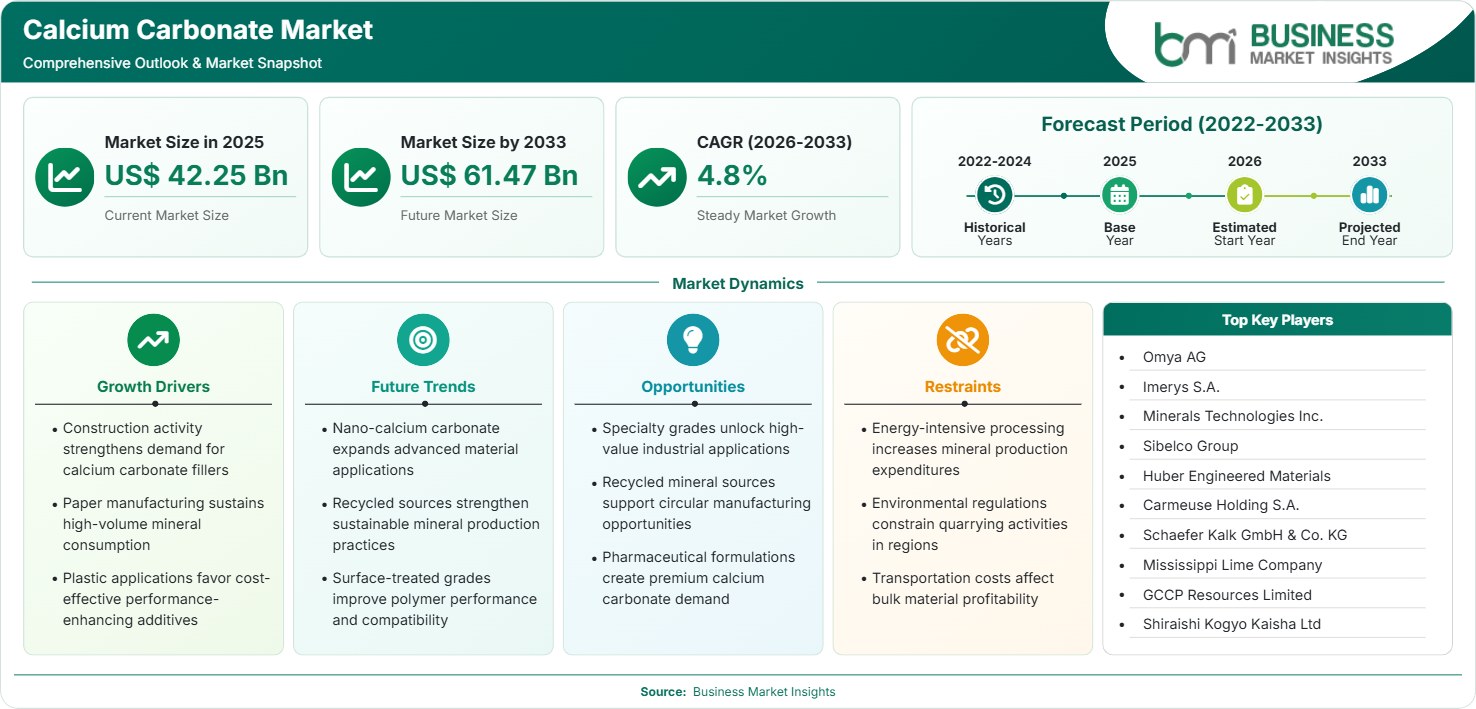
The Calcium Carbonate Market size was valued at US$ 42.25 Billion in 2025 and is projected to reach US$ 61.47 Billion by 2033, growing at a CAGR of 4.8% during 2026–2033. Key growth drivers include construction material demand, plastics compounding expansion, paper coating applications, and pharmaceutical use, while opportunities emerge from sustainable fillers, specialty PCC grades, and advanced industrial manufacturing growth.

Report Coverage
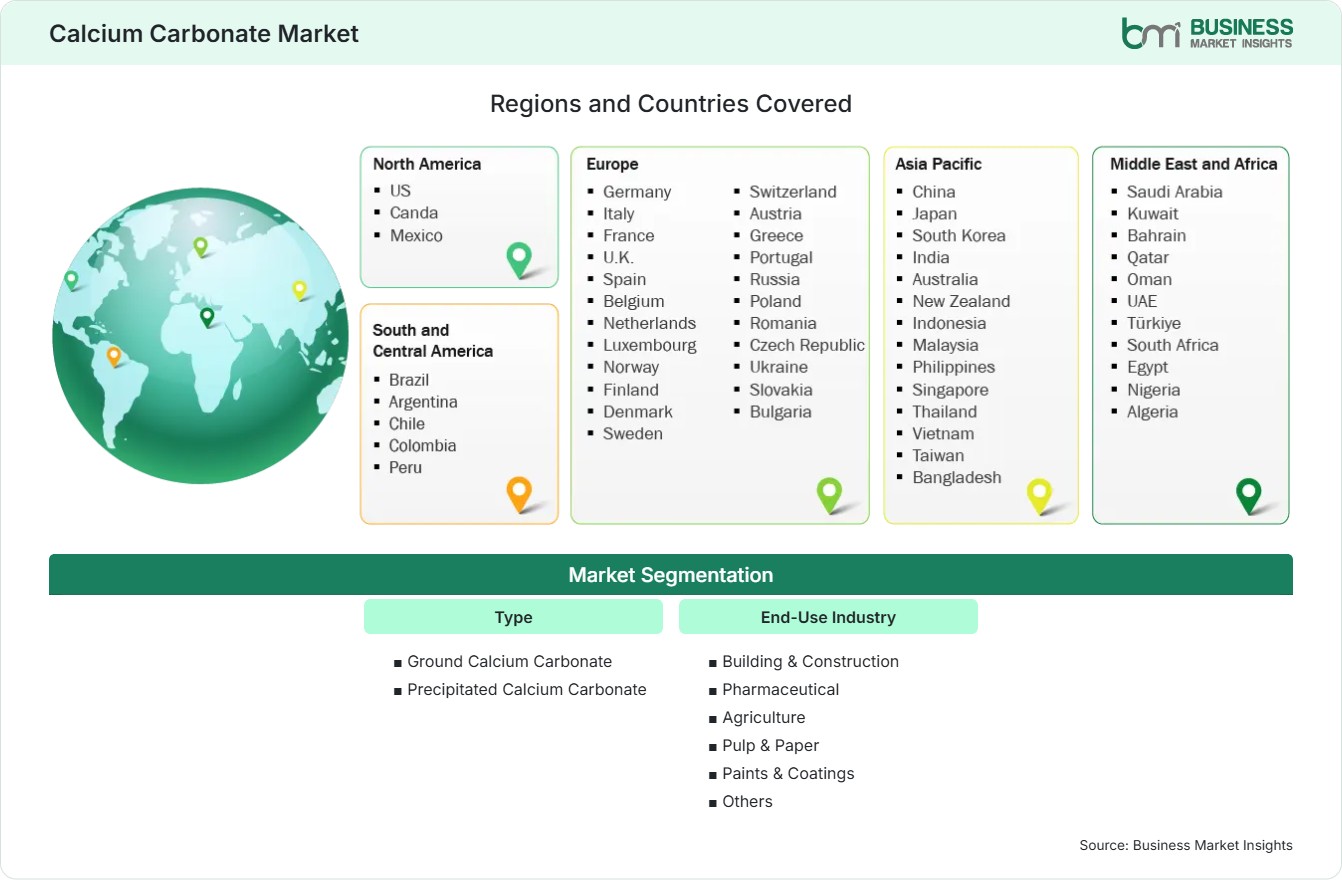
  • Type: Ground Calcium Carbonate, Precipitated Calcium Carbonate
  • End-Use Industry: Building & Construction, Pharmaceutical, Agriculture, Pulp & Paper, Paints & Coatings, Others
US$ 42.25 Bn Market size in 2025
US$ 61.47 Bn Market Size by 2033
4.8% CAGR, 2026 - 2033
2026-2033 Forecast Period

AI Overview

Calcium Carbonate Market Summary

  • North America Region: North America holds a 24%–27% share in 2025, growing at a CAGR of 3.8%–4.2% during 2026–2033. Drivers include infrastructure rehabilitation, specialty paper applications, plastics demand, and pharmaceutical-grade mineral consumption. US market benefits from construction modernization, industrial mineral integration, and packaging sector demand, advancing at approximately 4.0%–4.4% CAGR.
  • Fastest Growing Region: Asia Pacific accounts for 39%–43% share in 2025 and is projected to expand at a CAGR of 5.8%–6.3% through 2033. Manufacturing expansion, urbanization, packaging demand, mining investments, and construction materials consumption continue supporting long-term capacity additions.
  • Leading Segment: Ground Calcium Carbonate holds 68%–72% share in 2025 and grows at a CAGR of 4.4%–4.8%. Cost efficiency, abundant limestone reserves, plastics applications, paints usage, and paper industry requirements reinforce large-scale industrial adoption across regions.
  • High Growth Segment: Pharmaceutical end-use accounts for 8%–11% share in 2025 and is forecast at 5.8%–6.4% CAGR. Rising healthcare expenditure, nutraceutical production, tablet formulation demand, and high-purity mineral requirements accelerate specialty product consumption.
  • Key Market Opportunity: Expanding adoption of engineered and surface-treated mineral fillers in lightweight plastics, sustainable packaging, advanced coatings, and specialty healthcare applications creates attractive value-added opportunities for global producers.
  • Major Market Players: Omya AG, Imerys S.A., Minerals Technologies Inc., Sibelco Group, Huber Engineered Materials, Carmeuse Holding S.A., Schaefer Kalk GmbH & Co. KG, Mississippi Lime Company, GCCP Resources Limited, and Shiraishi Kogyo Kaisha Ltd.
Strategic Insights

Calcium Carbonate Market: Strategic Insights

Calcium Carbonate Market Strategic Framework
FREE PDF
Request your free sample
Request free sample
Stakeholder View

Key Takeaways

  • The value chain in the industry is still very integrated, with limestone quarry operators, processing plants, logistics companies, compounders, and manufacturers of the final products being linked together in the construction, packaging, healthcare, and paper sectors.
  • The best potential for profit is to be found in pharmaceutical formulations, specialty coatings, engineered plastics, and high-grade precipitated products since the purity requirements and performance features allow for higher margins.
  • Increasing emphasis is now being placed on product innovation involving nano-sized particles, surface-treated grades, controlled particle distribution, and enhanced dispersion technologies since these contribute to better application performance and improved processing efficiency.
  • The most attractive option for long-term investment is offered by the Asia Pacific region because of the industrialization taking place there, the growth in construction, the increasing consumption of packaging, and the expanding manufacturing ecosystems in China, India, Indonesia, and Vietnam.
  • Strategic acquisitions, the expansion of quarry operations, downstream integration and investments in specialty mineral technology are still having an effect on companies' competitive positions as they seek out scale and product portfolios that add value.
  • Sustainability initiatives, such as the use of lower-emission processing methods and resource optimization schemes, are now becoming important factors in the way industrial customers make their procurement decisions.
Geographic Outlook

Calcium Carbonate Market Regional Highlights

North America Calcium Carbonate Market

North America represents 24%–27% of global demand in 2025 and is projected to expand at a CAGR of 3.8%–4.2% through 2033. The region benefits from mature industrial infrastructure, strong coatings consumption, packaging requirements, and healthcare manufacturing. The Calcium Carbonate Market share remains supported by specialty applications, including pharmaceuticals and engineered plastics. Infrastructure modernization spending and advanced manufacturing investments continue to support stable long-term consumption despite relatively mature end-use sectors.

  • The need for fillers used in sealants, coatings, compounds, and building materials rises across the major industrial markets due to construction rehabilitation projects.
  • Packaging manufacturers are now more and more using performance mineral additives in order to cut costs without compromising product strength or processing efficiency.
  • The expansion of pharmaceutical manufacturing leads todemandmand for high-purity grathat meett have to meet strict compliance standards.
  • Sustainability programmes promote substitution strategies which involve the use of mineral fillers in polymer and packaging formulations.

US Calcium Carbonate Market

The United States accounts for 76%–80% of regional Calcium Carbonate Market demand and advances at a CAGR of 4.0%–4.4%. Growth is supported by infrastructure investment programs, industrial packaging requirements, and pharmaceutical manufacturing expansion. Domestic producers continue emphasizing higher-value specialty products rather than commodity-focused volume growth. Regional consumption patterns also benefit from strong coatings, plastics, and construction renovation activities.

  • Modernising the processing of industrial minerals leads to better consistency of the product and higher production efficiency throughout manufacturing networks.
  • The increase in healthcare production leads to greater demand for pharmaceutical-grade materials used in making tablets and nutritional supplements.
  • The use of treated mineral fillers is encouraged in more advanced applications of polymer compounding.
  • Spending on construction maintenance continues to play a key role in long-term consumption.

Europe Calcium Carbonate Market

Europe maintains a 22%–25% Calcium Carbonate Market share and records a CAGR of 3.6%–4.1% through 2033. Germany remains the leading country with growth near 3.8%–4.2%, while Eastern European markets demonstrate faster expansion around 4.8%–5.3%. Demand is supported by sustainability-focused manufacturing, paper applications, industrial coatings, and specialty mineral technologies. Regulatory emphasis on recyclable materials also supports substitution opportunities.

  • Germany takes the lead in regional producits tion as a result of its advintegration of specialty chemicalstegration of specialty chemicals.
  • Poland and Romania are among the relatively more rapidly growing industrial consumers, the growth being supported by investments in manufacturing.
  • The push to implement a circular economy helps to increase the use of mineral fillers in packaging applications.
  • Demand for specialty PCC is rising in the paper and healthcare industries.
  • Energy-efficient processing investments still form the heart of competitive strategies.

Asia Pacific Calcium Carbonate Market

Asia Pacific accounts for 39%–43% share in 2025 and posts the strongest CAGR of 5.8%–6.3%. China remains the largest consumer, while India records among the highest growth rates at approximately 6.3%–6.8%. Strong Calcium Carbonate Market growth stems from industrialization, urban development, packaging demand, plastics production, and infrastructure expansion. Extensive limestone reserves further reinforce regional competitiveness.

  • China's dominance in regional consumption is due to its large manufacturing base and the wide range of industrial applications.
  • India gains as a result of investment in infrastructure, ongoing construction activity, and the growing demand for plastics.
  • Investment in processing and manufacturing is increasingly being attracted to Southeast Asia.
  • The production of packaging and consumer goods is still causing a great demand for mineral fillers.
  • Local producers expand capacity to meet rising domestic and export demand.

Rest of World Calcium Carbonate Market

The rest of the world represents 10%–13% of the calcium carbonate market demand and grows at a CAGR of 4.5%–5.0%. South and Central America benefit from agricultural, packaging, and construction applications, while the Middle East and Africa markets are supported by infrastructure investments and industrial diversification. Brazil leads Latin America, whereas Saudi Arabia and the UAE drive regional growth within the Middle East.

  • Brazil enjoys high levels of consumption in the areas of paper, agriculture, and packaging industry.
  • Saudi Arabia is implementing initiatives in infrastructure and industry to increase demand.
  • The availability of minerals enhances the appeal of an area for investment.
  • In selected countries the addition to local production capacity leads to a reduction in dependence on imports.
  • The construction and coatings industries are still the main contributors to long-term demand.
Global Market Geography
FREE PDF
Request your free sample
Request free sample
Segment Analysis

Calcium Carbonate Market Segmentation

Type

Type-based demand reflects varying performance requirements across industrial applications. This segment defines a significant Calcium Carbonate Market scope because manufacturers select products based on purity, particle characteristics, and application performance. Ground Calcium Carbonate represents 68%–72% share in 2025 with a CAGR of 4.4%–4.8%, while specialty precipitated grades support higher-value expansion opportunities.

  • Ground Calcium Carbonate: Widely used across construction materials, plastics, paper, and paints because of cost efficiency, abundant availability, and favorable processing characteristics supporting large-scale industrial consumption.
  • Precipitated Calcium Carbonate: Preferred for specialty applications requiring controlled particle size, enhanced brightness, superior purity, and improved performance in pharmaceuticals, paper coatings, and advanced industrial formulations.

End-Use Industry

End-use diversification reduces exposure to individual industry cycles and strengthens overall demand resilience. Building and construction remains the leading category with 28%–32% share and a CAGR of 4.2%–4.7%. Pharmaceutical applications represent the fastest-growing segment with a CAGR of 5.8%–6.4%. Emerging Calcium Carbonate Market trends increasingly favor higher-purity and performance-engineered grades.

  • Building & Construction: Demand is driven by cementitious products, sealants, adhesives, architectural coatings, and polymer-based construction materials requiring economical filler solutions.
  • Pharmaceutical: High-purity grades support tablet formulations, dietary supplements, antacid products, and healthcare manufacturing requiring stringent quality and consistency standards.
  • Agriculture: Applications include soil conditioning, acidity management, nutrient optimization, and crop productivity improvement across diverse agricultural systems.
  • Pulp & Paper: Utilized for brightness enhancement, opacity improvement, printability performance, and production efficiency within paper manufacturing operations.
  • Paints & Coatings: Producers employ mineral fillers to improve durability, covering properties, rheology control, and overall formulation economics.
Market Forces

Calcium Carbonate Market Dynamics

Key Market Drivers

Expansion of Global Construction and Infrastructure Activity

Infrastructure programs across Asia, North America, and the Middle East continue supporting sustained demand for calcium carbonate used as a mineral filler in building materials, coatings, adhesives, and sealants. Construction expenditure remains elevated across several emerging economies as governments and private developers invest in transportation networks, housing, commercial buildings, and other infrastructure projects. Rising urbanization and housing development further stimulate consumption across multiple downstream sectors. Calcium carbonate offers cost-effective material solutions that can improve processing characteristics and product performance. In mature economies, renovation, repair, and maintenance activities also contribute to steady industrial consumption. These combined factors support long-term Calcium Carbonate Market growth.

Growing Consumption in Plastics and Packaging Industries

Plastic producers are now more and more using calcium carbonate as a mineral additive in order to control the cost of their formulations while at the same time enhancing certain mechanical and processing properties. This demand is especially noticeable in the case of packaging films, injection-molded items, pipes, and a wide range of consumer products. The companies are also creating grades with treated surfaces to improve compatibility and dispersion in various polymer matrices, enabling manufacturers to achieve more uniform product performance. The growing demand for packaged foods, the expansion of e-commerce logistics, and the increased production of consumer products are helping to promote greater use of calcium carbonate in both packaging and other plastic applications.

Healthcare and Nutraceutical Manufacturing Expansion

The growing proportion of the population, along with increasing awareness of nutrition and the ongoing expansion of the pharmaceutical and nutraceutical manufacturing industries, is leading to greater demand for high-purity grades of calcium carbonate. Since materials used in pharmaceuticals have to meet strict specifications, drug manufacturers need to ensure consistent product quality, comply with regulatory requirements, and have reliable supply chains. Calcium carbonate is used in a variety of products, including antacids, calcium supplements, and pharmaceutical excipients, which is driving demand in both the healthcare and nutritional sectors. At the same time, the wider availability of healthcare in developing economies is creating more consumption opportunities as pharmaceutical production rises and consumer awareness increases.

Key Market Opportunities

Development of High-Performance Surface-Treated Grades

Advanced processing technologies are enabling manufacturers to develop specialty calcium carbonate products with improved dispersion, compatibility, and functional performance. Surface-treated grades can provide greater formulation flexibility and support applications where standard commodity products may not deliver the required characteristics. These solutions are gaining opportunities across engineering plastics, automotive components, high-performance coatings, and other technically demanding applications. Manufacturers that invest in research and development can improve product differentiation and potentially achieve stronger margins while reducing exposure to commodity price fluctuations. As customers increasingly seek materials designed for specific performance requirements, future-focused Calcium Carbonate Market Forecasts are expected to highlight value-added and surface-treated products as important avenues for revenue expansion.

Growth in Sustainable Packaging Solutions

Packaging manufacturers are now seeking solutions and formulating solutions that will enhance performance while at the same time helping to achieve resource-efficiency and sustainability goals. Mineral fillers like calcium carbonate can be used to improve polymer utilization in certain packaging applications, thus offering possibilities as producers aim to boost material efficiency. The flexible packaging, rigid container, and consumer goods sectors all have a wide range of uses for these solutions. Moreover, the combined effect of growing regulatory pressure and industry-led efforts to promote recyclable and more resource-efficient materials is increasing the emphasis on better packaging formulations. Companies that create calcium carbonate grades and formulations tailored to specific applications can take advantage of the changing requirements in the packaging field and the rising demand for materials that combine good performance, affordability, and sustainability.

Emergence of Specialty Industrial Applications

New possibilities are now appearing for the use of calcium carbonate in advanced coatings, engineered composites, 3D printing materials, technical polymers, and other specialized industrial applications. Buyers in these sectors are increasingly asking for customized particle distributions, controlled properties, and specific functional performance appropriate to their particular manufacturing processes. Since in contrast to many of the standard applications specialty markets can offer higher margins due to customers placing more importance on consistency, technical performance, and requirements tailored to the application rather than just on price, companies that have advanced processing capabilities are able to distinguish their products and build stronger relationships with specialized end users. Furthermore, industrial diversification in the emerging economies is opening up new routes for market penetration, promoting the uptake of premium products and thereby expanding the total market size.

Market Restraints and Challenges

Energy and Mining Cost Volatility and Margin Pressure

Energy-intensive processing and mineral extraction activities expose producers to fluctuating operating costs. Impact: Rising fuel, electricity, and logistics expenses can compress profit margins and increase product pricing uncertainty. Companies with limited scale or lower operational efficiency may face competitive disadvantages during periods of elevated cost inflation. Supply chain disruptions can further amplify expenses and affect procurement planning.

Environmental Compliance Requirements and  Capital Burden

Mining operations and mineral processing facilities are subject to increasingly stringent environmental regulations. Impact: Compliance investments associated with emissions management, land rehabilitation, and operational monitoring can increase capital expenditure requirements. Smaller manufacturers may experience challenges maintaining competitiveness when regulatory obligations expand. Long approval timelines for capacity additions can additionally delay market expansion projects.

Company Analysis

Competitive Landscape

The competitive environment is characterized by global mineral specialists, quarry operators, and specialty materials suppliers. Current Calcium Carbonate Market analysis indicates that scale, resource access, processing technology, and specialty product capabilities remain the primary competitive differentiators.

Company Name

Overview

Products and Services relevant to this market

Omya AG

Global industrial minerals producer with extensive quarry and processing operations.

Ground and precipitated calcium carbonate for paper, plastics, coatings, and healthcare.

Imerys S.A.

Multinational specialty minerals company serving diversified industrial sectors.

Functional mineral solutions, GCC products, fillers, and industrial additives.

Minerals Technologies Inc.

Leading specialty minerals and PCC technology provider.

PCC systems, engineered minerals, performance additives, and paper solutions.

Sibelco Group

International materials solutions supplier with global mining assets.

Industrial minerals, fillers, and processed calcium carbonate materials.

Huber Engineered Materials

Specialty materials manufacturer focused on industrial performance products.

Calcium carbonate grades for plastics, coatings, and industrial applications.

Carmeuse Holding S.A.

Global lime and mineral products producer.

Processed calcium carbonate and industrial mineral solutions.

Schaefer Kalk GmbH & Co. KG

European mineral specialist with diversified product portfolio.

High-purity mineral products and specialty carbonate solutions.

Mississippi Lime Company

North American producer serving industrial and specialty markets.

Mineral fillers, performance additives, and industrial-grade products.

GCCP Resources Limited

Regional producer focused on quarrying and mineral processing.

Ground calcium carbonate products for construction and industrial sectors.

Shiraishi Kogyo Kaisha Ltd.

Japanese specialty materials company.

Precipitated calcium carbonate and functional industrial materials.

Trust & Transparency

Research Methodology

The market analysis combines proprietary research with secondary data from government agencies, company disclosures, regulatory filings, industry databases and expert interviews. Market estimates are validated through data triangulation, cross-market benchmarking and analyst review.

View Full Research Methodology

Questions Answered

Frequently Asked Questions

Which end-use segment offers the highest growth potential?

Pharmaceutical applications provide strong opportunities because of rising supplement demand, healthcare access expansion, and increasing use of high-purity mineral ingredients.

What does a Calcium Carbonate Market Report typically evaluate?

It examines market size, growth outlook, regional demand patterns, competitive positioning, technology developments, end-use industries, and investment opportunities across the value chain.

Why is precipitated material gaining attention?

Its controlled particle size, purity, brightness, and performance characteristics make it attractive for pharmaceuticals, specialty paper, advanced coatings, and high-value industrial applications.

Which region is expected to expand the fastest through 2033?

Asia Pacific is projected to record the fastest growth due to industrialization, urbanization, infrastructure spending, packaging demand, and manufacturing capacity expansion.

What factors most influence demand across industries?

Construction, plastics, packaging, paper, coatings, agriculture, and pharmaceuticals collectively determine consumption levels. Infrastructure investment and manufacturing activity are especially important demand indicators.

Access the Full Calcium Carbonate Market Report

Get segment-level forecasts, regional estimates, competitive benchmarking, company profiles and downloadable Excel datasets.

Access the full Calcium Carbonate Market Report
350 pages PDF & Excel | 2026-09-16
Similar Research

Related Market Reports