Market Summary
Executive Summary and Global Market Analysis
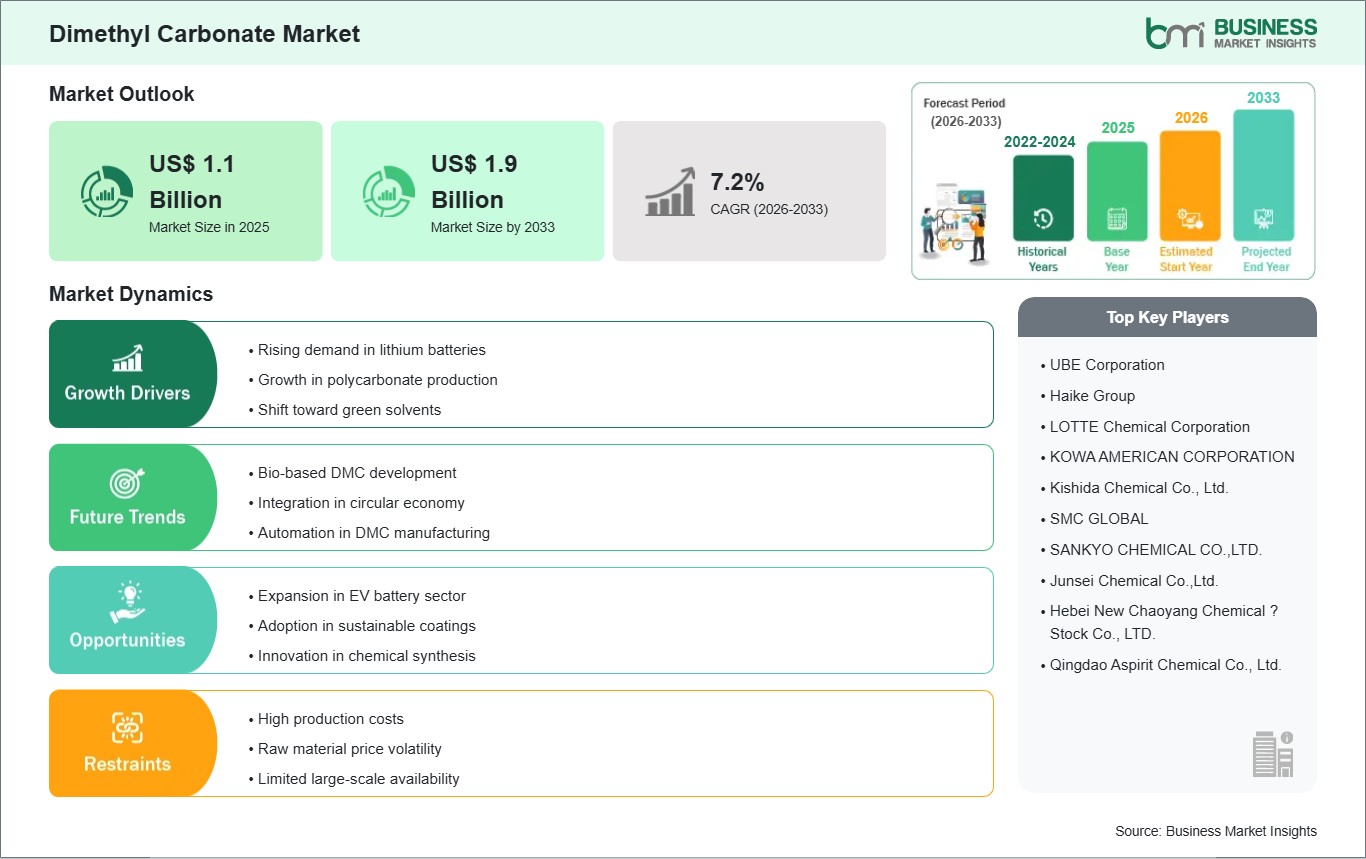
Dimethyl Carbonate (DMC) is a versatile, colorless, and non-toxic organic compound widely recognized for its role as an eco-friendly solvent and a critical chemical intermediate. Its unique properties make it an attractive alternative to hazardous chemicals such as phosgene and methyl ethyl ketone (MEK), aligning with global sustainability initiatives. DMC is increasingly used in high-value applications, including lithium-ion battery electrolytes, pharmaceutical synthesis, and polycarbonate production.
Despite its growing relevance, the market faces notable challenges. Conventional production methods often rely on hazardous raw materials like phosgene and carbon monoxide, creating safety and waste management concerns. These issues, coupled with stringent environmental regulations, can limit adoption in regions with strict compliance norms. Additionally, the need for high-purity grades in battery applications adds complexity and cost to manufacturing processes.
However, the opportunities far outweigh these challenges. The surge in electric vehicle adoption and the corresponding demand for lithium-ion batteries has positioned battery-grade DMC as a critical enabler of next-generation energy storage solutions. Furthermore, the global transition toward green chemistry and phosgene-free production routes, such as methanol carbonylation and transesterification, offers cost efficiency and scalability. Emerging applications in coatings, adhesives, and advanced plastics, combined with regulatory incentives for sustainable solvents, underscore DMC's potential as a cornerstone of clean technology and high-performance materials.
Segment Analysis
Dimethyl Carbonate Market Segmentation
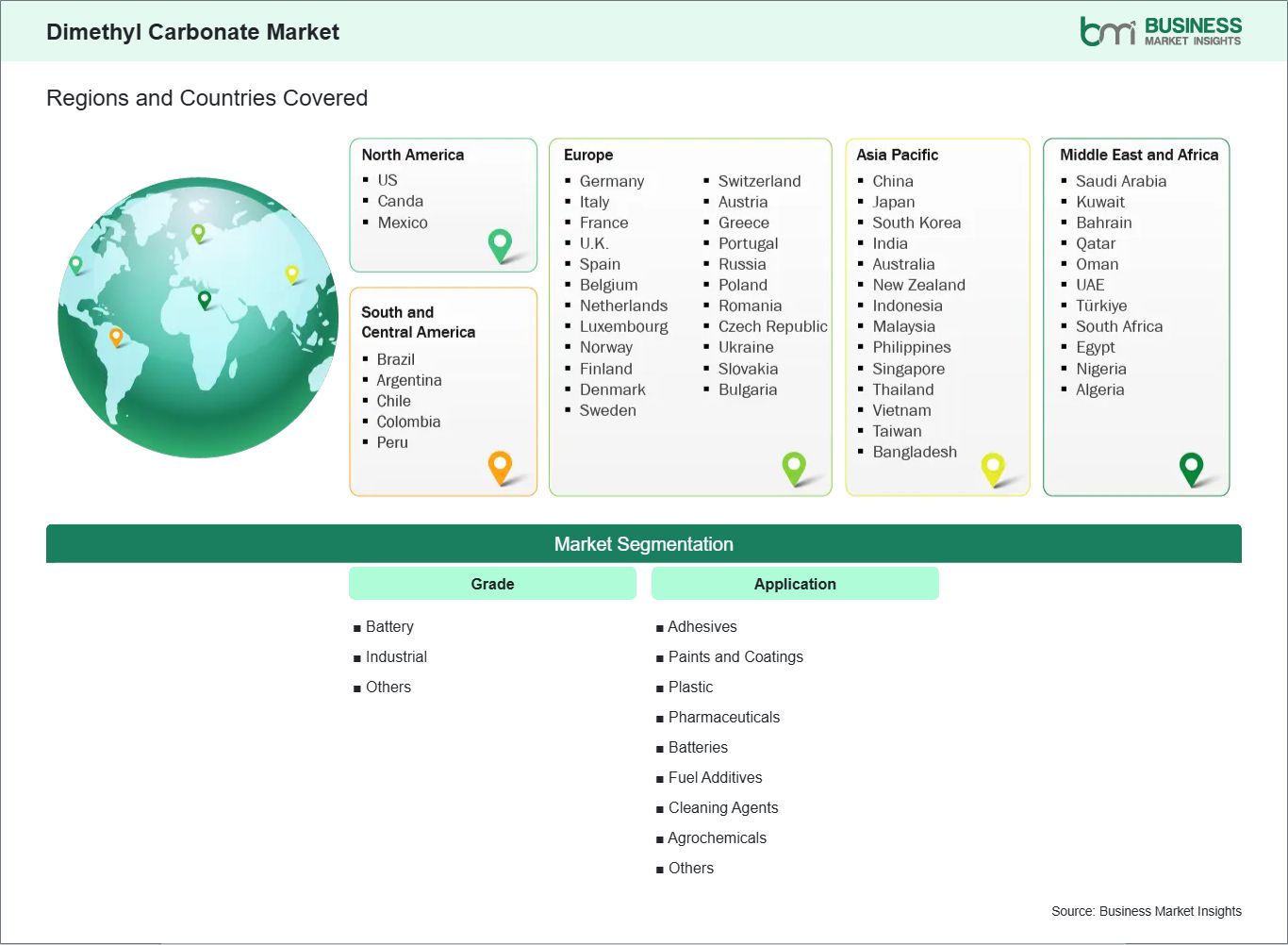
Key segments that contributed to the derivation of the Dimethyl Carbonate market analysis are grade and application.
- By Grade, the market is segmented into Battery, Industrial, and Others.
- By Application, the market is segmented into Adhesives, Paints and Coatings, Plastic, Pharmaceuticals, Batteries, Fuel Additives, Cleaning Agents, Agrochemicals, and Others.
Market Forces
Dimethyl Carbonate Market Drivers and Opportunities
Surging Demand for Lithium-Ion Batteries
The key driver for the growth of the Dimethyl Carbonate market is the increase in the production of lithium-ion batteries globally because of the rising demand for electric vehicles (EVs), energy storage solutions, and consumer electronics. DMC is a key solvent that is used in the manufacturing of lithium-ion batteries.
In the EV market, government policies, strict emission standards, and consumer adoption are driving the electrification of vehicles. High Purity Battery Grade DMC helps improve electrolyte stability, charging and discharging efficiency, and battery Safety, making it a critical component in EV batteries. Moreover, increasing demand for energy storage solutions and consumer electronics keeps driving demand for Lithium-Ion Batteries, thus fueling the market growth.
Transition Toward Green Chemistry and Sustainable Solvents
The global focus on sustainability and regulatory compliance has generated immense demand for DMC because of its green solvent properties. The regulatory agencies are imposing strict regulations on the emission of volatile organic compounds (VOC), and manufacturers are finding green solvents to replace the traditional solvents with low-toxicity properties. The low VOC content and desirable safety properties make DMC a preferable choice for paints, coatings, adhesives, and cleaning agents.
In addition, the technology provides the means for the production of polycarbonate without phosgene. This not only eliminates the use of highly toxic gases and corrosive by-products associated with the production of polycarbonate through phosgene, but it can also be considered a major opportunity in the plastic materials sector. In addition, the pharmaceutical sector has adopted the technology.
Size and Share Analysis
Dimethyl Carbonate Market Size and Share Analysis
The Dimethyl Carbonate market demonstrates steady growth, with size and share analysis revealing evolving trends and competitive positioning among key players. The report further examines subsegments categorized within grade and application, offering insights into their contribution to overall market performance.
For instance, the Battery subsegment stands out, driven by its indispensable role in lithium-ion battery electrolytes, where purity and performance are paramount. On the application front, Pharmaceuticals represent a significant growth area, leveraging DMC's ability to serve as a safe and efficient intermediate in drug synthesis. These segments collectively highlight the compound's dual importance in both energy and healthcare sectors.
Report Coverage
Dimethyl Carbonate Market Report Coverage and Deliverables
The Dimethyl Carbonate Market Size and Forecast (2022–2033) report provides a detailed analysis of the market covering below areas:
- Dimethyl Carbonate Market size and forecast at global, regional, and country levels for all the key market segments covered under the scope.
- Dimethyl Carbonate Market trends, as well as market dynamics such as drivers, restraints, and key opportunities.
- Dimethyl Carbonate Market analysis covering key market trends, global and regional framework, major players, regulations, and recent market developments
- Industry landscape and competition analysis covering market concentration, heat map analysis, prominent players, and recent developments for the Dimethyl Carbonate Market
- Detailed company profiles, including SWOT analysis
Geographic Insights
Dimethyl Carbonate Market Geographic Insights
The geographical scope of the Dimethyl Carbonate market report is divided into five regions: North America, Europe, Asia Pacific, the Middle East & Africa, and South & Central America.
The Asia Pacific region continues to expand its footprint in advanced manufacturing and chemical innovation, supported by strong industrial ecosystems. Europe emphasizes sustainability and regulatory compliance, fostering demand for green solvents across multiple industries. North America focuses on technological advancements and specialty applications, particularly in energy storage and high-performance materials. Meanwhile, Middle East & Africa and South & Central America are gradually integrating DMC into industrial processes, driven by infrastructure development and emerging market needs.
Industry Activity
Recent Developments
The Dimethyl Carbonate market is evaluated by gathering qualitative and quantitative data post-primary and secondary research, which includes important corporate publications, association data, and databases. A few of the key developments in the Dimethyl Carbonate market are:
- In February 2025, UBE Corporation (President: Masato Izumihara; Head Office: Minato-ku, Tokyo; hereinafter, "UBE") held a groundbreaking ceremony for a dimethyl carbonate (DMC) and ethyl methyl carbonate (EMC) plant in Louisiana, the United States. This is the largest investment in a manufacturing plant in UBE’s corporate history, valued at approximately $500 million.
- In March 2024, Dow announced the intent to invest in ethylene derivatives capacity on the U.S. Gulf Coast, including the production of carbonate solvents, critical components to the supply chain of lithium-ion batteries.
Trust & Transparency
Research Methodology
The market analysis combines proprietary research with secondary data from government agencies, company disclosures, regulatory filings, industry databases and expert interviews. Market estimates are validated through data triangulation, cross-market benchmarking and analyst
review.
View Full Research Methodology
Key Sources Referred:
World Bank – Global Trade IndicatorsWorld Trade Organization (WTO)International Monetary Fund (IMF)International Trade Administration (ITA)Company WebsitesCompany Annual ReportsCompany Investor Presentations