C5ISR Market Regional Highlights
North America C5ISR Market
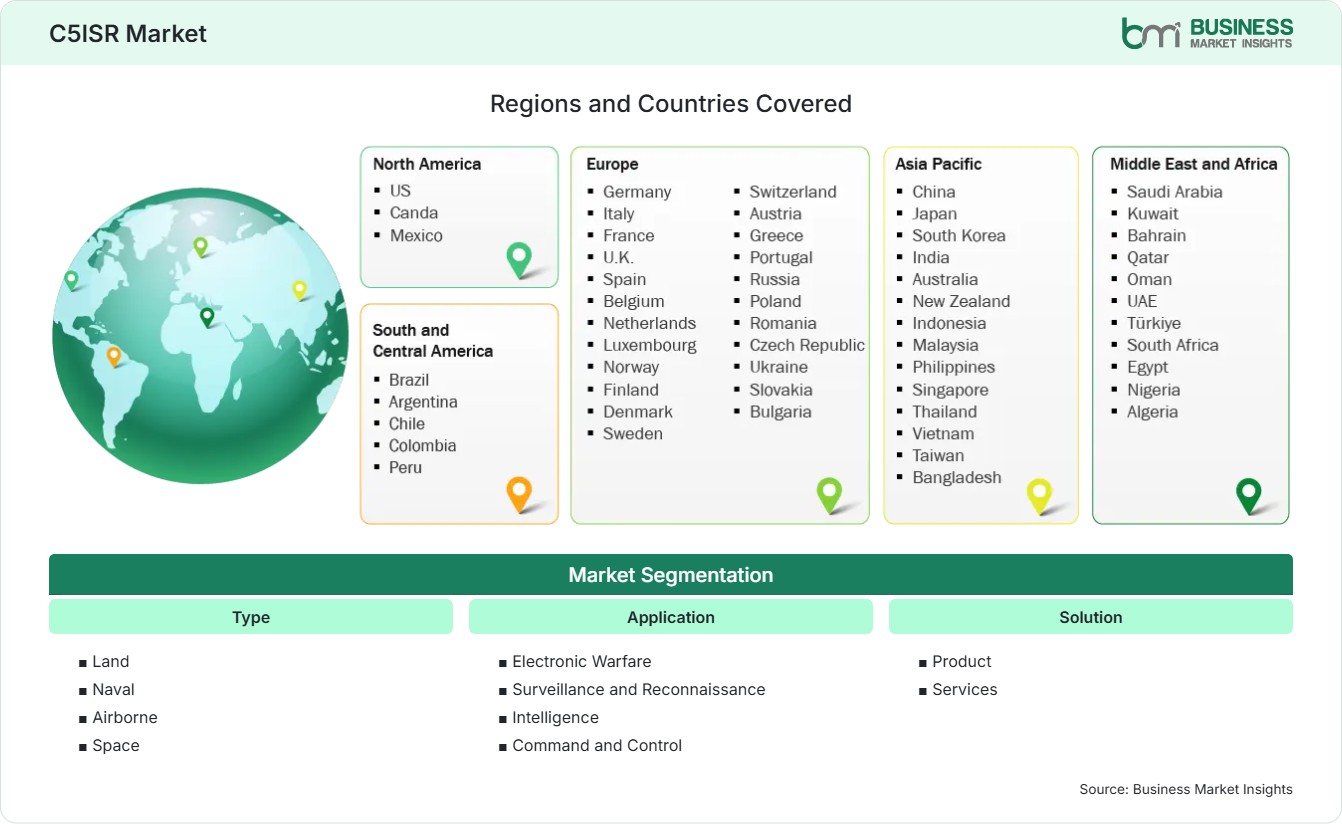
North America accounts for a 35%–38% share in 2025 and is projected to register a 4.7%–5.1% CAGR from 2026–2033. The region benefits from mature defense ecosystems, advanced communications infrastructure, large modernization programs, and sustained investment in joint-domain integration. The United States dominates national demand, while Canada contributes through Arctic awareness, coalition interoperability, and secure communications. C5ISR market growth is supported by tactical networking, cyber resilience, electronic warfare, sensor fusion, and sensor-to-shooter architectures.
- US procurement increasingly connects command applications with resilient communications, cyber protection, and distributed sensing to improve decision speed in contested operating environments.
- Canada’s modernization priorities emphasize Arctic surveillance, coalition interoperability, protected communications, and network resilience, creating opportunities for scalable mission systems and lifecycle support.
- North American suppliers increasingly combine hardware, software, integration, training, cybersecurity, and sustainment to capture recurring lifecycle value across lengthy defense programs.
- Open architectures and digital engineering are reducing technology-insertion barriers while increasing demand for certified integration, cybersecurity testing, and specialized systems engineering.
US C5ISR Market
The US accounts for 68%–74% of the C5ISR market share of North American demand in 2025 and is projected to record a 4.8%–5.2% CAGR during 2026–2033. Spending priorities center on joint all-domain command and control, tactical data links, cyber defense, electronic warfare, and integrated air and missile defense. Procurement increasingly rewards systems connecting legacy platforms with new sensors and software. The domestic supplier base supports rapid prototyping, testing, fielding, training, and sustainment across defense services.
- US programs increasingly prioritize resilient communications that preserve data exchange when satellite navigation, traditional networks, or spectrum access is disrupted during contested missions.
- Artificial intelligence is increasingly embedded into command applications to shorten detection-to-decision cycles, prioritize threats, correlate information, and automate selected information-management tasks.
- Counter-UAS requirements are expanding tactical radios and networks into distributed sensing and protection nodes, increasing their value within integrated battlefield architectures.
Europe C5ISR Market
Europe represents a 23%–26% share in 2025 and is projected to grow at a 4.3%–4.8% CAGR through 2033. Germany, the United Kingdom, and France remain leading markets because of defense modernization, sovereign industrial capabilities, and NATO interoperability. Poland and Nordic countries offer comparatively faster opportunities, with modeled CAGRs of 5.1%–5.8% as governments strengthen land, air, maritime, and border awareness. Regional demand favors secure coalition networking, electronic warfare, cyber resilience, and multi-domain command systems.
- Germany’s modernization agenda supports networked command systems, protected communications, sensors, and digital mission infrastructure across land and air forces, creating sustained integration demand.
- The United Kingdom emphasizes integrated sensing, cyber, electromagnetic operations, and resilient information architectures for expeditionary missions and coalition operations.
- France combines sovereign defense technology development with requirements for secure communications, ISR, naval awareness, electronic warfare, and independent decision-making capabilities.
- Nordic and eastern European programs increasingly prioritize distributed sensing, Arctic surveillance, counter-UAS systems, and interoperable tactical networks for regional defense.
Asia Pacific C5ISR Market
The Asia Pacific region is expected to account for 29% to 32% of the global market share by 2025 and is anticipated to exhibit a CAGR of 5.0% to 5.6% in the C5ISR market from 2026 to 2033, driven by maritime surveillance programs, aerospace modernization, border protection, and network-centric warfare, among other factors. India and Australia present favorable growth prospects, with growth rates of 5.6% to 6.2% driven by sovereign production, coalition operations, and the requirements of the Indo-Pacific region, which are accelerating investment in sensors, communications, electronic warfare, and command infrastructure.
- Japan is expanding resilient sensing, communications, and command capabilities as it strengthens maritime awareness, air defense, and interoperability with allied forces.
- India’s indigenous defense programs encourage domestic integration of secure radios, ISR payloads, battlefield management, electronic warfare, and networked command solutions.
- Australia’s geographic scale supports long-range communications, maritime ISR, space-enabled connectivity, and distributed command infrastructure across widely separated operational areas.
- South Korea’s advanced electronics ecosystem creates opportunities for integrated sensors, tactical networks, cyber protection, autonomous surveillance, and mission-processing systems.
Rest of World C5ISR Market
Rest of World holds a market share of 10%–13% in 2025 and is expected to grow at a CAGR of 4.0%–4.6% during 2033. The demand in South and Central America is fueled by border and maritime surveillance, counter-narcotics operations, and enhancements to communication networks. Brazil and Colombia are prominent countries, while Chile provides growth potential of 4.7%–5.2%. Demand for systems that are affordable and interoperable with training and sustainment is on the rise. The Middle East and Africa markets depend on air defense, border surveillance, electronic warfare, secure communications, and counter-UAS capabilities. Saudi Arabia, the UAE, and Israel are key regions, while the UAE provides growth potential of 5.2%–5.8%.
- Latin American procurement favors modular systems that improve surveillance and communications without requiring complete replacement of existing platforms, supporting retrofit-oriented suppliers.
- Gulf states are combining network modernization with counter-UAS, electronic warfare, and integrated air-defense requirements, increasing demand for cross-domain architectures.
- African programs remain selective, with investment concentrated on border security, secure communications, ISR, and mission systems that can operate under constrained infrastructure.
- Regional buyers increasingly evaluate localization, training, sustainment, technology transfer, and cybersecurity alongside equipment performance, interoperability, and acquisition cost.