
Bulletproof Vest Market Outlook: Size, Share, Trends, Growth Analysis, Competitive Landscape & Forecast, 2026–2033

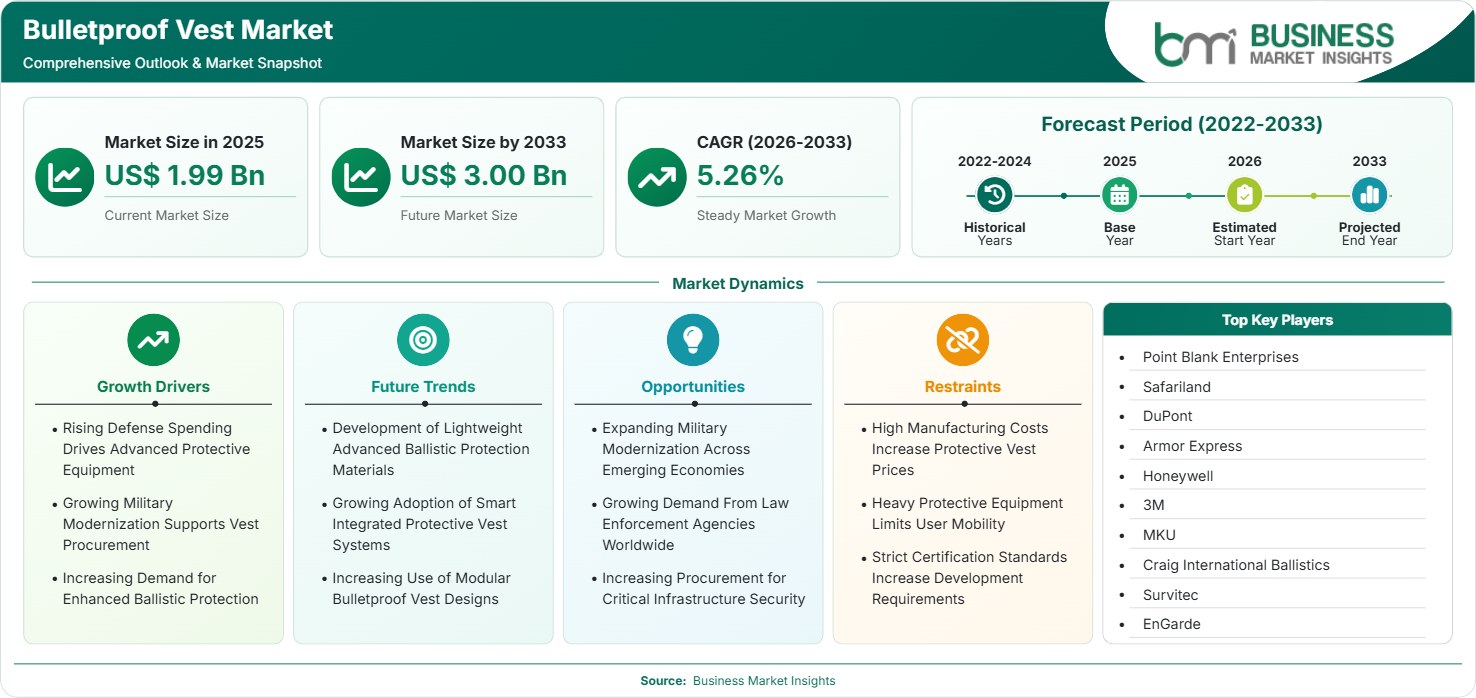
The Bulletproof Vest Market size was valued at US$ 1.99 billion in 2025 and is projected to reach US$ 3.00 billion by 2033, growing at a CAGR of 5.26% during 2026–2033. Rising defense modernization, increasing demand for ballistic protection, law enforcement procurement, material innovation, and critical infrastructure security are supporting opportunities.

Report Coverage
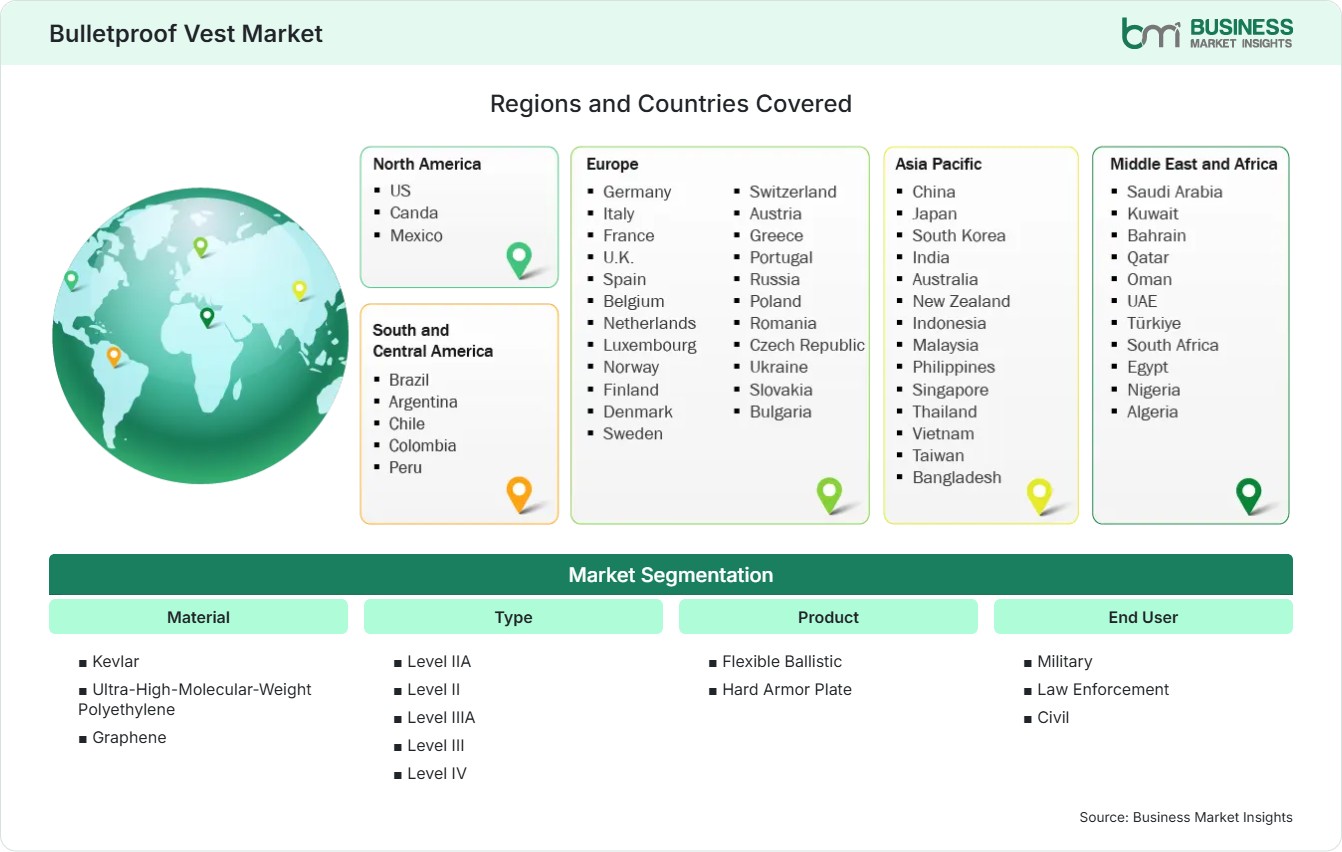
  • Material: Kevlar, Ultra-High-Molecular-Weight Polyethylene , Graphene
  • Type: Level IIA, Level II, Level IIIA, Level III, Level IV
  • Product: Flexible Ballistic, Hard Armor Plate
  • End User: Military, Law Enforcement, Civil
US$ 1.99 Bn Market size in 2025
US$ 3.00 Bn Market Size by 2033
5.26% CAGR, 2026 - 2033
2026-2033 Forecast Period

AI Overview

Bulletproof Vest Market Summary

  • North America Region: North America holds a 35%–39% share in 2025 and is projected to grow at a 5.5%–6.3% CAGR through 2033, supported by defense modernization, law enforcement procurement, advanced armor materials, replacement demand, and protective equipment upgrades. The U.S. remains the primary regional contributor, supported by sustained military and public safety requirements and is projected to grow at a 5.6%–6.4% CAGR.
  • Fastest Growing Region: Asia Pacific holds a 22%–26% share in 2025 and is projected to grow at a 6.4%–7.2% CAGR through 2033, supported by military modernization, expanding security requirements, domestic defense manufacturing, border protection, and rising procurement of advanced personal protective equipment.
  • Leading Segment: Level IIIA holds a 30%–34% Bulletproof Vest Market share in 2025 and is projected to grow at a 5.0%–5.8% CAGR through 2033, supported by broad handgun-threat protection, flexible armor applications, law enforcement demand, wearable comfort, and established procurement requirements.
  • High Growth Segment: Level IV is projected to grow at a 6.1%–6.9% CAGR through 2033, supported by increasing demand for higher rifle-threat protection, military modernization, tactical operations, improved ceramic technologies, and enhanced survivability requirements.
  • Key Market Opportunity: Advanced lightweight materials, modular armor architectures, female-specific designs, integrated protective systems, emerging defense procurement, and upgraded law enforcement equipment create opportunities for suppliers offering scalable and performance-focused solutions.
  • Major Market Players: Point Blank Enterprises, Inc.; Safariland, LLC; DuPont de Nemours, Inc.; Armor Express, Inc.; Honeywell International Inc.; 3M Company; MKU Private Limited; Craig International Ballistics Pty Ltd; Survitec Group Limited; EnGarde B.V.
Strategic Insights

Bulletproof Vest Market: Strategic Insights

Bulletproof Vest Market Strategic Framework
FREE PDF
Request your free sample
Request free sample
Stakeholder View

Key Takeaways

  • The value chain spans advanced fiber producers, ballistic material developers, armor manufacturers, system integrators, distributors, government procurement agencies, and specialized protective equipment providers.
  • Flexible ballistic products, lightweight rifle protection, modular plate systems, and application-specific armor configurations offer attractive opportunities as end users seek protection without excessive mobility restrictions.
  • Material innovation is shifting toward lighter high-strength fibers, advanced polyethylene structures, improved ceramic plates, graphene-enhanced concepts, and hybrid constructions designed to balance protection with wearer comfort.
  • Asia Pacific presents a compelling expansion opportunity as defense modernization, domestic manufacturing initiatives, border-security requirements, and increasing procurement sophistication encourage adoption of advanced personal protection systems.
  • Investment priorities are moving toward manufacturing automation, material engineering, testing capabilities, product customization, and regional production capacity rather than undifferentiated commodity armor manufacturing.
  • Procurement strategies increasingly favor modular systems that allow users to configure protection according to mission requirements, reducing replacement complexity while improving compatibility across tactical equipment platforms.
Geographic Outlook

Bulletproof Vest Market Regional Highlights

North America Bulletproof Vest Market

North America accounts for 35%–39% of global demand in 2025 and is projected to expand at a 5.5%–6.3% CAGR through 2033. Strong defense procurement, established law enforcement channels, advanced material development, and replacement demand support regional expansion. The United States remains the dominant market, while Canada contributes through military, border-security, and public safety applications.

  • Defense modernization programs are sustaining demand for lightweight armor, modular plate carriers, and advanced protective systems designed for changing operational requirements across military applications.
  • Law enforcement agencies continue replacing aging protective equipment with lighter and more ergonomic systems that provide improved mobility, comfort, and operational flexibility during extended deployment.
  • Advanced fiber and composite development is encouraging manufacturers to improve ballistic performance while reducing overall vest weight and enhancing integration with tactical equipment.
  • Government procurement increasingly emphasizes certification, durability, fit, lifecycle performance, and compatibility with existing protective equipment, benefiting established suppliers with broad testing and manufacturing capabilities.
  • Demand from correctional facilities, private security organizations, and specialized response units is expanding the addressable customer base beyond conventional military procurement.

US Bulletproof Vest Market

The United States represents the largest North American opportunity, supported by military modernization, extensive law enforcement requirements, homeland security activities, and established protective equipment procurement channels.

  • Military and law enforcement users are increasingly prioritizing lightweight systems that preserve protection while improving mobility, endurance, and compatibility with tactical equipment.
  • Replacement programs create recurring demand as agencies evaluate armor condition, fit, certification status, material degradation, and changing operational requirements.
  • Civilian and private-security applications provide supplementary demand, particularly where customers seek professionally manufactured protective equipment for specialized security activities.
  • Product differentiation increasingly centers on customization, modularity, wearer comfort, material performance, and integration with complementary protective systems.

Europe Bulletproof Vest Market

Europe represents 25%–29% of global demand in 2025 and is projected to grow at a 4.8%–5.6% CAGR through 2033. Germany, France, the United Kingdom, Poland, and Nordic markets provide important demand centers. Military readiness, security requirements, modernization programs, and domestic defense-industrial development are strengthening procurement opportunities across the region.

  • Germany remains a leading European opportunity as defense modernization encourages investment in advanced personal protective equipment and soldier-system upgrades.
  • Poland represents a high-growth market, supported by military capability expansion, procurement modernization, and heightened emphasis on individual survivability equipment.
  • European buyers increasingly evaluate weight, ergonomics, sustainability, durability, and interoperability alongside ballistic protection when selecting modern armor systems.
  • Manufacturers are strengthening regional production and engineering capabilities to satisfy procurement preferences for supply security, customization, and shorter delivery cycles.
  • Law enforcement and specialized security agencies are supporting recurring demand for flexible ballistic protection and mission-specific armor configurations.

Asia Pacific Bulletproof Vest Market

Asia Pacific accounts for 22%–26% of global demand in 2025 and is projected to grow at a 6.4%–7.2% CAGR through 2033. China, India, Japan, South Korea, and Australia represent important markets, while Southeast Asian countries provide additional expansion opportunities through defense modernization and security investment.

  • India is developing into an important growth market as domestic defense production, military modernization, and demand for locally manufactured protective equipment expand.
  • China supports regional demand through large defense and security requirements alongside extensive domestic material and manufacturing capabilities.
  • Japan, South Korea, and Australia are strengthening protective equipment procurement as military readiness and interoperability requirements become increasingly important.
  • Southeast Asian markets provide opportunities through border security, counterterrorism requirements, police modernization, and expanding defense procurement programs.
  • Regional manufacturers are investing in lightweight materials, advanced composites, domestic production, and product customization to compete for government procurement contracts.

Rest of World Bulletproof Vest Market

Rest of World represents 10%–14% of global demand in 2025 and is projected to expand at a 4.9%–5.8% CAGR through 2033. Latin America, the Middle East, and Africa are supported by security requirements, military procurement, law enforcement modernization, and protection needs.

Latin American demand is concentrated around military and police applications, while Middle Eastern markets emphasize advanced tactical protection. African opportunities are linked to security operations, peacekeeping requirements, and modernization of protective equipment.

  • Middle Eastern buyers increasingly favor advanced armor systems offering higher protection, modularity, and compatibility with modern tactical equipment.
  • Brazil and Mexico provide opportunities through police modernization, organized-crime response requirements, and replacement of aging protective equipment.
  • African markets remain selective but can generate demand through military modernization, border protection, peacekeeping, and specialized security operations.
  • Regional distributors play an important role by providing procurement access, technical support, fitting services, and product maintenance.
Global Market Geography
FREE PDF
Request your free sample
Request free sample
Segment Analysis

Bulletproof Vest Market Segmentation

Material

Kevlar represents a leading material category because of established ballistic applications, flexibility, durability, and extensive integration into soft armor systems. The Bulletproof Vest Market scope is expanding through UHMWPE and emerging hybrid materials that target lower weight and improved wearer mobility.

  • Kevlar: Kevlar provides established ballistic performance, flexibility, and durability, supporting extensive use in flexible armor systems for military, law enforcement, and security applications.
  • Ultra-High-Molecular-Weight Polyethylene (UHMWPE): UHMWPE offers lightweight ballistic protection and high strength-to-weight characteristics, supporting growing interest in mobility-focused armor and advanced plate constructions.
  • Graphene: Graphene remains an emerging material opportunity, with research focused on combining lightweight structures, strength, and advanced protective characteristics for next-generation armor concepts.

Type

Level IIIA represents the leading type with a 30%–34% share in 2025 and a 5.0%–5.8% CAGR through 2033. Its broad applicability across handgun protection, law enforcement, security, and flexible armor supports sustained demand across established procurement channels.

  • Level IIA: Level IIA armor supports applications requiring lightweight handgun protection, offering flexibility and comfort for users prioritizing mobility and lower-profile protective configurations.
  • Level II: Level II systems address handgun-related protection requirements and remain relevant where users require flexible armor with practical everyday wear characteristics.
  • Level IIIA: Level IIIA systems provide broader handgun-threat protection and support military, police, security, and tactical applications requiring flexible wearable armor.
  • Level III: Level III armor supports rifle-threat protection through hard armor configurations, making it relevant for military and specialized tactical operations.
  • Level IV: Level IV systems address higher rifle-threat requirements and are increasingly relevant where military users prioritize enhanced ballistic protection and survivability.

Product

Flexible Ballistic products maintain strong adoption because they combine wearable protection, mobility, and coverage for handgun-threat applications. Hard Armor Plate systems provide higher-threat protection and support tactical users requiring modular configurations. Product development increasingly emphasizes weight reduction, ergonomic fit, durability, and integration with carriers.

  • Flexible Ballistic: Flexible ballistic products provide wearable protection with improved mobility, supporting law enforcement, security, military, and specialized applications requiring extended-duration use.
  • Hard Armor Plate: Hard armor plates provide higher-level ballistic protection and modularity, supporting tactical operations where rifle-threat protection and configurable equipment are priorities.

End User

Military users represent the leading end-user category because of broad protective equipment requirements, modernization programs, and diverse mission profiles. Law enforcement provides recurring replacement demand, while civil applications create additional opportunities through private security and specialized protection requirements.

  • Military: Military organizations require scalable armor systems covering different missions, threat environments, mobility requirements, and protection levels across personnel and operational units.
  • Law Enforcement: Law enforcement agencies prioritize wearable protection, fit, flexibility, certification, and durability for patrol, tactical response, correctional, and specialized security applications.
  • Civil: Civil users include private security and specialized personnel seeking professionally manufactured protective systems for defined occupational and personal protection requirements.
Market Forces

Bulletproof Vest Market Dynamics

Key Market Drivers

Rising Defense Spending Drives Advanced Protective Equipment

Modernization of defense has created a requirement for personal protection that must integrate with modern armaments, communications, mobility, and tactical gear. The current procurement programs focus on the entire soldier system, rather than treating protection as armor only, necessitating light, modular protection. This will require that the Bulletproof Vest Market growth be spurred by the need for protection that does not impede your mobility or endurance. The solution to these requirements will include fiber innovation, composite plates, ergonomic vests, and protective configurations.

Growing Military Modernization Supports Vest Procurement

The trend of military modernization is driving increased procurement of integrated personal protection systems tailored to mission requirements. Modern users need body armor that does not hinder movement or impose an additional burden by allowing the use of communication devices, load-bearing gear, medical instruments, and other tactical accessories. Other trends include increased durability, resistance to environmental conditions, fit, and maintenance. All of these needs motivate companies to develop modular vests, advanced materials, plate geometries, and customization options. According to the Bulletproof Vest Market analysis, differentiating a product requires balancing between ballistic protection and effectiveness. Suppliers who can offer a complete system of protection, not just individual armor parts, will foster better cooperation with institutions.

Increasing Demand for Enhanced Ballistic Protection

Threat diversification is promoting the use of protective gear that can respond to various ballistic threats while remaining portable. While military users may need greater protection, law enforcement and security users will prefer modularity and low-profile designs. Such needs drive the development of systems that allow users to adjust their protection level based on their requirements. Also, there is an effort to improve the comfort and ergonomics of such protective gear to minimize wearers' exhaustion. In conclusion, the Bulletproof Vest Market forecasts are driven by the shift from conventional armor to flexible systems.

Key Market Opportunities

Expanding Military Modernization Across Emerging Economies

New market defense opportunities present possibilities for suppliers as governments aim to enhance personal protection and upgrade their militaries. Procurements may have a bias towards local manufacturing, technology collaboration, and customized systems that meet the nation's operational needs. The Bulletproof Vest Market trend indicates an increasing inclination toward modular personal protection, local manufacturing, and customization of the armor systems. Suppliers can leverage these trends by providing regional manufacturing, certification services, training facilities, and maintenance solutions. New markets also offer opportunities to segment products among regular forces, special forces, border forces, and tactical police forces.

Growing Demand From Law Enforcement Agencies Worldwide

Law enforcement agencies present an excellent prospect due to the nature of the protective clothing, which must be replaced regularly and requires fitting, certification, and changes in use requirements. Law enforcement agencies now demand protective wear that enables users to operate for long periods without sacrificing mobility or comfort while performing their duties. Differentiation among competitors can be achieved by suppliers through the provision of gender-appropriate sizing, modifiable body armor, breathability, modularity, and simple maintenance. The demands from the urban police force, tactical forces, correctional facilities, and specialized security teams present opportunities to develop application-specific products.

Increasing Procurement for Critical Infrastructure Security

There are new possibilities emerging in the area of specialized protective equipment as operators of critical infrastructure identify the need for it when their personnel are likely to face high levels of security threats. Such an opportunity exists for the production of armor that is discreet, light, and flexible enough to be integrated into a uniform without significantly limiting mobility. Airports, power plants, transportation systems, industrial plants, and other facilities may require protective equipment for security teams, depending on specific threat situations. This presents an opportunity for protective equipment that is discreet, lightweight, and flexible, so it can be integrated into uniforms without compromising individuals' mobility.

Market Restraints and Challenges

High Manufacturing Costs Increase Protective Vest Prices

Factor: Use of high-end ballistic materials, ceramics, precise production, testing, quality control, and specific assembly techniques results in higher manufacturing expenses. Effect: These can raise vest prices, making them more expensive and thus limiting their use among cost-conscious consumers. The cost considerations are especially pertinent to developing nations, where purchasing authorities must balance the need for protection with limited equipment budgets. Therefore, manufacturers should strive to enhance material efficiency, introduce automation, design better, and develop better sourcing techniques without sacrificing ballistic effectiveness.

Heavy Protective Equipment Limits User Mobility

Factor: Increasing levels of protection may entail the use of additional material layers, hard plates, reinforced carriers, or other supplementary protection devices, resulting in heavier equipment. Impact: Heavyweight may limit mobility, increase user fatigue and weariness, and hence decrease acceptance during prolonged use. Hence, both military and law enforcement users seek methods that provide adequate protection without additional weight. Innovations in materials have been aiding in addressing this problem through high-strength fibers, lightweight polyethylene, ceramics, and composite materials. Nonetheless, it is technically difficult to find an appropriate combination of all the factors mentioned.

Company Analysis

Competitive Landscape

The competitive environment is shaped by ballistic material innovation, certification capabilities, manufacturing scale, customization, government procurement relationships, and product integration. The Bulletproof Vest Market report indicates that suppliers increasingly compete through lightweight construction, modular architecture, improved ergonomics, and application-specific protection.

Company Name

Overview

Products and Services relevant to this market

Point Blank Enterprises, Inc.

Protective equipment manufacturer serving military, law enforcement, and security customers with ballistic protection solutions.

Ballistic vests, body armor, plate carriers, protective systems, tactical armor, and customized ballistic equipment.

Safariland, LLC

Protective equipment provider serving law enforcement, military, and public safety markets with integrated tactical products.

Body armor, ballistic vests, armor carriers, protective equipment, tactical systems, and related duty gear.

DuPont de Nemours, Inc.

Advanced materials company supplying high-performance fibers and technologies used in protective applications.

Kevlar fiber, ballistic materials, protective technologies, and material solutions for body armor manufacturing.

Armor Express, Inc.

Armor manufacturer specializing in protective equipment for military, law enforcement, and security applications.

Ballistic vests, plate carriers, hard armor plates, shields, and customized protective systems.

Honeywell International Inc.

Diversified technology company with advanced materials capabilities serving industrial and protective applications.

High-performance fibers, protective materials, ballistic technologies, and material solutions for armor systems.

3M Company

Diversified technology company providing advanced materials and protective solutions across multiple industries.

Ballistic materials, protective technologies, composite solutions, and components used in personal protection systems.

MKU Private Limited

Defense and security equipment manufacturer providing protective solutions for military and law enforcement users.

Ballistic helmets, body armor, bulletproof vests, hard armor plates, and customized protective systems.

Craig International Ballistics Pty Ltd

Australian ballistic protection specialist serving defense, police, security, and government customers.

Ballistic vests, body armor, hard plates, ballistic shields, and customized protective equipment.

Survitec Group Limited

Global survival and safety equipment provider serving defense, maritime, aviation, and specialist markets.

Ballistic protection, protective equipment, tactical systems, survival products, and specialized defense solutions.

EnGarde B.V.

Protective equipment company focused on advanced body armor for professional and specialized users.

Bulletproof vests, ballistic plates, concealed armor, tactical protection, and customized body armor solutions.

Trust & Transparency

Research Methodology

The market analysis combines proprietary research with secondary data from government agencies, company disclosures, regulatory filings, industry databases and expert interviews. Market estimates are validated through data triangulation, cross-market benchmarking and analyst review.

View Full Research Methodology

Questions Answered

Frequently Asked Questions

What does the Bulletproof Vest Market report indicate about future competition?

The report indicates that competition will focus on material innovation, protection-to-weight performance, certification, modularity, customization, manufacturing efficiency, and procurement relationships. Companies capable of delivering reliable protection with improved ergonomics and scalable production are positioned to strengthen competitive differentiation.

Why are lightweight armor systems creating new opportunities?

Lightweight armor systems improve wearer mobility and reduce fatigue during extended operations. They are particularly relevant where personnel must combine ballistic protection with communications, load-bearing equipment, medical supplies, and other tactical equipment, encouraging manufacturers to optimize complete protective systems.

How are advanced materials influencing bulletproof vest adoption?

Advanced fibers, polyethylene structures, ceramics, and hybrid materials are helping manufacturers reduce weight while maintaining required protection. Material development is enabling more ergonomic and mission-specific products, supporting broader adoption among users who require protection without excessive mobility restrictions.

Which applications present the strongest opportunity in the market?

Military modernization, tactical law enforcement, border security, private security, and critical infrastructure protection present strong opportunities. These applications require differentiated combinations of ballistic protection, mobility, durability, modularity, and user comfort, supporting demand for specialized armor configurations.

What factors are improving Bulletproof Vest Market return on investment?

Defense modernization, replacement requirements, law enforcement procurement, advanced material development, and demand for lightweight protective equipment are improving return on investment. Manufacturers can strengthen value through durable designs, modular systems, improved fit, lifecycle support, and application-specific protection that addresses different operational requirements.

Access the Full Bulletproof Vest Market Report

Get segment-level forecasts, regional estimates, competitive benchmarking, company profiles and downloadable Excel datasets.

Access the full Bulletproof Vest Market Report
350 pages PDF & Excel | 2026-08-19