
Bottle Cap Market Outlook: Size, Share, Trends, Growth Analysis, Competitive Landscape & Forecast, 2026-2033

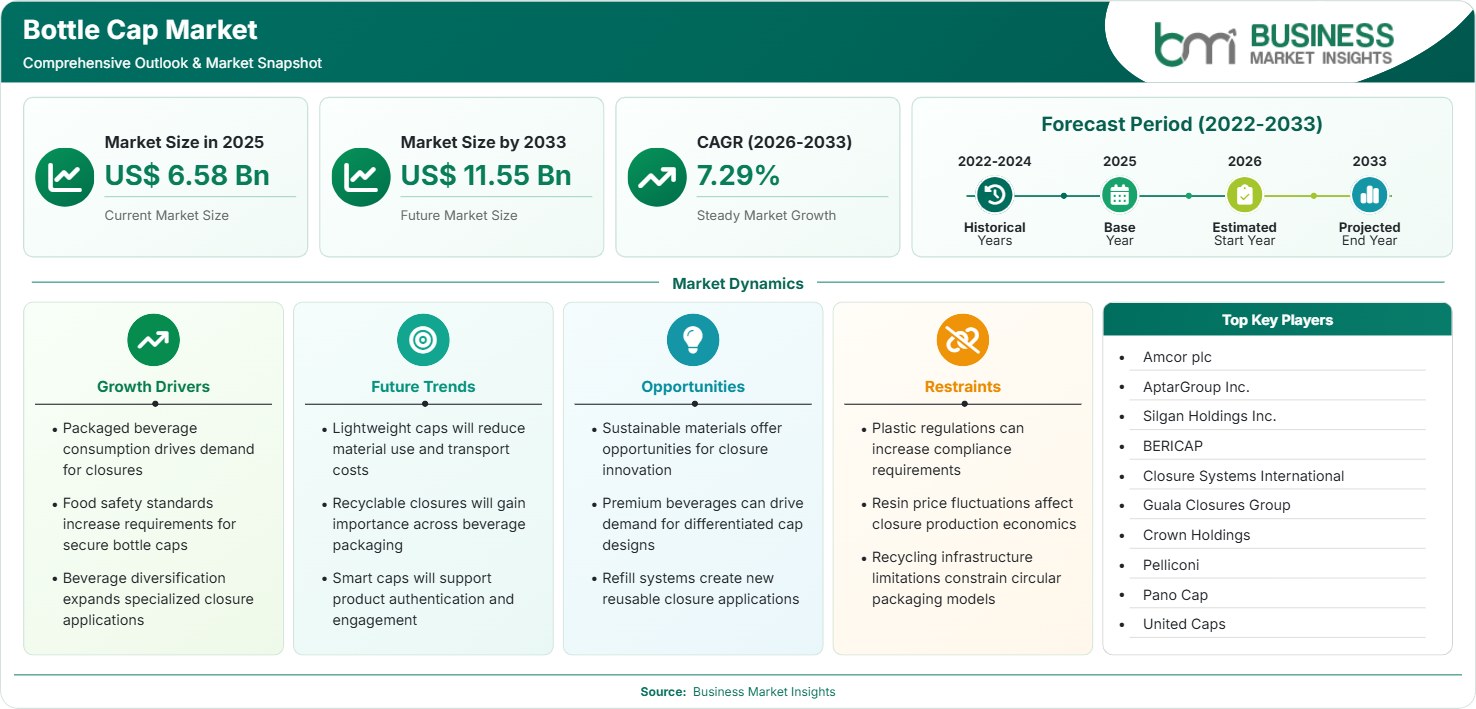
The Bottle Cap Market size was valued at USD 6.58 Billion in 2025 and is projected to reach USD 11.55 Billion by 2033, growing at a CAGR of 7.29% during 2026–2033. Rising packaged beverage consumption, increasing demand for tamper-evident closures, expansion of pharmaceutical packaging, and sustainability-driven innovations in closure materials are supporting market expansion. Opportunities are emerging from recyclable closures, premium packaging designs, and reusable packaging systems.

Report Coverage
  • Material: Plastic, Metal
  • Type: Screw Caps, Flip-top Caps, Crown Caps, Push-pull Caps, Dispensing Caps
  • Application: Beverages, Food, Pharmaceuticals, Personal Care & Cosmetics, Household
US$ 6.58 Bn Market size in 2025
US$ 11.55 Bn Market Size by 2033
7.29% CAGR, 2026 - 2033
2026-2033 Forecast Period

01 AI Overview

Bottle Cap Market Summary

  • North America Region: North America holds 28%–32% share in 2025 and is projected to grow at 6.5%–7.2% CAGR during 2026–2033. Strong packaged beverage demand, consumer preference for convenience packaging, sustainability initiatives, and premium product development continue supporting closure innovation. The U.S. dominates regional demand, supported by beverage and food packaging investments, expanding at 6.7%–7.4% CAGR.
  • Fastest Growing Region: Asia Pacific accounts for 34%–38% share in 2025 and is expected to expand at 8.1%–8.9% CAGR during 2026–2033. Urbanization, rising packaged food consumption, and expanding beverage manufacturing industries continue accelerating closure demand.
  • Leading Segment: Plastic holds 62%–66% share in 2025 and is projected to grow at 7.1%–7.8% CAGR. Lightweight properties, cost efficiency, design flexibility, and compatibility with high-volume production support market dominance.
  • High Growth Segment: Beverages represents 42%–46% share in 2025 and is expected to advance at 8.0%–8.8% CAGR. Demand for bottled water, carbonated drinks, juices, and functional beverages continues driving closure consumption.
  • Key Market Opportunity: Development of recyclable, tethered, and reusable closure solutions enables manufacturers to address sustainability requirements while improving packaging performance and supporting circular economy initiatives.
  • Major Market Players: Amcor plc, AptarGroup, Inc., Silgan Holdings Inc., BERICAP Holding GmbH, Closure Systems International, Inc., Guala Closures Group, Crown Holdings, Inc., Pelliconi & C. S.p.A., Pano Cap Ltd., United Caps Luxembourg S.A.
02 Strategic Insights

Bottle Cap Market: Strategic Insights

Bottle Cap Market Strategic Framework
FREE PDF
Request your free sample
Request free sample
03 Stakeholder View

Key Takeaways

  • The value chain is increasingly integrated among resin suppliers, metal producers, closure manufacturers, beverage companies, and packaging converters focused on sustainability and efficiency.
  • Beverage applications provide the strongest long-term revenue opportunity due to expanding bottled water, carbonated beverage, and functional drink consumption worldwide.
  • Innovation is increasingly centered on lightweight designs, recyclable materials, tethered caps, and smart closure technologies improving packaging performance.
  • Asia Pacific presents the most attractive investment environment due to rising consumer spending, urbanization, and manufacturing expansion.
  • Strategic partnerships between packaging manufacturers and beverage producers are accelerating commercialization of sustainable closure solutions.
  • Premiumization trends in beverages, cosmetics, and pharmaceuticals are creating demand for differentiated closure formats with enhanced aesthetics and functionality.
04 Geographic Outlook

Bottle Cap Market Regional Highlights

North America Bottle Cap Market

North America accounted for 28%–32% Bottle Cap Market share in 2025 and is expected to expand at 6.5%–7.2% CAGR through 2033. Growth is supported by high consumption of packaged beverages, established food processing industries, and strong demand for sustainable packaging solutions. Manufacturers continue investing in recyclable and lightweight closures to align with regulatory and consumer expectations.

  • Beverage companies increasingly adopt lightweight closure designs to reduce material usage and improve packaging efficiency while maintaining product integrity.
  • Sustainability initiatives encourage higher adoption of recyclable closure formats compatible with circular economy objectives and packaging regulations.
  • Premium beverage categories continue driving demand for differentiated closure designs and enhanced brand presentation.
  • Pharmaceutical packaging applications require tamper-evident closures that improve safety and regulatory compliance.
  • Investment in automated packaging lines supports innovation and production efficiency across closure manufacturing operations.

US Bottle Cap Market

The United States represents 76%–80% of North American demand and is projected to expand at 6.7%–7.4% CAGR through 2033. Beverage innovation, strong consumer packaged goods demand, and sustainability-focused packaging initiatives support continued closure consumption.

  • Bottled water and ready-to-drink beverage categories remain major contributors to closure demand.
  • Brand owners increasingly seek recyclable packaging solutions aligned with sustainability commitments.
  • Growing pharmaceutical production supports requirements for secure and tamper-resistant closures.
  • Advanced manufacturing capabilities strengthen domestic closure innovation and production capacity.

Europe Bottle Cap Market

Europe held 24%–28% share in 2025 and is anticipated to grow at 6.8%–7.5% CAGR through the forecast period. Sustainability legislation and circular economy objectives continue shaping product development strategies. Germany remains the largest national market, while Poland demonstrates strong momentum.

  • Germany leads regional consumption through its extensive beverage, food, and pharmaceutical packaging industries.
  • Poland is expected to achieve 7.5%–8.2% CAGR supported by industrial expansion and packaging investments.
  • Tethered cap regulations continue accelerating innovation among closure manufacturers.
  • Brand owners increasingly prioritize recycled-content packaging solutions to support environmental goals.
  • Premium beverage packaging trends encourage greater adoption of differentiated closure technologies.

Asia Pacific Bottle Cap Market

Asia Pacific represented 34%–38% share in 2025 and is forecast to expand at 8.1%–8.9% CAGR, making it the fastest-growing regional market. Rapid urbanization, rising disposable incomes, and increasing packaged food and beverage consumption support demand. The strongest market momentum is observed across developing economies investing in manufacturing and consumer goods production.

  • China remains the largest regional market due to extensive beverage and food packaging production.
  • India is projected to achieve 8.6%–9.4% CAGR supported by growth in packaged consumer goods and pharmaceuticals.
  • Expanding retail networks increase demand for packaged products requiring reliable closure solutions.
  • Rising bottled beverage consumption creates significant opportunities for plastic and metal closure manufacturers.
  • Manufacturing investments support capacity expansion and technological modernization across the packaging industry.

Rest of World Bottle Cap Market

Rest of World accounted for 10%–14% share in 2025 and is projected to expand at 7.0%–7.7% CAGR through 2033. Demand is supported by beverage consumption growth, food processing investments, and expansion of packaging industries across Latin America and the Middle East.

  • Brazil remains the leading Latin American market due to strong beverage production and consumer goods consumption.
  • Saudi Arabia continues investing in food processing and packaging manufacturing capabilities.
  • Increasing urban populations support growth in packaged food and beverage categories.
  • Expanding pharmaceutical manufacturing strengthens demand for secure closure applications.
  • Sustainability awareness is encouraging gradual adoption of recyclable packaging solutions.
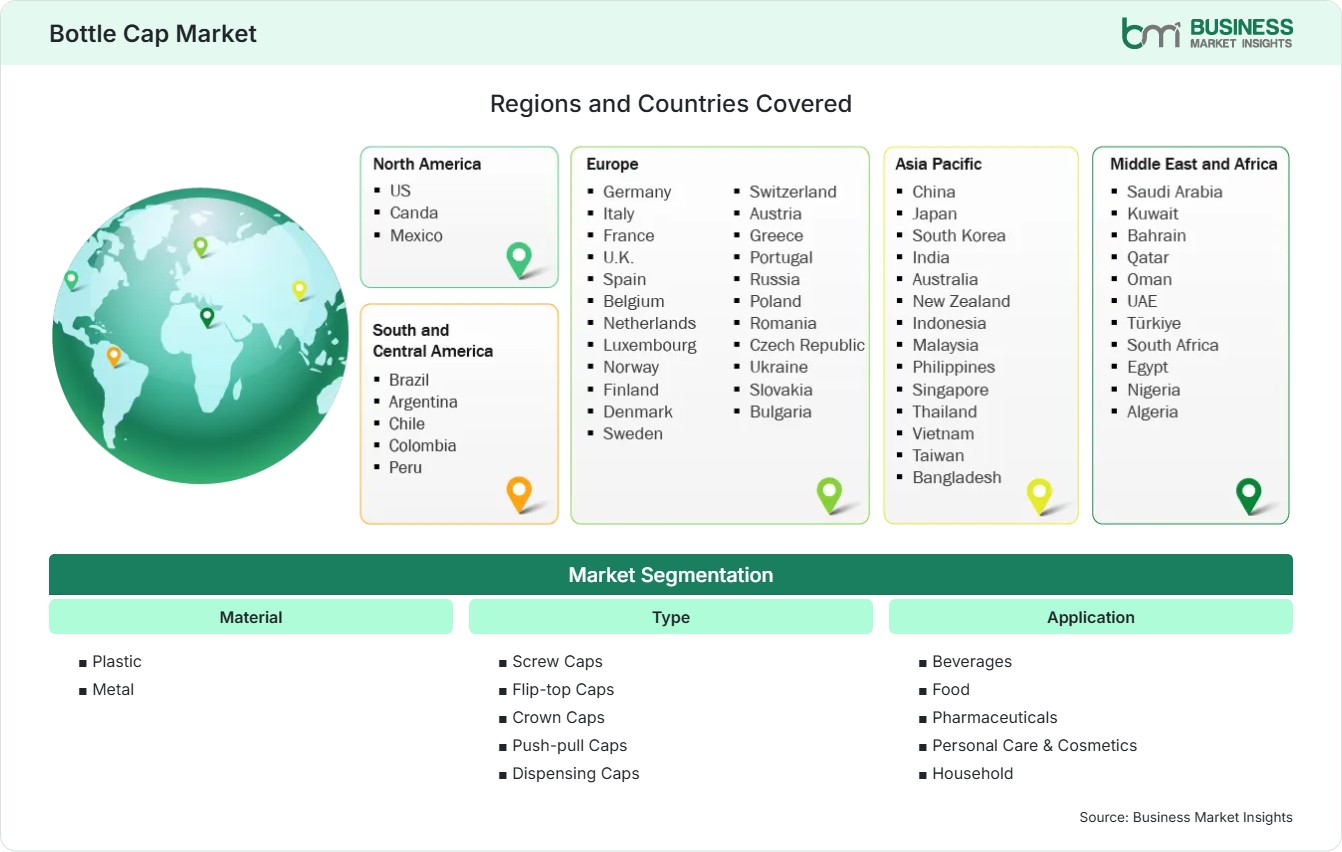
Global Market Geography
FREE PDF
Request your free sample
Request free sample
05 Segment Analysis

Bottle Cap Market Segmentation

Material

The material segment forms the foundation of product performance, cost efficiency, recyclability, and application suitability across packaging industries. Plastic accounted for 62%–66% share in 2025 and is projected to expand at 7.1%–7.8% CAGR through 2034. The Bottle Cap Market scope continues expanding as manufacturers prioritize lightweight packaging, production efficiency, improved sealing performance, and compatibility with high-volume beverage and food packaging operations.

  • Plastic: Widely used due to lightweight properties, cost-effectiveness, molding flexibility, strong sealing capability, and compatibility with beverages, pharmaceuticals, and personal care packaging applications.
  • Metal: Preferred in premium beverages and specialty packaging where durability, tamper evidence, product protection, and premium aesthetics are critical purchasing criteria.

Type

Type segmentation reflects the growing diversity of packaging formats and consumer convenience requirements. Screw Caps accounted for 38%–42% share in 2025 and are expected to grow at 7.0%–7.7% CAGR through the forecast period. Emerging Bottle Cap Market trends highlight stronger demand for user-friendly, resealable, and sustainable closure formats across beverage, food, and pharmaceutical applications.

  • Screw Caps: Provide reliable sealing performance, resealability, convenience, and compatibility across a wide range of beverage and packaged food products.
  • Flip-top Caps: Popular in personal care, sauces, and household products requiring easy opening, controlled dispensing, and enhanced consumer convenience.
  • Crown Caps: Commonly used in carbonated beverages and specialty drinks requiring high sealing integrity and pressure resistance.
  • Push-pull Caps: Preferred in sports drinks and functional beverages where ease of consumption and portability are important.
  • Dispensing Caps: Support controlled product usage in personal care, household cleaning products, and liquid food applications.

Application 

Application demand continues to be dominated by beverage packaging due to high product turnover and extensive global consumption volumes. Beverages accounted for 42%–46% share in 2025 and are forecast to expand at 8.0%–8.8% CAGR through 2034. Rising demand for bottled water, carbonated drinks, juices, dairy beverages, and functional drinks continues supporting closure consumption worldwide.

  • Beverages: Require secure, lightweight, and tamper-evident closures that maintain freshness, product quality, and transportation reliability across distribution channels.
  • Food: Growing packaged food consumption increases requirements for dependable closure technologies that improve product safety and shelf-life performance.
  • Pharmaceuticals: Depend on tamper-evident and child-resistant closure solutions that support regulatory compliance and consumer safety objectives.
  • Personal Care & Cosmetics: Utilize differentiated closure designs that enhance convenience, functionality, brand recognition, and premium product positioning.
  • Household: Require dispensing, resealable, and spill-resistant closures that improve product usability and customer experience.
06 Market Forces

Bottle Cap Market Dynamics

Key Market Drivers

Packaged beverage consumption drives demand for closures

Increasing global usage of bottled water, carbonated soft drinks, dairy drinks, fruit juices, and functional drinks continues to drive demand for reliable closure systems. Urbanization, changes in lifestyle patterns, and growing preference for packaged products are driving the production volumes of beverages in developed as well as developing countries. Closure companies can take advantage of recurring demand arising out of high volume bottling activities of beverages. The Bottle Cap Market growth outlook remains closely tied to beverage industry expansion, where large-scale production and continuous product innovation sustain demand for advanced closure technologies across multiple packaging formats.

Food safety standards increase requirements for secure bottle caps

Stringent food safety regulations and quality assurance requirements continue encouraging adoption of advanced closure solutions. Tamper-proofing, leakage prevention, and contamination prevention technologies which help build customer trust and compliance with regulations are important considerations for manufacturers. In addition, there is an increased tendency among packaging firms to produce closures with improved sealing capabilities and material performance to meet market needs. The need for packaged food items also facilitates the use of security closures. Food processing companies view packaging as one of the important determinants of product shelf life and quality preservation.

Beverage diversification expands specialized closure applications

The introduction of premium beverages, ready-to-drink products, plant-based drinks, sports beverages, and functional nutrition categories has increased demand for specialized closure configurations. Various beverage formulas require closure systems with different properties for sealing, dispensing, and consumer convenience. Packaging development is now more about enhancing user experience without compromising safety and shelf-life. Closure companies continue to design custom solutions that suit the specific functions and applications of various beverage types. With more beverages available in the market, there is also an increasing demand for new closure systems.

Key Market Opportunities

Sustainable materials offer opportunities for closure innovation

Sustainability priorities are influencing how packaging is developed in the global consumer products industry. More companies are demanding closures made using materials that can be recycled, recycled content and less impactful polymers. Companies focusing on developing sustainable packaging have an opportunity to establish stronger partnerships with beverage and food producers. Bottle Cap Market Forecasts indicate that demand for sustainable closures will become a major competitive differentiator as global packaging industries pursue ambitious waste reduction and recycling objectives.

Premium beverages can drive demand for differentiated cap designs

Premium product positioning increasingly influences packaging decisions across alcoholic beverages, bottled water, energy drinks, and specialty beverage categories. The use of unique closure designs allows brand owners to increase their shelf appeal, enhance their image of quality, and improve the consumer experience. The developments in decorative techniques, custom designed closures, and new methods of opening allow the closure manufacturers to add value to their products. Growth in premium products helps in providing packaging solutions which provide high margins.

Refill systems create new reusable closure applications

The growing demand for reusable packaging systems has created opportunities for new closure designs that work with them. Consumer goods companies are focusing more on designing packaging options that minimize material use and support their sustainability goals. Reusable containers need closures that ensure reliable performance across multiple uses. Companies that can create reusable, durable closures could benefit from this trend in circular packaging systems.

Market Restraints and Challenges

Plastic regulations can increase compliance requirements

Factor: Governments and regulatory authorities continue introducing stricter policies concerning plastic waste, recyclability requirements, and environmental impact reduction. Impact: Closure producers are facing higher sustainability-related expenditures for materials used, redesigning, testing for regulatory compliance, and adapting production processes. Regional differences in regulations may lead to increased operational difficulties and higher costs in commercializing the product. Continuous changes to the range of products in response to environmental requirements are required from closure producers.

Resin price fluctuations affect closure production economics

Factor: Plastic resin and metal raw material markets remain exposed to fluctuations driven by energy costs, supply-demand imbalances, transportation disruptions, and geopolitical developments. Impact: Manufacturers experience uncertainty in production costs and margin management. Sudden increases in raw material prices can reduce profitability and complicate long-term supply agreements. Companies often face challenges transferring higher costs to customers, particularly in highly competitive packaging markets. Effective procurement strategies and supply chain optimization therefore remain essential for mitigating financial risks associated with raw material volatility.

07 Company Analysis

Competitive Landscape

The Bottle Cap Market analysis reflects competition centered on sustainable material innovation, lightweight closure designs, beverage packaging partnerships, tamper-evident technologies, and manufacturing scale. Leading companies continue investing in recyclable closures, tethered cap solutions, and advanced dispensing technologies to strengthen market position and support evolving regulatory requirements.

Company Name

Overview

Products and Services Relevant to This Market

Amcor plc

Global packaging leader with strong presence across beverage, food, healthcare, and consumer goods packaging markets.

Plastic closures, sustainable packaging solutions, recyclable cap technologies, beverage packaging systems.

AptarGroup, Inc.

Packaging solutions provider specializing in dispensing, sealing, and consumer packaging innovations.

Dispensing caps, flip-top closures, pharmaceutical closures, personal care packaging solutions.

Silgan Holdings Inc.

Major manufacturer serving food, beverage, and consumer goods packaging industries globally.

Metal and plastic closures, food packaging caps, beverage sealing technologies.

BERICAP Holding GmbH

International closure manufacturer known for innovative beverage and industrial packaging solutions.

Tethered caps, beverage closures, tamper-evident systems, specialty packaging solutions.

Closure Systems International, Inc.

Global closure supplier serving beverage, food, and consumer goods manufacturers.

Screw caps, lightweight closures, beverage sealing systems, packaging technologies.

Guala Closures Group

Leading producer of premium closure solutions for beverages and specialty packaging markets.

Aluminum closures, spirits closures, wine closures, anti-counterfeit closure technologies.

Crown Holdings, Inc.

Packaging manufacturer with a strong portfolio in beverage and food packaging applications.

Metal closures, crown caps, beverage packaging components, sealing systems.

Pelliconi & C. S.p.A.

Specialized closure producer serving beverage manufacturers across international markets.

Crown caps, twist-off closures, metal packaging components, beverage closure solutions.

Pano Cap Ltd.

Closure manufacturer supplying packaging products for food and beverage industries.

Plastic caps, screw closures, customized packaging solutions, consumer product closures.

United Caps Luxembourg S.A.

International packaging company focused on sustainable and innovative closure technologies.

Plastic closures, tethered caps, sustainable solutions, beverage packaging technologies.

10 Trust & Transparency

Research Methodology

The market analysis combines proprietary research with secondary data from government agencies, company disclosures, regulatory filings, industry databases and expert interviews. Market estimates are validated through data triangulation, cross-market benchmarking and analyst review.

View Full Research Methodology

11 Questions Answered

Frequently Asked Questions

What does a Bottle Cap Market Report include?

A Market Report typically provides market sizing, growth forecasts, segmentation analysis, regional insights, competitive landscape evaluation, sustainability developments, investment opportunities, and key industry trends.

How are sustainability trends influencing closure manufacturers?

Manufacturers are increasingly introducing recyclable polymers, tethered caps, recycled-content materials, and reusable closure solutions to align with environmental regulations and consumer preferences.

Why are beverage applications the largest revenue contributor?

Beverages require high-volume closure consumption across bottled water, carbonated drinks, juices, dairy products, alcoholic beverages, and functional drinks, creating consistent recurring demand.

Which material segment dominates the market?

Plastic remains the leading material segment due to its lightweight nature, production efficiency, design flexibility, cost advantages, and compatibility with large-volume packaging applications.

What are bottle caps primarily used for?

Bottle caps provide sealing, tamper evidence, contamination protection, leak prevention, and product preservation for beverages, food products, pharmaceuticals, personal care products, and household goods.

Access the Full Bottle Cap Market Report

Get segment-level forecasts, regional estimates, competitive benchmarking, company profiles and downloadable Excel datasets.

Access the full Bottle Cap Market Report
350 pages PDF & Excel | 2026-08-19