
Blockchain Identity Management Market Outlook: Size, Share, Trends, Growth Analysis, Competitive Landscape & Forecast, 2026-2033

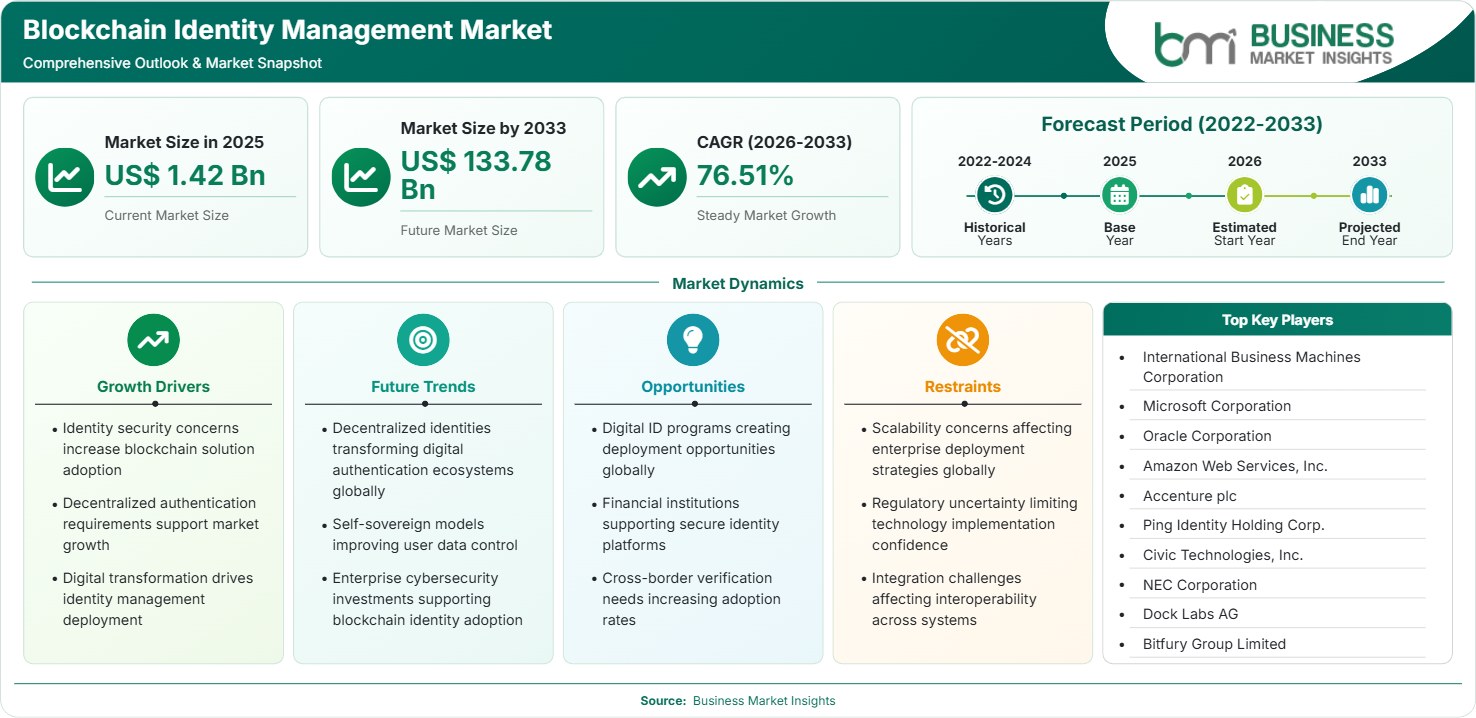
The Blockchain Identity Management Market size was valued at US$ 1.42 Billion in 2025 and is projected to reach US$ 133.78 Billion by 2033, growing at a CAGR of 76.51% during 2026–2033. Growing adoption of decentralized identity frameworks, stringent data privacy regulations, rising digital transactions, expanding Web3 ecosystems, and increasing demand for secure authentication create strong opportunities across enterprises, governments, and financial institutions worldwide.

Report Coverage
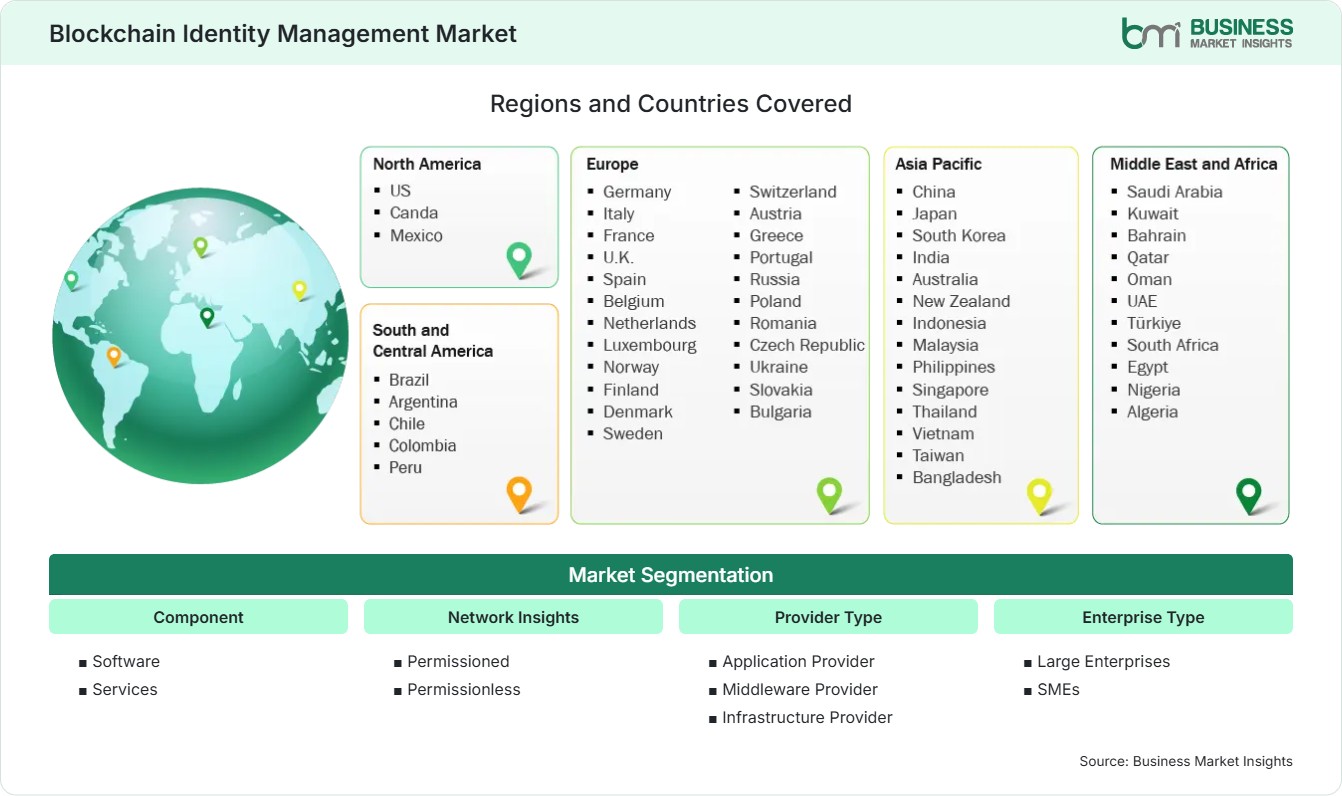
  • Component: Software, Services
  • Network Insights: Permissioned, Permissionless
  • Provider Type: Application Provider, Middleware Provider, Infrastructure Provider
  • Enterprise Type: Large Enterprises, SMEs
  • Vertical: BFSI, Energy & Utilities, Government, Healthcare & Life Sciences, Manufacturing, Telecom, Media & Entertainment, Retail, E-Commerce & Consumer Goods, Logistics & Transportation, Others
US$ 1.42 Bn Market size in 2025
US$ 133.78 Bn Market Size by 2033
76.51% CAGR, 2026 - 2033
2026-2033 Forecast Period

AI Overview

Blockchain Identity Management Market Summary

  • North America Region: North America holds a market share of 38%–41% in 2025, growing with a CAGR of 72%–75% during 2026–2033, driven by enterprise blockchain adoption, digital identity regulations, cybersecurity investments, and decentralized credential initiatives across regulated sectors. The U.S. benefits from large-scale digital identity programs, enterprise authentication modernization, and blockchain-backed credential deployment, advancing at a CAGR of 73%–76%.
  • Fastest Growing Region: Asia Pacific accounts for 24%–27% market share in 2025 and is projected to grow at a CAGR of 80%–84% during 2026–2033. Government digital identity initiatives, fintech expansion, mobile-first populations, smart city programs, and public-private partnerships accelerate adoption throughout major economies.
  • Leading Segment: Software represents 58%–61% share in 2025 and advances at a CAGR of 75%–78% through 2033. Organizations prioritize identity orchestration platforms, decentralized credential management, authentication automation, compliance monitoring, and digital trust infrastructure modernization initiatives.
  • High Growth Segment: BFSI captures 22%–25% Blockchain Identity Management Market share in 2025 and expands at a CAGR of 81%–85% during 2026–2033. Institutions increasingly deploy decentralized identity verification, fraud prevention systems, KYC optimization tools, digital onboarding capabilities, and secure transaction authentication frameworks.
  • Key Market Opportunity: Integration of decentralized identity solutions with AI-driven risk assessment, cross-border digital services, Web3 ecosystems, healthcare records, and government-issued credentials enables scalable trust architectures and new monetization models.
  • Major Market Players: International Business Machines Corporation, Microsoft Corporation, Oracle Corporation, Amazon Web Services, Inc., Accenture plc, Ping Identity Holding Corp., Civic Technologies, Inc., NEC Corporation, Dock Labs AG, and Bitfury Group Limited.
Strategic Insights

Blockchain Identity Management Market: Strategic Insights

Blockchain Identity Management Market Strategic Framework
FREE PDF
Request your free sample
Request free sample
Stakeholder View

Key Takeaways

  • The ecosystem is evolving toward interconnected identity networks where infrastructure providers, middleware vendors, application developers, regulators, and credential issuers collectively create scalable trust frameworks.
  • Financial services, healthcare, and government applications present the strongest commercialization opportunities due to regulatory compliance requirements and increasing digital verification volumes.
  • Innovation is shifting toward self-sovereign identity, verifiable credentials, decentralized identifiers, and interoperable digital wallets that reduce dependence on centralized databases.
  • Asia Pacific offers a compelling investment case as governments accelerate digital transformation strategies and private enterprises expand blockchain-enabled authentication deployments.
  • Strategic partnerships, venture funding, and acquisitions increasingly focus on decentralized identity platforms, cybersecurity integration capabilities, and credential verification technologies.
  • Future value creation will emerge from combining blockchain-based identity verification with artificial intelligence, real-time fraud analytics, and machine-readable trust architectures.
Geographic Outlook

Blockchain Identity Management Market Regional Highlights

North America Blockchain Identity Management Market

North America accounted for 38%–41% of global revenue in 2025 and is projected to record a 72%–75% CAGR through 2033. The region benefits from mature cloud infrastructure, extensive cybersecurity spending, and strong adoption of decentralized identity frameworks across financial services, healthcare, and government sectors. The Blockchain Identity Management Market share remains highest in North America due to early enterprise blockchain investments and a favorable innovation ecosystem. Growing digital credential deployment and identity verification automation continue strengthening regional leadership while supporting long-term market growth prospects.

  • Financial institutions increasingly implement decentralized identity solutions to improve customer onboarding, strengthen KYC processes, reduce fraud exposure, and streamline compliance with evolving privacy and cybersecurity regulations.
  • Government agencies continue investing in blockchain-based credential verification platforms supporting secure citizen services, trusted digital identity frameworks, and interoperable authentication systems for cross-agency collaboration.
  • Healthcare providers are expanding deployment of blockchain-backed identity management to secure patient information, improve consent management, and facilitate trusted data exchange across medical ecosystems.
  • Corporate adoption of zero-trust security architectures supports demand for decentralized authentication systems that enhance workforce identity verification while reducing risks associated with centralized databases.
  • Innovation partnerships among technology vendors, enterprises, and regulatory bodies accelerate commercial deployments and standardization efforts for decentralized identity infrastructure.

US Blockchain Identity Management Market

The United States represented 76%–79% of North American Blockchain Identity Management Market revenue in 2025 and is expected to expand at a 73%–76% CAGR during 2026–2033. Strong venture capital funding, extensive blockchain innovation activity, and large-scale enterprise digitization projects support market development. Financial institutions, healthcare organizations, and technology companies are actively integrating decentralized identity frameworks. Federal cybersecurity initiatives and growing emphasis on privacy-preserving digital authentication solutions further encourage commercial adoption across public and private sector applications.

  • Large technology firms continue integrating decentralized identity capabilities into cloud infrastructure and enterprise security portfolios, supporting broad commercial deployment across regulated industries.
  • Financial service providers strengthen investment in blockchain-enabled digital identity verification to improve trust, accelerate onboarding efficiency, and enhance customer experience.
  • Increasing adoption of verifiable credentials supports workforce authentication, educational certification verification, and secure digital record management across numerous industries.
  • Public and private collaborations advance interoperability standards, helping organizations deploy scalable identity ecosystems across multiple applications and jurisdictions.

Europe Blockchain Identity Management Market

Europe held approximately 27%–30% Blockchain Identity Management Market share in 2025 and is anticipated to grow at a 74%–78% CAGR through 2033. Expansion into new regions is facilitated by digital sovereignty, privacy laws, and trusted electronic identities. Germany leads in revenue from market operations, whereas France is seen as the most active in deploying the technology. Spain finds its place among the rapidly growing national markets, with CAGR in the range of 79%–82%, supported by digital public service modernization and increasing enterprise investment in decentralized authentication technologies.

  • The eIDAS framework continues encouraging development of interoperable identity solutions across member states, strengthening trust services and cross-border digital interactions.
  • Financial organizations adopt decentralized identity technologies to improve authentication security and reduce operational costs associated with traditional identity verification models.
  • Manufacturing enterprises increasingly deploy blockchain-based credentials for workforce management, supply chain visibility, and secure partner authentication processes.
  • Germany remains the largest regional contributor, benefiting from strong enterprise digitization initiatives and advanced industrial technology ecosystems.
  • Spain and several Eastern European countries are witnessing accelerated adoption through government-led innovation programs and digital transformation investments.

Asia Pacific Blockchain Identity Management Market

Asia Pacific region is projected to have the largest market share in the Blockchain Identity Management Market in 2025, accounting for 24%–27% of global revenue. The region is estimated to register a high CAGR of 80%–84% between 2026 and 2033 due to digitalization, growth in fintech services, mobile identity initiatives, and government-led digital transformation initiatives. China and Japan are among the leading revenue-generating countries, whereas India is anticipated to be the fastest-growing region with a CAGR of 83%–86%.

  • Government-backed identity modernization initiatives support adoption across public administration, digital welfare services, and citizen engagement platforms.
  • Financial technology companies leverage decentralized identity technologies to improve onboarding efficiency, strengthen security controls, and expand access to digital services.
  • India demonstrates exceptional growth potential due to expanding digital infrastructure, rising internet penetration, and increasing enterprise blockchain investments.
  • Telecom providers increasingly utilize blockchain-enabled authentication systems to improve customer verification and support secure digital service delivery.
  • Cross-border commerce growth and regional digital trade initiatives create opportunities for interoperable identity verification frameworks.

Rest of World Blockchain Identity Management Market

The Rest of World region accounted for around 7%–10% of total Blockchain Identity Management Market income in 2025 and is forecast to experience a CAGR of 76%–80% through 2033. South & Central America are expected to continue reaping the benefits of financial inclusion campaigns, digitized banking offerings, and government reform initiatives. Brazil will dominate the market, whereas Argentina will show impressive growth prospects.

Digital government, smart city initiatives, and cybersecurity spending in the Middle East and Africa region are driving the demand. The UAE will be the leader in regional adoption, and Saudi Arabia will record one of the highest growth rates.

  • Digital banking expansion across Latin America increases demand for secure customer identity verification and decentralized authentication technologies.
  • Governments throughout the Middle East are investing heavily in trusted digital identity ecosystems to support smart governance and citizen services.
  • Brazil maintains leadership through active fintech innovation and growing adoption of blockchain-based digital trust solutions.
  • Saudi Arabia exhibits rapid expansion driven by national digitization programs, cybersecurity investments, and modernization of public sector infrastructure.
  • Cross-border remittances, digital commerce growth, and financial inclusion strategies continue creating long-term adoption opportunities across developing economies.
Global Market Geography
FREE PDF
Request your free sample
Request free sample
Segment Analysis

Blockchain Identity Management Market Segmentation

Component

The Component part stands as the bedrock of industry implementation, with the Software part contributing the most. This part had a market share of around 58% – 61% in 2025 and is projected to grow at a 75% – 78% CAGR through 2033. Enterprises tend to invest in identity orchestration, credential management, decentralized authentication, and compliance automation solutions. The widening scope of the Blockchain Identity Management Market across regulated sectors is fueling investments in platform implementation.

  • Software: Identity lifecycle management, decentralized identifier solutions, credential issuance platforms, and authentication applications drive adoption as organizations modernize identity infrastructure while strengthening data security, compliance, and interoperability capabilities.
  • Services: Consulting, deployment, integration, maintenance, and managed services support enterprise adoption by helping organizations implement decentralized identity architectures, optimize operational efficiency, and address governance requirements.

Network Insights

Network architecture is a major factor that impacts scalability, security, governance, and interoperability. The market segment comprises varying enterprise preferences depending on regulatory compliance and business goals. A permissioned network is the preferred choice in most implementations, especially in the financial and governmental sectors. The total market segment plays an important role in the Blockchain Identity Management Market trends by providing a balance between transparency and data security.

  • Permissioned: Enterprise and government organizations favor permissioned networks due to stronger governance controls, participant authentication, privacy protection, regulatory compliance support, and predictable performance within critical identity management environments.
  • Permissionless: Open-network architectures attract organizations exploring decentralized ecosystems, public credential verification, broader interoperability, and trust models that reduce dependency on centralized identity authorities.

Provider Type

The Provider Types classification reflects the evolving value chain required for decentralized identity implementation. Application providers provide the highest revenue share since there is high demand for end-user applications and credential management systems. The market share of this segment was around 41%–44% in 2025, and it is estimated to grow at a CAGR of 77%–80% by 2033. Increased enterprise usage is driving collaboration among different vendor types.

  • Application Provider: Vendors focus on user-facing identity solutions, authentication applications, digital wallets, and credential verification platforms that simplify deployment while improving customer and workforce experiences.
  • Middleware Provider: Middleware providers enable integration between distributed identity ecosystems and enterprise applications, supporting interoperability, workflow automation, data synchronization, and governance across complex digital environments.
  • Infrastructure Provider: Infrastructure vendors deliver blockchain networks, cloud platforms, security frameworks, and supporting resources essential for scalable decentralized identity deployment and ecosystem operation.

Enterprise Type

Enterprise adoption patterns depend on enterprise size, compliance requirements, and capabilities for technology investment. Large enterprises are currently the largest adopters, accounting for around 63%–66% of the Blockchain Identity Management Market share in 2025, due to large cybersecurity budgets and strong digital transformation initiatives. This segment is expected to witness a 74%–77% CAGR until 2033. But the rising availability of cloud-based identity platforms is opening up possibilities for decentralized identity management even for small enterprises.

  • Large Enterprises: Complex regulatory requirements, extensive user bases, and significant cybersecurity investments encourage adoption of decentralized identity technologies across multinational operations and digital ecosystems.
  • Small & Medium Enterprises: SMEs increasingly leverage cloud-delivered identity platforms to reduce operational costs, improve trust, strengthen customer onboarding processes, and enhance cybersecurity resilience.

Vertical

Industry-specific requirements continue to influence the deployment of the technology. BFSI is the frontrunner in adoption, as security is critical to gaining new customers, meeting regulatory requirements, and implementing fraud prevention programs. BFSI commanded 22%–25% Blockchain Identity Management Market share in 2025 and is projected to grow at an 81%–85% CAGR through 2033, making it both the leading and fastest-growing vertical due to increasing demand for trusted digital identities.

  • BFSI: Financial institutions leverage decentralized identity technologies for customer onboarding, fraud mitigation, KYC compliance, secure authentication, and enhanced digital banking experiences across multiple channels.
  • Energy & Utilities: Organizations utilize trusted identity frameworks to secure operational technology environments, authenticate users, manage partner access, and support critical infrastructure cybersecurity initiatives.
  • Government: Public agencies deploy decentralized identity systems to improve citizen services, strengthen digital trust, streamline administrative processes, and enhance secure access to government platforms.
  • Healthcare & Life Sciences: Providers implement blockchain-based identity verification to protect patient information, facilitate consent management, and support secure data sharing across healthcare ecosystems.
  • Manufacturing: Manufacturers use decentralized identity technologies to authenticate suppliers, manage workforce credentials, strengthen ecosystem trust, and improve operational transparency across value chains.
  • Telecom: Telecommunications providers deploy advanced identity verification systems to improve subscriber authentication, reduce digital fraud, and support secure service provisioning.
  • Media & Entertainment: Content providers use decentralized identity frameworks to manage user access, protect intellectual property, and enhance digital engagement ecosystems.
  • Retail: Retail organizations adopt secure identity verification tools to improve customer experiences, support omnichannel commerce, and strengthen fraud prevention capabilities.
  • E-Commerce & Consumer Goods: Digital commerce companies leverage decentralized authentication to secure transactions, personalize services, and improve trust across online consumer journeys.
  • Logistic & Transportation: Identity verification solutions support secure cargo management, workforce authentication, partner coordination, and supply chain visibility requirements across transportation networks.
Market Forces

Blockchain Identity Management Market Dynamics

Key Market Drivers

Rising Adoption of Decentralized Identity Frameworks

Companies across all industry sectors are moving away from centralized to decentralized identity management, aiming to boost security, privacy, and users’ ownership of their private data. Cyberattacks on centralized databases and identity management systems have become more frequent lately, underscoring the need to develop new blockchain-based authentication mechanisms. Companies and governments are applying verifiable credentials and decentralized identifiers to reduce the risk of identity theft and simplify onboarding procedures, among other benefits. The implementation of decentralized identity is being seen in companies and governments working in the finance and healthcare sectors, among others. These developments continue to stimulate Blockchain Identity Management Market growth while accelerating adoption of trusted digital ecosystems and interoperable verification standards worldwide.

Expansion of Digital Transactions and Remote Services

As a result of the worldwide spread of digital banking, e-commerce, telemedicine, online learning, and work-from-home scenarios, there is considerable interest in secure identity verification solutions. Conventional authentication methods have limitations in privacy, scalability, and interoperability. Blockchain-based identity solutions offer tamper-proof records, a smoother authentication process, and less reliance on intermediary authentication mechanisms. Enterprises are developing robust authentication systems to achieve their CX goals while guarding against fraud. As transaction volumes continue to rise in the digital sphere, enterprises are seeing greater demand for identity infrastructure, strengthening long-term adoption opportunities across developed and emerging economies alike.

Regulatory Focus on Data Privacy and Digital Trust

Governments around the world are implementing digital identity protocols, privacy legislation, and cybersecurity policies to enable the use of privacy-preserving authentication techniques. Regulatory actions based on user consent, credential security, and electronic identification have increased market momentum. Businesses need to demonstrate data governance, auditability, and compliance in more complex digital environments. Blockchain identity solutions can assist businesses in meeting those needs because of the transparency of verification and immutable record-keeping they offer. Compliance needs, together with greater awareness of digital trust, continue to shape Blockchain Identity Management Market trends and encourage investment in decentralized identity infrastructures across industries.

Key Market Opportunities

Integration of Verifiable Credentials with Digital Wallet Ecosystems

The use of digital wallets is expanding beyond payment to include authentication, credential management, and citizen services. Such a trend presents many opportunities for blockchain-based identity providers, who can create ecosystems for interoperable credentials. Verifiable credentials are becoming increasingly common among organizations that use them to verify user identities and transfer data. The companies that create systems for these digital wallets can continue to meet market demands and expand their ecosystems. There are now numerous investment opportunities arising from the worldwide standardization of digital credentials.

Emerging Web3 and Decentralized Finance Applications

The rise of DeFi, tokenized assets, the metaverse, and Web3 apps will create the need for portable and trusted identity solutions. Consumers will need reliable systems to manage their digital reputations and credentials in the decentralized space. Identity providers can capture significant value by offering authentication services suited to the decentralized space. The Blockchain Identity Management Market Forecasts will increasingly be influenced by these emerging digital ecosystems, which need trusted verification as a basic necessity. Investments in identity-centric Web3 infrastructure are expected to support platform scalability, regulatory alignment, and broader mainstream adoption.

Government-Led Digital Identity Modernization Programs

Digital transformation efforts in the public sector offer many opportunities for decentralized identity providers. Governments across North America, Europe, Asia Pacific, and the Middle East are building digital citizen platforms, digital credential programs, and secure access solutions. These initiatives usually require reliable, interoperable identity infrastructures capable of serving large numbers of people. Identity providers that offer solutions compliant with privacy regulations and standards have a strong chance of securing large implementation deals. Further investments by governments in digital governance and digital services modernization will drive significant demand across software, integration, and managed service segments.

Market Restraints and Challenges

Regulatory Fragmentation and Deployment Complexity

Identity implementations in blockchain typically suffer from issues stemming from inconsistent privacy laws, localization rules, and digital identity regulations. Factor: Regulatory fragmentation hinders implementation for vendors operating in international environments due to differing rules governing identity data across regions. Impact: Organizations incur additional costs and implementation complications and face problems with the interoperability of solutions at the international level. Often, enterprises have to develop their own architecture to meet regulatory requirements in each region. These constraints may slow adoption among organizations seeking globally standardized identity frameworks and can create additional barriers for smaller technology providers.

Integration Barriers and Increased Implementation Costs

Most businesses have older ID management systems that were not designed for decentralization. Factor: Difficulties arise during integration when a company attempts to integrate its blockchain-based authentication system into existing corporate applications, governance practices, and security systems. Impact: Higher cost of implementation because of customizing, upgrading IT infrastructure, educating employees, and conducting testing on interoperability. Some companies decide to postpone a project until a clearer return on investment becomes apparent. Although the long-term benefits of a project can be substantial, technical difficulties remain a major issue.

Company Analysis

Competitive Landscape

Growing enterprise demand for decentralized authentication, verifiable credentials, and trusted digital ecosystems continues shaping competitive positioning across the industry. The following companies represent major participants in the Blockchain Identity Management Market analysis landscape.

Company Name

Overview

Products and Services relevant to this market

International Business Machines Corporation

Global technology provider focused on enterprise blockchain, cloud, security, and digital trust solutions across regulated industries.

Blockchain platforms, identity verification solutions, decentralized identity frameworks, consulting, cybersecurity services, and enterprise integration capabilities.

Microsoft Corporation

Leading cloud and enterprise software company supporting decentralized identity innovation and digital credential ecosystems.

Azure-based identity services, decentralized identity tools, authentication technologies, cloud infrastructure, and security platforms.

Oracle Corporation

Enterprise technology provider delivering cloud, database, and security solutions supporting trusted identity management initiatives.

Identity governance solutions, cloud security services, authentication platforms, compliance tools, and blockchain-enabled applications.

Amazon Web Services, Inc.

Major cloud services provider enabling scalable infrastructure for decentralized identity and authentication deployments.

Cloud infrastructure, security services, blockchain support environments, analytics, and identity management capabilities.

Accenture plc

Global consulting and technology services company assisting enterprises with blockchain-based transformation initiatives.

Strategy consulting, implementation services, digital identity solutions, blockchain integration, and cybersecurity services.

Ping Identity Holding Corp.

Specialized identity security provider focused on workforce and customer authentication technologies.

Identity verification, access management, authentication solutions, federated identity services, and governance capabilities.

Civic Technologies, Inc.

Digital identity specialist developing decentralized identity and credential verification platforms.

Identity verification, reusable credentials, blockchain-enabled trust solutions, and authentication applications.

NEC Corporation

Technology company supporting biometric authentication and digital identity modernization initiatives.

Biometric authentication, identity verification systems, security software, and enterprise digital identity technologies.

Dock Labs AG

Decentralized identity company focused on verifiable credentials and trusted digital verification ecosystems.

Credential issuance platforms, decentralized identity infrastructure, verification services, and interoperability solutions.

Bitfury Group Limited

Blockchain technology provider offering infrastructure and digital trust solutions for enterprise deployments.

Blockchain infrastructure, digital identity enablement technologies, security services, and enterprise blockchain solutions.

Trust & Transparency

Research Methodology

The market analysis combines proprietary research with secondary data from government agencies, company disclosures, regulatory filings, industry databases and expert interviews. Market estimates are validated through data triangulation, cross-market benchmarking and analyst review.

View Full Research Methodology

Questions Answered

Frequently Asked Questions

What role do verifiable credentials play in future identity ecosystems?

Verifiable credentials enable secure, reusable, and privacy-preserving identity verification. They support digital wallets, educational certificates, workforce credentials, healthcare records, and government-issued identities without exposing unnecessary personal data.

What does the Blockchain Identity Management Market Report indicate about regional opportunities?

The report highlights North America as the current revenue leader, while Asia Pacific presents the strongest growth potential due to digital government programs, fintech expansion, and large-scale digital transformation investments.

How does blockchain improve digital identity management?

Blockchain provides tamper-resistant records, decentralized verification, improved transparency, stronger user control over credentials, and reduced dependence on centralized identity repositories, helping organizations create trusted digital ecosystems.

Which industry vertical is expected to generate the strongest demand through 2033?

BFSI is expected to remain the most attractive vertical due to its extensive requirements for customer onboarding, fraud prevention, KYC compliance, secure authentication, and trusted digital transaction processing.

What factors are accelerating adoption of blockchain identity management solutions?

Organizations are prioritizing secure digital authentication, fraud reduction, privacy compliance, remote onboarding capabilities, and decentralized credential management. Rising cyberattacks against centralized databases have further strengthened demand for blockchain-based identity infrastructures.

Access the Full Blockchain Identity Management Market Report

Get segment-level forecasts, regional estimates, competitive benchmarking, company profiles and downloadable Excel datasets.

Access the full Blockchain Identity Management Market Report
350 pages PDF & Excel | 2026-11-10
Similar Research

Related Market Reports