
Identity and Access Management Market Outlook: Size, Share, Trends, Growth Analysis, Competitive Landscape & Forecast, 2026-2033

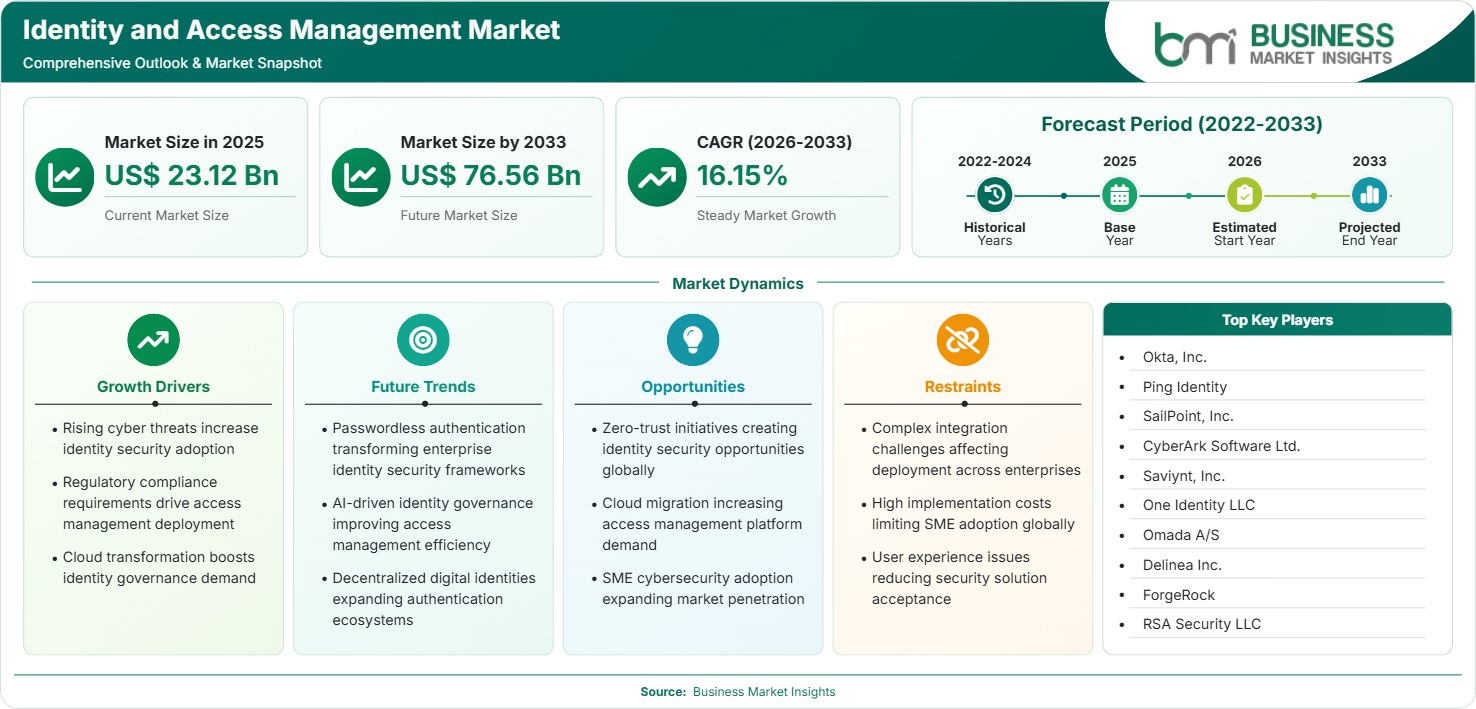
The Identity and Access Management Market size was valued at USD 23.12 Billion in 2025 and is projected to reach USD 76.56 Billion by 2033, growing at a CAGR of 16.15% during 2026–2033, driven by cloud adoption, AI-enabled threats, regulatory requirements, identity governance, and demand for secure digital access.

Report Coverage
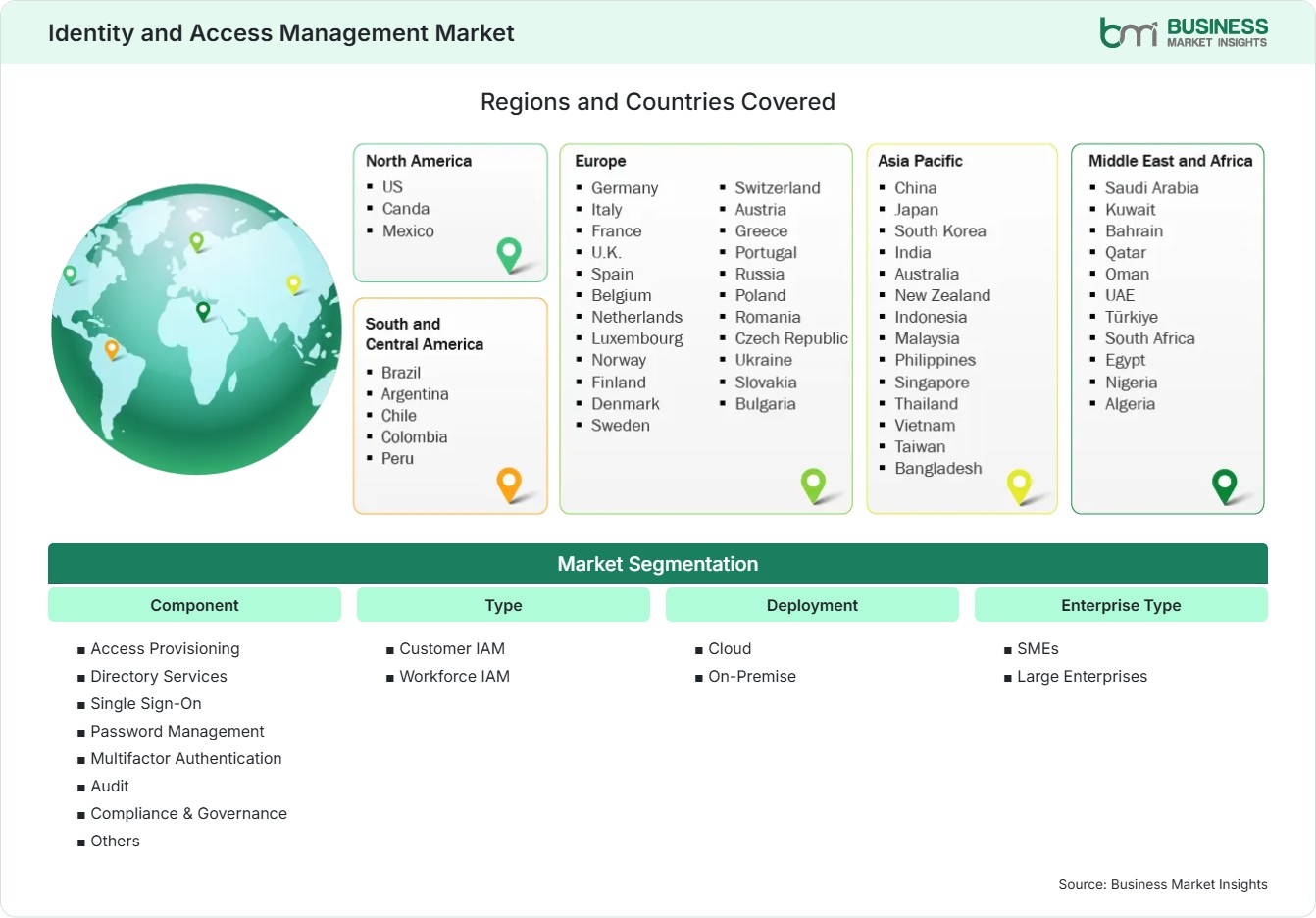
  • Component: Access Provisioning, Directory Services, Single Sign-On, Password Management, Multifactor Authentication, Audit, Compliance & Governance, Others
  • Type: Customer IAM, Workforce IAM
  • Deployment: Cloud, On-Premise
  • Enterprise Type: SMEs, Large Enterprises
  • Vertical: BFSI, IT & Telecom, Retail & Consumer Goods, Government, Energy & Utilities, Education, Manufacturing, Healthcare & Life Sciences, Others
US$ 23.12 Bn Market size in 2025
US$ 76.56 Bn Market Size by 2033
16.15% CAGR, 2026 - 2033
2026-2033 Forecast Period

AI Overview

Identity and Access Management Market Summary

  • North America Region: North America holds a 38%–41% share in 2025, with a 15%–17% CAGR during 2026–2033, supported by mature cybersecurity infrastructure, cloud migration, zero-trust adoption, regulatory compliance, and enterprise identity modernization.
  • Fastest Growing Region: Asia Pacific holds a 20%–24% share in 2025 and is projected to record a 18%–21% CAGR during 2026–2033, supported by digital transformation, expanding cloud infrastructure, mobile services, cybersecurity investment, regulatory modernization, and increasing enterprise adoption of identity-centric security.
  • Leading Segment: Access Provisioning represents approximately 28%–31% of 2025 revenue and is expected to expand at a 14%–16% CAGR through 2033, reflecting demand for automated onboarding, entitlement management, lifecycle control, and governance across increasingly complex enterprise application environments.
  • High Growth Segment: Multifactor Authentication is positioned as a high-growth segment, with an 18%–21% CAGR during 2026–2033, driven by phishing-resistant authentication, passwordless access, zero-trust architectures, account takeover prevention, regulatory pressure, and growing requirements for stronger authentication across distributed workforces.
  • Key Market Opportunity: The strongest opportunity lies in unified identity platforms that govern human, machine, customer, workforce, and AI-agent identities while connecting authentication, privileged access, governance, analytics, and automated remediation.
  • Major Market Players: Okta, Inc.; Ping Identity; SailPoint, Inc.; CyberArk Software Ltd.; Saviynt, Inc.; One Identity LLC; Omada A/S; Delinea Inc.; ForgeRock; RSA Security LLC.
Strategic Insights

Identity and Access Management Market: Strategic Insights

Identity and Access Management Market Strategic Framework
FREE PDF
Request your free sample
Request free sample
Stakeholder View

Key Takeaways

  • Identity has shifted from being an administrative IT function to becoming a key security control. The value chain now includes authentication, provisioning, governance, privileged access, analytics, compliance, and automated remediation, which in turn provides opportunities for vendors who are able to integrate a number of identity functions.
  • The greatest benefit lies in the areas of automated identity governance, multifactor authentication, privileged access, and the management of machine or non-human identities. Businesses are looking for controls that will cut down on manual entitlement administration while at the same time continuously detecting excessive or inappropriate access.
  • The priorities in product development are being changed by AI, with identity platforms now including features such as AI-assisted administration, behavioral analytics, automated recommendations, intelligent access reviews, and governance procedures for machine and AI-agent identities.
  • Asia Pacific represents a highly attractive opportunity for expansion since digital services, cloud adoption, mobile ecosystems, and investments in cybersecurity are all developing rapidly in a number of large economies. Companies that have the ability to comply with local regulations and can deploy cloud solutions on a large scale are able to take advantage of this growth.
  • Competitive activity is becoming more influenced by the consolidation of platforms. The proposal for Palo Alto Networks to acquire CyberArk in 2025 shows how important identity security is as part of broader cybersecurity platforms and thus underlines identity's role as a key security layer.
Geographic Outlook

Identity and Access Management Market Regional Highlights

North America Identity and Access Management Market

North America accounted for approximately 38%–41% of 2025 Identity and Access Management Market revenue and is projected to maintain a 15%–17% CAGR through 2033. The region benefits from mature cybersecurity infrastructure, extensive enterprise cloud adoption, sophisticated regulatory requirements, and a dense concentration of IAM providers.

  • The need for centralized identity controls is growing as a result of enterprise cloud migration, covering SaaS, private infrastructure, APIs, and distributed applications.
  • The regulations in the financial services, healthcare, and government sectors all place an emphasis on authentication, access control management, auditability, and the controls associated with the identity lifecycle.
  • US companies are still the main ones to adopt this approach since identity is becoming more integrated with wider zero-trust and security operations strategies.
  • As businesses' environments become more automated, vendors are extending their efforts into the areas of AI agents, machine identities, and privileged-access governance.
  • The combination of platforms is providing opportunities for companies to integrate authentication, governance, analytics, and security response.

US Identity and Access Management Market

The US represents approximately 32%–35% of global 2025 Identity and Access Management Market revenue and is projected to expand at a 15%–17% CAGR during 2026–2033. Strong enterprise cybersecurity budgets, cloud-first strategies, regulatory obligations, and the concentration of leading identity technology providers support continued adoption.

  • Financial institutions and healthcare organizations are still giving priority to strong authentication and access governance to reduce unauthorized access and to help with compliance.
  • Large companies are combining their identity and access management with zero-trust security initiatives and their overall security operations.
  • New governance requirements are being created by AI and machine identities beyond those associated with traditional employee access.
  • For digital commerce, financial services, and consumer applications, customer identity platforms are becoming more important.

Europe Identity and Access Management Market

Europe represents approximately 24%–27% of 2025 Identity and Access Management Market revenue and is projected to grow at a 14%–17% CAGR through 2033. Data protection requirements, digital identity initiatives, cybersecurity regulation, and enterprise cloud adoption are supporting IAM investment.

  • Germany is still a leading market since more industrial enterprises are connecting cloud, operational, and business applications that require controlled identities.
  • The UK is still giving priority to the modernization of enterprise identity in the areas of financial services, government, and technology.
  • France gains support from digitalization within the public sector, from investments in cybersecurity, and from requirements for identity in the regulated industries.
  • There is great potential for the adoption of cloud IAM, passwordless authentication, and identity automation in the Nordic markets.
  • The requirements for compliance in Europe are increasingly in favor of platforms that are able to keep auditable access policies in complex environments.

Asia Pacific Identity and Access Management Market

Asia Pacific represents approximately 20%–24% of 2025 revenue and is projected to record an 18%–21% CAGR, making it the fastest-growing regional Identity and Access Management Market.

  • China is still a significant player in the digital economy, with demand for identity controls supported by enterprise modernization and online services.
  • The country is experiencing rapid digitalization together with an increasing awareness of cybersecurity, which is leading to new opportunities in the BFSI sector, among the government, the telecom industry, and the technology sector.
  • Japan and South Korea offer great potential for businesses through their adoption of advanced technology and their modernization of cybersecurity.
  • Both Singapore and Australia have well-developed digital ecosystems, and both place a strong emphasis on cybersecurity and data protection.
  • The economies of the Southeast Asian region offer plenty of opportunities for growth as developments in cloud computing, fintech, e-commerce, and digital government services take place.

Rest of World Identity and Access Management Market

South and Central America, together with the Middle East and Africa, account for approximately 10%–14% of 2025 Identity and Access Management Market revenue and are projected to grow at a combined 16%–20% CAGR. Brazil, Mexico, the UAE, Saudi Arabia, and South Africa provide major opportunities, supported by digital banking, government modernization, cloud migration, and cybersecurity investment.

  • The expansion of digital banking is leading to a greater demand for improved methods of authentication, fraud prevention, and customer identity verification.
  • The Gulf states are putting their money into secure digital government and business services, which is opening up opportunities for cloud identity platforms.
  • Brazil is an important market for customer and workforce identity solutions in the fields of financial and digital services.
  • There are opportunities in South Africa in the fields of banking, telecommunications, healthcare, and large enterprises.
  • Vendors who have expertise in complying with regional regulations and who have local implementation partners can increase adoption in emerging markets.
Global Market Geography
FREE PDF
Request your free sample
Request free sample
Segment Analysis

Identity and Access Management Market Segmentation

Component

Component-based demand remains centered on access provisioning, authentication, governance, and identity administration. Access provisioning represented approximately 28%–31% of 2025 Identity and Access Management Market revenue and is expected to grow at a 14%–16% CAGR as enterprises automate lifecycle management, reduce excessive permissions, and improve visibility across increasingly distributed application environments.

  • Access Provisioning: Automated onboarding, role assignment, entitlement changes, and deprovisioning improve lifecycle efficiency while reducing orphaned accounts and inappropriate access.
  • Directory Services: Centralized identity repositories support authentication, user management, application integration, and consistent identity information across hybrid environments.
  • Single Sign-On: SSO reduces authentication friction while improving centralized policy enforcement across SaaS applications and enterprise digital services.
  • Password Management: Password controls address credential security, administrative overhead, and employee access challenges while supporting stronger authentication practices.
  • Multifactor Authentication: MFA strengthens identity verification through additional factors and increasingly incorporates phishing-resistant and passwordless approaches.
  • Audit, Compliance, & Governance: Governance capabilities provide visibility into entitlements, access reviews, policy enforcement, and compliance evidence across enterprise identities.

Type

Workforce IAM remains the broader enterprise identity category, while customer IAM is expanding rapidly as organizations digitize customer journeys. Combined demand is supported by authentication modernization, lifecycle automation, fraud prevention, privacy requirements, and the need to manage increasingly diverse identity populations.

  • Customer IAM: CIAM protects consumer-facing applications while supporting registration, authentication, authorization, personalization, privacy, and friction-reduced digital experiences.
  • Workforce IAM: Workforce IAM manages employee and contractor access across applications, infrastructure, cloud environments, and enterprise resources throughout the employment lifecycle.

Deployment

Cloud deployment is gaining strategic importance as enterprises migrate workloads and seek scalable identity infrastructure. On-premise platforms continue serving organizations with legacy applications, strict infrastructure requirements, or specialized control environments, creating a mixed deployment landscape during modernization.

  • Cloud: Cloud IAM enables scalable identity services, rapid deployment, centralized management, and integration with distributed SaaS and hybrid environments.
  • On-Premise: On-premise deployment remains relevant where organizations require infrastructure control, legacy integration, data residency, or specialized operational environments.

Enterprise Type

Large enterprises account for a substantial portion of spending because complex application estates, regulatory obligations, and distributed workforces require advanced identity governance. SMEs increasingly adopt cloud IAM because subscription models reduce infrastructure requirements and provide access to enterprise-grade authentication capabilities.

  • Small & Medium Enterprises (SMEs): SMEs increasingly adopt managed and cloud IAM to strengthen authentication and access controls without extensive internal security infrastructure.
  • Large Enterprises: Large organizations require sophisticated lifecycle management, governance, privileged access, analytics, and integration across extensive hybrid application estates.

Vertical

Industry requirements differ according to regulatory exposure, identity volumes, operational complexity, and digital service intensity. BFSI, IT and telecom, government, healthcare, and energy provide particularly strong use cases because unauthorized access can create financial, operational, privacy, or safety consequences.

  • BFSI: Banks and financial institutions use IAM to protect customer accounts, employee access, digital banking applications, and regulated information.
  • IT and Telecom: Technology providers manage extensive workforce, customer, developer, infrastructure, and machine identities across distributed environments.
  • Retail and Consumer Goods: Retail IAM supports customer authentication, digital commerce, employee access, and protection against account takeover.
  • Government: Government organizations require secure citizen, employee, contractor, and privileged access across increasingly digital public services.
  • Energy and Utilities: Identity controls protect enterprise systems, operational environments, remote users, and critical infrastructure access.
  • Education: Universities and educational institutions require scalable identity management across students, faculty, researchers, applications, and external collaborators.
  • Manufacturing: Manufacturers increasingly govern workforce, supplier, operational technology, and connected-device identities across digital production environments.
  • Healthcare and Life Sciences: Healthcare organizations require strong identity controls to protect sensitive information while enabling authorized clinical and administrative access.
Market Forces

Identity and Access Management Market Dynamics

Key Market Drivers

Expansion of Zero-Trust Security Architectures

Zero-trust strategies are moving identity controls from periodic authentication toward continuous verification, contextual authorization, and least-privilege enforcement. This shift directly supports Identity and Access Management Market growth because organizations need identity infrastructure capable of integrating device context, application sensitivity, user behavior, and risk signals. Enterprises are increasingly connecting IAM with security operations and access governance rather than treating authentication as an isolated function.

Rising Identity-Based Cybersecurity Threats

Credential theft, phishing, account takeover, privilege abuse, and identity-related intrusion techniques are increasing the strategic importance of identity controls. The resulting Identity and Access Management Market trends include broader adoption of phishing-resistant MFA, privileged identity management, behavioral analytics, automated access reviews, and identity threat detection. Ping Identity reported in its 2025 consumer research that 73% of surveyed consumers considered AI regulation critical for protecting identity data, while only 17% trusted organizations to manage identity data.

Growth of Cloud and Hybrid Application Environments

Cloud migration is increasing the number of applications, identities, permissions, APIs, and access pathways that organizations must govern. Traditional directory-centric approaches are often insufficient when identities span multiple cloud providers, SaaS platforms, private infrastructure, and third-party ecosystems. IAM platforms are consequently evolving toward cloud-native administration, automated provisioning, centralized policy management, and continuous entitlement monitoring. The growth of the Identity and Access Management market in hybrid environments also creates demand for interoperability because enterprises rarely migrate all applications simultaneously.

Key Market Opportunities

Governance of Machine and AI-Agent Identities

The rapid deployment of AI systems introduces identities that operate differently from traditional employees and customers. AI agents can initiate transactions, access enterprise applications, invoke APIs, and interact with sensitive information, creating requirements for authentication, authorization, privilege controls, monitoring, and accountability. SailPoint's 2025 research identified the need to govern human, machine, and AI-agent identities as identity security evolves. This creates a substantial Identity and Access Management Market opportunity for vendors to develop identity inventories, agent-specific policies, risk scoring, lifecycle controls, and automated remediation.

Expansion of Passwordless and Phishing-Resistant Authentication

The modernization of authentication offers vendors of passkeys, hardware-supported credentials, adaptive authentication, and risk-driven access decisions a chance to expand their market. There is pressure on organizations to enhance security without increasing the friction experienced by employees and customers. Passwordless methods can meet both aims by replacing weak shared secrets with more robust authentication techniques. This opportunity is especially evident in the financial services, healthcare, government, retail, and digital platforms sectors, since a compromise of accounts in these areas can lead directly to financial or reputational damage.

Identity Platforms for Digital Transformation in Emerging Markets

Emerging markets offer substantial room for IAM modernization because cloud applications, digital banking, e-government, mobile services, and online commerce are expanding simultaneously. Identity and Access Management Market Forecasts should therefore account for different maturity levels rather than assuming uniform adoption across countries. Vendors that provide cloud-native deployment, local regulatory support, simplified integration, and partner-led implementation can reduce adoption barriers. India, Southeast Asia, the Gulf states, and Latin America offer particularly attractive opportunities because organizations are building new digital services while simultaneously strengthening cybersecurity.

Market Restraints and Challenges

Complexity of Legacy Integration

Many companies run heterogeneous application environments that include legacy directories, proprietary applications, on-premises infrastructure, SaaS platforms, and custom interfaces. Integrating these different environments results in longer implementation times, higher migration costs, and greater operational complexity. Because of this, modernizing their IAM is very seldom just a simple matter of replacing technology. Before automation can realize its full benefits, organizations have to map out their current entitlements, detect any duplicate identities, redesign their roles, and set up governance procedures.

Skills Shortages and Identity Program Maturity

The need for effective identity and access management involves a range of specialized knowledge covering cybersecurity, directory architecture, governance, application integration, authentication, compliance, and automation. As companies have limited experience with identity, they find it difficult to implement sophisticated controls or translate technological capabilities into viable governance programs. The expansion in 2025 of SailPoint's Identity University was aimed at meeting the demand for identity-security skills as businesses begin to adopt more advanced capabilities.

Company Analysis

Competitive Landscape

The Identity and Access Management Market analysis indicates increasing competition between dedicated identity specialists and broader cybersecurity platforms. Vendors are expanding beyond individual authentication functions toward integrated identity security, governance, privileged access, analytics, and automation.

Company Name

Overview

Products and Services relevant to this market

Okta, Inc.

Identity technology provider focused on workforce and customer identity management for modern digital environments.

Workforce Identity, Customer Identity, SSO, MFA, lifecycle management, identity governance, and authentication services.

Ping Identity

Enterprise identity provider focused on secure digital experiences and identity orchestration.

Customer IAM, workforce IAM, SSO, MFA, authentication, authorization, and identity orchestration.

SailPoint, Inc.

Identity security specialist focused on governance, lifecycle management, and enterprise identity risk.

Identity Security Cloud, identity governance, access management, machine identity, non-employee risk, and analytics.

CyberArk Software Ltd.

Identity security specialist with strong capabilities in privileged access and enterprise identity protection.

Privileged access, workforce identity, machine identity, secrets management, and identity security.

Saviynt, Inc.

Enterprise identity platform provider focused on governance, access management, and risk reduction.

Identity governance, access management, application access, privileged access, and cloud identity security.

One Identity LLC

Identity and access management provider serving enterprises with complex infrastructure environments.

Identity governance, access management, privileged access, authentication, and identity administration.

Omada A/S

Identity governance specialist focused on automated lifecycle and compliance processes.

Identity governance, access requests, lifecycle management, access reviews, and compliance automation.

Delinea Inc.

Privileged access management specialist focused on securing privileged identities across enterprise infrastructure.

Privileged access management, secrets management, password management, and identity security.

ForgeRock

Digital identity platform provider serving customer and workforce identity use cases.

CIAM, workforce identity, authentication, authorization, identity orchestration, and access management.

RSA Security LLC

Cybersecurity provider with established capabilities in authentication and identity risk management.

MFA, risk-based authentication, identity assurance, access controls, and security authentication technologies.

Trust & Transparency

Research Methodology

The market analysis combines proprietary research with secondary data from government agencies, company disclosures, regulatory filings, industry databases and expert interviews. Market estimates are validated through data triangulation, cross-market benchmarking and analyst review.

View Full Research Methodology

Questions Answered

Frequently Asked Questions

Why is identity governance important for large enterprises?

Large enterprises typically manage extensive application estates, distributed workforces, third parties, privileged users, and machine identities. Governance provides visibility into entitlements, supports access reviews, enforces policies, reduces excessive permissions, and creates evidence for regulatory and internal controls.

How is AI affecting identity management?

AI introduces new identities, including autonomous agents and machine accounts, that may access applications, data, and APIs. This requires identity platforms to provide governance, privilege controls, lifecycle management, monitoring, and accountability for non-human actors.

Why is multifactor authentication becoming more important?

MFA adds verification factors beyond passwords and can significantly strengthen protection against credential theft and account takeover. Modern implementations increasingly use phishing-resistant methods, adaptive policies, passkeys, and risk signals to improve security while reducing authentication friction.

What is the difference between workforce IAM and customer IAM?

Workforce IAM manages employees, contractors, administrators, and other organizational users accessing enterprise resources. Customer IAM manages external users accessing digital products and services, emphasizing authentication, authorization, registration, privacy, personalization, and low-friction customer experiences.

What is driving adoption of identity and access management solutions?

Cloud migration, zero-trust security, identity-based cyber threats, regulatory requirements, remote work, digital services, and the growth of machine and AI-agent identities are increasing demand for centralized authentication, authorization, governance, and lifecycle controls.

Access the Full Identity and Access Management Market Report

Get segment-level forecasts, regional estimates, competitive benchmarking, company profiles and downloadable Excel datasets.

Access the full Identity and Access Management Market Report
350 pages PDF & Excel | 2026-10-26
Similar Research

Related Market Reports