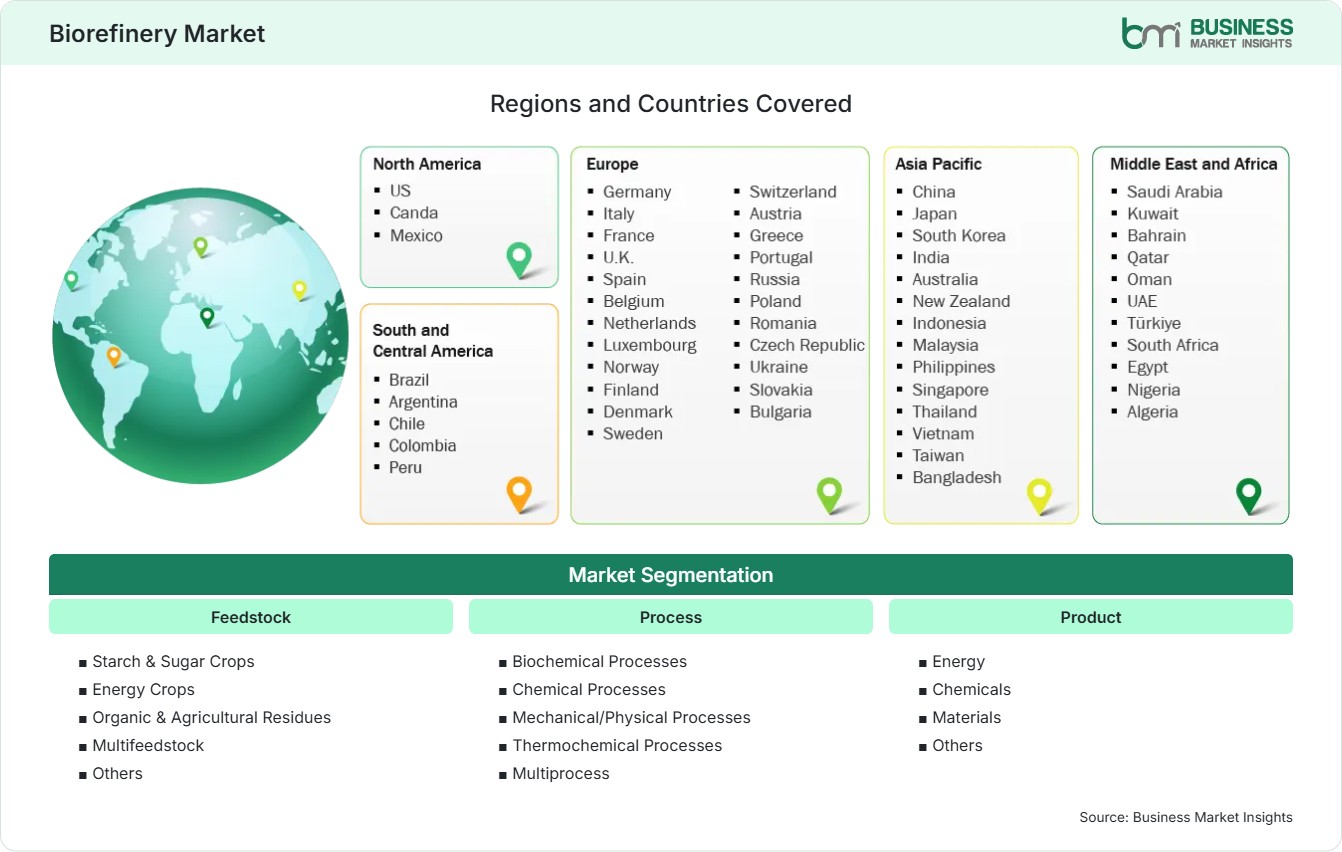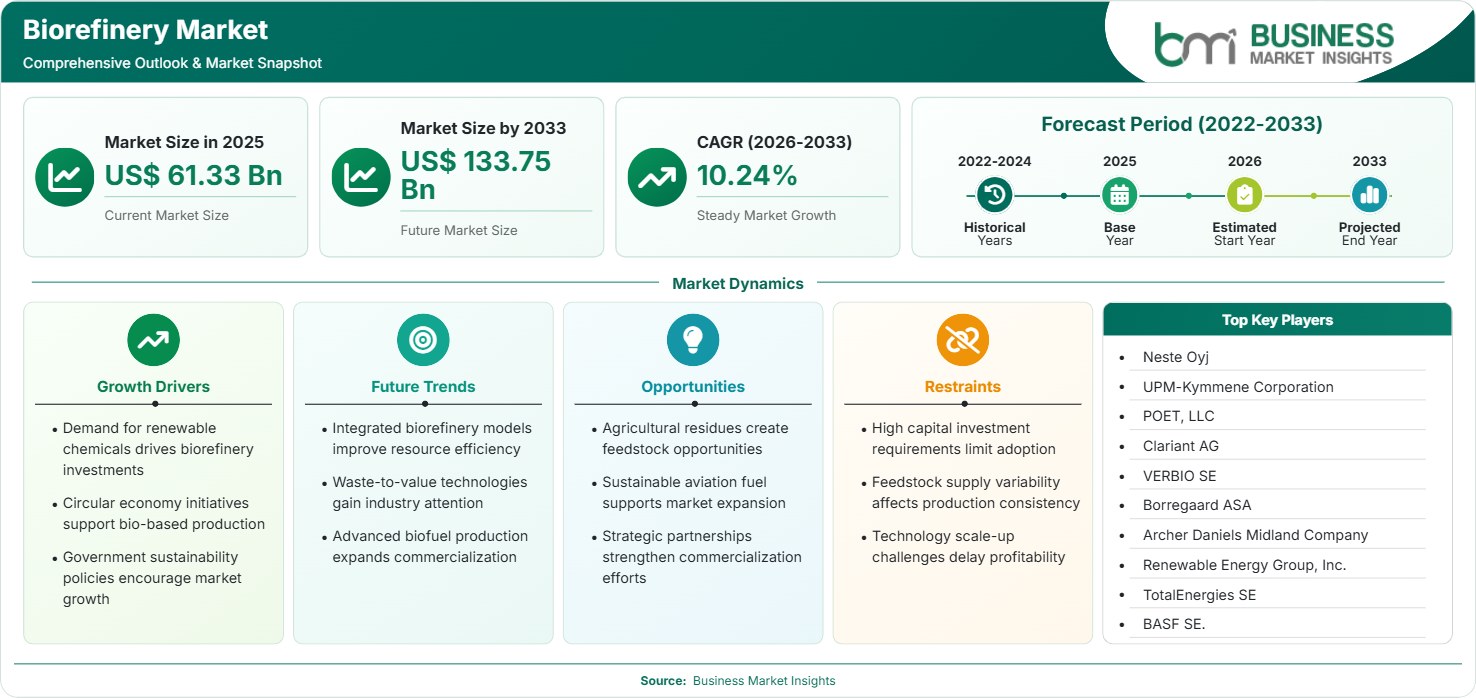
Biorefinery Market Regional Highlights
North America Biorefinery Market
North America represented 34%–37% of global revenue during 2025 and is projected to expand at 9.2%–9.8% CAGR through 2033. The region benefits from large agricultural output, advanced ethanol infrastructure, supportive renewable fuel policies, and established biofuel distribution systems. The Biorefinery Market share remains strongest in the United States due to extensive corn, soybean, and residue availability. Investments in renewable diesel, sustainable aviation fuel, and advanced biomass technologies continue strengthening regional competitiveness while improving integration between agricultural and industrial value chains.
- Renewable diesel capacity expansion continues attracting investment from traditional energy producers.
- Federal and state incentives support advanced biofuel deployment and commercialization.
- Agricultural residue utilization improves supply availability without disrupting food production.
- Sustainable aviation fuel projects are creating demand for advanced feedstock conversion technologies.
- Carbon reduction targets encourage broader adoption of renewable chemical alternatives.
US Biorefinery Market
The United States accounts for 74%–78% of North American revenue and records a 9.4%–10.0% CAGR through 2033. Strong ethanol manufacturing infrastructure, technology innovation, and federal clean fuel support programs sustain market leadership. Commercial-scale investments increasingly target renewable diesel, SAF, and specialty bio-based chemicals. Collaboration between agricultural producers, energy companies, and technology providers improves feedstock security while enhancing operational efficiencies across integrated processing facilities.
- Corn-based and residue-based feedstocks maintain strategic importance across production platforms.
- SAF development programs accelerate commercialization of advanced conversion technologies.
- Bio-based chemical demand rises among packaging and industrial manufacturing sectors.
- Technology partnerships enhance feedstock flexibility and production efficiency.
Europe Biorefinery Market
Europe accounted for 28%-31% of market share in 2025 and is expected to register a CAGR of 9.7%-10.4%. The region is driven by favorable policies, the circular economy, and the need for industrial decarbonization. Germany dominates in regional adoption, while the Nordics exhibit strong innovation activity. The Netherlands and Finland have continued to receive investment in bio-based chemicals. France is one of the high-growth regions, with a CAGR of 10.3%-10.9% driven by renewable fuels and sustainability programs.
- EU climate legislation supports bio-based manufacturing investment.
- Renewable chemical applications gain traction in packaging and consumer goods.
- Forestry residues remain critical feedstock sources across Nordic economies.
- Germany leads capacity deployment while France records faster emerging growth.
- Industrial decarbonization strategies strengthen long-term demand visibility.
Asia Pacific Biorefinery Market
Asia Pacific held a 25% to 28% market share in 2025 and is expected to grow at a CAGR of 11.5% to 12.3%, making it the fastest-growing regional market for Biorefinery. China leads in installed capacity, whereas India has immense growth opportunities due to its bioenergy programs and utilization of agricultural waste. Energy security and low-carbon-intensity fuels have become a focus for regional governments.
- China remains the leading regional market through large-scale investment programs.
- India records high-growth expansion with CAGR estimated near 12%–13%.
- Agricultural residue conversion reduces waste while supporting renewable energy objectives.
- Bio-based chemical production supports import substitution and industrial development.
- Public funding and private investments accelerate commercialization activities.
Rest of World Biorefinery Market
Rest of World constituted 8%–10% in 2025 and is forecast to expand at a 10.0%–10.8% CAGR. Sugarcane biomass and bioethanol skills available in South & Central America offer benefits. Biomass use and diversification programs facilitate growth in the Middle East & Africa. Nations such as Brazil & Saudi Arabia seek ways to produce advanced biofuels, while selected countries in Africa evaluate waste-to-value approaches to ensure resource efficiency and the development of renewables.
- Brazil remains the leading market supported by established ethanol capabilities.
- Saudi Arabia explores bioeconomy diversification and low-carbon fuel opportunities.
- Agricultural feedstocks support export-oriented renewable product development.
- Waste valorization initiatives gain relevance across emerging economies.
- Investment activity increasingly targets integrated processing and circular economy models.