Bionematicides Market Regional Highlights
North America Bionematicides Market
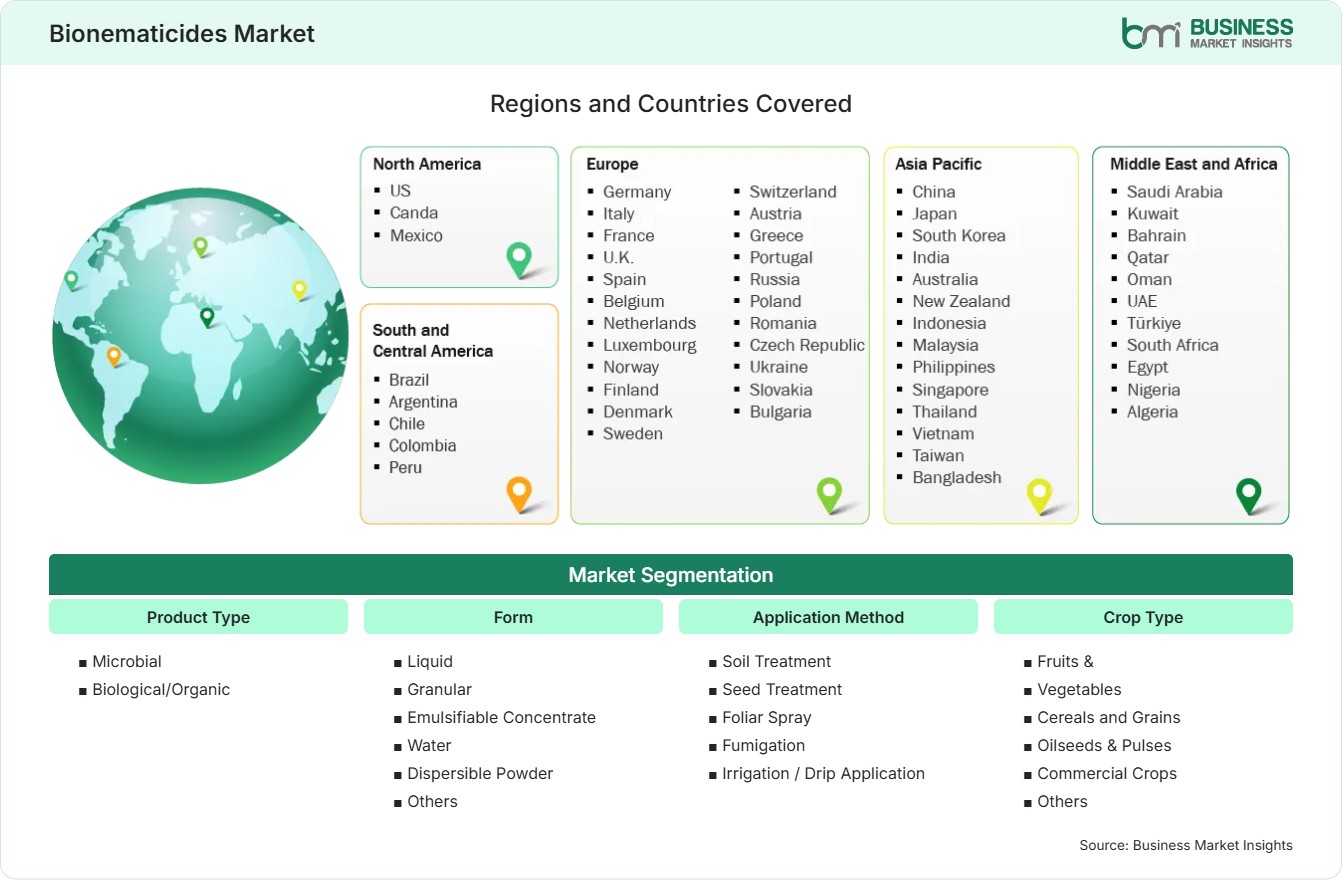
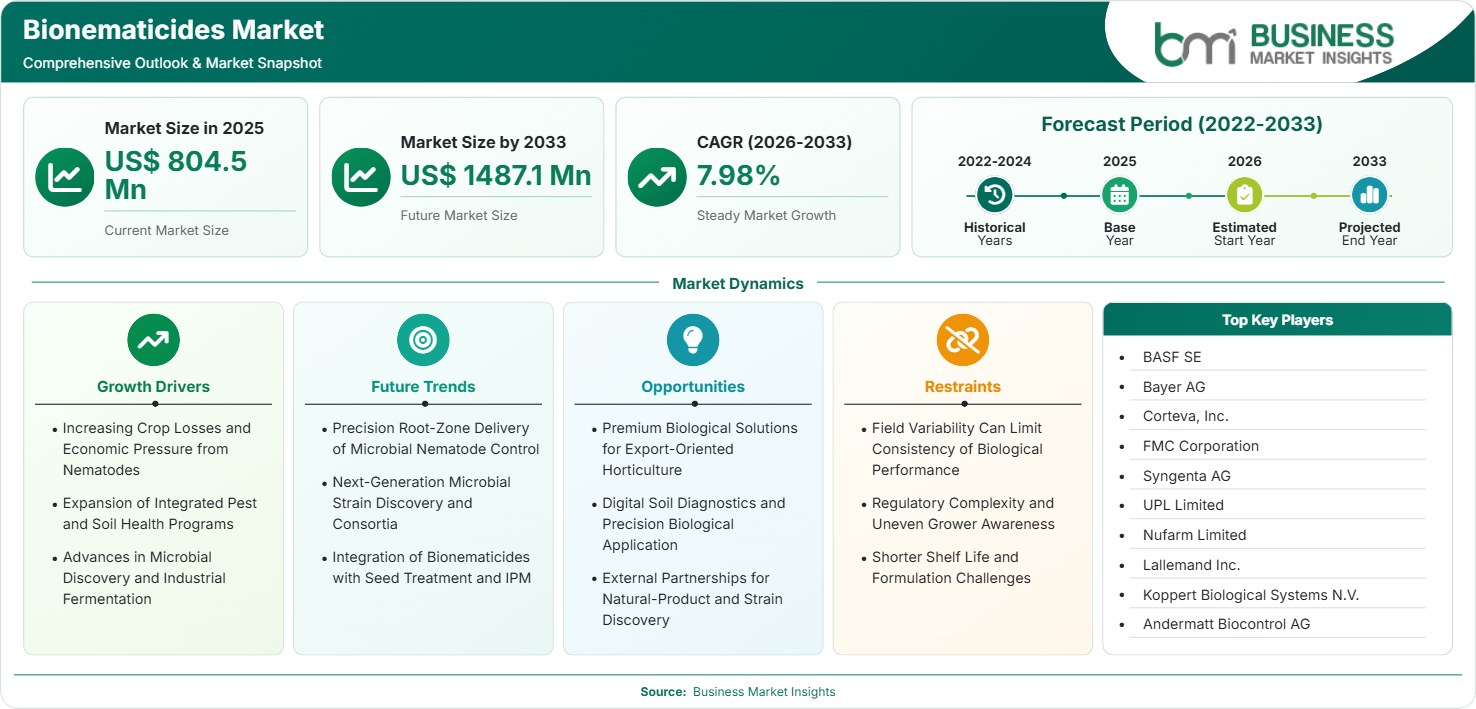
North America accounts for 29%–32% Bionematicides Market share in 2025, with a 7.2%–7.8% CAGR during 2026–2033. Demand is concentrated in specialty crops, vegetables, fruits, potatoes, and intensive farming systems where nematode pressure carries high economic consequences. The United States represents the dominant market, supported by biological registration infrastructure and advanced agronomic services. Canada contributes through greenhouse production, horticulture, and sustainable agriculture programs.
- Specialty crops support premium biological formulations because crop value, residue considerations, and soil stewardship influence purchasing decisions.
- Precision irrigation and soil-application equipment improve placement consistency, strengthening commercial opportunities for liquid and concentrated formulations.
- Biological registration pathways encourage specialized developers to build evidence-based products with clearly defined efficacy and safety profiles.
- Distributor expertise and extension networks remain important for translating biological efficacy into practical treatment schedules.
US Bionematicides Market
The US represents approximately 72%–76% of North American share in 2025, with a 7.3%–7.9% CAGR during 2026–2033. Adoption is concentrated across vegetables, fruits, potatoes, orchards, vineyards, and other high-value production systems. The regulatory environment provides dedicated treatment of microbial and biochemical pesticides, although registrants must satisfy applicable data and labeling requirements. EPA guidance distinguishes microbial pesticides from conventional chemical products, creating a structured pathway for specialized biological technologies.
- California specialty-crop production provides a strong commercialization environment because growers prioritize residue management, soil health, and alternatives to broad-spectrum soil treatments.
- Biological products increasingly enter integrated programs where scouting, crop rotation, resistant varieties, and selective chemistry complement biological treatment.
- Label expansions can materially increase addressable acreage, making regulatory execution an important competitive differentiator.
- Technical agronomy remains critical because microbial performance can vary with soil moisture, temperature, pH, and application timing.
Europe Bionematicides Market
Europe represents 25%–28% share in 2025, expanding at a 7.7%–8.4% CAGR during 2026–2033. Demand is supported by integrated pest management, residue-conscious food production, biological-input adoption, and regulatory pressure toward lower-risk crop-protection approaches. Germany benefits from biotechnology expertise and distribution infrastructure, while the Netherlands provides an advanced protected-cultivation environment for precise biological application and root-zone management in Bionematicides Market.
- Spain and Italy provide attractive opportunities because intensive vegetable and fruit production creates recurring soil-pest pressure and strong demand for residue-conscious solutions.
- Germany benefits from research capabilities, established agricultural distribution, and grower familiarity with biological crop-management technologies.
- The Netherlands offers sophisticated greenhouse infrastructure where irrigation-based biological delivery can improve application precision.
- Regulatory scrutiny increases the importance of efficacy evidence, product chemistry documentation, environmental assessment, and reliable manufacturing quality.
- Bayer's European distribution arrangement for Velsinum illustrates commercial interest in biological nematicide alternatives for vegetable and potato production.
Asia Pacific Bionematicides Market
Asia Pacific holds 27%–30% share in 2025 and records the fastest regional growth at 8.4%–9.2% CAGR during 2026–2033. India, China, Australia, Japan, and Southeast Asian markets provide varied demand conditions. Intensive horticulture, export agriculture, protected cultivation, and increasing biological-input awareness support adoption. India presents particularly strong opportunities because nematode pressure affects economically important crops and biological agriculture is expanding in Bionematicides Market.
- India provides substantial potential as horticultural production expands and farmers seek alternatives that can complement chemical crop-protection programs.
- China combines large agricultural acreage with growing interest in technology-enabled farming and biological solutions for higher-value production.
- Australia supports premium adoption through export-oriented horticulture, advanced farm management, and sustainability-driven production requirements.
- Japan offers opportunities for high-performance formulations where intensive cultivation and quality standards support specialized input economics.
- Southeast Asian fruit, vegetable, plantation, and protected-cultivation systems create additional demand for root-zone biological management.
Rest of World Bionematicides Market
Rest of World accounts for 14%–17% share in 2025, with a 7.0%–8.0% CAGR during 2026–2033. South and Central America are led by Brazil, Mexico, Argentina, Chile, and Colombia, where commercial agriculture and export crops provide broad opportunities. Middle Eastern and African demand remains smaller but offers opportunities in irrigated horticulture, greenhouse cultivation, and commercial agriculture.
- Brazil combines large agricultural acreage with sophisticated distribution networks, creating opportunities for scalable biological nematode-management technologies.
- Mexico and Chile provide attractive markets where export-oriented fruit and vegetable growers increasingly evaluate residue-sensitive crop-protection programs.
- South Africa offers a regional platform for biological products through commercial horticulture and established agricultural-input channels.
- Gulf greenhouse markets favor irrigation-compatible biological solutions because controlled environments enable accurate dosing and root-zone placement.
- African markets offer longer-term potential as extension services, biological-input awareness, and agricultural technology distribution improve.