
Biomedical Refrigerators & Freezers Market Outlook: Size, Share, Trends, Growth Analysis, Competitive Landscape & Forecast, 2026-2033

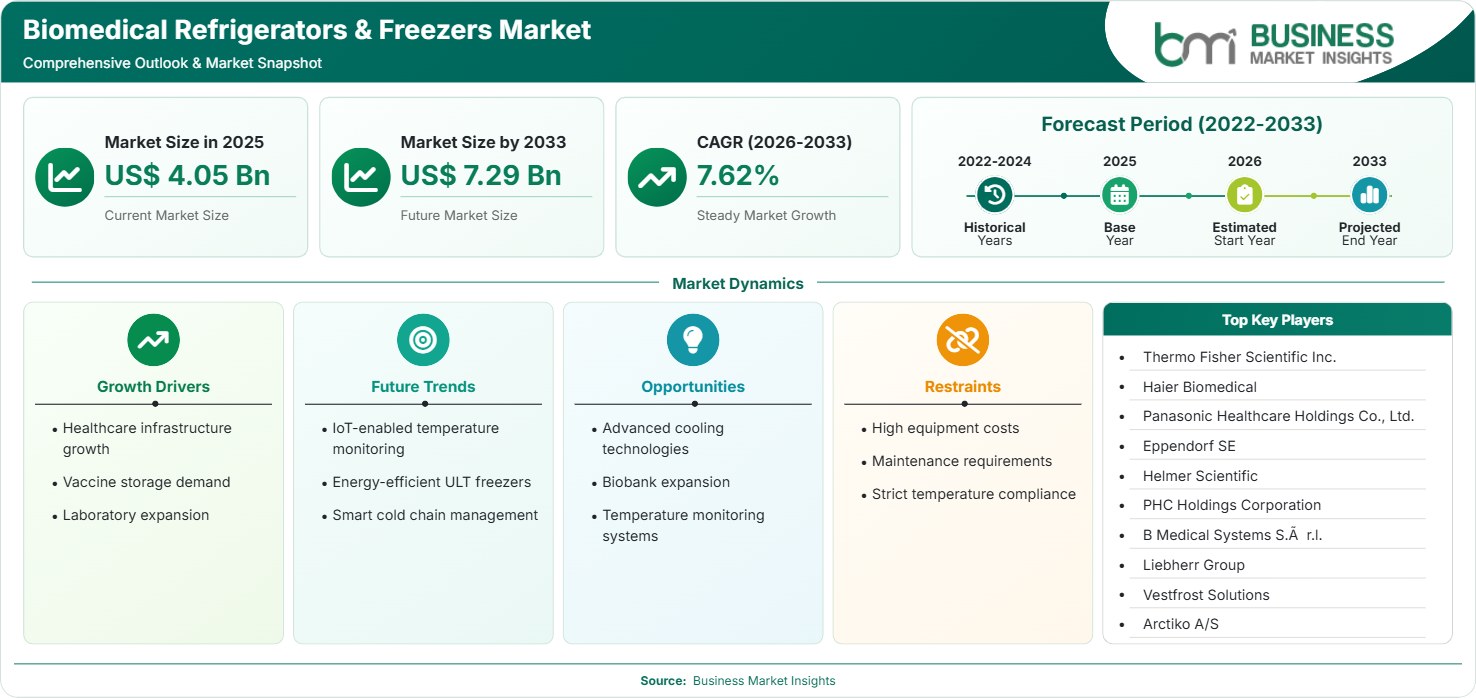
The Biomedical Refrigerators & Freezers Market size was valued at US$ 4.05 billion in 2025 and is projected to reach US$ 7.29 billion by 2033, growing at a CAGR of 7.62% during 2026–2033. Increasing healthcare infrastructure investments, expanding vaccine storage requirements, growing laboratory networks, biobank development, and adoption of advanced temperature-controlled storage technologies are driving expansion.

Report Coverage
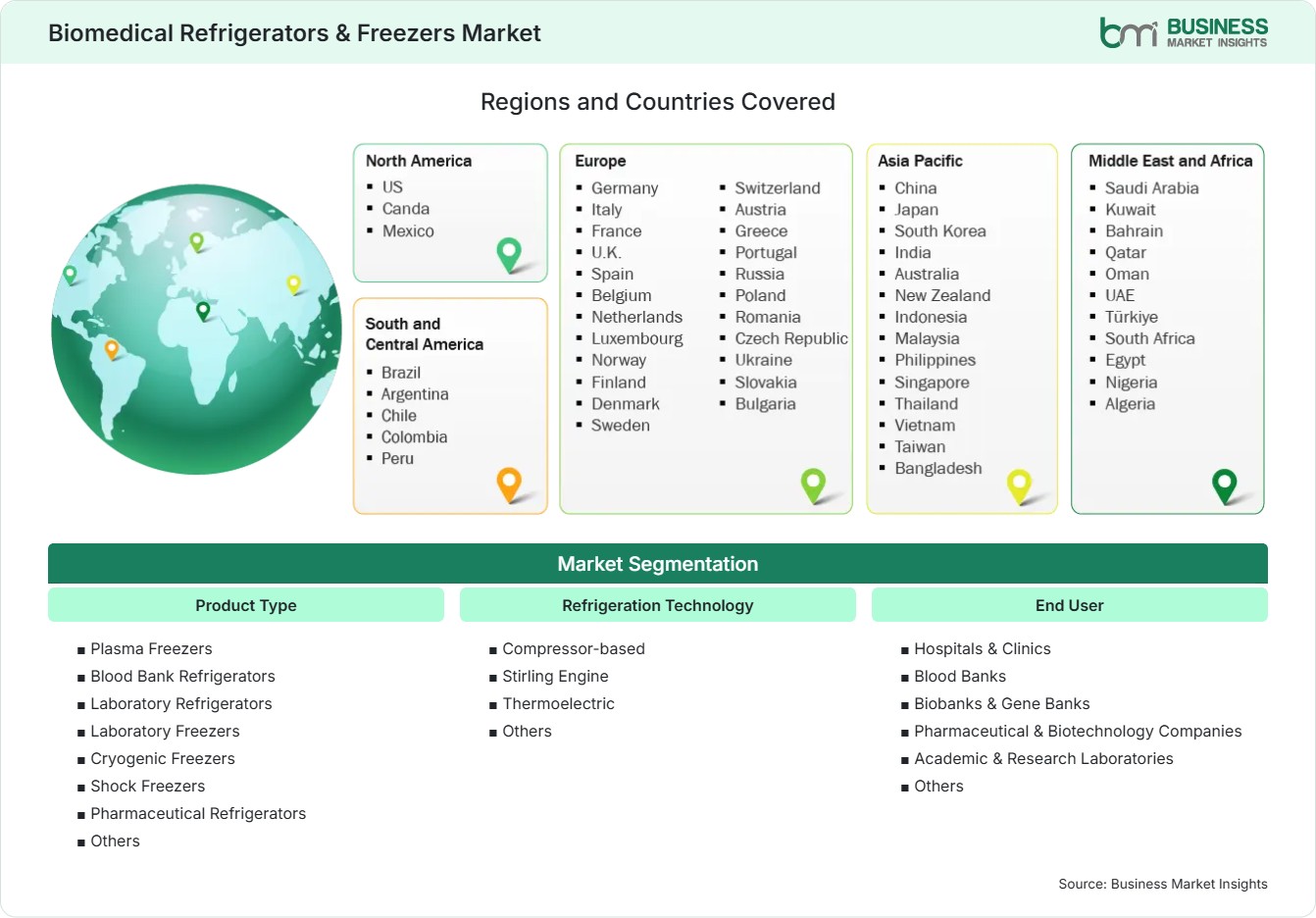
  • Product Type: Plasma Freezers, Blood Bank Refrigerators, Laboratory Refrigerators, Laboratory Freezers, Cryogenic Freezers, Shock Freezers, Pharmaceutical Refrigerators, Others
  • Refrigeration Technology: Compressor-based, Stirling Engine, Thermoelectric, Others
  • End User: Hospitals & Clinics, Blood Banks, Biobanks & Gene Banks, Pharmaceutical & Biotechnology Companies, Academic & Research Laboratories, Others
US$ 4.05 Bn Market size in 2025
US$ 7.29 Bn Market Size by 2033
7.62% CAGR, 2026 - 2033
2026-2033 Forecast Period

AI Overview

Biomedical Refrigerators & Freezers Market Summary

  • North America Region: North America holds an estimated 36%–40% market share in 2025 and is projected to expand at a 6.9%–7.6% CAGR during 2026–2033. Strong healthcare infrastructure, pharmaceutical research activity, vaccine distribution networks, and advanced laboratory systems support regional growth. The United States remains the leading market, growing at a 7.0%–7.7% CAGR, driven by biotechnology investments, clinical research expansion, and demand for reliable biomedical storage solutions, aligning with biomedical refrigerators & freezers market trends.
  • Fastest Growing Region: Asia Pacific accounts for approximately 24%–28% biomedical refrigerators & freezers share in 2025 and is forecast to register a 8.2%–9.0% CAGR through forecasts 2033. Healthcare infrastructure development, increasing laboratory capacity, pharmaceutical manufacturing expansion, and growing biobank investments are accelerating regional adoption in the market.
  • Leading Segment: Laboratory Refrigerators represent an estimated 24%–28% biomedical refrigerators & freezers share in 2025 and are expected to grow at a 7.3%–8.0% CAGR. Increasing diagnostic testing, research activities, and clinical laboratory expansion are supporting segment leadership in the market.
  • High Growth Segment: Cryogenic Freezers account for approximately 12%–16% market share in 2025 and are projected to expand at a 8.5%–9.5% CAGR. Growing demand for cell storage, genetic research, and advanced biobanking applications is driving adoption.
  • Key Market Opportunity: Advanced cooling technologies, automated temperature monitoring systems, and expanding biobank infrastructure are creating opportunities for manufacturers to develop energy-efficient, reliable, and digitally connected biomedical storage solutions.
  • Major Market Players: Thermo Fisher Scientific Inc., Haier Biomedical, Panasonic Healthcare Holdings Co., Ltd., Eppendorf SE, Helmer Scientific, PHC Holdings Corporation, B Medical Systems S.à r.l., Liebherr Group, Vestfrost Solutions, Arctiko A/S.
Strategic Insights

Biomedical Refrigerators & Freezers Market: Strategic Insights

Biomedical Refrigerators & Freezers Market Strategic Framework
FREE PDF
Request your free sample
Request free sample
Stakeholder View

Key Takeaways

  • The market ecosystem is transitioning toward integrated biomedical cold chain networks involving equipment manufacturers, healthcare providers, pharmaceutical companies, research institutions, monitoring technology suppliers, and logistics operators. Stakeholders are prioritizing reliable storage infrastructure to maintain sample integrity, vaccine effectiveness, and compliance with stringent temperature management requirements.
  • Growth opportunities are concentrated in cryogenic storage, pharmaceutical refrigeration, biobanking infrastructure, and digitally enabled cold storage systems. Expanding cell therapy research, genomic studies, and biologics development are increasing demand for specialized refrigeration equipment with precise temperature control capabilities.
  • Innovation is focused on energy-efficient refrigeration systems, smart monitoring technologies, advanced insulation materials, remote connectivity, and automated alarm systems. Manufacturers are developing intelligent cold storage platforms that enable real-time temperature tracking, predictive maintenance, and improved operational reliability across healthcare environments.
  • Asia Pacific presents a strong investment opportunity due to expanding healthcare infrastructure, increasing pharmaceutical manufacturing capacity, growing research activities, and rising biobank development. Countries including China, India, Japan, and South Korea are strengthening laboratory networks and increasing adoption of advanced biomedical storage technologies.
  • Investment and strategic partnership activities are increasingly centered on expanding product portfolios, improving refrigeration efficiency, integrating digital monitoring capabilities, and strengthening global distribution networks. Companies are focusing on technology development and regional expansion to address growing demand from healthcare and life science sectors.
  • Sustainability is becoming an important competitive factor as healthcare organizations seek refrigeration solutions with lower energy consumption, environmentally responsible refrigerants, and improved operational efficiency. Manufacturers are investing in greener technologies while maintaining strict biomedical storage performance requirements.
Geographic Outlook

Biomedical Refrigerators & Freezers Market Regional Highlights

North America Biomedical Refrigerators & Freezers Market

North America represents the largest regional market, accounting for an estimated 36%–40% Biomedical Refrigerators & Freezers Market share in 2025 and expanding at a projected 6.9%–7.6% CAGR during 2026–2033. The region benefits from advanced healthcare infrastructure, strong pharmaceutical research activity, established vaccine distribution systems, and widespread adoption of laboratory technologies. The United States remains the primary contributor due to biotechnology investments, clinical research expansion, and increasing demand for reliable biomedical cold storage solutions.

  • The United States leads regional adoption through advanced healthcare facilities, pharmaceutical research expansion, and increasing requirements for precision temperature-controlled storage systems.
  • Canada is expanding biomedical cold storage adoption through healthcare modernization, biotechnology development, and increasing laboratory infrastructure investments.
  • Hospitals and research institutions are upgrading refrigeration systems to support vaccine storage, biological sample preservation, and clinical research requirements.
  • Pharmaceutical companies are investing in advanced freezers with monitoring capabilities to maintain product stability and regulatory compliance.

US Biomedical Refrigerators & Freezers Market

The United States accounts for approximately 32%–35% of global revenue in 2025 and is projected to grow at a 7.0%–7.7% CAGR through 2033. Strong biotechnology research, pharmaceutical manufacturing, vaccine storage requirements, and clinical laboratory expansion are supporting market development. Healthcare providers are increasingly adopting advanced refrigeration systems with digital monitoring features to improve sample management and maintain storage accuracy.

  • Pharmaceutical and biotechnology companies are increasing adoption of specialized freezers for biologics, vaccines, and temperature-sensitive research materials.
  • Hospitals are upgrading biomedical refrigeration infrastructure to support growing diagnostic testing volumes and healthcare service expansion.
  • Research laboratories are implementing intelligent monitoring technologies to improve operational efficiency and reduce temperature-related storage risks.

Europe Biomedical Refrigerators & Freezers Market

Europe accounts for an estimated 27%–31% share of the global market in 2025 and is expected to register a 6.8%–7.5% CAGR during 2026–2033. The region benefits from established healthcare systems, strong life sciences research capabilities, and increasing demand for advanced laboratory infrastructure. Germany represents a leading market, while the United Kingdom and France demonstrate growth through biotechnology investments, pharmaceutical research, and expanding clinical applications.

  • Germany maintains regional leadership through strong pharmaceutical manufacturing, research infrastructure, and adoption of advanced biomedical storage technologies.
  • The United Kingdom is expanding through biotechnology research growth, clinical trial activity, and increasing demand for specialized laboratory refrigeration systems.
  • France continues developing biomedical storage capabilities through healthcare modernization and pharmaceutical sector investments.
  • European institutions are adopting energy-efficient refrigeration technologies to reduce operational costs and improve sustainability performance.
  • Regulatory requirements related to sample preservation and pharmaceutical storage are encouraging investment in reliable temperature-controlled equipment.

Asia Pacific Biomedical Refrigerators & Freezers Market

Asia Pacific represents approximately 24%–28% of market revenue in 2025 and is forecast to achieve the fastest expansion with a 8.2%–9.0% CAGR through 2033. Rising healthcare investments, expanding pharmaceutical production, growing laboratory networks, and increasing biobank activities are accelerating adoption. China represents the largest regional market, while India and South Korea are experiencing strong growth due to healthcare infrastructure development and research expansion.

  • China leads regional demand through pharmaceutical manufacturing growth, healthcare infrastructure development, and increasing laboratory capacity investments.
  • India is experiencing rapid growth due to expanding healthcare facilities, vaccine storage requirements, and biotechnology research initiatives.
  • Japan continues adopting advanced biomedical refrigeration systems through strong life sciences research and healthcare technology development.
  • South Korea is strengthening demand through biotechnology expansion, advanced medical research programs, and increasing adoption of precision storage equipment.
  • Regional healthcare providers are investing in digitally connected refrigeration systems with remote monitoring and automated alert capabilities.

Rest of World Biomedical Refrigerators & Freezers Market

The Rest of the World contributes approximately 8%–11% of global revenue in 2025 and is projected to grow at a 7.8%–8.6% CAGR through 2033. South and Central America are experiencing increased demand due to healthcare infrastructure development, vaccine programs, and laboratory modernization, particularly in Brazil and Mexico.

Middle East and Africa markets are expanding through healthcare investments, biotechnology initiatives, and improved cold chain infrastructure. Countries such as the United Arab Emirates and Saudi Arabia are developing advanced healthcare systems that require reliable biomedical storage equipment.

  • Brazil remains a key regional market due to healthcare expansion, pharmaceutical activity, and increasing laboratory infrastructure requirements.
  • Mexico is growing through improved healthcare facilities, vaccine distribution initiatives, and adoption of modern biomedical storage systems.
  • The United Arab Emirates is expanding investment in advanced healthcare infrastructure and temperature-controlled storage technologies.
  • Saudi Arabia demonstrates growth potential through healthcare transformation programs and increasing biomedical research activities.
  • Regional organizations are prioritizing reliable refrigeration systems to strengthen vaccine storage, diagnostics, and biological sample preservation capabilities.
Global Market Geography
FREE PDF
Request your free sample
Request free sample
Segment Analysis

Biomedical Refrigerators & Freezers Market Segmentation

Product Type

The product type segment represents the core equipment category within biomedical cold storage, with laboratory refrigerators maintaining a leading position due to extensive usage across healthcare facilities and research environments. The segment accounted for an estimated 100% share in 2025 and is projected to expand at a 7.62%–8.1% CAGR during 2026–2033. Increasing laboratory expansion, vaccine storage requirements, pharmaceutical research, and biological sample preservation needs are supporting demand for specialized refrigeration solutions.

  • Plasma Freezers: Plasma freezers are essential for blood component preservation, maintaining controlled temperatures required for plasma storage in hospitals, blood banks, and transfusion centers.
  • Blood Bank Refrigerators: Blood bank refrigerators support safe blood component storage through precise temperature regulation, monitoring systems, and compliance with healthcare storage standards.
  • Laboratory Refrigerators: Laboratory refrigerators are widely adopted for storing reagents, samples, chemicals, and diagnostic materials across clinical and research laboratories.
  • Laboratory Freezers: Laboratory freezers provide reliable low-temperature storage for biological samples, research materials, enzymes, and temperature-sensitive laboratory products.
  • Cryogenic Freezers: Cryogenic freezers are expanding through increased demand for cell preservation, genomic research, stem cell storage, and advanced biotechnology applications.
  • Shock Freezers: Shock freezers support rapid cooling requirements in specialized applications where quick temperature reduction helps preserve sensitive biological materials.
  • Pharmaceutical Refrigerators: Pharmaceutical refrigerators are gaining importance due to growing vaccine storage needs, biologics development, and pharmaceutical supply chain expansion.
  • Other Specialized Biomedical Cold Storage: Specialized biomedical storage solutions support niche applications requiring customized temperature control, enhanced monitoring, and specific preservation conditions.

Refrigeration Technology

The refrigeration technology segment reflects advancements focused on efficiency, temperature accuracy, and sustainable operation. The segment represented an estimated 100% share in 2025 and is expected to grow at a 7.62%–8.2% CAGR between 2026–2033. Compressor-based systems maintain broad adoption, while emerging technologies such as Stirling engines and thermoelectric systems are gaining attention for improved efficiency and specialized applications.

  • Compressor-based: Compressor-based refrigeration remains widely used due to proven reliability, temperature stability, and suitability across hospitals, laboratories, and pharmaceutical storage environments.
  • Stirling Engine: Stirling engine technology is gaining attention for energy efficiency, compact design, and applications requiring advanced cooling performance with reduced environmental impact.
  • Thermoelectric: Thermoelectric refrigeration supports specialized biomedical applications through silent operation, compact configurations, and reliable temperature management capabilities.
  • Other Refrigeration Technologies: Other refrigeration technologies address specialized requirements through innovative cooling approaches, improved efficiency, and application-specific biomedical storage solutions.

End User

The end user segment highlights expanding adoption across healthcare, pharmaceutical, and research institutions requiring dependable cold storage infrastructure. The segment accounted for an estimated 100% share in 2025 and is projected to grow at a 7.62%–8.3% CAGR during 2026–2033. Hospitals, biobanks, and biotechnology companies are increasing investments in advanced storage systems to support growing healthcare and research activities.

  • Hospitals & Clinics: Hospitals and clinics represent major users due to increasing requirements for vaccine storage, diagnostic materials, blood products, and pharmaceutical preservation.
  • Blood Banks: Blood banks rely on specialized refrigeration systems to maintain blood component quality, ensure safety, and support transfusion service operations.
  • Biobanks & Gene Banks: Biobanks and gene banks are expanding adoption through rising demand for long-term biological sample storage, genomic research, and precision medicine applications.
  • Pharmaceutical & Biotechnology Companies: Pharmaceutical and biotechnology companies are investing in advanced freezers for biologics, vaccines, clinical trials, and research material preservation.
  • Academic & Research Laboratories: Academic and research laboratories require reliable cold storage systems to support scientific studies, experimental workflows, and biological sample management.
  • Others: Other end users include diagnostic centers, government institutions, and specialized facilities requiring dependable biomedical storage solutions for various applications.
Market Forces

Biomedical Refrigerators & Freezers Market Dynamics

Key Market Drivers

Expansion of Healthcare Infrastructure and Medical Facilities

Growing healthcare infrastructure development across emerging and developed economies is increasing demand for reliable biomedical cold storage equipment. The Biomedical Refrigerators & Freezers Market growth is driven by growth in hospitals, diagnostic centers, pharmaceutical production facilities, and health services. There is a need for biomedical refrigerators & freezers in new healthcare facilities to store vaccines, blood products, chemicals, and biologicals. Trends in Biomedical Refrigerators & Freezers show an increase in the use of digitally monitored storage solutions.

Increasing Vaccine Storage and Distribution Requirements

Growing vaccine production, immunization programs, and pharmaceutical distribution networks are strengthening demand for biomedical refrigeration systems. The development of temperature-sensitive vaccines is increasing the use of specialized refrigeration facilities capable of monitoring them. Government healthcare and expanded vaccination programs have become a driving factor behind investment in cold chain facilities.

Expansion of Laboratory Research and Biotechnology Activities

Increasing laboratory expansion and biotechnology research activities are creating demand for advanced biomedical refrigeration solutions. Research institutions, pharmaceutical companies, and academic laboratories require specialized cold storage equipment for biological samples, genetic materials, reagents, and experimental compounds. Growth in areas such as genomics, cell therapy, and personalized medicine is increasing requirements for reliable low-temperature preservation systems.

Key Market Opportunities

Adoption of Advanced Cooling Technologies

Advanced cooling technologies represent a major opportunity as healthcare organizations seek more efficient, reliable, and sustainable refrigeration solutions. The Biomedical Refrigerators & Freezers market Forecasts indicate increasing demand for systems incorporating energy-efficient designs, improved temperature stability, and innovative cooling mechanisms. Stirling engines and thermoelectric devices are becoming more popular due to their ability to deliver precise results and conserve energy. Those involved in manufacturing new refrigeration technologies can cater to the increasing needs of pharmaceutical firms and research organizations.

Expansion of Biobank and Gene Storage Infrastructure

Growing biobank and gene bank activities are creating opportunities for specialized biomedical freezer manufacturers. Increasing genomic research, precision medicine initiatives, and biological sample collection programs require long-term storage solutions with highly controlled environmental conditions. The biobanks have started investing in high-end cryogenic facilities and technology for preservation of biological material. Pharmaceutical companies as well as organizations involved in research and development have started building relationships with storage facilities that will aid in their drug discovery process. The vendors who offer scalable and digitally-monitored storage options are likely to profit from increasing demands in the market.

Integration of Temperature Monitoring Systems

Temperature monitoring systems are becoming an important opportunity area as healthcare organizations prioritize real-time visibility and regulatory compliance. Smart monitoring technologies enable continuous tracking, automated alerts, remote access, and improved management of biomedical storage environments. Intelligent refrigeration systems are being introduced by hospitals, labs, and drug manufacturing companies to mitigate problems posed by temperature variations and machine failures. This is being achieved through the integration of sensor technology and connectivity capabilities in the cold storage system. The growing importance of quality assurance and data-driven healthcare management will boost their adoption.

Market Restraints and Challenges

High Equipment Costs Limiting Adoption

Factor: Advanced biomedical refrigerators and freezers require significant investment due to specialized cooling technologies, precision components, monitoring systems, and compliance requirements.

Impact: High initial equipment costs can limit adoption among smaller healthcare facilities, research laboratories, and institutions operating under budget constraints. Organizations may delay replacement of aging systems or choose lower-cost alternatives despite potential efficiency benefits. Manufacturers are addressing this challenge through diversified product portfolios, financing models, and development of cost-efficient solutions. However, maintaining performance standards while reducing acquisition costs remains a key challenge for broader market penetration.

Maintenance Requirements and Operational Complexity

Factor: Biomedical refrigeration systems require regular maintenance, calibration, monitoring, and technical support to ensure consistent temperature performance and regulatory compliance.

Impact: Maintenance complexity can increase operational expenses, create downtime risks, and require specialized technical expertise. Healthcare facilities may face challenges in managing service schedules and ensuring uninterrupted storage conditions for sensitive biological materials. Manufacturers are developing predictive maintenance features, remote diagnostics, and service networks to improve equipment reliability. However, ongoing maintenance requirements remain a significant consideration influencing purchasing decisions among healthcare providers and research organizations.

Company Analysis

Competitive Landscape

The Biomedical Refrigerators & Freezers Market analysis highlights a competitive landscape driven by refrigeration innovation, healthcare infrastructure development, cold chain reliability, digital monitoring integration, and expansion of life sciences research. Leading companies are focusing on energy-efficient systems, advanced temperature control technologies, remote monitoring capabilities, and specialized storage solutions for vaccines, biological samples, pharmaceuticals, and research materials. Market participants are strengthening global distribution networks, expanding product portfolios, and developing application-specific solutions to address increasing demand from healthcare and biotechnology sectors.

Company Name

Overview

Products and Services relevant to this market

Thermo Fisher Scientific Inc.

Global life sciences company providing laboratory and healthcare equipment solutions.

Laboratory freezers, biomedical refrigerators, cryogenic storage systems, and temperature monitoring solutions.

Haier Biomedical

Healthcare equipment manufacturer specializing in cold chain technologies.

Vaccine refrigerators, blood bank refrigerators, laboratory freezers, and biobank storage solutions.

Panasonic Healthcare Holdings Co., Ltd.

Healthcare technology company focused on medical equipment solutions.

Biomedical refrigerators, ultra-low temperature freezers, and laboratory cold storage systems.

Eppendorf SE

Life sciences company providing laboratory equipment and technologies.

Laboratory freezers, sample storage systems, and temperature-controlled laboratory solutions.

Helmer Scientific

Medical equipment manufacturer specializing in cold storage products.

Blood bank refrigerators, plasma freezers, laboratory refrigerators, and monitoring systems.

PHC Holdings Corporation

Healthcare technology company supporting diagnostics and research sectors.

Biomedical refrigerators, pharmacy refrigerators, laboratory freezers, and healthcare storage solutions.

B Medical Systems S.à r.l.

Cold chain solutions provider for healthcare applications.

Vaccine refrigerators, medical freezers, transport refrigeration, and temperature monitoring technologies.

Liebherr Group

Global engineering company offering specialized refrigeration technologies.

Laboratory refrigerators, pharmacy refrigerators, medical freezers, and professional cooling equipment.

Vestfrost Solutions

Manufacturer specializing in medical and laboratory refrigeration systems.

Vaccine refrigerators, laboratory freezers, biomedical cold storage, and monitoring solutions.

Arctiko A/S

Refrigeration technology company focused on specialized cooling systems.

Laboratory refrigerators, ultra-low temperature freezers, and biomedical storage equipment.

Industry Activity

Recent Developments

March 2026

Midea Biomedical exhibited its Dual X ULT Series featuring dual cooling and dual guard technology, ENERGY STAR certification, and FLEX‑VOLT° universal power (100–240V) at Analytica 2026 in Munich, positioning the company as a key player in energy-efficient ultra-low temperature storage solutions for research laboratories.

January 2026

Haier Biomedical deployed its Pharmacy Refrigerators and Blood Bank Refrigerators at Chughtai Healthcare, Pakistan's leading large-scale comprehensive medical institution, enhancing operational efficiency and service reliability while building a more sustainable and dependable public healthcare infrastructure.

January 2026

Haier Biomedical deployed six pharmacy refrigerators across four advanced local laboratories in Brazil's Rio Grande do Sul state, delivering a professional and reliable storage solution tailored to the challenges of temperature fluctuations, limited space, and inefficient management systems.

January 2026

Haier Biomedical supported the Westmead Institute for Medical Research in Australia with its ultra-low temperature (ULT) storage technology as part of the Freezer Challenge, a global initiative to optimize low-temperature storage practices and reduce laboratory energy consumption and carbon emissions.

Trust & Transparency

Research Methodology

The market analysis combines proprietary research with secondary data from government agencies, company disclosures, regulatory filings, industry databases and expert interviews. Market estimates are validated through data triangulation, cross-market benchmarking and analyst review.

View Full Research Methodology

Questions Answered

Frequently Asked Questions

How does the Biomedical Refrigerators & Freezers Report evaluate market opportunities?

The Biomedical Refrigerators & Freezers Market Report evaluates opportunities through analysis of product segments, refrigeration technologies, end users, regional demand patterns, innovation trends, and competitive strategies.

Why are biobanks increasing demand for specialized freezers?

Growing genomic research, precision medicine initiatives, cell therapy development, and biological sample preservation requirements are increasing demand for advanced biobank storage solutions.

How are digital technologies improving biomedical refrigeration systems?

Digital monitoring systems enable real-time temperature tracking, automated alerts, remote management, predictive maintenance, and improved compliance with biomedical storage requirements.

Which product types are widely used in biomedical cold storage?

Laboratory refrigerators, laboratory freezers, blood bank refrigerators, pharmaceutical refrigerators, and cryogenic freezers are widely used across healthcare, research, and pharmaceutical applications.

What factors are driving demand for Biomedical Refrigerators & Freezers market?

Healthcare infrastructure expansion, vaccine storage requirements, laboratory growth, biotechnology research, and increasing demand for reliable biological sample preservation systems are driving market adoption.

Access the Full Biomedical Refrigerators & Freezers Market Report

Get segment-level forecasts, regional estimates, competitive benchmarking, company profiles and downloadable Excel datasets.

Access the full Biomedical Refrigerators & Freezers Market Report
350 pages PDF & Excel | 2026-08-03
Similar Research

Related Market Reports