
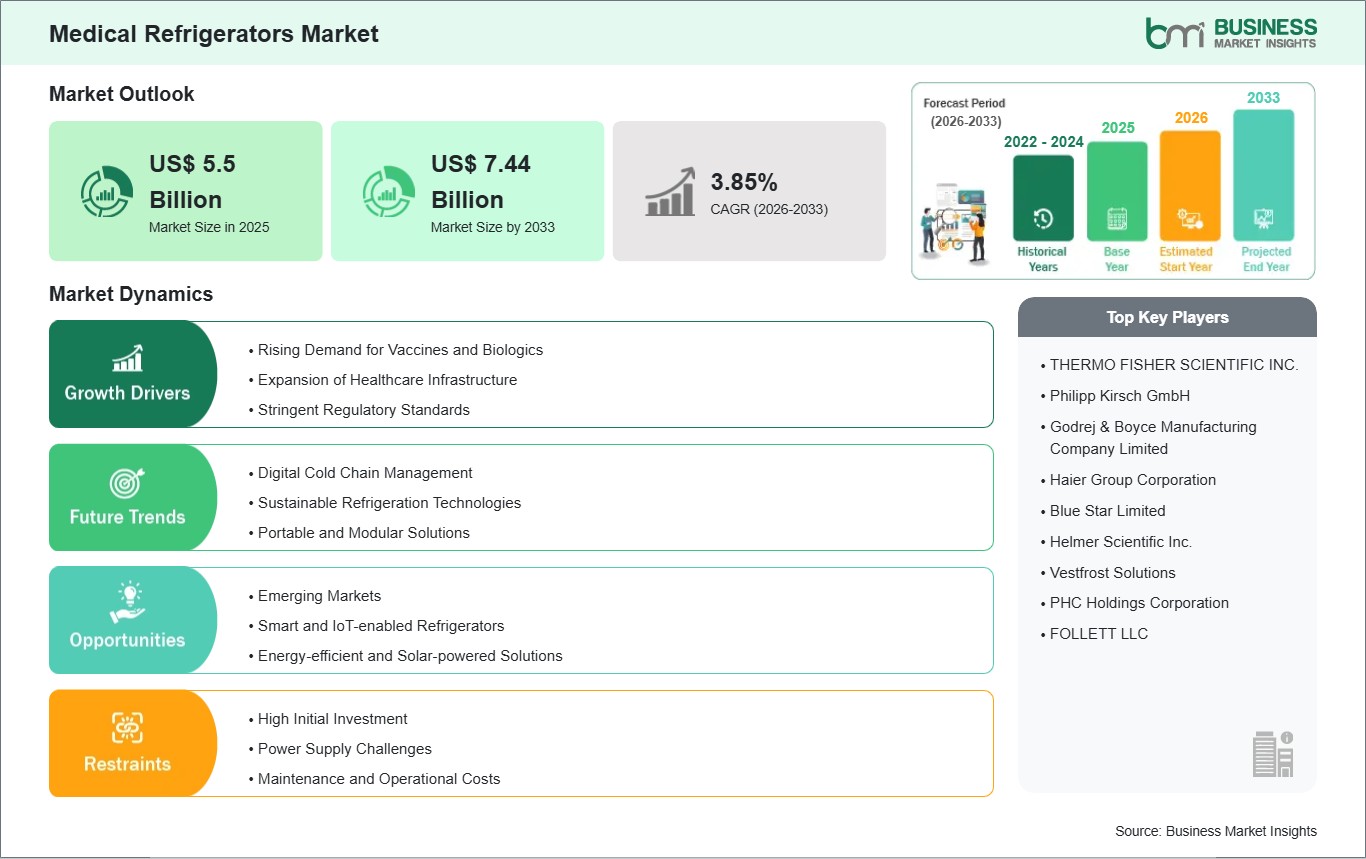
The medical Refrogerator market size is expected to reach US$ 7.44 billion by 2033 from US$ 5.5 billion in 2025. The market is estimated to record a CAGR of 3.85% from 2026 to 2033.
The global medical refrigerators market is representing continuous growth. The main driver behind this increase is the rising demand for temperature, controlled storage of vaccines, blood components, pharmaceuticals, biologics, and laboratory samples that needs to be reliable. As healthcare systems expand and modernize to keep up with the demand for cold, chain solutions globally, the need for such advanced devices has escalated mainly due to massive vaccination programs, biopharmaceutical production increase, and stringent regulations for medical storage.
Medical refrigerators are devices that are indispensable in hospitals, clinics, blood banks, pharmacies, and research laboratories where product safety, efficacy, and compliance are ensured. The market is being transformed by technological changes, and manufacturers are increasingly adding functionalities such as digital temperature monitoring, alarms, remote connectivity, energy efficiency, and eco, friendly refrigerants to their products. These features improve reliability while cutting down operational costs and environmental impact.
In terms of geography, North America is a major contributor to the global market due to its advanced healthcare infrastructure and the high adoption rate of cutting, edge medical equipment, whereas Asia, Pacific can be described as the region with the most rapid growth rate as a result of the increasing healthcare investments, expanding access to medical services, and growing awareness of cold, chain management. Europe also remains a significant contributor, driven by regulatory compliance and research activities. In general, the market outlook is still positive as it is supported by continuous innovation, increasing healthcare expenditure, and the global emphasis on maintaining the integrity of temperature, sensitive medical products.

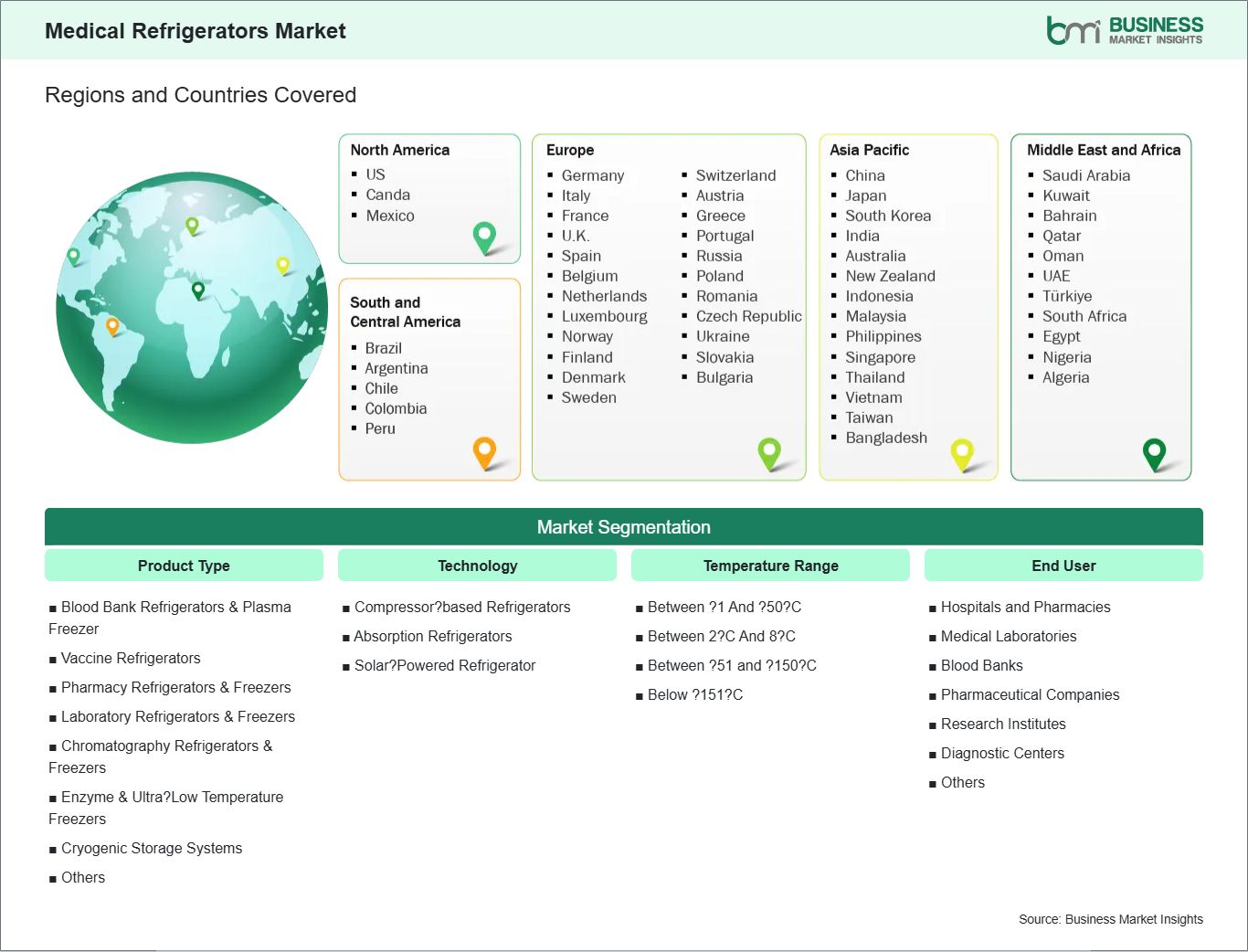
Key segments that contributed to the derivation of the Medical Refrigerators market analysis are product type, technology, temperature range, and end user.
Medical refrigerators are essential for storing vaccines, biologics, blood products, and other temperature, sensitive pharmaceuticals. These products have become increasingly popular due to the rise of chronic diseases such as diabetes, cancer, and autoimmune disorders. Biologic drugs and specialty medicines, which are currently the most widely used in such diseases, have to be stored within narrow temperature ranges to remain effective. Besides that, immunization programs and vaccination campaigns have been extensively promoted by governments and international health organizations, thus increasing the need for medical refrigeration in hospitals, clinics, pharmacies, and public health centers. Healthcare providers have been forced to replace conventional refrigerators with certified medical refrigerators that offer precise temperature control, alarms, and continuous monitoring due to the stringent guidelines imposed by regulatory bodies worldwide. Non, compliance with these standards can lead to product spoilage, financial losses, and risks to patient safety, thereby reinforcing adoption. In addition, the growth of diagnostic laboratories, blood banks, and biopharmaceutical research facilities has contributed to the demand for specialized refrigeration units. All these factors have made temperature, controlled medical storage a vital infrastructure requirement, which is the main reason for the steady increase in the global medical refrigerators market.
The rapid development of healthcare infrastructure and cold, chain systems in emerging economies present a substantial opportunity for the medical refrigerators market. A large number of countries in Asia, Pacific, Latin America, the Middle East, and Africa are actively investing in extending healthcare access, bolstering immunization coverage, and upgrading pharmaceutical distribution networks. The widespread expansion of healthcare services generates a high demand for medical refrigerators that are both reliable and affordable, especially in the environments of rural clinics, community health centers, and small laboratories. The manufacturers can seize this opportunity by producing innovative medical equipment solutions that cater to these markets, such as energy, saving, small, sized, and solar, powered medical refrigerators that can be used in areas with unstable electricity supply. Moreover, the deployment of digital technologies is another significant growth prospect in the market. Intelligent medical refrigerators with IoT, enabled features like temperature monitoring, remote alerts, data logging, and predictive maintenance can empower healthcare providers to achieve better compliance, minimize wastage, and streamline operations. With the progressive digitalization and automation of healthcare systems, the need for connected cold, storage solutions is likely to increase. Collaborations with governments, NGOs, and global health organizations to facilitate vaccination and public health programs, therefore, become an additional driver of growth. These opportunities give manufacturers the ability to broaden their presence in the market while simultaneously solving the most pressing healthcare issues globally.
By product type, the medical refrigerators market is segmented into blood bank refrigerators and plasma freezer, vaccine refrigerators, pharmacy refrigerators and freezers, laboratory refrigerators and freezers, chromatography refrigerators and freezers, enzyme and ultra-low temperature freezers, cryogenic storage systems, others. The vaccine refrigerators segment dominated the market in 2024 owing to the focus on immunization programs and the necessity of keeping temperature, sensitive vaccines safe.
By technology, the market is segmented into compressor-based refrigerators, absorption refrigerators, solar-powered refrigerator. The compressor-based refrigerators segment held the largest share of the market in 2024. Their efficiency, reliability, and ability to function over a wide temperature range, from standard 28 C storage to ultra, low temperatures, have made them very popular. They are extensively used in hospitals, laboratories, and blood banks where stable cooling and quick recovery after door openings are of utmost importance.
By temperature range, the market is segmented into Between −1 And −50°C, Between 2°C And 8°C, Between −51 and −150°C, and Below −151°C. The Between 2°C And 8°C segment held the largest share of the market in 2024. This segment dominates due to storage of vaccines, some biologics, and pharmaceuticals. The temperature range is required by worldwide health organizations for the storage of vaccines, which is the main reason for high adoption in hospitals, clinics, and vaccination centers all over the world..
By end user, the market is segmented hospitals and pharmacies, medical laboratories, blood banks, pharmaceutical companies, research institutes, diagnostic centers, and others. The hospitals and pharmacies segment held the largest share of the market in 2024. The segment growth is driven by the ongoing need to keep medications, vaccines, blood, and biologicals in storage, hospitals and pharmacies have become the major users of refrigerated storage, as a result of being one of the largest consumer markets with their need for many different types of products, compliance with Government regulations, and the need for constant storage.
| Report Attribute | Details |
|---|---|
| Market size in 2025 | US$ 5.5 Billion |
| Market Size by 2033 | US$ 7.44 Billion |
| Global CAGR (2026 - 2033) | 3.85% |
| Historical Data | 2022 - 2024 |
| Forecast period | 2026-2033 |
| Segments Covered | By Product Type
|
|
Regions and Countries Covered
| |
| North America | US, Canada, Mexico |
| Europe | Belgium, Austria, Finland, Denmark, Greece, Poland, Romania, Russia, Ukraine, Czech Republic, Slovakia, Bulgaria, Italy, Luxembourg, Germany, Switzerland, France, Netherlands, Norway, Portugal, Spain, Sweden, United Kingdom |
| Asia-Pacific | Australia, China, India, Japan, South Korea, Indonesia, Malaysia, Philippines, Singapore, Thailand, Vietnam, Bangladesh, New Zealand, Taiwan |
| South and Central America | Brazil, Argentina, Peru, Chile, Colombia |
| Middle East and Africa | Bahrain, Kuwait, Oman, Qatar, Saudi Arabia, United Arab Emirates, Turkiye, South Africa, Egypt, Algeria, Nigeria |
| Market leaders and key company profiles |
|
The "Medical Refrigerators Market Size and Forecast (2022–2033)" report provides a detailed analysis of the market covering below areas:
The geographical scope of the Medical Refrigerators market report is divided into five regions: North America, Asia Pacific, Europe, Middle East and Africa, and South and Central America. The Medical Refrigerators market in Asia Pacific is expected to grow significantly during the forecast period.
The Asia-Pacific Medical Refrigerators market is segmented into China, Japan, South Korea, India, Australia, New Zealand, Indonesia, Malaysia, the Philippines, Singapore, Thailand, Vietnam, Taiwan, Bangladesh, and the Rest of Asia. The Asia Pacific medical refrigerators market is growing at a fast pace. The expansion of the market is largely attributed to the increased development of healthcare infrastructure, higher government spending on public health, and awareness of the cold chain for vaccines and biologics. China, India, Japan, and Australia are the countries leading the demand in the region. China and India are, in particular, experiencing a significant growth due to their large population, immunization programs, and prevalence of chronic and infectious diseases.
The ongoing vaccination programs, such as routine immunizations and mass vaccination drives, have enormously increased the need for medical refrigeration solutions that can keep vaccines at the right temperature in hospitals, clinics, rural health centers, and healthcare units that can move around. Besides that, the rising pharmaceutical and biotechnology industries in the region require state, of, the, art refrigeration to store temperature, sensitive drugs, research samples, and biologics. Technological innovations, such as compressor, based, solar, powered, and IoT, enabled smart refrigerators, are increasingly being adopted to meet regulatory standards and improve the cold chain. The problem of electricity supply that is not continuous in rural areas has led to the development of solar, powered and energy, efficient refrigeration systems. The Asia Pacific market is, in general, a great opportunity for medical refrigerator manufacturers who are willing to invest in this market. The main factors that are driving the market are the escalating healthcare expenditure, increasing availability of medical services, and growing investments in the cold chain that is modern, reliable, and sustainable.

The Medical Refrigerators market is evaluated by gathering qualitative and quantitative data post primary and secondary research, which includes important corporate publications, association data, and databases. A few of the key developments in the medical refrigerators market are:
The Medical Refrigerators Market is valued at US$ 5.5 Billion in 2025, it is projected to reach US$ 7.44 Billion by 2033.
As per our report Medical Refrigerators Market, the market size is valued at US$ 5.5 Billion in 2025, projecting it to reach US$ 7.44 Billion by 2033. This translates to a CAGR of approximately 3.85% during the forecast period.
The Medical Refrigerators Market report typically cover these key segments-
The historic period, base year, and forecast period can vary slightly depending on the specific market research report. However, for the Medical Refrigerators Market report:
The Medical Refrigerators Market is populated by several key players, each contributing to its growth and innovation. Some of the major players include:
The Medical Refrigerators Market report is valuable for diverse stakeholders, including:
Essentially, anyone involved in or considering involvement in the Medical Refrigerators Market value chain can benefit from the information contained in a comprehensive market report.
Please tell us your area of interest
(Market Segments/ Regions and Countries/ Companies)