Market Summary
Executive Summary and Global Market Analysis
Medical carts are specialized mobile devices utilized within a medical context to store, transfer, and manage medical supplies and equipment, drugs, and computerized workstations within the care environment, improving workflow, safety, and mobility of medical professionals. Medical carts can be as simple as drug carts and as advanced as mobile computerized workstations, along with specialized EHR applications, barcode scanners, and scanners supporting various medical technology solutions related to documentation processes and point-of-care applications. Current designs and demands include aspects of ergonomics, antimicrobial materials, and telehealth functionality.
Globally, the medical carts market has shown strong growth owing to the digitalization of the healthcare industry, increasing adoption of mobile and point-of-care solutions, and the development of the medical infrastructure in various regions. The market is dominated by the North American region on account of the developed infrastructure of the healthcare industry and the push from electronic health record adoption. The Asia-Pacific region has been reported to be the fastest-growing market. Key driving factors include the increasing prevalence of chronic diseases.
Segment Analysis
Medical Carts Market Segmentation
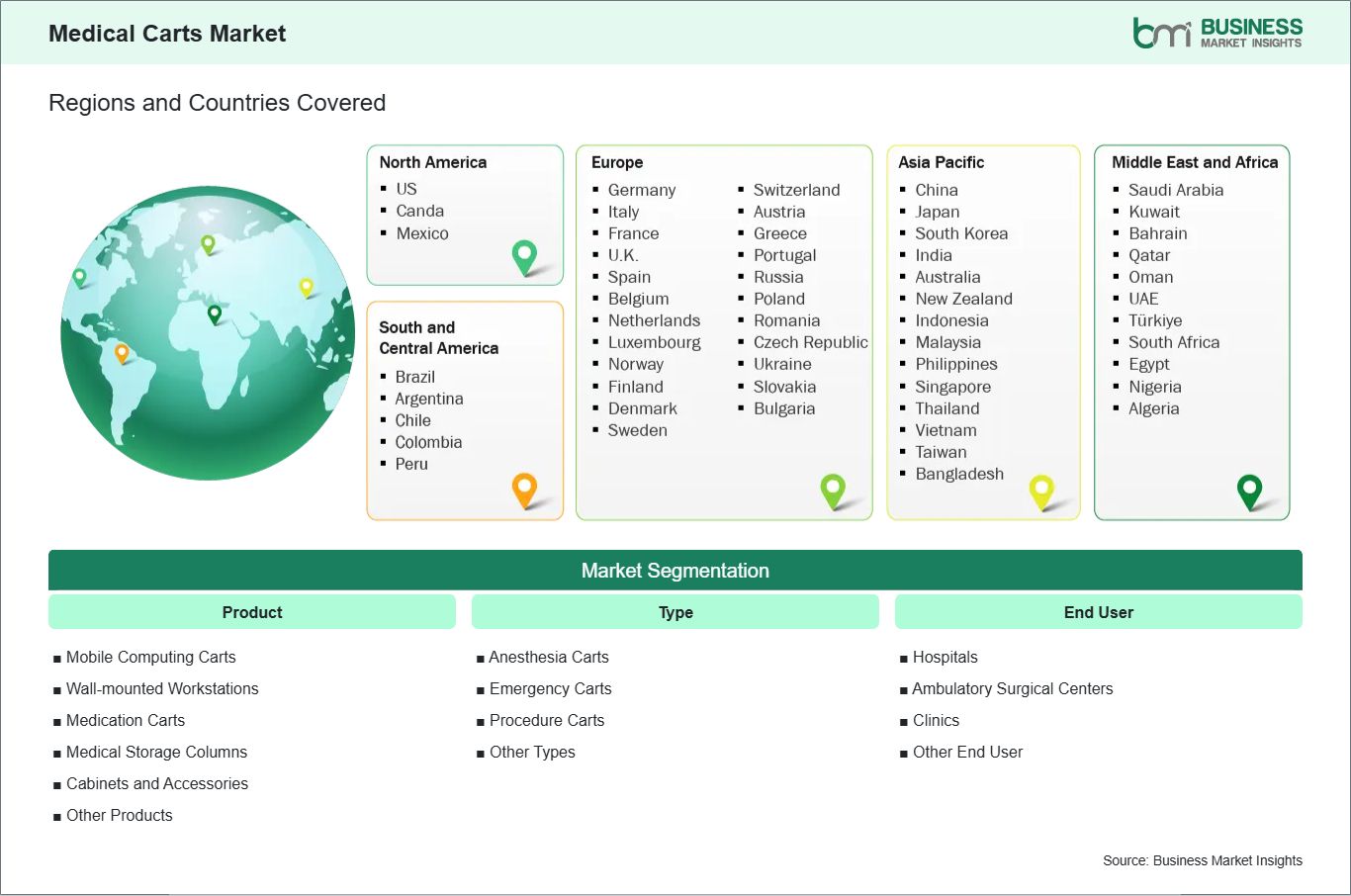
Key segments that contributed to the derivation of the medical carts market analysis are product, type, and end user.
- By product, the market is categorized into mobile computing carts, wall-mounted workstations, medication carts, medical storage columns, cabinets and accessories, other products. The mobile computing carts segment held the largest share of the market in 2025.
- By type, the market is segmented into anesthesia carts, emergency carts, procedure carts, other types. The emergency carts segment held the largest share of the market in 2025.
- By end user, the medical carts market is segmented into hospitals, ambulatory surgical centers, clinics, other end users. The hospitals segment dominated the market in 2025.
Market Forces
Medical Carts Market Drivers and Opportunities
Healthcare Digitalization and Point-of-Care Efficiency
The primary growth factor for the global medical carts market is the ever-accelerating adoption of digital healthcare technology and the need for more efficient point-of-care practices. As the healthcare delivery practices of hospitals and clinics become more modern and efficient, there is increased emphasis on integrating Electronic Health Record systems along with mobile workstations, where healthcare professionals can update and manage patient records directly at the point of care. Latest research suggests that more than 68% of hospitals worldwide have mobile carts integrated with Electronic Health Records systems, which resulted in greatly reduced errors and increased efficiency in workflow practices.
These technology-aided carts make it possible to carry out real-time graphing, medication, and diagnosis, and this property increases the efficiency of clinical decisions and the safety provided for the patient. Furthermore, the growth in the use of telemedicine has also increased the adoption of the cart and the telemedicine module.
The hospitals also have prioritized requirements related to wireless communication capabilities, ergonomics, and antimicrobial finishes. Thus, with digital transformation playing a bigger role in healthcare delivery institutions, technology-driven needs seem to provide a new push to the adoption of medical carts globally.
Expansion of Telemedicine and Remote Care Integration
One of the key opportunities available within the medical carts market lies within the growing field of telemedicine and telehealth care delivery, owing to the ongoing digital transformation taking place in the healthcare delivery environment. With the telehealth trend growing at an unprecedented level, as telemedicine appointments are growing considerably all over the globe, healthcare facilities are now increasingly demanding carts that could act as telehealth carts, acting as an integrated digital communication hub for telehealth applications. For example, in October 2024, AVer Information Inc. introduced the telehealth cart product solution consisting of the medical-grade camera, panel PC, and mobile monitor for tele-ICU, virtual consultations, and live surgery broadcasting, thereby indicating the level of innovations taking place within the telehealth carts product category.
Likewise, studies point to the integration of vital signs monitoring and telemedicine-enabled carts being able to offer digital diagnosis assistance beyond the hospital environment to remote settings. Such developments create an imperative for companies to address these challenges and provide innovative solutions that focus on telemedicine carts designed to assist with remote diagnosis and chronic disease management.
Size and Share Analysis
Medical Carts Market Size and Share Analysis
By product, the medical carts market is categorized into mobile computing carts, wall-mounted workstations, medication carts, medical storage columns, cabinets and accessories, other products. The mobile computing carts segment held the largest share of the market in 2025. Mobile computing carts lead because they enable real-time access to electronic health records at the point of care, improving clinical accuracy, workflow efficiency, and caregiver productivity. Their integration with IT systems, barcode scanning, and medication verification supports patient safety and regulatory compliance, making them essential in digitally driven healthcare environments.
By type, the market is segmented into anesthesia carts, emergency carts, procedure carts, other types. The emergency carts segment held the largest share of the market in 2025. Emergency carts dominate as they are mandatory in emergency rooms, ICUs, and operating areas. Their standardized configuration ensures immediate access to life-saving drugs and equipment, making them critical for rapid response and patient survival.
By end user, the medical carts market is segmented into hospitals, ambulatory surgical centers, clinics, other end users. The hospitals segment dominated the market in 2025. Hospitals lead as they have high patient volumes and complex operational needs across departments (ER, ICU, surgical units). They invest heavily in diverse medical carts to support workflows, improve efficiency, and enhance patient safety.
Report Coverage
Medical Carts Market Report Coverage and Deliverables
The " Medical Carts Market Size and Forecast (2022–2033)" report provides a detailed analysis of the market covering below areas:
- Medical carts market size and forecast at global, regional, and country levels for all the key market segments covered under the scope
- Medical carts market trends, as well as market dynamics such as drivers, restraints, and key opportunities
- Medical carts market analysis covering key market trends, global and regional framework, major players, regulations, and recent market developments
- Industry landscape and competition analysis covering market concentration, heat map analysis, prominent players, and recent developments for the medical carts market
- Detailed company profiles, including SWOT analysis
Geographic Insights
Medical Carts Market Geographic Insights
The geographical scope of the medical carts market report is divided into five regions: North America, Asia Pacific, Europe, Middle East & Africa, and South & Central America. The medical carts market in Asia Pacific is expected to grow significantly during the forecast period.
The Asia-Pacific medical carts market is segmented into China, Japan, South Korea, India, Australia, New Zealand, Indonesia, Malaysia, the Philippines, Singapore, Thailand, Vietnam, Taiwan, Bangladesh, and the Rest of Asia. The Asia-Pacific medical carts market is experiencing robust growth due to the swift development and modernization of health infrastructure in the main economies such as China, India, Japan, and Southeast Asia. The governments in these countries are considerably raising their budget for health care and at the same time investing in the upgrading of facilities to make healthcare more accessible and of better quality, which in turn increases the demand for modern medical devices, including mobile and digital medical carts. The use of Electronic Medical Records (EMR/EHR) and digital health technologies has made remarkable progress, with a large number of hospitals incorporating mobile carts to provide real-time patient data access and bedside care workflows, thereby reducing clinical pressure and mistakes. This practice is especially strong in China and India, where there is support in terms of policies and funds for healthcare digitalization efforts.
Also, the region’s attention to infection control, patient safety, and point-of-care solutions has been a primary reason for hospitals to frequently use specialized carts, among others. Moreover, the setting up of local manufacturing and the collaboration of international companies with regional companies make the products more affordable and available, which eventually leads to more varied and extensive adoption in different healthcare setups.
Industry Activity
Recent Developments
The medical carts market is evaluated by gathering qualitative and quantitative data post primary and secondary research, which includes important corporate publications, association data, and databases. A few of the key developments in the medical carts market are:
- In October 2024, AVer Information Inc. introduced a telehealth cart solution that integrates a medical-grade camera, panel PC, and mobile monitor to enable seamless support of tele-ICU, virtual consultation, and live surgery broadcast. This is indicative of how different manufacturers are going about innovating to meet these hybrid care needs.
- In October 2025, GlobalMed, the worldwide leader in telehealth delivery systems, and virtual care solutions, introduced three new additions to its lineup of medical hardware: the ClinicalAccess Pro Connect, the ClinicalAccess Kiosk, and the updated WallDoc. The ClinicalAccess Pro Connect is the latest evolution of GlobalMed's line of medical carts, engineered from the ground up to offer a smarter, more ergonomic, and feature-rich user experience.
Trust & Transparency
Research Methodology
The market analysis combines proprietary research with secondary data from government agencies, company disclosures, regulatory filings, industry databases and expert interviews. Market estimates are validated through data triangulation, cross-market benchmarking and analyst
review.
View Full Research Methodology
Key Sources Referred:
World Health Organization (WHO)
Centers for Disease Control and Prevention
European Centre for Disease Prevention and Control
World Bank Health Data
UNICEF
Company websites
Company annual reports
Company investor presentations