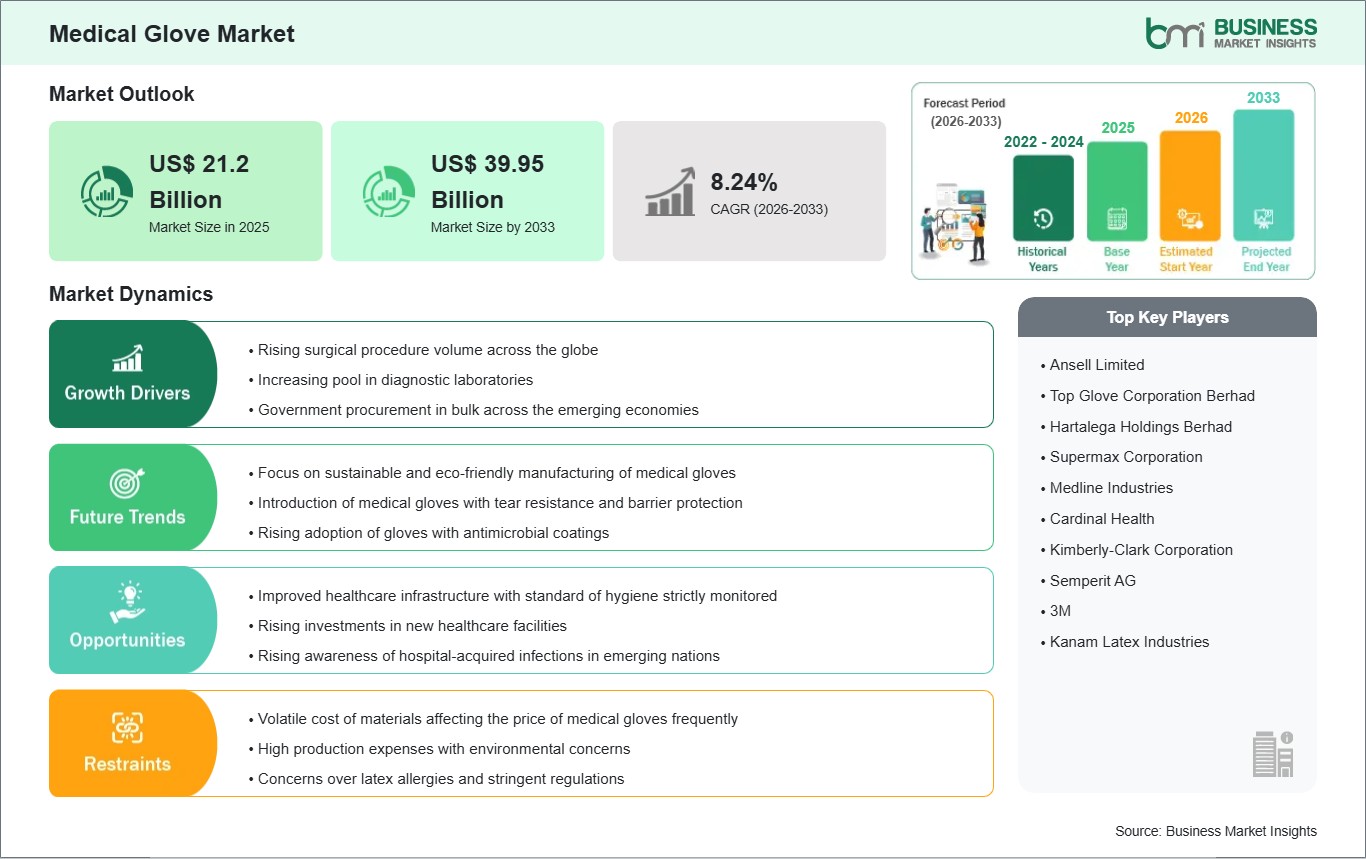
The Medical Glove Market size is expected to reach US$ 39.95 billion by 2033 from US$ 21.20 billion in 2025. The market is estimated to record a CAGR of 8.24% from 2026 to 2033.
Medical gloves, as the main type of personal protective equipment (PPE), are used by healthcare professionals not only to protect themselves but also to protect their patients in case of examinations, surgeries, and other clinical procedures as the main reason for their use is to avoid cross-contamination and contact with pathogens, chemicals, and bodily fluids. The gloves are made out of different materials like latex, nitrile, vinyl, and neoprene each material having its own specific feature, for instance, latex, and nitrile are very elastic, vinyl is chemically resistant, and nitrile is non-allergenic. Medical gloves are by far the most common type of gloves in the medical field and are expected to continue dominating the market, especially in developing countries, where the demand for gloves is to be more for free-of-charge reasons and infections are still the primary concern in hospitals and clinics. The global medical gloves market is strongly influenced by the aforementioned factors, mainly the adoption of disposable gloves due to their convenience and hygiene. By region, the North American and European markets have been identified as leading markets largely due to their state-of-the-art healthcare infrastructure and stringent safety regulations, while the Asia-Pacific region is the fastest growing one nodding with the provision of healthcare services and investments. Apart from e-commerce trunking, technological import—such as latex-free, antimicrobial, and biodegradable glove designs—is gradually becoming a major maker of market dynamics.

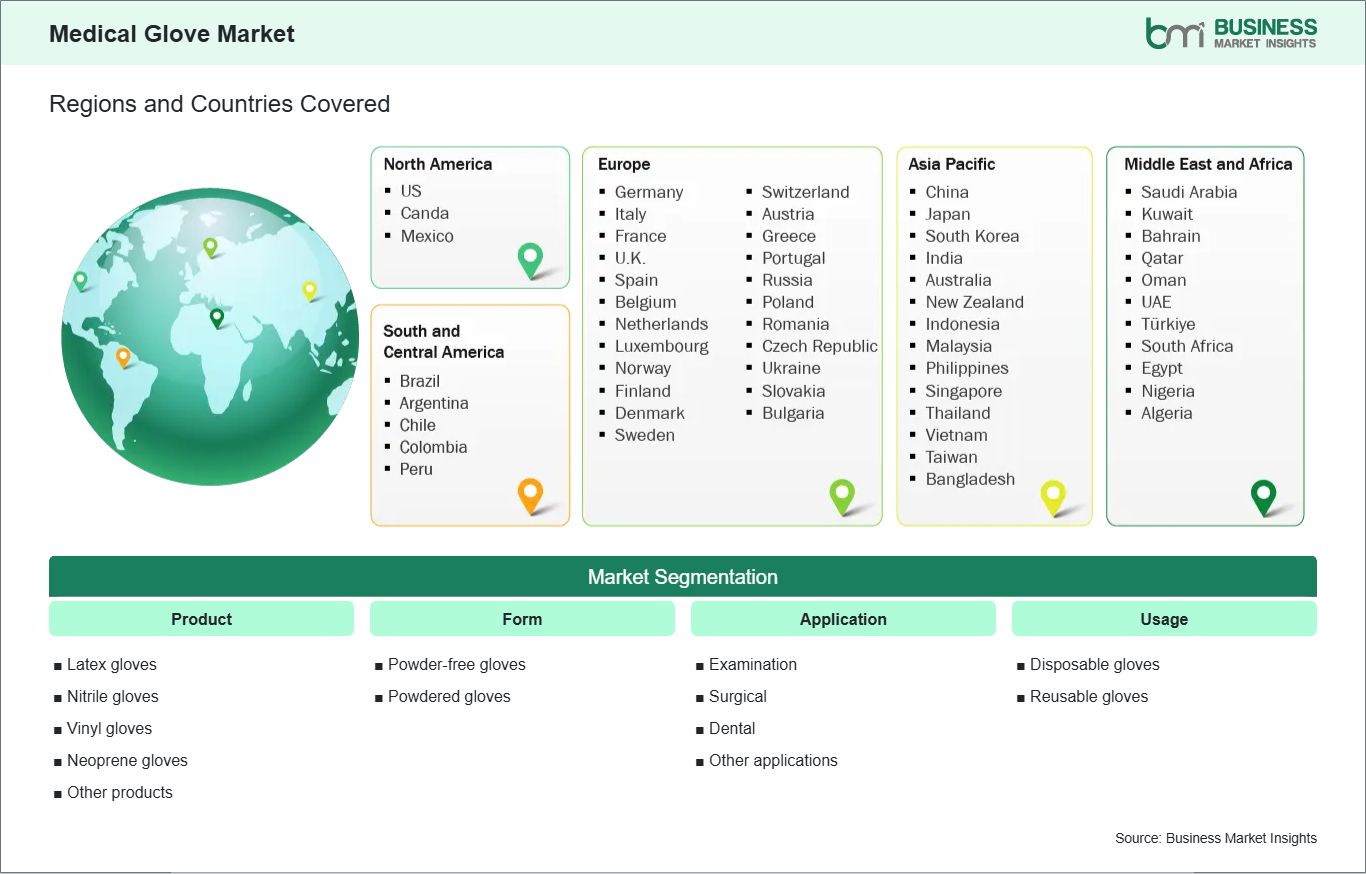
Key segments that contributed to the derivation of the medical glove market analysis are product, form, application, usage, and end user.
The medical glove market is largely driven by the growing awareness and prioritizing of infection control in healthcare settings around the globe. Healthcare-associated infections (HAIs) are still a major health issue; the World Health Organization (WHO) claims that roughly 10% of hospitalized patients in the world acquire an HAI with the rates being even higher in emerging economies. With this concern, strict hygiene rules have been put in place, which include the use of medical gloves by doctors at all times for examinations, surgeries, and tests to prevent transmission and protect the patients and the staff. In America, the Centers for Disease Control and Prevention (CDC) estimates that on any given day, there are about 1 in 31 hospital patients who have an HAI, which indicates the very importance of barrier protection like gloves during infection control in hospitals.
Moreover, the practices that were put in place after the COVID-19 pandemic have brought about the use of high hygiene standards not only in common clinical places but also in areas such as dental clinics and nursing homes that are not traditionally associated with such standards, the glove usage has been maintained at high levels even when the crisis is over. The persistent emphasis on infection risk reduction is what directly drives the global medical gloves demand up.
The medical glove market has an opportunity that could be regarded as one of the major ones in the present day with the introduction of eco-friendly and sustainable glove solutions. The rise in environmental concern in the world has made it possible for healthcare institutions, regulatory authorities, and purchasing departments to give priority to products that minimize not only medical waste but also carbon footprints. This scenario has led to the growing demand for glove alternatives that are biodegradable and compostable. Among the manufacturers, the response has been by the introduction of innovations like biodegradable nitrile and plant-based polymer gloves that are able to meet clinical safety standards during their composting under controlled conditions. For instance, Top Glove and Sybron are two of the companies that have been producing biodegradable nitrile gloves, and the amount of environmental impact that they have is considerably less than that of traditional synthetic gloves.
This transition is being facilitated by government regulations and sustainability mandates that are pushing hospitals and clinics towards adopting greener procurement practices. The healthcare sector is gradually introducing biodegradable gloves not only for their clinical purposes but also as a way of contributing to the environment through the social and governance (ESG) frameworks by reducing waste from single-use PPE. Digital traceability and circular economy strategies, such as recycling and lifecycle tracking, are also opening up this opportunity further since they allow buyers to prove their compliance with sustainability standards.
To sum up, the partnership of sustainability-driven innovation with changing procurement policies acts as a strong driving force for glove manufacturers to be able to create a product with distinctive features, attract eco-friendly buyers and even get into adjacent sectors that are focused on green PPE solutions.
By product, the medical glove market is categorized into latex gloves, nitrile gloves, vinyl gloves, neoprene gloves, and other products. The nitrile gloves segment dominated the market in 2025. Nitrile gloves lead the market due to their superior durability, puncture resistance, and chemical protection compared to latex and vinyl gloves. They are latex-free, eliminating the risk of allergic reactions among healthcare workers and patients. Nitrile gloves also provide a good balance of comfort, flexibility, and barrier protection, making them suitable for a wide range of medical applications, including examinations, surgeries, and handling hazardous substances. Their longer shelf life further supports widespread adoption.
By form, the market is bifurcated into powder-free gloves and powdered gloves. The powder-free gloves segment held a larger share of the market in 2025. Powder-free gloves dominate because they reduce the risk of skin irritation, allergic reactions, and post-surgical complications associated with glove powder. Regulatory restrictions and bans on powdered medical gloves in several countries have accelerated this shift. Powder-free gloves also improve cleanliness and patient safety, making them the preferred choice in hospitals and clinical environments. Their compatibility with sensitive procedures and infection-control protocols has strengthened their market leadership.
By application, the market is segmented into examination, surgical, dental, and other applications. The examination segment held the largest share of the market in 2025. Examination gloves account for the largest share due to their high-volume usage across routine medical activities such as patient checkups, diagnostic tests, sample collection, and general healthcare procedures. Unlike surgical gloves, which are used only in operating rooms, examination gloves are required across nearly all healthcare settings daily. Their frequent single-use nature and growing outpatient and diagnostic services significantly contribute to sustained demand.
By usage, the market is bifurcated into disposable gloves and reusable gloves. The disposable gloves segment held a larger share of the market in 2025. Disposable gloves lead the market because they align with strict hygiene and infection-prevention standards in healthcare. Single-use gloves eliminate the risk of cross-contamination associated with reuse and reduce the need for sterilization processes. They are cost-effective, convenient, and widely accepted in hospitals, clinics, and diagnostic centers. Increased awareness of healthcare-associated infections and pandemic preparedness has further reinforced the dominance of disposable gloves.
By end user, the medical glove market is segmented into hospitals, clinics, ambulatory surgical centers, diagnostic centers, and other end users. The hospitals segment dominated the market in 2025. Hospitals represent the largest end-user segment due to their high patient volumes, extensive surgical procedures, and continuous need for infection control. Gloves are used across multiple departments, including emergency care, intensive care units, operating rooms, and laboratories. Strict regulatory requirements, higher budgets, and standardized safety protocols drive consistent and large-scale glove consumption in hospitals, making them the primary contributors to overall market demand.

| Report Attribute | Details |
|---|---|
| Market size in 2025 | US$ 21.2 Billion |
| Market Size by 2033 | US$ 39.95 Billion |
| Global CAGR (2026 - 2033) | 8.24% |
| Historical Data | 2022 - 2024 |
| Forecast period | 2026-2033 |
| Segments Covered | By Product
|
|
Regions and Countries Covered
| |
| North America | US, Canada, Mexico |
| Europe | Belgium, Austria, Finland, Denmark, Greece, Poland, Romania, Russia, Ukraine, Czech Republic, Slovakia, Bulgaria, Italy, Luxembourg, Germany, Switzerland, France, Netherlands, Norway, Portugal, Spain, Sweden, United Kingdom |
| Asia-Pacific | Australia, China, India, Japan, South Korea, Indonesia, Malaysia, Philippines, Singapore, Thailand, Vietnam, Bangladesh, New Zealand, Taiwan |
| South and Central America | Brazil, Argentina, Peru, Chile, Colombia |
| Middle East and Africa | Bahrain, Kuwait, Oman, Qatar, Saudi Arabia, United Arab Emirates, Turkiye, South Africa, Egypt, Algeria, Nigeria |
| Market leaders and key company profiles |
|
The Medical Glove Market Size and Forecast (2025-2033) report provides a detailed analysis of the market covering below areas:
The geographical scope of the medical glove market report is divided into five regions: North America, Asia Pacific, Europe, Middle East & Africa, and South & Central America. The medical glove market in Asia Pacific is expected to grow significantly during the forecast period. The Asia-Pacific medical glove market is segmented into China, Japan, South Korea, India, Australia, New Zealand, Indonesia, Malaysia, the Philippines, Singapore, Thailand, Vietnam, Taiwan, Bangladesh, and the Rest of Asia. The Asia-Pacific medical glove market is experiencing robust growth, due to development and adoption of eco-friendly and sustainable glove solutions. Along with the requirement for eco-conscious regulations, the medical industry and the related supply chain are coming up with different ways to reduce environmental hazard by using new eco-friendly medical gloves. The manufacturers, on the other hand, are offering eco-friendly solutions such as nitrile with a biodegradable content and plant-based polymer gloves that possess clinical safety standards and are compostable within a short time. For instance, the manufacturers like Top Glove and Sybron are making nitrile gloves that can biodegrade and have a far lesser impact on the environment than the normal synthetic ones. Governments are giving support to this change through their regulations and sustainability mandates that make hospitals and clinics adopt eco-friendly procurement practices. The healthcare sector is using disposable gloves made of biodegradable material not only in the operating rooms but also as part of their environmental, social, and governance (ESG) commitment to waste reduction from single-use PPE. The digital traceability solutions and circular economy strategies such as recycling projects and life-time tracking are opening up even more opportunities to demonstrate compliance with sustainability standards through the buyers. To sum up, the glove manufacturers are going to reap the benefits of the bio-friendly innovation and changes in the procurement policies by distinguishing their products, attracting the eco-aware customers, and moving to the adjacent sectors that are focusing on green manufacturing of PPEs.

The medical glove market is evaluated by gathering qualitative and quantitative data post primary and secondary research, which includes important corporate publications, association data, and databases. A few of the key developments in the medical glove market are:
The Medical Glove Market is valued at US$ 21.2 Billion in 2025, it is projected to reach US$ 39.95 Billion by 2033.
As per our report Medical Glove Market, the market size is valued at US$ 21.2 Billion in 2025, projecting it to reach US$ 39.95 Billion by 2033. This translates to a CAGR of approximately 8.24% during the forecast period.
The Medical Glove Market report typically cover these key segments-
The historic period, base year, and forecast period can vary slightly depending on the specific market research report. However, for the Medical Glove Market report:
The Medical Glove Market is populated by several key players, each contributing to its growth and innovation. Some of the major players include:
The Medical Glove Market report is valuable for diverse stakeholders, including:
Essentially, anyone involved in or considering involvement in the Medical Glove Market value chain can benefit from the information contained in a comprehensive market report.
Please tell us your area of interest
(Market Segments/ Regions and Countries/ Companies)