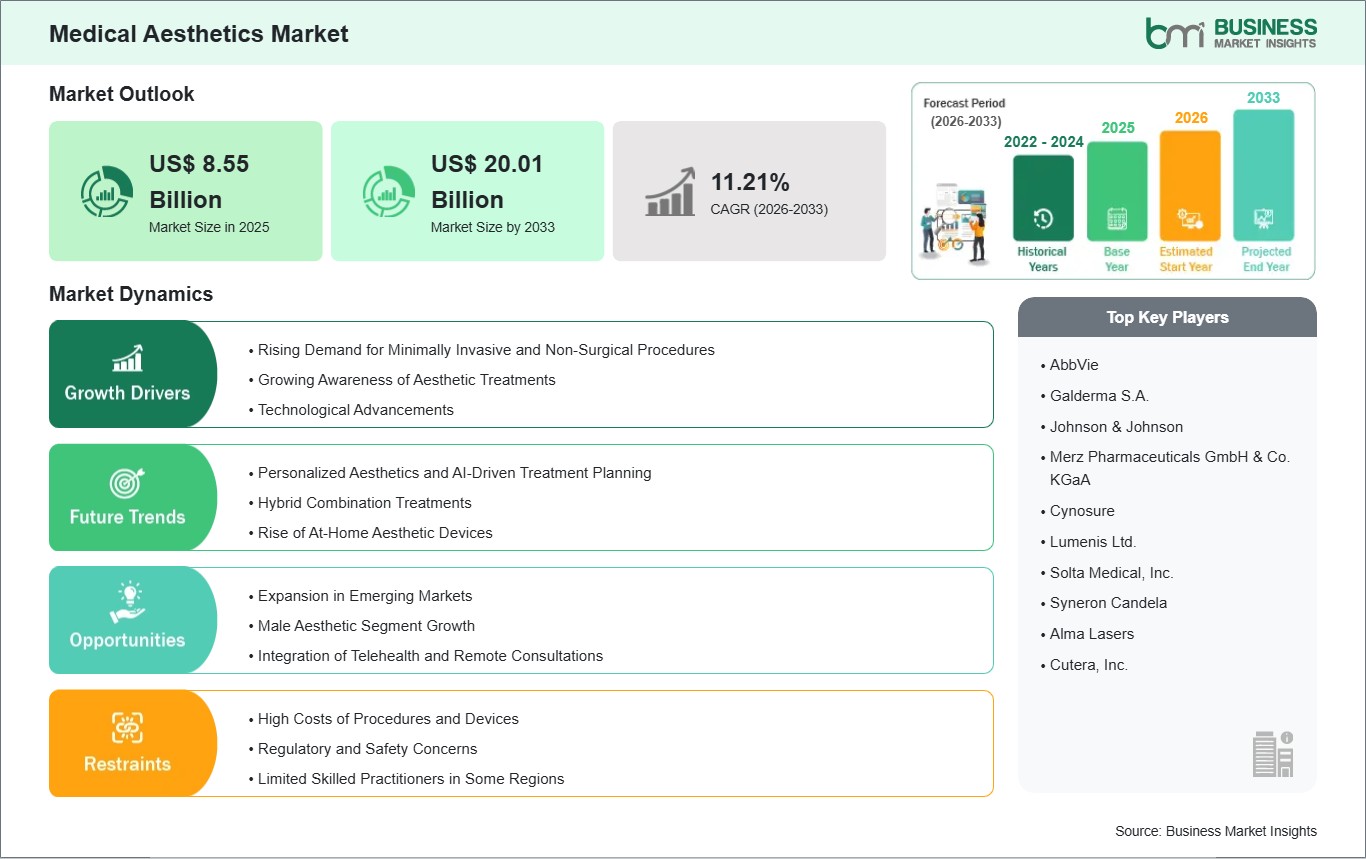
The Medical Aesthetics market size is expected to reach US$ 20.01 billion by 2033 from US$ 8.55 billion in 2025. The market is estimated to record a CAGR of 11.21% from 2026 to 2033.
Factors contributing to the expansion of the international medical aesthetics industry include growing consumer desire for non-invasive methods to achieve desired physical looks and non-invasive cosmetic enhancements yielding successful results with minimal downtime. Increased awareness of beauty, aging concerns and self-confidence related to appearance are significantly enhancing the global acceptance of this market. Non-surgical treatments include dermal filler injections, botulinum toxin type products (BTXs), laser therapy and body contouring products, all having a lower risk, shorter recovery time and higher safety record than their traditional surgical counterparts.
In addition, technological advancements in the area of energy based devices, artificial intelligence integration and combination treatment systems are expanding the capabilities of treatments and providing better patient outcomes, providing greater incentive for the market. The emergence of social media and changing standards regarding beauty are also normalizing the practice of aesthetic procedures across diverse scope of demographics including younger and male consumers. Furthermore, established mature markets (North America and Europe) have large market shares due to well developed healthcare systems, excessive disposable incomes and strong aesthetic service networks while rapidly developing regions (Asia-Pacific) are emerging as high growth markets due to increasing disposable incomes, growing levels of healthcare access and increased the penetration of aesthetic clinics throughout the region. Overall, continued demographic trends, advanced technology, and sociological influences will continually fuel the growth of the global medical aesthetics market.

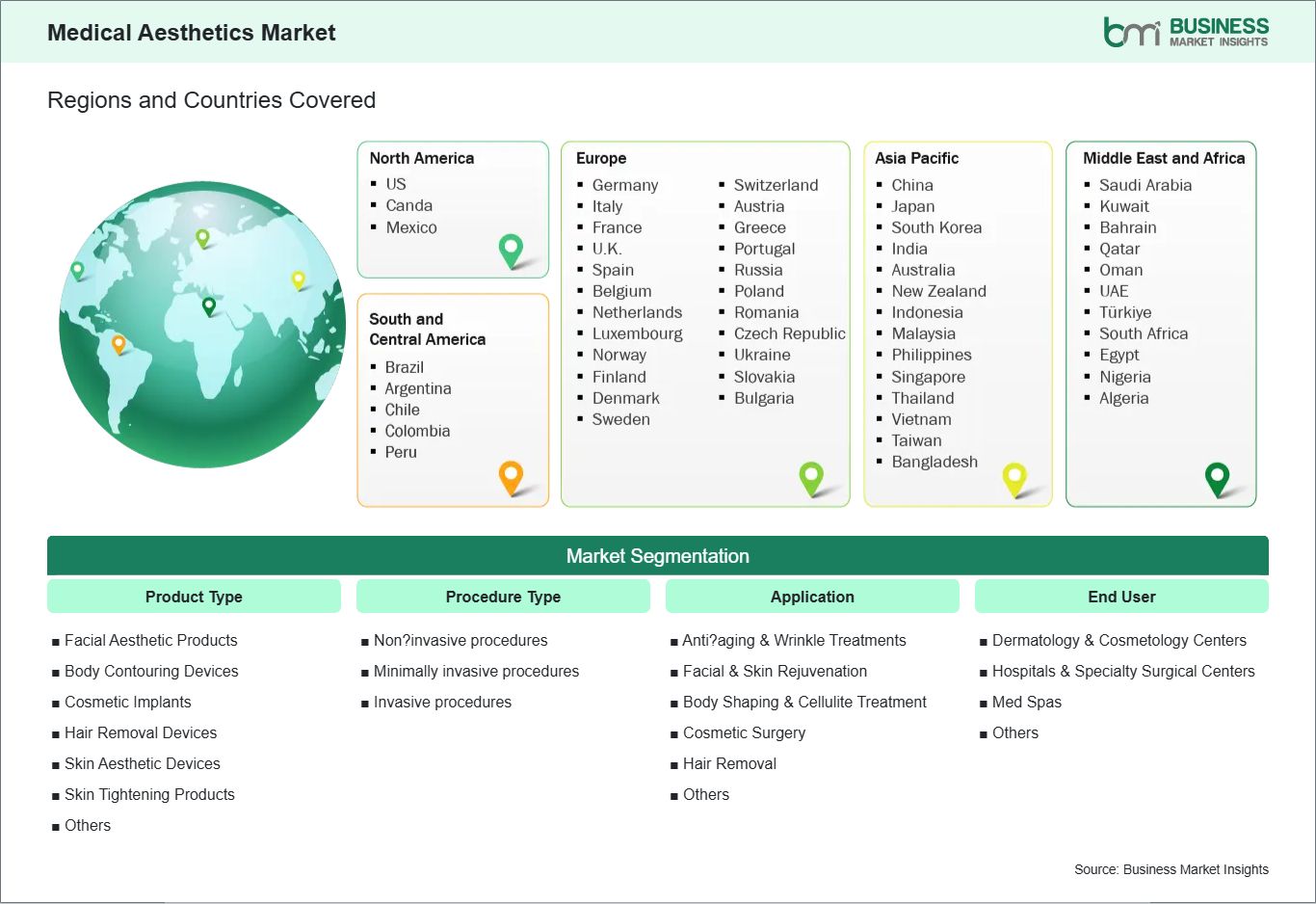
Key segments that contributed to the derivation of the Medical Aesthetics market analysis are product type, procedure type, application, and end user.
The consumer shift towards minimally invasive and non, surgical cosmetic procedures is a significant factor behind the growing medical aesthetics market. These procedures like botulinum toxin injections, dermal fillers, laser treatments, and body contouring are gaining popularity as they deliver effective results in a short time without much risk or recovery. The perception of aesthetic treatments as safe and effective has led up both young and old to see these treatments as a way to enhance their appearance and self, confidence. The marketing through social media, exposure to celebrity trends, and the increasing acceptance of aesthetic procedures for all genders have, therefore, contributed significantly to the demand. The advancements in technology, therefore, have contributed to the improvement of patient comfort, precision, and safety by energy, based devices, combination treatment platforms, and injectable formulations, thus making procedures more accessible and desirable. Higher disposable incomes, urbanization, and a trend towards personal grooming are some of the factors leading to increased adoption, particularly in developed regions such as North America and Europe. The convenience, efficiency, and reduced recovery associated with non, surgical treatments are among the factors that continue to drive market growth, thus positioning minimally invasive procedures as a central factor propelling the expansion of the global medical aesthetics market.
The medical aesthetics market has a sizable chance for the growth of service areas in new markets and demographic groups. Due to the increasing disposable incomes, better healthcare infrastructure, and growing awareness of aesthetic treatments, countries in the Asia, Pacific, Latin America, and the Middle East regions are becoming ready to expand the market. Moreover, young consumers such as millennials and Gen Z along with male patients are an underpenetrated segment who are looking for treatments for skincare, wrinkle reduction, and body contouring. The rising influence of social media, beauty apps, and online platforms have not only normalized cosmetic enhancements but also educated consumers about the available options, thus acceptance has increased among these demographics. Clinics and manufacturers that focus on localized marketing, affordable solutions, and minimally invasive procedures can therefore enter these high, growth areas. Moreover, technological innovations such as portable energy, based devices, teleconsultations, and combination treatments also help providers to extend their services to remote or semi, urban populations. By focusing on emerging markets and the demographic groups that have been underserved before, companies have the potential to widen their customer base, deepen market penetration, and stimulate long, term revenue growth, thus they will be able to establish a strong position in the changing global medical aesthetics landscape.

By product type, the medical aesthetics market is segmented into facial aesthetic products, body contouring devices, cosmetic implants, hair removal devices, skin aesthetic devices, skin tightening products, and others. The facial aesthetic products segment dominated the market in 2024 The growing awareness of appearance among consumers, along with the influence of social media, has contributed to an increased desire by consumers for a more youthful appearance.
By procedure type, the market is segmented into non-invasive procedures, minimally invasive procedures, invasive (surgical) procedures. The non-invasive procedures segment held the largest share of the market in 2024. Increased consumer awareness of the effectiveness of these types of treatments and increased availability and affordability of these products has resulted in consumers being more likely to choose a non-invasive procedure instead of an invasive procedure.
By application, the market is segmented into anti-aging and wrinkle treatments, facial and skin rejuvenation, body shaping and cellulite treatment, cosmetic surgery, hair removal, and others. The anti-aging and wrinkle treatments segment held the largest share of the market in 2024. As the aging population continues to grow, urban lifestyles are becoming more prevalent, and consumers are focusing on maintaining a more youthful appearance, the demand for this type of solution continues to increase among both men and women.
By end user, the market is segmented dermatology and cosmetology centers, hospitals and specialty surgical centers, med spas, others. The dermatology and cosmetology centers segment held the largest share of the market in 2024. These facilities provide an expert level of aesthetic treatment, and access to state-of-the-art equipment and technology, which many patients desire when looking for a safe, professional aesthetic service.
| Report Attribute | Details |
|---|---|
| Market size in 2025 | US$ 8.55 Billion |
| Market Size by 2033 | US$ 20.01 Billion |
| Global CAGR (2026 - 2033) | 11.21% |
| Historical Data | 2022 - 2024 |
| Forecast period | 2026-2033 |
| Segments Covered | By Product Type
|
| Regions and Countries Covered | North America
|
| Market leaders and key company profiles |
|
The "Medical Aesthetics Market Size and Forecast (2022–2033)" report provides a detailed analysis of the market covering below areas:
The geographical scope of the Medical Aesthetics market report is divided into five regions: North America, Asia Pacific, Europe, Middle East and Africa, and South and Central America. The Medical Aesthetics market in Asia Pacific is expected to grow significantly during the forecast period.
The Asia-Pacific Medical Aesthetics market is segmented into China, Japan, South Korea, India, Australia, New Zealand, Indonesia, Malaysia, the Philippines, Singapore, Thailand, Vietnam, Taiwan, Bangladesh, and the Rest of Asia. Increasing Urbanization, Higher Disposable Incomes, and Increased Awareness of Aesthetic Treatments all drive the Asia Pacific Medical Aesthetics Market; however, some countries are more affected. Facial Aesthetics (face lifts), Skin Rejuvenation, Body Contouring, and Hair Removal are sought after services and are especially popular among younger People and an Aging Population seeking out Anti-Aging Solutions. Non-Invasive and Minimally Invasive Cosmetic Procedures are very popular because they are Affordable, require little or No Downtime, and have a good Safety Profile. South Korea and Japan are Leading Innovators in Cosmetic Surgery, while China and India have great potential for growth due to the expanding Middle Class and Increased Awareness of Aesthetic Enhancements. Medical Tourism plays an important role in the overall growth of this Region. Countries such as Thailand, South Korea and India have gained a reputation for providing high-quality medical services at competitive prices to both patients traveling to those Countries or residing in the Asian Pacific Region. Increased factory presence of Dermatology Clinics, Med Spas, Cosmetology Centers, and the Substantial Influence of Social Media to promote beauty Awareness is Expediting Market Expansion into the Asia Pacific Region.

The Medical Aesthetics market is evaluated by gathering qualitative and quantitative data post primary and secondary research, which includes important corporate publications, association data, and databases. A few of the key developments in the medical aesthetics market are:
The Medical Aesthetics Market is valued at US$ 8.55 Billion in 2025, it is projected to reach US$ 20.01 Billion by 2033.
As per our report Medical Aesthetics Market, the market size is valued at US$ 8.55 Billion in 2025, projecting it to reach US$ 20.01 Billion by 2033. This translates to a CAGR of approximately 11.21% during the forecast period.
The Medical Aesthetics Market report typically cover these key segments-
The historic period, base year, and forecast period can vary slightly depending on the specific market research report. However, for the Medical Aesthetics Market report:
The Medical Aesthetics Market is populated by several key players, each contributing to its growth and innovation. Some of the major players include:
The Medical Aesthetics Market report is valuable for diverse stakeholders, including:
Essentially, anyone involved in or considering involvement in the Medical Aesthetics Market value chain can benefit from the information contained in a comprehensive market report.
Please tell us your area of interest
(Market Segments/ Regions and Countries/ Companies)