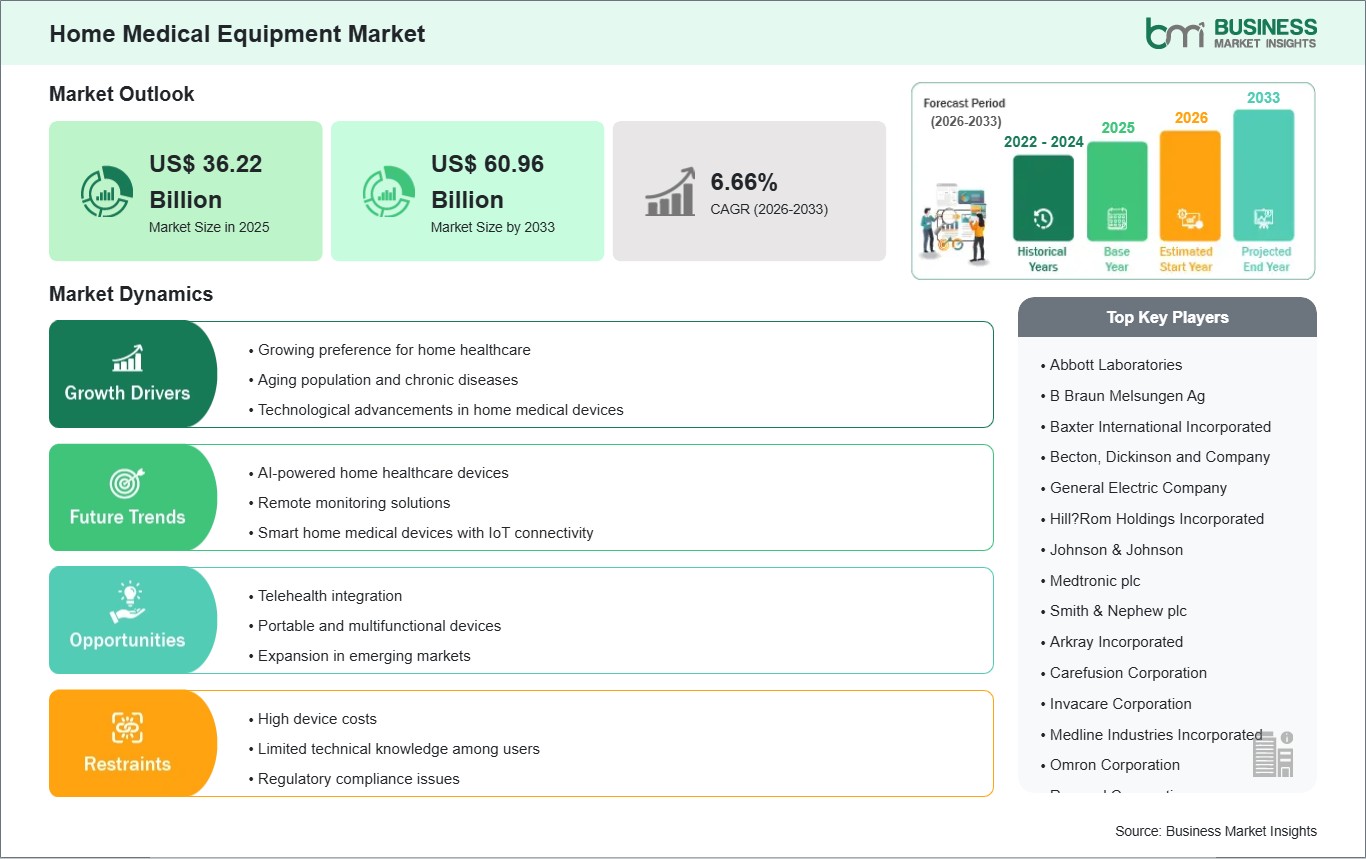
The Home Medical Equipment market size is expected to reach US$ 60.96 billion by 2033 from US$ 36.22 billion in 2025. The market is estimated to record a CAGR of 6.66% from 2026 to 2033.
Home Medical Equipment is an integral component of the global healthcare services that allow giving safe and effective treatment in households. These devices are a must for patients with chronic diseases like lung problems, diabetes, difficulty in moving, and post-operative recovery. Home medical equipment brings in many pluses like a more comfortable patient, shorter hospital stays, less expensive healthcare, and the possibility to accommodate aging people at home. The market is getting bolstered by the fast-growing number of patients with chronic diseases, the increase in elderly population, and the rise in preference for home-based care models. Moreover, remote monitoring, smart devices, and connected health technologies are making treatment more accurate and patient outcomes better.
Nevertheless, the market might be restricted by challenges like the high cost of equipment, limitations in reimbursement, and lack of patient education in some regions. The industry is also subject to regulatory issues, maintenance problems, and variations in home healthcare infrastructure. Nonetheless, the market is opening up with strong opportunities from the growing home healthcare programs, the highly innovative technology in portable devices, and the increasing telehealth services. It is expected that the investment in patient-centric solutions, rental styles, and integrated care platforms will lead to the creation of new paths for market growth

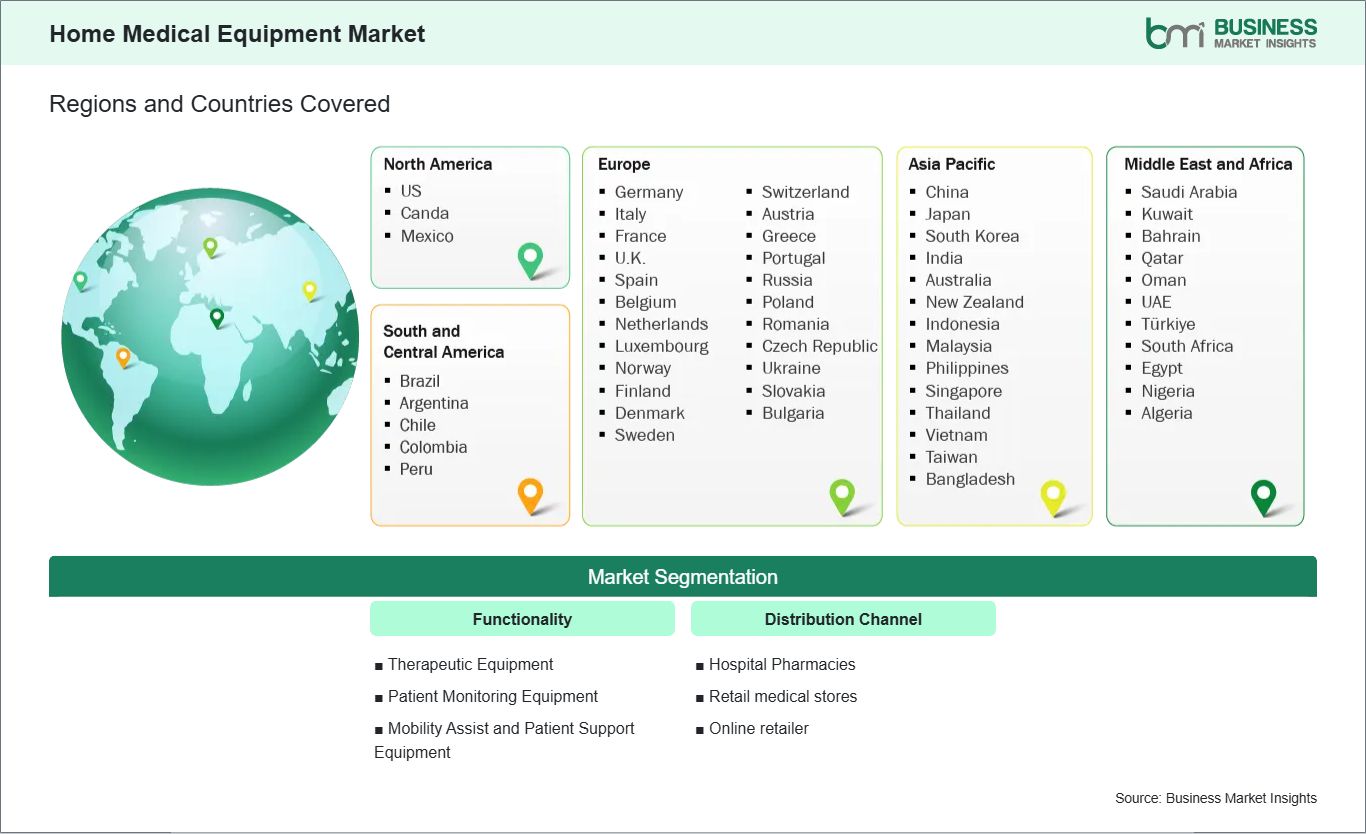
Key segments that contributed to the derivation of the Home Medical Equipment market analysis are Functionality and Distribution Channel.
The Home Medical Equipment market is primarily driven by the increasing adoption of home-based healthcare solutions that offer more comfort and convenience to patients, caregivers, and healthcare systems as compared to the traditional approach. Furthermore, the home care option lessens the pressure on hospitals, decreases the probability of infections acquired in hospitals, and enhances the general condition of the patient especially for those who need long-term or chronic care.
The rising incidence of chronic diseases such as diabetes, heart and blood vessel disorders, breathing problems, and lack of movement, has been one of the main factors pushing the demand for home medical equipment up. For example, oxygen concentrators, infusion pumps, therapeutic devices, and patient monitoring systems, among others, allow carrying on with the medical care at home without having to go to the hospital frequently. Such a transition is in line with the value-based healthcare models that put a strong emphasis on prevention and long-term disease control.
An older population worldwide has even more reinforced this driver, as old people usually need medical care all the time but prefer to live in their own familiar places. The medical treatment at home has become easier and more reliable due to the use of technology such as portable medical instruments that are easy to use and connect. The combination of telehealth services with the medical devices allows the healthcare professionals to monitor the patients from a distance, change the treatments, and even act if the situation demands it.
Furthermore, the high cost of healthcare and the insufficient number of beds in hospitals are capitalism-making medical treatments at home really attractive to governments and health insurance companies. Besides, a number of initiatives such as reimbursement policies and rental-based equipment models are encouraging the people to see home healthcare as a less costly option. In total, the increasing number of people preferring home-based health care is continuously pushing up the demand for home medical equipment, thus making it one of the major factors driving growth in the global market.
The Home Medical Equipment sector is poised to exploit the mega trend of remote patient monitoring and connected medical devices spread. Digital health technology development has allowed for the combination of home medical equipment to wireless communication, cloud platform, and data analysis, thus permitting and conducting monitoring of patients’ health outside hospitals at the same time. This function helps not only to identify health problems soon but also to give medical help without delay and make disease management easier and causes les resultant deaths.
The increasing number of patients suffering from chronic diseases like diabetes, heart diseases, and lung diseases is one of the factors that lead to the rise in demand for continuous monitoring solutions, which include blood sugar monitors, heart monitoring devices and smart breathing machines. Connecting home medical equipment increases the level of patient participation in the treatment process, as such, it will be providing patients with feedback, alerts, and reminders for taking medicines, and the outcome will be that there will be better compliance with treatment and consequently fewer cases of patients going back to the hospital.
Hospitals and insurance companies are increasingly valuing remote monitoring's cut beside the healthcare and its contributing factor to the resource utilization. Giving heed to worldwide telehealth market acceptance, the amalgamation of home medical equipments and virtual care platforms are making the care delivery process effortless. This breakthrough is being further fostered by the rising digital infrastructure investments, granting reimbursement in certain places, and regulations that promote the use of remote care solutions.
Moreover, the old population and their reluctance to moving into nursing homes are making smart and simple home medical devices a must-have. Companies that will be concentrating on compatibility, privacy, and ease in operation will be in a better position than the others. To summarize, the rise in remote patient monitoring signifies a great potential for growth, making the home medical equipment sector more innovative, efficient in patient outcomes, and keeping the market active

By Functionality, the Home Medical Equipment market is segmented into Therapeutic Equipment, Patient Monitoring Equipment, and Mobility Assist and Patient Support Equipment. The Therapeutic segment dominated the market in 2025. The Therapeutic Equipment segment dominated by increasing chronic disease prevalence, demand for home-based treatments, and use of respiratory, infusion, and pain devices.
By Distribution Channel, the market is segmented into Hospital Pharmacies, Retail medical stores, and Online retailer. The Retail medical stores segment held the largest share of the market in 2025. The Retail medical stores segment dominated by easy accessibility, professional assistance, immediate product availability, and consumer preference for in-person purchasing of home medical equipment
| Report Attribute | Details |
|---|---|
| Market size in 2025 | US$ 36.22 Billion |
| Market Size by 2033 | US$ 60.96 Billion |
| Global CAGR (2026 - 2033) | 6.66% |
| Historical Data | 2022 - 2024 |
| Forecast period | 2026-2033 |
| Segments Covered | By Functionality
|
|
Regions and Countries Covered
| |
| North America | US, Canada, Mexico |
| Europe | Belgium, Austria, Finland, Denmark, Greece, Poland, Romania, Russia, Ukraine, Czech Republic, Slovakia, Bulgaria, Italy, Luxembourg, Germany, Switzerland, France, Netherlands, Norway, Portugal, Spain, Sweden, United Kingdom |
| Asia-Pacific | Australia, China, India, Japan, South Korea, Indonesia, Malaysia, Philippines, Singapore, Thailand, Vietnam, Bangladesh, New Zealand, Taiwan |
| South and Central America | Brazil, Argentina, Peru, Chile, Colombia |
| Middle East and Africa | Bahrain, Kuwait, Oman, Qatar, Saudi Arabia, United Arab Emirates, Turkiye, South Africa, Egypt, Algeria, Nigeria |
| Market leaders and key company profiles |
|
The "Home Medical Equipment Market Size and Forecast (2022–2033)" report provides a detailed analysis of the market covering below areas:
The region is also witnessing increased adoption of technologically advanced home medical equipment, including remote patient monitoring devices, portable therapeutic systems, and connected healthcare solutions—particularly relevant for chronic disease management and elderly care. Expansion of home healthcare services, alongside growing availability of medical equipment through retail and online channels, is improving accessibility and patient convenience. Additionally, the rise in healthcare awareness and demand for cost-effective treatment options, coupled with increased telehealth integration, is positioning Asia-Pacific as a key growth hub in the global home medical equipment market. The development of healthcare policies, expanding insurance coverage, and ongoing investments in digital health infrastructure further strengthen the region’s prominent market position

The Home Medical Equipment market is evaluated by gathering qualitative and quantitative data post primary and secondary research, which includes important corporate publications, association data, and databases. A few of the key developments in the Home Medical Equipment market are:
The Home Medical Equipment Market is valued at US$ 36.22 Billion in 2025, it is projected to reach US$ 60.96 Billion by 2033.
As per our report Home Medical Equipment Market, the market size is valued at US$ 36.22 Billion in 2025, projecting it to reach US$ 60.96 Billion by 2033. This translates to a CAGR of approximately 6.66% during the forecast period.
The Home Medical Equipment Market report typically cover these key segments-
The historic period, base year, and forecast period can vary slightly depending on the specific market research report. However, for the Home Medical Equipment Market report:
The Home Medical Equipment Market is populated by several key players, each contributing to its growth and innovation. Some of the major players include:
The Home Medical Equipment Market report is valuable for diverse stakeholders, including:
Essentially, anyone involved in or considering involvement in the Home Medical Equipment Market value chain can benefit from the information contained in a comprehensive market report.
Please tell us your area of interest
(Market Segments/ Regions and Countries/ Companies)