
Biocontrol Market Outlook: Size, Share, Trends, Growth Analysis, Competitive Landscape & Forecast, 2026-2033

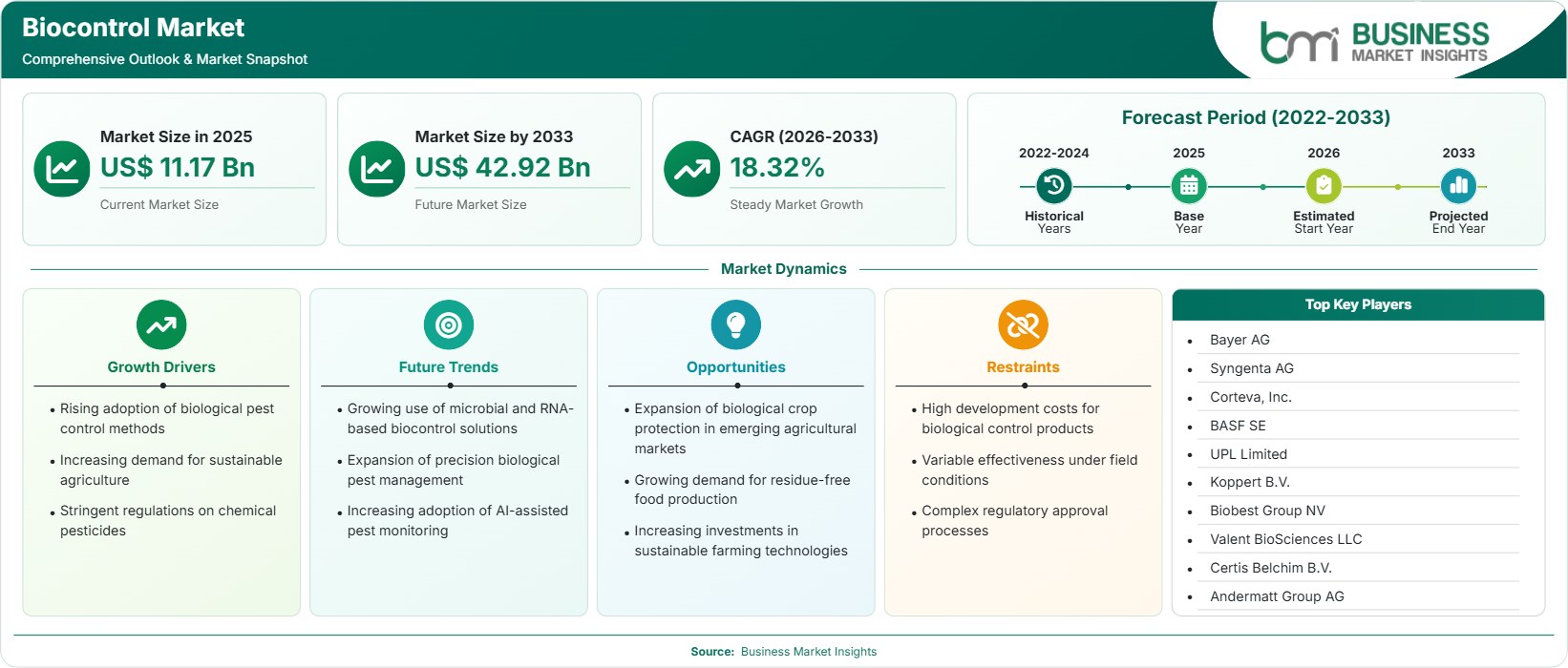
The Biocontrol Market size was valued at US$ 11.17 Billion in 2025 and is projected to reach US$ 42.92 Billion by 2033, growing at a CAGR of 18.32% during 2026–2033. Growth is driven by rising adoption of biological pest control methods, increasing demand for sustainable agriculture practices, and stringent regulations restricting chemical pesticide usage. Expanding investments in environmentally friendly crop protection technologies continue creating significant opportunities across global agricultural markets.

Report Coverage
  • Source: Microbials, Macrobials, Biochemicals
  • Type: Biopesticides, Semiochemicals
  • Crop Type: Cereals & Grains, Fruits & Vegetables, Oilseeds & Pulses, Others
  • Application: Soil Treatment, Seed Treatment, Foliar Spray, Traps, Dispensers
US$ 11.17 Bn Market size in 2025
US$ 42.92 Bn Market Size by 2033
18.32% CAGR, 2026 - 2033
2026-2033 Forecast Period

01 AI Overview

Biocontrol Market Summary

  • North America Region: North America holds a 34%–37% share in 2025 and is projected to expand at a 17.1%–17.8% CAGR during 2026–2033. Growth is supported by organic farming expansion, sustainable crop protection adoption, advanced agricultural practices, strong regulatory support, increasing grower awareness, and investments in biological pest management solutions. The U.S. remains the largest regional market, supported by commercial agriculture and innovative biological crop protection initiatives, growing at a 17.2%–18.0% CAGR.
  • Fastest Growing Region: Asia Pacific accounts for 25%–28% share in 2025 and is anticipated to register a 20.1%–20.9% CAGR through 2033. Increasing food security concerns, government support for sustainable farming, rising awareness of biological products, and expanding high-value crop cultivation continue accelerating adoption.
  • Leading Segment: Microbials represent 44%–48% share in 2025 and are expected to grow at a 18.5%–19.3% CAGR during 2026–2033. Strong effectiveness against multiple pests and diseases, compatibility with integrated pest management programs, and continuous product innovation support segment leadership.
  • High Growth Segment: Fruits & Vegetables account for 35%–39% share in 2025 and are forecast to expand at a 19.7%–20.5% CAGR through 2033. Rising consumer demand for residue-free produce and higher adoption of biological crop protection solutions are driving growth.
  • Key Market Opportunity: Growing investments in sustainable farming technologies and increasing demand for residue-free food production are creating opportunities for innovative biological crop protection products across commercial agriculture sectors.
  • Major Market Players: Bayer AG, Syngenta AG, Corteva, Inc., BASF SE, UPL Limited, Koppert B.V., Biobest Group NV, Valent BioSciences LLC, Certis Belchim B.V., Andermatt Group AG.
02 Strategic Insights

Biocontrol Market: Strategic Insights

Biocontrol Market Strategic Framework
FREE PDF
Request your free sample
Request free sample
03 Stakeholder View

Key Takeaways

  • The value chain is evolving toward integrated biological crop protection solutions involving microbial developers, agricultural input suppliers, distributors, research institutions, and farming cooperatives to improve pest management efficiency and sustainability.
  • Fruits and vegetables present the highest commercial opportunity as growers increasingly adopt biological alternatives to meet residue-free production requirements and comply with export market standards.
  • Innovation is centered on microbial strain development, precision application technologies, enhanced formulation stability, and integrated pest management compatibility to improve field performance and adoption rates.
  • Asia Pacific offers strong long-term investment potential due to growing agricultural modernization, increasing regulatory support for sustainable farming practices, and expanding cultivation of high-value crops.
  • Strategic partnerships between biological solution providers and agricultural technology companies are accelerating product development, commercialization, and market penetration across key farming regions.
  • Demand for environmentally friendly crop protection products is encouraging investment in advanced biological technologies that support productivity while reducing dependence on conventional chemical pesticides.
04 Geographic Outlook

Biocontrol Market Regional Highlights

North America Biocontrol Market

North America accounted for 34%–37% of the Biocontrol Market share in 2025 and is projected to grow at a 17.1%–17.8% CAGR through 2033. Strong adoption of integrated pest management practices, expanding organic farming activity, and favorable regulatory frameworks continue to support market expansion. Commercial growers increasingly utilize biological solutions to address pesticide resistance challenges while maintaining crop productivity. Innovation in microbial technologies and growing awareness regarding sustainable crop protection further strengthen regional demand across agricultural applications.

  • Organic farming expansion continues supporting adoption of biological pest management products across commercial crop cultivation operations.
  • Agricultural producers are increasingly incorporating biological solutions into integrated pest management programs to improve sustainability outcomes.
  • Research investments are accelerating development of advanced microbial formulations with improved efficacy and field stability.
  • Demand for environmentally friendly crop protection solutions continues increasing among growers and agricultural stakeholders.

US Biocontrol Market

The United States represents 76%–80% share within North America and is anticipated to expand at a 17.2%–18.0% CAGR during the forecast period. The Biocontrol Market trends benefit from large-scale commercial agriculture, extensive research capabilities, and increasing adoption of biological crop protection technologies. Rising concerns regarding chemical pesticide residues and resistance management are encouraging growers to adopt biological alternatives. Continuous innovation and regulatory support are expected to sustain rapid growth across major crop-producing regions.

  • Commercial agriculture increasingly incorporates biological products to support sustainable and residue-conscious farming practices.
  • Strong research and development activities continue introducing advanced microbial and biochemical solutions.
  • Integrated pest management adoption remains a major growth driver across specialty crop production.
  • Increasing focus on sustainable agriculture supports long-term market expansion opportunities.

Europe Biocontrol Market

Europe held 28%–31% share in 2025 and is expected to register a 18.0%–18.7% CAGR through 2033. Strict regulations governing chemical pesticide use and growing sustainability objectives are supporting widespread biocontrol adoption. Countries such as France, Spain, and Italy remain major markets, while Eastern European nations are witnessing increasing adoption in Biocontrol Market forecasts. Strong consumer demand for organic and residue-free food products continues encouraging growers to transition toward biological crop protection solutions.

  • France remains among the leading adopters due to strong support for sustainable agriculture initiatives.
  • Spain demonstrates substantial demand supported by intensive horticultural and greenhouse cultivation activities.
  • Regulatory restrictions on chemical pesticides continue encouraging biological alternative adoption.
  • Increasing demand for organic food products supports sustained market growth.

Asia Pacific Biocontrol Market

Asia Pacific accounted for 25%–28% share in 2025 and is projected to witness the fastest growth at a 20.1%–20.9% CAGR through 2033. Expanding food production requirements, rising environmental awareness, and increasing government support for sustainable farming are strengthening demand. China remains the largest regional Biocontrol Market, while India is among the fastest-growing countries. Agricultural modernization initiatives and growing cultivation of fruits and vegetables continue supporting adoption of biological crop protection technologies.

  • China continues leading regional demand through agricultural modernization and sustainable farming investments.
  • India is emerging as a high-growth market due to increasing awareness of biological crop protection products.
  • Government initiatives promoting reduced chemical pesticide dependence support market expansion.
  • Growing production of export-oriented crops drives demand for residue-free pest management solutions.

Rest of World Biocontrol Market

The Rest of World region accounted for 6%–8% share in 2025 and is forecast to grow at a 17.5%–18.2% CAGR through 2033. South and Central America benefits from extensive agricultural activity and increasing export requirements, while the Middle East and Africa are gradually adopting sustainable crop protection practices. Expanding awareness of biological pest control benefits and improving accessibility of advanced agricultural inputs continue creating opportunities for Biocontrol Market participants.

  • Brazil remains a key market due to large-scale agricultural production and export-oriented farming operations.
  • Adoption is increasing across horticultural and specialty crop cultivation activities.
  • Agricultural sustainability initiatives continue supporting biological product penetration.
  • Expanding distributor networks are improving farmer access to biocontrol solutions.
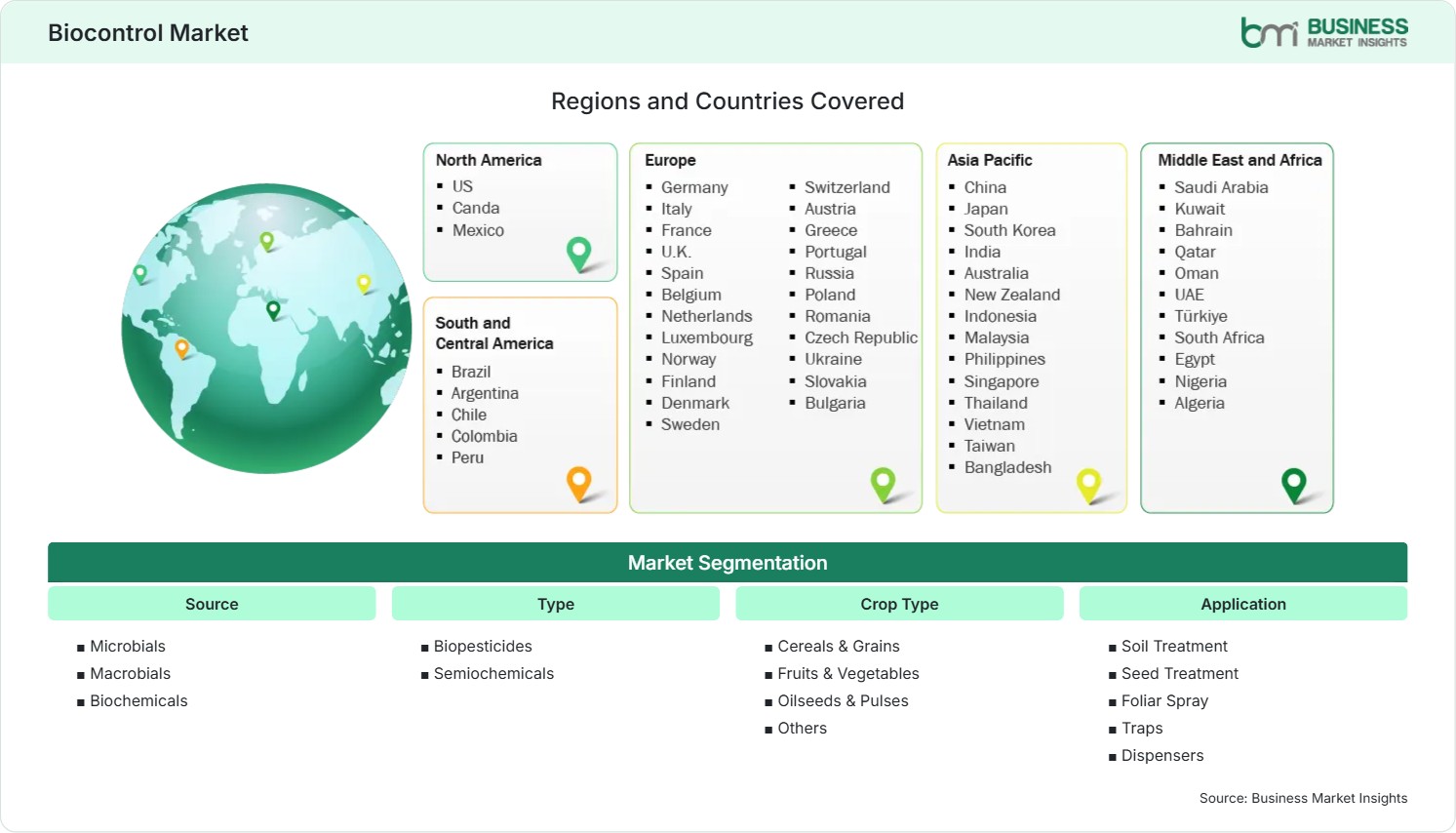
Global Market Geography
FREE PDF
Request your free sample
Request free sample
05 Segment Analysis

Biocontrol Market Segmentation

Source

The source segment forms the foundation of product development within the Biocontrol Market. Microbials currently account for the largest revenue contribution due to their broad applicability across crop protection programs and compatibility with integrated pest management practices. The segment is expected to grow at a 18.5%–19.3% CAGR through 2033, supported by technological advancements, increasing grower acceptance, and expanding regulatory support for biological crop inputs.

  • Microbials: The leading sub-segment due to strong effectiveness against pests and diseases, compatibility with sustainable farming practices, and continuous innovation in microbial strain development.
  • Macrobials: Widely used in greenhouse cultivation and specialty crops where beneficial insects and mites provide effective biological pest suppression without chemical intervention.
  • Biochemicals: Growing adoption is supported by increasing demand for environmentally friendly crop protection tools and improved integration within sustainable farming programs.

Type

The Type segment is led by Biopesticides, accounting for approximately 61%–65% share in 2025 and projected to grow at a CAGR of 18.6%–19.2% during 2026–2033. Rising demand for biological pest management, residue-free cultivation practices, and regulatory pressure on chemical pesticides continue supporting Biocontrol Market growth adoption. Semiochemicals are also gaining traction due to their effectiveness in pest monitoring and targeted control programs.

  • Biopesticides: Represent the dominant category due to broad applicability across multiple crops and increasing integration into sustainable pest management programs.
    • Bioinsecticides: Increasing utilization for effective insect control while minimizing environmental impact and supporting integrated pest management strategies.
    • Biofungicides: Demand is growing due to rising concerns regarding fungal diseases and the need for residue-free crop protection solutions.
  • Semiochemicals: Adoption is increasing as growers seek targeted pest monitoring and control methods that reduce chemical intervention requirements.
    • Pheromones: Widely utilized in monitoring, mating disruption, and pest population management programs across high-value crops.
    • Allelochemicals: Gaining attention for their ability to influence pest behavior and support environmentally sustainable crop protection strategies.

Crop Type

Crop-specific demand continues expanding as producers increasingly seek sustainable pest management solutions capable of protecting crop yields while complying with residue regulations. Fruits & Vegetables account for approximately 35%–39% share in 2025 and are projected to grow at a 19.7%–20.5% CAGR through 2033. Strong export requirements and consumer preference for chemical-residue-free produce continue driving segment growth in Biocontrol Market.

  • Cereals & Grains: Adoption continues increasing as farmers integrate biological products into large-scale crop production systems focused on sustainability.
  • Fruits & Vegetables: The largest and fastest-growing sub-segment due to premium crop values, export standards, and demand for residue-free produce.
  • Oilseeds & Pulses: Increasing usage is supported by growing awareness of biological solutions and integrated pest management practices.

Application

The Application segment is driven by foliar spray methods, which account for 32%–36% share in 2025 and are expected to grow at a CAGR of 18.8%–19.5% through 2033. Increased ease of application, compatibility with integrated pest management programs, and expanding use in commercial agriculture continue driving segment growth across key crop categories globally in Biocontrol Market.

  • Soil Treatment: Widely adopted for disease suppression, root health improvement, and enhancement of overall soil biological activity.
  • Seed Treatment: Increasingly utilized to provide early-stage crop protection and support healthy crop establishment.
  • Foliar Spray: Represents a key application method due to ease of deployment and effective crop canopy coverage.
  • Traps: Extensively used for pest monitoring and population management within integrated pest management strategies.
  • Dispensers: Supporting targeted release of biological agents and semiochemicals for effective pest control across commercial agriculture operations.
06 Market Forces

Biocontrol Market Dynamics

Key Market Drivers

Rising Adoption of Biological Pest Control Methods

Environmental sustainability issues, growing pesticide resistance, and the impact of pesticides on soil health are among the main factors driving farmers' uptake of biocontrol solutions. Biocontrol solutions allow for effective pest management without the need for chemicals. The inclusion of biological pest management in the agricultural industry is helping farmers achieve effective crop protection while ensuring compliance. Increasing awareness among farmers, product availability and technological developments in formulations have been contributing to the rapid adoption of such solutions in agriculture.

Increasing Demand for Sustainable Agriculture

Sustainable agricultural methods are gaining importance worldwide because of various reasons like environmental issues, food safety regulations, and the need for conservation of resources. The farmers are now using inputs that would help in keeping their ecosystems healthy along with increasing their output levels. Biological crop protection agents align with sustainability goals because they have no adverse effects on the environment and promote balanced pest control. Government initiative towards encouraging sustainable agriculture along with the growing demand for responsible food products is also boosting up the trend.

Stringent Regulations on Chemical Pesticides

Regulatory authorities across major agricultural markets are implementing stricter controls on chemical pesticide usage to address environmental and health concerns. Restrictions on active ingredients and residue limits are encouraging growers to adopt biological alternatives that comply with evolving standards. Biocontrol products offer producers an effective pathway to maintain crop protection while meeting increasingly demanding regulatory requirements. As pesticide regulations continue to tighten globally, biological crop protection solutions are expected to gain further momentum. This regulatory transition remains a significant driver supporting market expansion across developed and emerging agricultural economies.

Key Market Opportunities

Expansion of Biological Crop Protection in Emerging Agricultural Markets

Newly emerging agricultural economies are turning to biological crop protection products, which is a result of government initiative towards sustainable agriculture practices that involve the reduction of usage of traditional pesticides. Growing production of valuable crops, enhanced awareness among farmers and better logistics systems create a favorable environment for the industry growth. Various countries located in Asia Pacific region, Latin America and even Africa are focusing on improving agricultural productivity while preserving environment. The use of biocontrol products offers a lucrative opportunity, as they can help fulfill crop protection goals without compromising sustainability.

Growing Demand for Residue-Free Food Production

Consumer’s demands are changing in favor of food items that use lesser chemicals and have low pesticide residues. Retailers, food processors, and exporters are now putting pressure to meet stringent residue levels, urging farmers to use biocontrol products on their crops. The biocontrol products will assist producers in meeting regulatory requirements and market demands without affecting crop quality and yield efficiency. The rising demand for organic produce, premium fruits, vegetables, and export crops will further contribute to its growth. This trend of using residue-based food products will keep on prevailing in the coming years as well.

Increasing Investments in Sustainable Farming Technologies

Investments in agricultural technology are progressively becoming more inclined towards sustainability, precision farming, and environmentally friendly crop production. The development of bio-crop protection products is increasingly becoming a key part of such endeavors, as they are compatible with the new advances in agriculture technologies and integrated pest management programs. Advances in sustainable agriculture, through public and private research, are ensuring that products become more effective, more stable in formulation, and easier to apply. Such trends are creating many opportunities for the development of bio-control technologies.

Market Restraints and Challenges

High Development Costs for Biological Control Products

Factor: Biological control products require extensive research, microbial strain identification, formulation development, regulatory approvals, and field validation before commercial deployment. Impact: High development costs can extend commercialization timelines and increase financial risks for manufacturers. Smaller companies may face difficulties allocating resources for large-scale research and regulatory compliance activities. These challenges can limit product availability, slow innovation cycles, and create barriers to market entry despite growing demand for sustainable crop protection technologies.

Variable Effectiveness Under Field Conditions

Factor: Biological products can be influenced by environmental conditions such as temperature, humidity, soil composition, and pest pressure variability. Impact: Performance inconsistencies across different agricultural environments may affect farmer confidence and adoption rates. Growers often require predictable pest management outcomes, making variability a concern when compared with conventional chemical alternatives. Manufacturers therefore continue investing in formulation improvements, application technologies, and agronomic support to enhance reliability and strengthen product acceptance across diverse crop production systems.

07 Company Analysis

Competitive Landscape

The competitive environment is characterized by investments in microbial technologies, strategic acquisitions, sustainable agriculture innovation, and expansion of biological crop protection portfolios. The Biocontrol Market analysis indicates that market participants are focusing on product efficacy, regulatory approvals, and global distribution capabilities to strengthen their competitive positions.

Company Name

Overview

Products and Services relevant to this market

Bayer AG

Global agricultural solutions provider with a growing portfolio of biological crop protection technologies and sustainable farming initiatives.

Biocontrol products, biological crop protection solutions, integrated pest management technologies, and agricultural advisory services.

Syngenta AG

Major crop protection company investing in biological innovations and sustainable agriculture platforms worldwide.

Biological crop inputs, biopesticides, seed solutions, pest management products, and precision agriculture technologies.

Corteva, Inc.

Agricultural technology company focused on advancing biological solutions that complement modern farming systems.

Biological crop protection products, microbial technologies, seed treatments, and integrated crop management solutions.

BASF SE

Global chemical and agricultural solutions company expanding biological product development capabilities.

Biopesticides, agricultural biologicals, crop protection products, and sustainable farming technologies.

UPL Limited

International agricultural inputs company actively expanding biological crop protection offerings.

Biological crop solutions, microbial products, biostimulants, sustainable agriculture technologies, and pest management products.

Koppert B.V.

Specialized biological control company serving greenhouse and open-field agricultural applications worldwide.

Beneficial insects, microbial biocontrol agents, pollination solutions, and integrated pest management services.

Biobest Group NV

Provider of biological pest management and pollination technologies for commercial agriculture.

Beneficial insects, biological control systems, pollination products, and crop monitoring solutions.

Valent BioSciences LLC

Leading developer of biological agricultural technologies focused on sustainable crop production.

Biopesticides, microbial products, biorational technologies, and biological crop enhancement solutions.

Certis Belchim B.V.

Agricultural company specializing in biological and residue-management crop protection solutions.

Biological pesticides, crop protection products, pest management solutions, and sustainable agriculture technologies.

Andermatt Group AG

Specialist provider of biological crop protection products operating across global agricultural markets.

Microbial products, biocontrol solutions, biological pesticides, and integrated farming support technologies.


10 Trust & Transparency

Research Methodology

The market analysis combines proprietary research with secondary data from government agencies, company disclosures, regulatory filings, industry databases and expert interviews. Market estimates are validated through data triangulation, cross-market benchmarking and analyst review.

View Full Research Methodology

11 Questions Answered

Frequently Asked Questions

How do biocontrol products support sustainable farming?

Biocontrol products help reduce chemical pesticide usage, support biodiversity, minimize environmental impact, improve resistance management, and align with long-term agricultural sustainability objectives.

Which crop type offers the greatest growth potential?

Fruits and vegetables offer substantial growth opportunities because growers increasingly require residue-free pest management solutions to meet consumer and export market requirements.

Which source segment dominates the biocontrol market report?

Microbials represent the leading source segment due to their effectiveness, broad crop applicability, compatibility with integrated pest management programs, and continuous product innovation.

Why is the biocontrol market growing rapidly?

Growth is driven by increasing adoption of sustainable agriculture practices, stricter pesticide regulations, expanding demand for residue-free food, and growing awareness of environmentally friendly crop protection methods.

What is biocontrol in agriculture?

Biocontrol refers to the use of living organisms, natural substances, or biological processes to manage pests, diseases, and weeds while reducing reliance on conventional chemical pesticides.

Access the Full Biocontrol Market Report

Get segment-level forecasts, regional estimates, competitive benchmarking, company profiles and downloadable Excel datasets.

Access the full Biocontrol Market Report
350 pages PDF & Excel | 2026-08-20