Biocompatible 3D Printing Materials Market Outlook (2022-2033)

Historic Data: 2022-2024   |   Base Year: 2025   |   Forecast Period: 2026-2033
Report Content: Market Scope, Market Segmentation, Market Dynamics, and Competitive Analysis

Report Coverage:
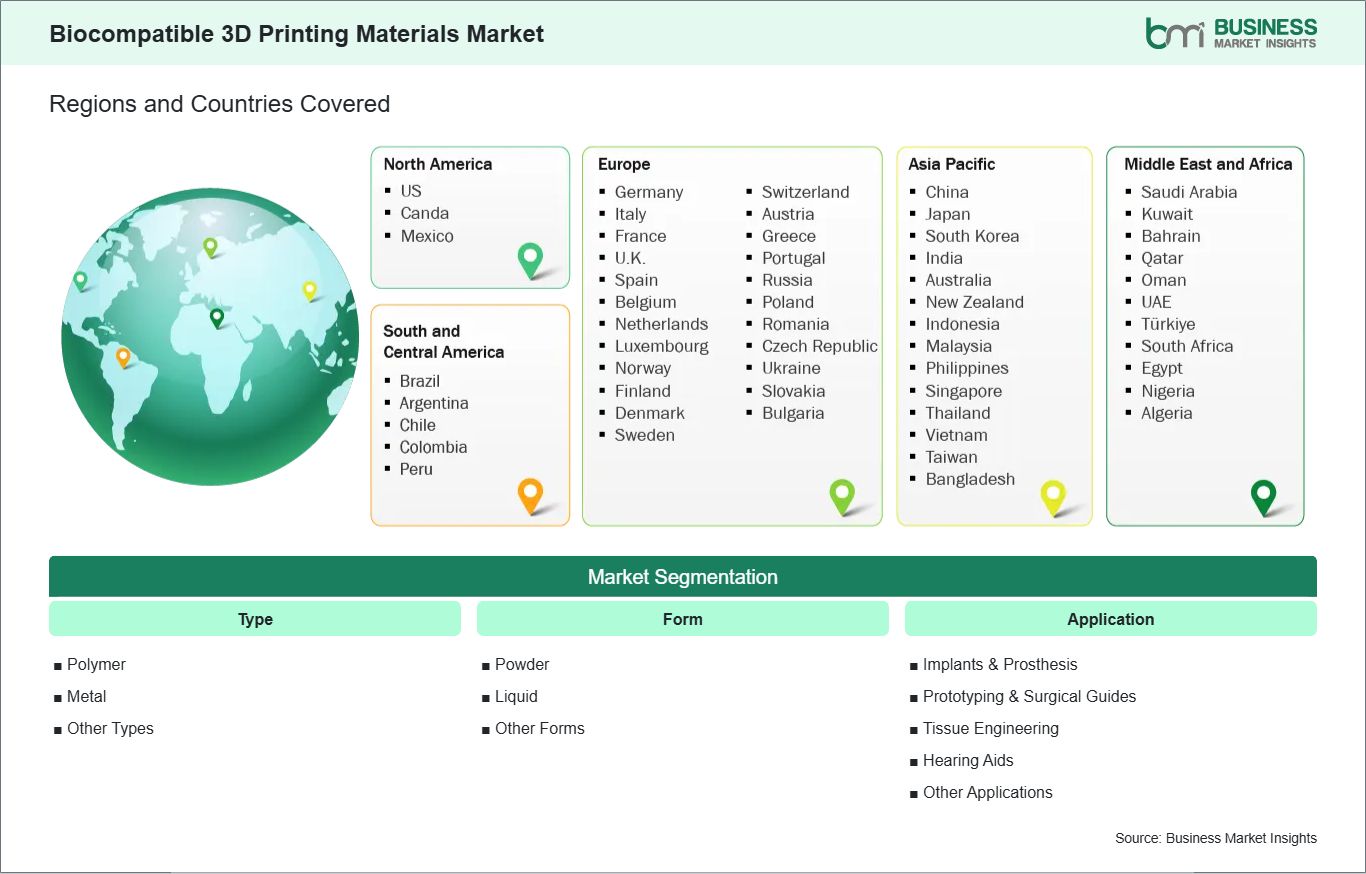
  • Type (Polymer, Metal, Other Types)
  • Form (Powder, Liquid, Other Forms)
  • Application (Implants & Prosthesis, Prototyping & Surgical Guides, Tissue Engineering, Hearing Aids, Other Applications)

No. of Pages: 395
Report Code: BMIPUB00033792
Category: Chemicals and Materials
Biocompatible 3D Printing Materials Market

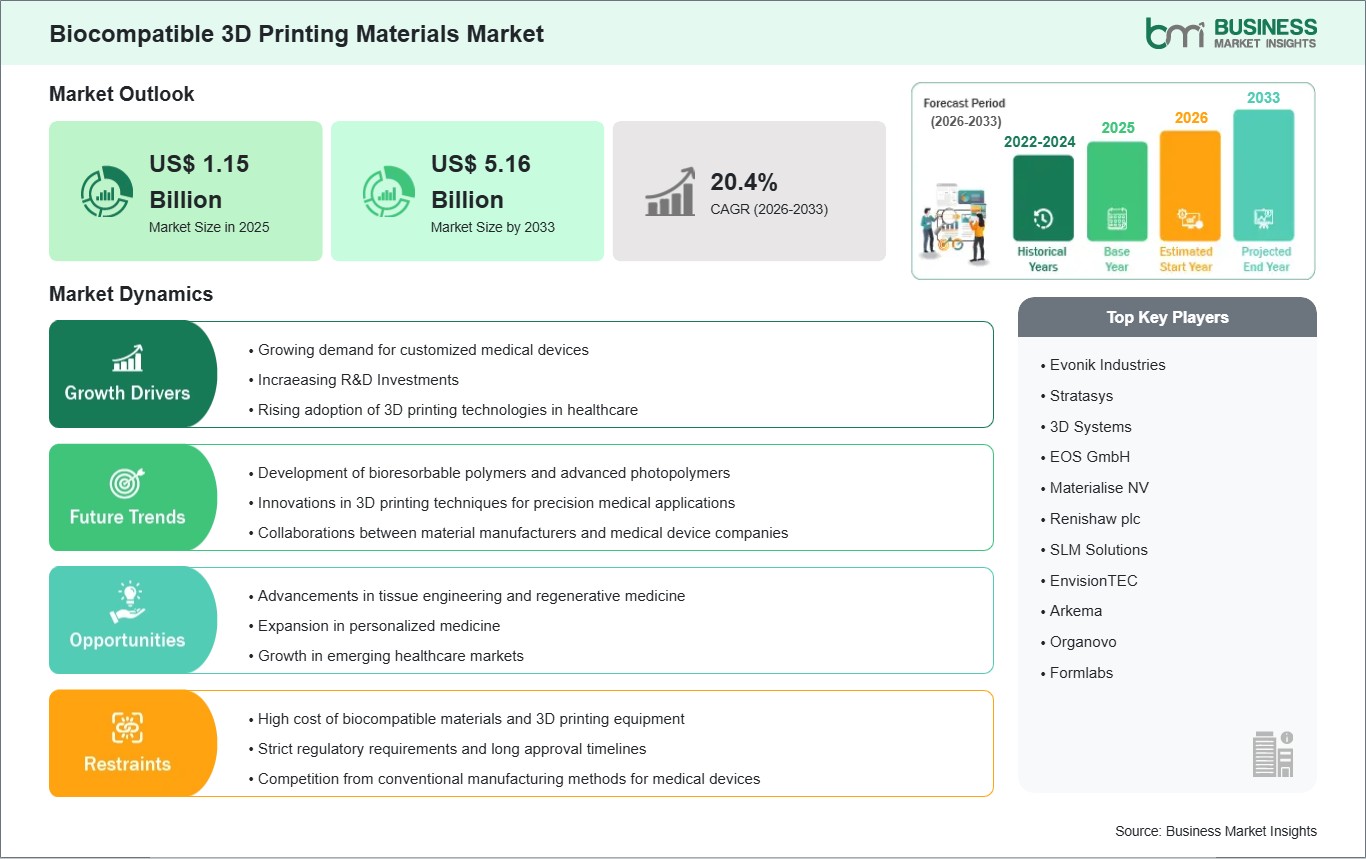
The Biocompatible 3D Printing Materials Market size is expected to reach US$ 5.16 Billion by 2033 from US$ 1.15 Billion in 2025 .The market is estimated to record a CAGR of 20.4% from 2026 to 2033.

Executive Summary and Global Market Analysis:

The global biocompatible 3D printing materials market is experiencing strong growth driven by advancements in additive manufacturing and increasing demand for personalized medical solutions. Biocompatible materials are specifically designed to interact safely with biological systems, making them essential for applications such as implants, prosthetics, and tissue engineering. These materials include specialized polymers, metals, and composites that meet stringent medical and regulatory standards.

The market is expanding due to the growing adoption of 3D printing technologies in healthcare, particularly for customized implants and surgical tools. The ability to produce patient-specific devices with complex geometries is transforming treatment approaches and improving clinical outcomes. Additionally, the rising prevalence of chronic diseases and aging populations is increasing demand for medical implants and prosthetics, further driving the need for biocompatible materials.

Competitive dynamics are centered on innovation in material science, regulatory compliance, and application-specific customization. Companies are investing in research to develop advanced materials with enhanced mechanical properties, biocompatibility, and degradation profiles. Collaborations between material manufacturers, medical device companies, and research institutions are accelerating product development and commercialization. The integration of digital design tools and advanced manufacturing technologies is further shaping the market landscape.

Biocompatible 3D Printing Materials Market - Strategic Insights:

global-market-strategic-framework
Get more information on this report

Biocompatible 3D Printing Materials Market Segmentation Analysis:

Key segments that contributed to the derivation of the biocompatible 3D printing materials market analysis are type, form, and application.

  • By type, the biocompatible 3D printing materials market is segmented into polymer, metal, and other types. The polymer segment dominated the market in 2025.
  • Based on form, the biocompatible 3D printing materials market is segmented into powder, liquid, and other forms. The powder segment dominated the market in 2025.
  • In terms of application, the biocompatible 3D printing materials market is segmented into implants & prosthesis, prototyping & surgical guides, tissue engineering, hearing aids, and other applications. The implants & prosthesis segment dominated the market in 2025.

Biocompatible 3D Printing Materials Market Drivers and Opportunities:

Growing Demand for Customized Medical Devices

A significant factor influencing the growth of the biocompatible 3D printing material market is the rise of personalized healthcare solutions. 3D printing allows for the development of custom-designed implants and prosthetics that are suited to a specific patient`s anatomy, thereby enhancing the fit, function, and clinical outcomes of these devices. Biocompatible materials are essential to the successful use of implants and prosthetics for humans as they ensure that these devices do not cause negative effects when put into direct contact with a human body.

The increase in the number of orthopedic, dental, and cardiovascular patients has created a demand for implants and prosthetics. In addition, continued advancements in 3D printing technology have allowed the creation of more complex 3D printed structures than can be made using traditional manufacturing techniques. Biocompatible polymers and metal alloys are being designed and manufactured with optimal tensile strength, ductility, and biocompatibility for use as implant and prosthetic devices.

Regulatory changes and an increased number of approved 3D printed medical devices will also continue to expand the size of the biocompatible 3D printing material market. As more and more healthcare providers embrace patient-specific treatment methods, the biocompatible 3D printing material market is expected to experience a significant increase.

Advancements in Tissue Engineering and Regenerative Medicine

3D printing material for the biocompatible 3D printing materials market is rapidly evolving with the emerging science of new technologies, biotechnology advancements, and the continued growth of regenerative medicine and tissue engineering. Traditional methods of producing organs and tissues are limited to conventional manufacturing techniques and materials. Innovations in bio-inks and biopolymers are developing new scaffolding to create functional tissues and organs mimicking natural conditions.

Innovative developments have resulted in many different types of advanced biocompatible materials, methods, and processes. Companies developing biocompatible materials need to use advanced methods, processes, and comprehensive cell culture techniques to develop scaffolds that imitate natural processes providing support for cellular proliferation, differentiation, and integration with other cells within surrounding tissues.

In addition to developing 3D printed organ and tissue scaffolds, the benefit of new scaffolding materials has the potential to provide real-time clinical testing of drugs in the laboratory setting prior to patient administration. The biocompatible materials market is expected to experience tremendous growth over the next several years due to the substantive amounts of investment being made by both academic institutions and private sector players, and being driven by many partners in the regenerative medicine market.

Additionally, advances in biocompatible materials beyond the healthcare and tissue segments of the market will continue to drive the overall growth of the biocompatible 3D printing materials market. Overall, there will be an increasing demand for advanced biocompatible 3D printing materials as technology continues to advance within the biocompatible materials market.

Biocompatible 3D Printing Materials Market Size and Share Analysis:

The Biocompatible 3D Printing Materials Market demonstrates steady growth, with size and share analysis highlighting evolving trends and competitive dynamics among key players. The report examines subsegments categorized within type, form, and application, offering insights into their contribution to overall market performance.

By type, the polymer subsegment dominated the market in 2025, driven by its versatility and wide range of medical applications.

Based on form, the powder subsegment dominated the market in 2025, driven by its suitability for various 3D printing technologies such as selective laser sintering.

In terms of application, the implants & prosthesis subsegment dominated the market in 2025, driven by increasing demand for patient-specific medical devices.

Biocompatible 3D Printing Materials Market Report Highlights:

Report Attribute Details
Market size in 2025 US$ 1.15 Billion
Market Size by 2033 US$ 5.16 Billion
Global CAGR (2026 - 2033)20.4%
Historical Data 2022-2024
Forecast period 2026-2033
Segments Covered By Type
  • Polymer
  • Metal
  • Other Types
By Form
  • Powder
  • Liquid
  • Other Forms
By Application
  • Implants & Prosthesis
  • Prototyping & Surgical Guides
  • Tissue Engineering
  • Hearing Aids
  • Other Applications
Regions and Countries Covered
North America US, Canada, Mexico
Europe Belgium, Austria, Finland, Denmark, Greece, Poland, Romania, Russia, Ukraine, Czech Republic, Slovakia, Bulgaria, Italy, Luxembourg, Germany, Switzerland, France, Netherlands, Norway, Portugal, Spain, Sweden, United Kingdom
Asia-Pacific Australia, China, India, Japan, South Korea, Indonesia, Malaysia, Philippines, Singapore, Thailand, Vietnam, Bangladesh, New Zealand, Taiwan
South and Central America Brazil, Argentina, Peru, Chile, Colombia
Middle East and Africa Bahrain, Kuwait, Oman, Qatar, Saudi Arabia, United Arab Emirates, Turkiye, South Africa, Egypt, Algeria, Nigeria
Market leaders and key company profiles
  • Evonik Industries
  • Stratasys
  • 3D Systems
  • EOS GmbH
  • Materialise NV
  • Renishaw plc
  • SLM Solutions
  • EnvisionTEC
  • Arkema
  • Organovo
Get more information on this report

Biocompatible 3D Printing Materials Market Report Coverage and Deliverables:

The "Biocompatible 3D Printing Materials Market Size and Forecast (2022 - 2033)" report provides a detailed analysis of the market covering below areas:

  • Biocompatible 3D Printing Materials Market size and forecast at global, regional, and country levels for all the key market segments covered under the scope
  • Biocompatible 3D Printing Materials Market trends, as well as drivers, restraints, and opportunities
  • Biocompatible 3D Printing Materials Market analysis covering key trends, global and regional framework, major players, regulations, and recent developments
  • Industry landscape and competition analysis covering market concentration, heat map analysis, prominent players, and recent developments for the Biocompatible 3D Printing Materials Market
  • Detailed company profiles, including SWOT analysis

Biocompatible 3D Printing Materials Market Geographic Insights:

The geographical scope of the Biocompatible 3D Printing Materials Market report is divided into North America, Asia Pacific, Europe, Middle East & Africa, and South & Central America. North America held the largest share in 2025.

The adoption of biocompatible 3D printing materials varies across regions, influenced by healthcare infrastructure, technological advancements, and regulatory frameworks. North America leads the global market, supported by strong research and development capabilities, high healthcare spending, and early adoption of advanced medical technologies. The U.S. in particular has established itself as a hub for innovation in medical 3D printing, with hospitals, research institutions, and private companies investing heavily in biocompatible materials for implants, prosthetics, and surgical tools. Favorable reimbursement policies and a robust regulatory environment further strengthen North America’s leadership position.

Europe is also a significant market, driven by favorable regulatory policies and increasing investment in healthcare innovation. Countries such as Germany, the UK, and France are actively integrating 3D printing into medical applications, supported by strong academic research and government-backed initiatives. The region’s emphasis on patient safety and sustainability aligns well with the adoption of biocompatible materials.

Asia Pacific represents the fastest-growing region, fueled by expanding healthcare infrastructure, rising demand for medical devices, and increasing adoption of 3D printing technologies in countries such as China, Japan, and India. Rapid urbanization and growing healthcare investments are creating opportunities for advanced medical solutions, while local manufacturers are scaling up production to meet demand.

Emerging regions in Latin America, the Middle East, and Africa are gradually adopting biocompatible 3D printing materials to support healthcare advancements and improve patient outcomes. While their market shares remain smaller, ongoing investments in healthcare modernization and technology adoption are expected to drive steady growth. Overall, North America’s dominance, combined with Asia Pacific’s rapid expansion, defines the global trajectory of this market.

global-market-geography
Get more information on this report

Biocompatible 3D Printing Materials Market Research Report Guidance:

  • The report includes qualitative and quantitative data in the Biocompatible 3D Printing Materials Market across type, form, application, and geography.
  • The report starts with the key takeaways (chapter 2), highlighting key trends and outlook of the Biocompatible 3D Printing Materials Market.
  • Chapter 3 focuses on the research methodology of the study.
  • Chapter 4 includes ecosystem analysis.
  • Chapter 5 highlights the major industry dynamics in the Biocompatible 3D Printing Materials Market, including factors that are driving the market, prevailing deterrents, potential opportunities, as well as future trends. Impact analysis of these drivers and restraints is also covered in this section.
  • Chapter 6 discusses the Biocompatible 3D Printing Materials Market scenario, in terms of historical market revenues, and forecast till the year 2033.
  • Chapters 7 to 10 cover Biocompatible 3D Printing Materials Market segments by type, form, application, and geography across North America, Asia Pacific, Europe, Middle East & Africa, and South & Central America. They cover the market revenue forecast and factors driving the market.
  • Chapter 11 describes the competitive analysis along with the heat map analysis for the key players operating in the market.
  • Chapter 12 describes the industry landscape analysis. It provides detailed descriptions of business activities such as market initiatives, new developments, mergers, and joint ventures globally, along with a competitive landscape.
  • Chapter 13 provides detailed profiles of the major companies operating in the Biocompatible 3D Printing Materials Market. Companies have been profiled on the basis of their key facts, business descriptions, products, financial overview, SWOT analysis, and key developments.
  • Chapter 14, i.e., the appendix, is inclusive of a brief overview of the company, a list of abbreviations, and a disclaimer.

Biocompatible 3D Printing Materials Market News and Key Development:

The Biocompatible 3D Printing Materials Market is evaluated by gathering qualitative and quantitative data post primary and secondary research, which includes important corporate publications, association data, and databases. A few of the key developments in the biocompatible 3D printing materials market are:

  • In September 2025, Evonik Industries launched new bioresorbable polymer materials for medical 3D printing applications, enhancing performance in implants and tissue engineering.
  • In April 2025, Stratasys introduced advanced biocompatible photopolymers designed for surgical guides and dental applications, improving precision and safety.

Key Sources Referred:

  • World Health Organization (WHO)
  • U.S. Food and Drug Administration (FDA)
  • European Medicines Agency (EMA)
  • National Institutes of Health (NIH)
  • International Organization for Standardization (ISO)
  • International Trade Administration
The List of Companies - Biocompatible 3D Printing Materials Market
  • Evonik Industries
  • Stratasys
  • 3D Systems
  • EOS GmbH
  • Materialise NV
  • Renishaw plc
  • SLM Solutions
  • EnvisionTEC
  • Arkema
  • Organovo
  • Formlabs
Frequently Asked Questions
How big is the Biocompatible 3D Printing Materials Market?

The Biocompatible 3D Printing Materials Market is valued at US$ 1.15 Billion in 2025, it is projected to reach US$ 5.16 Billion by 2033.

What is the CAGR for Biocompatible 3D Printing Materials Market by (2026 - 2033)?

As per our report Biocompatible 3D Printing Materials Market, the market size is valued at US$ 1.15 Billion in 2025, projecting it to reach US$ 5.16 Billion by 2033. This translates to a CAGR of approximately 20.4% during the forecast period.

What segments are covered in this report?

The Biocompatible 3D Printing Materials Market report typically cover these key segments-

  • Type (Polymer, Metal, Other Types)
  • Form (Powder, Liquid, Other Forms)
  • Application (Implants & Prosthesis, Prototyping & Surgical Guides, Tissue Engineering, Hearing Aids, Other Applications)

What is the historic period, base year, and forecast period taken for Biocompatible 3D Printing Materials Market?

The historic period, base year, and forecast period can vary slightly depending on the specific market research report. However, for the Biocompatible 3D Printing Materials Market report:

  • Historic Period : 2022-2024
  • Base Year : 2025
  • Forecast Period : 2026-2033
  • Who are the major players in Biocompatible 3D Printing Materials Market?

    The Biocompatible 3D Printing Materials Market is populated by several key players, each contributing to its growth and innovation. Some of the major players include:

  • Evonik Industries
  • Stratasys
  • 3D Systems
  • EOS GmbH
  • Materialise NV
  • Renishaw plc
  • SLM Solutions
  • EnvisionTEC
  • Arkema
  • Organovo
  • Formlabs
  • Who should buy this report?

    The Biocompatible 3D Printing Materials Market report is valuable for diverse stakeholders, including:

    • Investors: Provides insights for investment decisions pertaining to market growth, companies, or industry insights. Helps assess market attractiveness and potential returns.
    • Industry Players: Offers competitive intelligence, market sizing, and trend analysis to inform strategic planning, product development, and sales strategies.
    • Suppliers and Manufacturers: Helps understand market demand for components, materials, and services related to concerned industry.
    • Researchers and Consultants: Provides data and analysis for academic research, consulting projects, and market studies.
    • Financial Institutions: Helps assess risks and opportunities associated with financing or investing in the concerned market.

    Essentially, anyone involved in or considering involvement in the Biocompatible 3D Printing Materials Market value chain can benefit from the information contained in a comprehensive market report.

    Available Report Formats

    pdf-format excel-format pptx-format
    Buy Now
    Sales Assistance
    +1 646 791 7070 (US & UK)
    Customization Form

    Please tell us your area of interest
    (Market Segments/ Regions and Countries/ Companies)