
Biocides Market Outlook: Size, Share, Trends, Growth Analysis, Competitive Landscape & Forecast, 2026-2033

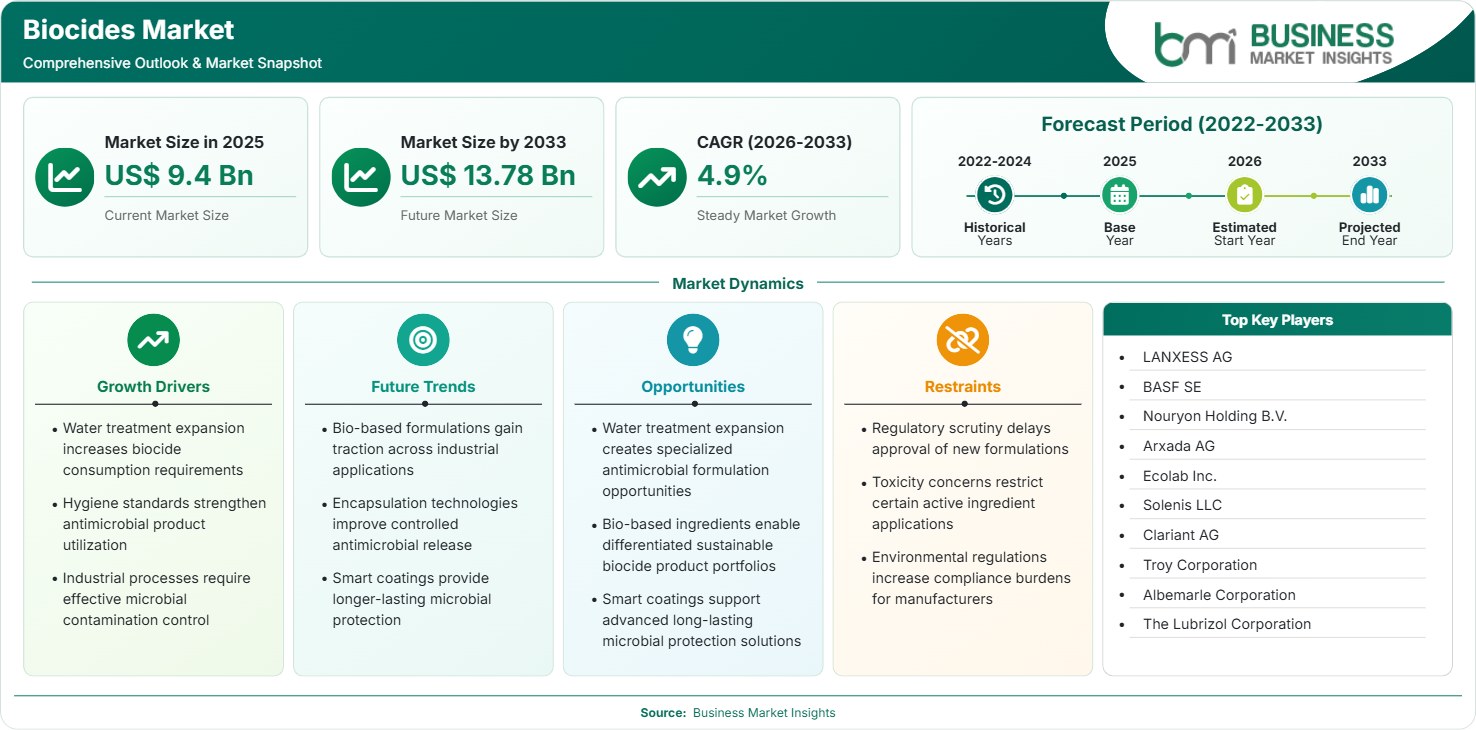
The Biocides Market size was valued at US$ 9.4 Billion in 2025 and is projected to reach US$ 13.78 Billion by 2033, growing at a CAGR of 4.90% during 2026–2033, driven by water hygiene, preservation demand, regulatory compliance, sustainable formulations, and industrial microbial control opportunities.

Report Coverage
  • Type: Halogen Compounds, Quaternary Ammonium Compounds, Metallic Compounds, Phenolic, Organic Acids, Organosulfur, Others
  • Application: Water Treatment, Food and Personal Care Products, Cleaning Products, Furniture and Furnishings, Clothing and Textiles, Leather and Suede, Paints and Coatings, Fuel Preservatives, Others
US$ 9.4 Bn Market size in 2025
US$ 13.78 Bn Market Size by 2033
4.9% CAGR, 2026 - 2033
2026-2033 Forecast Period

AI Overview

Biocides Market Summary

  • North America Region: North America holds a 24%–27% share in 2025, growing at a 4.4%–4.8% CAGR, supported by industrial water reuse, stringent hygiene standards, coatings preservation, and demand for efficient antimicrobial formulations across manufacturing and institutional applications. The U.S. represents most regional demand, with a 4.2%–4.6% CAGR through 2033, supported by municipal water infrastructure, food safety requirements, industrial cooling systems, and antimicrobial product innovation.
  • Fastest Growing Region: Asia Pacific holds a 35%–38% share in 2025 and records a 5.5%–5.9% CAGR, supported by expanding municipal treatment, manufacturing output, food processing, construction materials, rising hygiene standards, and investments in water reuse infrastructure.
  • Leading Segment: Organosulfur compounds hold a 22%–25% share in 2025 and expand at a 4.9%–5.3% CAGR, supported by strong efficacy, established industrial formulations, preservation performance, and continued use across coatings, water treatment, adhesives, and process industries.
  • High Growth Segment: Water Treatment holds a 27%–30% share in 2025 and advances at a 5.3%–5.7% CAGR, driven by water scarcity, cooling-system protection, municipal reuse, industrial wastewater requirements, and greater emphasis on microbial risk management.
  • Key Market Opportunity: Demand is shifting toward application-specific, lower-dose, regulatory-ready chemistries that combine microbial efficacy with improved environmental profiles, creating opportunities for differentiated formulations, monitoring services, and integrated treatment programs.
  • Major Market Players: LANXESS AG; BASF SE; Nouryon Holding B.V.; Arxada AG; Ecolab Inc.; Solenis LLC; Clariant AG; Troy Corporation; Albemarle Corporation; The Lubrizol Corporation.
Strategic Insights

Biocides Market: Strategic Insights

Biocides Market Strategic Framework
FREE PDF
Request your free sample
Request free sample
Stakeholder View

Key Takeaways

  • Market structure: The value chain is becoming more application-led, linking active-ingredient manufacturers, formulators, distributors, water-treatment specialists, and industrial service providers. Regulatory documentation and technical support increasingly influence supplier selection alongside chemistry and price.
  • Growth opportunity: Water treatment provides the strongest application upside as municipal reuse, industrial cooling, wastewater management, and microbial control become increasingly important operating requirements.
  • Innovation trend: Product development is moving toward optimized dosing, lower-leaching systems, peracetic-acid technologies, specialty preservatives, and formulations designed around specific regulatory and application profiles.
  • Regional opportunity: Asia Pacific offers the strongest investment case because industrial capacity expansion intersects with water infrastructure development, urbanization, food processing, and increasing adoption of formal microbial-control programs.
  • Investment and M&A: Portfolio optimization is accelerating as large chemical groups divest non-core technologies while specialist owners acquire platforms that can be commercialized through focused distribution and technical-service models.
Geographic Outlook

Biocides Market Regional Highlights

North America Biocides Market

North America comprises 24%-27% market share in 2025 and is expected to grow at a CAGR of 4.4%-4.8% till 2033. The drivers for the market include industrial water treatment, food processing, paints & coatings, and institutional hygiene. The region enjoys the advantage of having a well-developed technical service and regulatory infrastructure. The biocides market share in the Biocides segment is sustained by replacement demand and formulation improvements, rather than by the fast-paced expansion of capacity. North American industrial consumers are the primary consumers, while additional growth prospects exist in Canada and Mexico.

  • Industrial water users increasingly prioritize continuous microbial monitoring and optimized dosing to limit biofilm formation and maintain process efficiency.
  • Coatings producers are adopting preservatives capable of protecting water-based formulations while meeting tighter customer expectations around environmental performance.
  • Food and institutional applications favor validated antimicrobial systems where documented efficacy, traceability, and controlled application are purchasing prerequisites.
  • Regional suppliers benefit from established distribution networks and technical support, strengthening customer retention in specialized applications.

US Biocides Market

The U.S. Biocides Market accounts for about 68%-72% of North American demand and has a CAGR of 4.2%-4.6% through 2033. Water treatment applications, coatings, cleaners, food processing, and fuel treatment form the basis of demand. Application efficacy and compliance needs play an increasing role in determining demand. Moreover, the U.S. biocides market provides a solid platform for bringing specialty chemicals into agricultural sanitization and industrial disinfection applications. Suppliers who can register with the EPA and develop solutions gain an edge.

  • Municipal and industrial water operators are investing in microbial control alongside water reuse, cooling efficiency, and wastewater treatment upgrades.
  • Specialty preservatives remain relevant in paints, adhesives, sealants, and formulated products where microbial contamination can damage finished goods.
  • U.S. customers increasingly value suppliers capable of combining chemistry, dosing guidance, monitoring, and compliance documentation.

Europe Biocides Market

The Europe Biocides Market is 21%–24% of the total market in 2025 and is expanding at a 4.1%–4.5% CAGR. Germany, France, Italy, and the United Kingdom are considered key players, while Spain and Central Europe offer additional demand. Germany is growing at 4.2%–4.6%, while Poland and Italy are growing at 4.7%–5.1%. Regulatory compliance is one of the major factors that define the business.

  • Germany remains a major specialty-chemical and coatings hub, supporting demand for industrial preservatives and microbial-control technologies.
  • Regulatory dossier quality increasingly influences product availability, portfolio continuity, and supplier economics across European markets.
  • Southern and Central European manufacturers offer growth potential through industrial water treatment, construction materials, coatings, and institutional hygiene.
  • Product developers increasingly prioritize formulations compatible with evolving environmental and exposure requirements.

Asia Pacific Biocides Market

The Asia-Pacific Biocides Market holds a market share of 35% - 38% in 2025 and is projected to grow at a CAGR of 5.5% - 5.9%. China and Japan have robust demand, whereas India, Indonesia, and Southeast Asia have higher incremental demand. India can achieve an annual growth of 6.0%-6.5%, driven by manufacturing, water treatment, food processing, and urban infrastructure. China remains a major production and consumption center, with growth of approximately 5.3%–5.8%.

  • Water scarcity and industrial wastewater requirements are increasing demand for microbial-control solutions in manufacturing and municipal applications.
  • India offers attractive opportunities in coatings, textiles, food processing, water treatment, and industrial preservation.
  • China combines great domestic demand with extensive chemical manufacturing capabilities, supporting localized formulation and supply-chain development.
  • Southeast Asian markets benefit from expanding food, beverage, consumer-product, and industrial manufacturing capacity.

Rest of World Biocides Market

South and Central America Biocides Market accounts for an estimated 8%–11% of global demand, while the Middle East and Africa contribute approximately 7%–10%. Brazil remains the leading Latin American market, supported by water treatment, food processing, agriculture-related applications, and industrial production. Saudi Arabia and the United Arab Emirates provide strong Middle Eastern opportunities as desalination and water reuse expand. South Africa leads African demand, while Gulf markets can achieve approximately 5.2%–5.8% growth.

  • Brazil benefits from large-scale water, food, agricultural, and industrial processing requirements that require reliable microbial management.
  • Saudi Arabia and the UAE are attractive because desalination, industrial water reuse, and infrastructure investment increase treatment intensity.
  • South Africa provides opportunities in mining, municipal water, food processing, and industrial preservation.
  • Regional growth favors suppliers with localized technical service, distribution partnerships, and application-specific regulatory expertise.
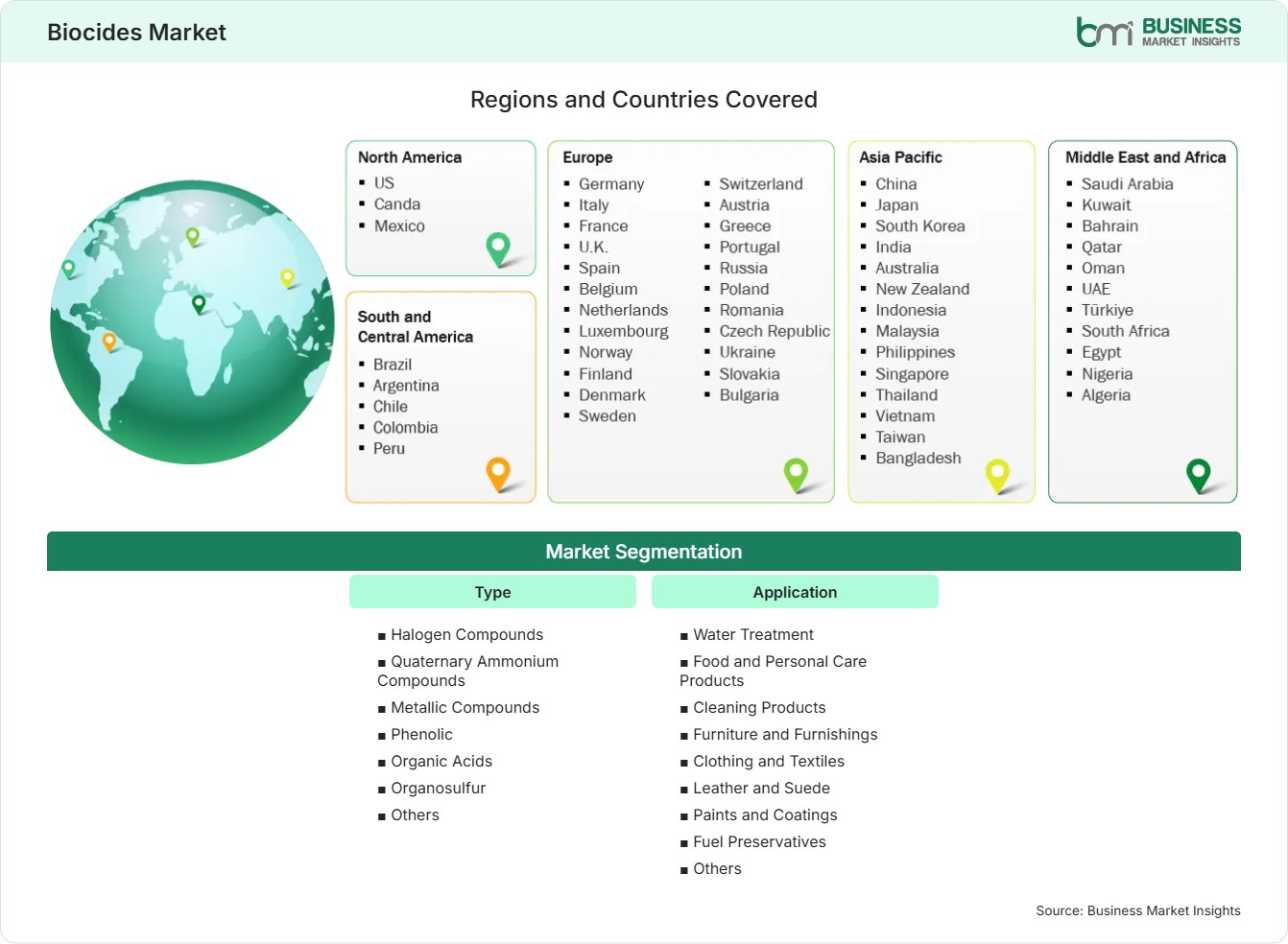
Global Market Geography
FREE PDF
Request your free sample
Request free sample
Segment Analysis

Biocides Market Segmentation

Type

The Types section is the chemical basis of the industry, where organosulfur products are dominating with a 22% - 25% market share in 2025 and a CAGR of 4.9% - 5.3% from 2026 to 2033. Acceptance relies on the microbial spectrum, compatibility, dosage, regulatory status, and formulation stability. The scope of the biocides market is gradually shifting toward different chemistries.

  • Halogen Compounds: Chlorine-based and related chemistries provide rapid microbial control across water and industrial applications, supported by established infrastructure, cost efficiency, and broad disinfection familiarity.
  • Quaternary Ammonium Compounds: Quats provide persistent surface activity and compatibility with cleaning formulations, supporting use in institutional hygiene, consumer products, and industrial sanitation programs.
  • Metallic Compounds: Silver, copper, and related technologies provide durable antimicrobial performance where controlled release, surface protection, and long-term preservation justify higher formulation complexity.
  • Phenolic: Phenolic systems remain relevant where robust antimicrobial performance and formulation stability are required, although regulatory and environmental considerations encourage selective application and reformulation.
  • Organic Acids: Organic-acid chemistries support food, cleaning, and water applications through effective microbial reduction, favorable formulation flexibility, and growing interest in alternative preservation systems.
  • Organosulfur: Organosulfur compounds provide strong preservation efficiency across coatings, industrial fluids, adhesives, and water systems, making them a core platform for specialty microbial control.
  • Others: Other chemistries address specialized microbial targets and formulation requirements, creating niche opportunities where conventional active ingredients cannot balance efficacy, compatibility, regulatory status, and environmental performance.

Application

The applications market will be driven by Water Treatment, which will hold a market share of 27%–30% by 2025 and grow at a CAGR of 5.3%–5.7% from 2019 to 2033. This is because the increasing use of water recycling, industrial microbiological control, and infrastructure upgrades will drive demand. Application diversification supports the Biocides Market trends toward integrated treatment, dosing optimization, and service-supported product models.

  • Water Treatment: Municipal, industrial, cooling, and wastewater systems require microbial control to protect assets, maintain process efficiency, and support increasingly intensive water reuse.
  • Food and Personal Care Products: Preservation protects product quality and shelf life, with formulation developers balancing antimicrobial efficacy, consumer expectations, ingredient compatibility, and regulatory requirements.
  • Cleaning Products: Institutional and household cleaning applications rely on antimicrobial systems that deliver validated efficacy while supporting formulation stability, safety requirements, and efficient dosing.
  • Furniture and Furnishings: Preservatives protect treated materials and formulations from microbial deterioration, particularly where moisture exposure, storage conditions, and extended product life create contamination risks.
  • Clothing and Textiles: Antimicrobial treatment supports odor control, material protection, and specialized textile performance, with opportunities linked to technical fabrics and hygiene-sensitive applications.
  • Leather and Suede: Preservation systems reduce microbial deterioration during processing and storage, particularly where moisture, organic substrates, and extended supply-chain handling increase contamination risks.
  • Paints and Coatings: Biocides protect water-based formulations against microbial growth and support dry-film protection, making preservative performance critical to product stability and coating durability.
  • Fuel Preservatives: Fuel biocides control microbial contamination in stored fuels, supporting transportation, power generation, maritime operations, and industrial storage where water accumulation can accelerate microbial growth.
  • Others: Specialized applications create smaller but defensible niches where microbial protection improves product performance, asset reliability, hygiene outcomes, or material durability.
Market Forces

Biocides Market Dynamics

Key Market Drivers

Water Reuse and Industrial Microbial Control

Industrial water reuse is increasing the need for precise microbial management because repeated water recirculation can increase the risk of biofilm and fouling. The Biocides Market growth therefore benefits from cooling towers, wastewater systems, process water, and municipal reuse programs. Increasing treatment strength will be beneficial for products with accompanying monitoring and dosing services. Increased margins can be achieved through combinations of chemistry with diagnostic tools, dosing, and other forms of technical support. These developments are increasingly becoming driven by performance optimization rather than mere volume utilization. They benefit suppliers with strong application engineering skills, product efficacy, and regional service offerings. Water-intensive industries such as manufacturing, mining, power generation, and food processing remain key customers, seeking microbial control without damaging assets.

Regulatory-Driven Product Optimization

The increased value of regulation in product formulation is evident in its contribution to the importance of approved active ingredients, efficacy, exposure, and stewardship. The European regulations require that active substances be approved and that biocidal products be authorized, thereby ensuring that regulatory compliance becomes a business competence rather than an administrative task. This has facilitated the reformulation of the Biocides Market to favor the approval of approved chemistries. Suppliers have been compelled to keep complete technical dossiers. Businesses that handle regulations well can safeguard their access to markets, whereas small formulators will face compliance costs. Portfolios are thus becoming more selective as suppliers focus on areas where performance and regulatory continuity are economically rewarding.

Demand for Durable Product Preservation

Paints, coatings, adhesives, textiles, personal care products, and other industrial products often require preservatives to protect them throughout storage and use. This requirement supports the development of specialty chemistry because there is always a risk of contamination that can lead to product recalls, production losses, rejects, and a bad reputation. At the same time, the formulator should pay attention not only to antimicrobial properties but also to compatibility, odor, color, stability, leaching tendency, and performance during production. Consequently, such needs will help specific blends win the market rather than universal products. Companies that can conduct laboratory analysis and assist with formulations will be able to establish more lasting relationships with customers. Another field where such preservatives are increasingly required is the water-based products sector.

Key Market Opportunities

Integrated Water Treatment Solutions

The most promising opportunity would be to integrate biocidal chemistry with monitoring, dosing, analytical testing, and water treatment services. Increasingly, industrial clients are looking for quantifiable results, not just the supply of chemicals; hence, there are opportunities for recurring revenue for companies that can provide control of microbiological risk throughout the entire treatment process. Digital monitoring allows the company to detect variations in microbial loads, fine-tune dosing, and minimize chemical waste while still providing the necessary protection. Another means of differentiating themselves would be in their formulation of application-specific products for use in cooling towers, wastewater, desalination plants, and process water. Expansion into the Asia-Pacific and Middle East regions would be highly promising due to their ongoing industrialization and water stress.

Specialty Preservation and Sustainable Formulations

Efforts to find preservation systems that balance efficacy with improved environmental footprints have created opportunities for specialty organic acid products, peracetic acid-based technologies, quaternary ammonium formulations, and reduced dosing. However, this is not a simple swap, since various formulations will require different microbial profiles. Innovators able to formulate around these challenges can build up their technical moats. There are multiple routes to commercializing such developments, including personal care, coatings, food processing, institutional cleaning, and industrial preservation. It also provides an avenue for contract formulation and regulatory assistance, where small customers do not always have the ability to navigate the authorization process.

Emerging Application Platforms

Fuel conservation, agriculture, sanitation, textile processing, and new materials constitute attractive white spaces since microbial infestation generates operational or product-quality costs that make special processing worthwhile. The recent trend of commercialization proves increasing adoption of peracetic acid technology in poultry sanitation and wastewater applications. Fuel conservation is another area of recurrent demand, since time, water, and microbial infestation can affect fuel quality. It would be wise for investors to focus on platforms with a regulatory pathway and performance economics, rather than on sustainability. In terms of the Biocides Market Forecasts, it is more favorable to consider application areas where the suppliers can demonstrate shorter downtime, longer asset life, product shelf life, and lower treatment cost intensity.

Market Restraints and Challenges

Regulatory Complexity and Portfolio Attrition

Factor: As authorization becomes more demanding, the costs of testing, documentation, registration, and maintenance for both active substances and formulated products increase. Impact: Higher costs to achieve compliance could reduce the economic viability of low-volume products and encourage portfolio reduction. The authorization requirements in Europe highlight the direct impact of regulations on market availability, and changes to these assessments can create uncertainty about product continuity in the long run. In this case, the manufacturer will need to invest not only in the production process but also in toxicological evaluations, efficacy assessments, exposure assessments, stewardship, and regulatory affairs. This factor could disproportionately burden smaller manufacturers, increasing the likelihood of consolidation and outsourcing to regulatory experts. Portfolio reductions may also compel customers to change their formulations.

Raw Material Volatility and Formulation Constraints

Factor: The volatility of the chemical feedstock, energy prices, logistical issues, and the availability of specialty intermediates may drive up the manufacturing costs. Impact: This might create margin pressure, increased lead times, and customer pushback for passing along any price increases. Biocides, on the other hand, are subject to formulation issues, in which the active ingredients must be compatible with the solvents, stabilizers, packaging, and the substrate on which they will be applied. There might even be regulatory limitations for alternative sources. These factors will benefit companies with diversified sourcing, a regional manufacturing presence, sound inventory practices, and formulation skills. Customers today place importance on supply reliability, as these chemicals are operational necessities. However, having too much inventory is costly.

Company Analysis

Competitive Landscape

The Biocides Market analysis indicates competition is concentrated around specialty chemistry, regulatory capability, technical service, geographic coverage, and application expertise. Large diversified chemical companies compete with focused antimicrobial specialists, while water-treatment providers increasingly integrate chemical supply with monitoring and services.

Company Name

Overview

Products and Services relevant to this market

LANXESS AG

Global specialty-chemicals producer with a broad antimicrobial and preservation portfolio serving industrial and formulated-product applications.

Preventol, Kathon, Bioban, Rocima, Sea Nine, water-treatment microbiocides, fuel-preservation and coatings protection solutions.

BASF SE

Diversified chemical company supplying specialty ingredients and antimicrobial technologies across formulated products and industrial applications.

Preservation ingredients, antimicrobial solutions, hydrogen-peroxide and peracetic-acid technologies, industrial and institutional cleaning applications.

Nouryon Holding B.V.

Specialty chemicals supplier with established antimicrobial technologies and global formulation support capabilities.

Organic and inorganic biocides, specialty preservatives, industrial microbial-control solutions and formulation support.

Arxada AG

Specialty materials and microbial-control company focused on preservation, disinfection, personal care, coatings, and hygiene applications.

Peracetic-acid systems, preservatives, antimicrobial technologies, industrial biocides and specialty hygiene solutions.

Ecolab Inc.

Global water, hygiene, and infection-prevention provider integrating chemistry with technical services and customer-site programs.

Water-treatment biocides, disinfectants, industrial hygiene systems, microbial monitoring, dosing and technical services.

Solenis LLC

Specialty chemicals and water-treatment company serving industrial water, pulp and paper, and process industries.

Microbial-control chemicals, water-treatment programs, monitoring, dosing technologies and industrial process solutions.

Clariant AG

Specialty chemicals producer with formulation expertise across industrial, consumer, and preservation-oriented applications.

Specialty additives, preservatives, antimicrobial ingredients, formulation technologies and industrial performance chemicals.

Troy Corporation

Specialist supplier known for preservatives and antimicrobial technologies used in coatings and formulated products.

Paint and coatings preservatives, dry-film protection, in-can preservation and specialty antimicrobial formulations.

Albemarle Corporation

Specialty chemicals company with expertise in bromine chemistry and applications requiring controlled microbial performance.

Brominated biocides, industrial water-treatment chemistries, specialty antimicrobial products and chemical intermediates.

The Lubrizol Corporation

Specialty chemicals provider supporting performance formulations across industrial, consumer, and water-related applications.

Specialty additives, antimicrobial formulation components, water-treatment technologies, and performance-enhancing chemical solutions.

.

Trust & Transparency

Research Methodology

The market analysis combines proprietary research with secondary data from government agencies, company disclosures, regulatory filings, industry databases and expert interviews. Market estimates are validated through data triangulation, cross-market benchmarking and analyst review.

View Full Research Methodology

Questions Answered

Frequently Asked Questions

What does the Biocides Market Report help stakeholders evaluate?

The report provides a framework for assessing market size, regional demand, application opportunities, competitive positioning, chemical technology shifts, regulatory pressures, investment priorities, and strategic expansion opportunities through 2033.

How are suppliers increasing customer retention?

Suppliers are combining chemistry with monitoring, dosing, laboratory testing, technical support, and regulatory documentation. Integrated programs make microbial-control performance measurable and increase switching costs for industrial customers.

Why is Asia Pacific strategically important?

Asia Pacific combines large industrial production bases with expanding water infrastructure, food processing, construction, and consumer-product manufacturing. India and Southeast Asia provide particularly attractive incremental demand opportunities.

What makes regulatory capability commercially important?

Authorization determines whether many products can legally reach customers. Strong regulatory teams can protect portfolio continuity, accelerate product registrations, and reduce reformulation risks when active-substance requirements change.

Which application offers the strongest growth opportunity?

Water Treatment provides the strongest opportunity because industrial reuse, municipal wastewater treatment, cooling systems, and desalination increase microbial-control requirements while encouraging more sophisticated dosing and monitoring solutions.

Access the Full Biocides Market Report

Get segment-level forecasts, regional estimates, competitive benchmarking, company profiles and downloadable Excel datasets.

Access the full Biocides Market Report
350 pages PDF & Excel | 2026-09-28
Similar Research

Related Market Reports