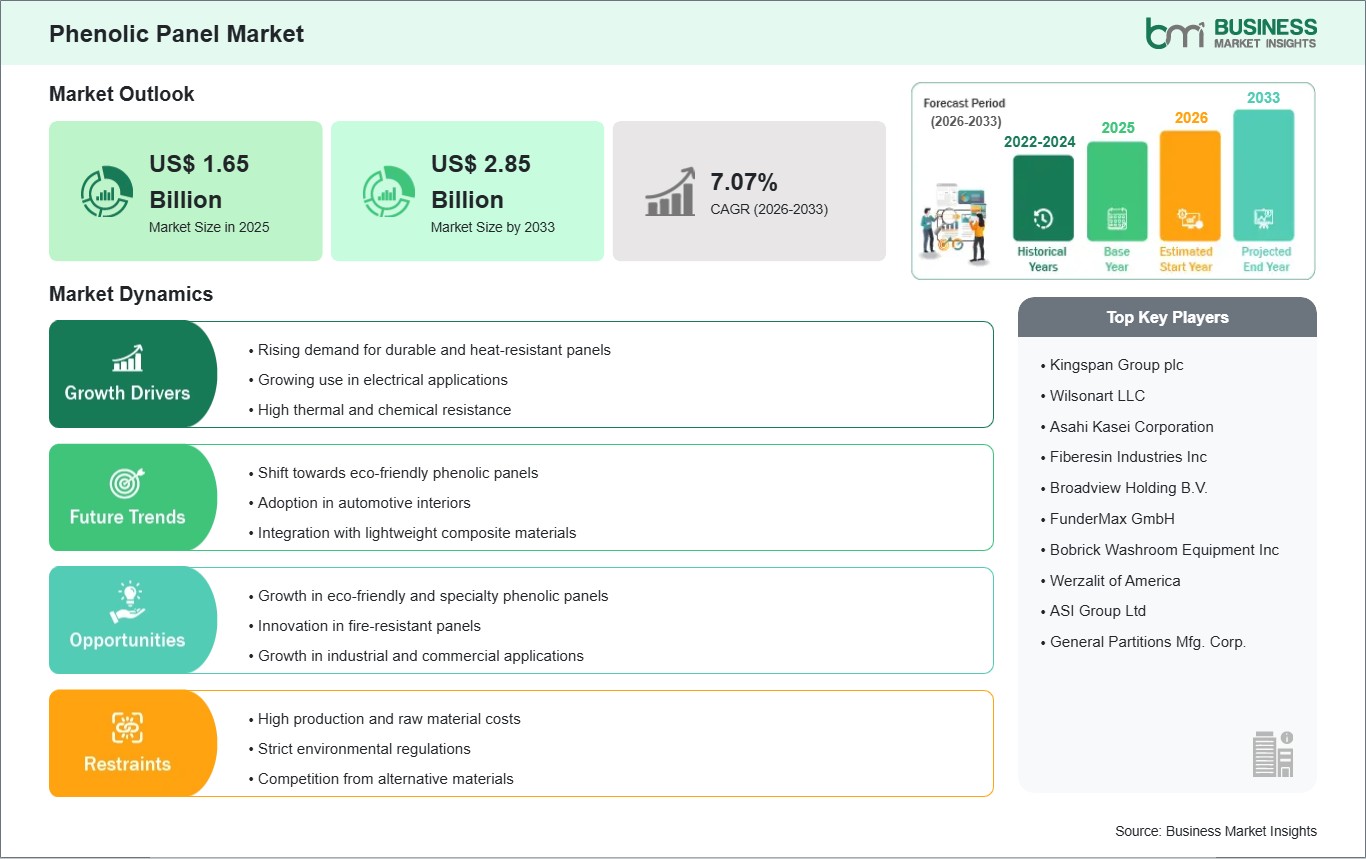
The Phenolic Panel Market size is expected to reach US$ 2.85 billion by 2033 from US$ 1.65 billion in 2025. The market is estimated to record a CAGR of 7.07% from 2026 to 2033.
The phenolic panel market is witnessing sustained growth due to the rising need for high-performance materials that are durable and possess fire-resistant properties for use in building construction, transportation infrastructure, electrical equipment, and industrial applications. Phenolic panels, made up of phenolic resin-impregnated laminates, possess high strength and resistance to heat, chemicals, and fire. The rising use of phenolic panels for furniture, interior wall claddings, and other applications reflects its use for different purposes. One of the major phenolic panel market trends is the emphasis on sustainability and regulatory compliance. Phenolic panels possess high longevity and recyclability characteristics and are in line with global environmental movements for sustainable building materials.
Moreover, manufacturers are focusing on developing formaldehyde-reduced and low-emitting phenolic resins to meet indoor air quality and environmental regulations, especially in developed nations. Technological innovation is influencing product differentiation. High-pressure laminates (HPL) and compact phenolic panels are being engineered for enhanced moisture resistance, surface hardness, and impact durability, enabling usage in high-traffic and outdoor applications. Decorative finishes, customizable textures, and fire-rated solutions further expand market applicability across residential, commercial, and industrial sectors.
The competitive landscape features global chemical and panel manufacturers alongside regional producers focusing on localized supply and cost-efficient solutions. Strategic partnerships with construction firms, modular panel fabricators, and interior designers are increasingly important to accelerate product adoption. Supply chain efficiency, consistent product quality, and value-added technical support are key factors shaping market success. The phenolic panel market is defined by the intersection of performance-driven innovation, regulatory compliance, and growing demand for durable, sustainable materials. Manufacturers that can deliver high-quality, customizable, and eco-compliant phenolic panels are well-positioned to capitalize on opportunities across both mature and emerging regions.

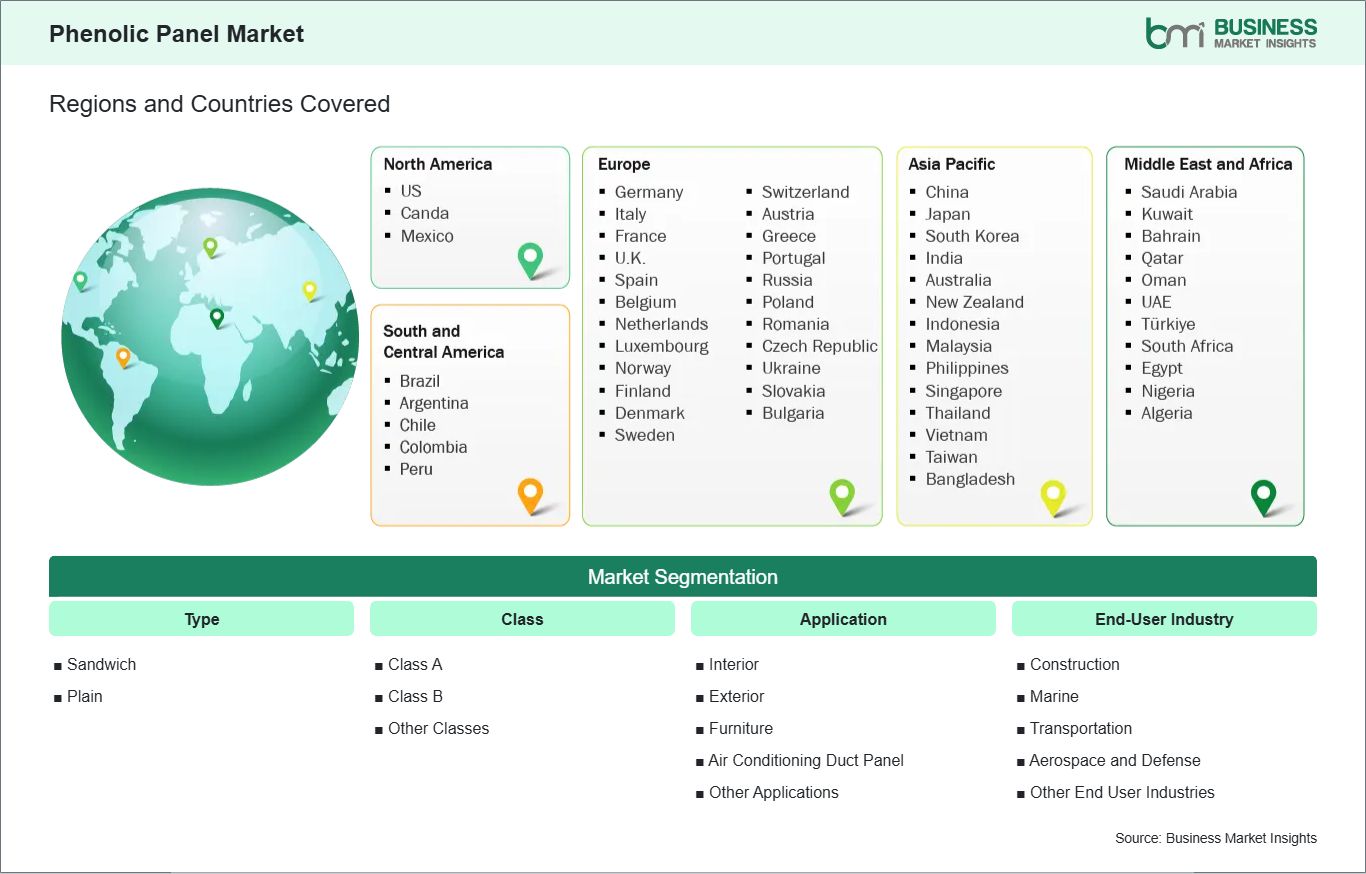
Key segments that contributed to the derivation of the phenolic panel market analysis are type, class, application, and end‑user industry.
The need for phenolic panels is increasing as industries require materials that can withstand harsh conditions while being reliable and possessing high mechanical strength. Phenolic panels are used in many applications due to their ability to withstand harsh conditions. They have high mechanical strength and can withstand harsh conditions. They are also useful in safety-critical applications due to their ability to withstand high temperatures and moisture.
Manufacturers are using phenolic panels to make products that are reliable and can withstand harsh conditions. The ability of phenolic panels to withstand harsh conditions has made them popular in many applications. Their ability to withstand deformation and moisture has also made them popular. The ability of phenolic panels to withstand harsh conditions has made them popular in many applications.
Innovation is also affecting the market, with panels being created for specific uses. The improved finish, lightweight, and multi-layer construction are making the panels more versatile without compromising on the core benefits. As the world becomes more safety-conscious, durability-focused, and efficiency-driven, phenolic panels are becoming an increasingly vital product in the world of construction.
Sustainability is one area where new opportunities are being created in the phenolic panel market. New opportunities are being created for phenolic panels through sustainable materials and processes. New sustainable processes and materials for phenolic panels help manufacturers comply with regulatory requirements and consumer demands for sustainable products.
Specialty phenolic panels are another area where phenolic panels are finding new opportunities. Panels that have better fire retardation, better resistance to moisture, and better finishes are being used for specialty applications. Panels with specialty properties are being used for high-end construction, transportation, and industrial applications.
Currently, there is ongoing research in developing phenolic panel products that offer high performance as well as environmentally friendly characteristics. Improvements in resin technology and processing methods are resulting in products that are not only stronger but also environmentally friendly. With various industries looking for safer, efficient, and environmentally friendly products, specialty phenolic panel products will definitely increase in the global market.
The phenolic panel market demonstrates steady growth, with size and share analysis highlighting evolving trends and competitive dynamics among key players. The report examines subsegments categorized within type, class, application, and end‑user industry, offering insights into their contribution to overall market performance.
By Type, the sandwich subsegment dominated the market in 2025, driven by its superior strength‑to‑weight ratio, thermal insulation properties, and enhanced fire resistance.
Based on Class, the Class A subsegment dominated the market in 2025, supported by its high fire‑retardant performance and compliance with stringent safety codes.
On the Basis of Application, the interior subsegment dominated the market in 2025, owing to extensive use in wall panels, partitions, ceilings, and decorative surfaces.
In Terms of End‑User Industry, the construction subsegment dominated the market in 2025, driven by rapid urbanization and rising adoption of fire‑safe, lightweight panels in building projects.
| Report Attribute | Details |
|---|---|
| Market size in 2025 | US$ 1.65 Billion |
| Market Size by 2033 | US$ 2.85 Billion |
| Global CAGR (2026 - 2033) | 7.07% |
| Historical Data | 2022-2024 |
| Forecast period | 2026-2033 |
| Segments Covered | By Type
|
|
Regions and Countries Covered
| |
| North America | US, Canada, Mexico |
| Europe | Belgium, Austria, Finland, Denmark, Greece, Poland, Romania, Russia, Ukraine, Czech Republic, Slovakia, Bulgaria, Italy, Luxembourg, Germany, Switzerland, France, Netherlands, Norway, Portugal, Spain, Sweden, United Kingdom |
| Asia-Pacific | Australia, China, India, Japan, South Korea, Indonesia, Malaysia, Philippines, Singapore, Thailand, Vietnam, Bangladesh, New Zealand, Taiwan |
| South and Central America | Brazil, Argentina, Peru, Chile, Colombia |
| Middle East and Africa | Bahrain, Kuwait, Oman, Qatar, Saudi Arabia, United Arab Emirates, Turkiye, South Africa, Egypt, Algeria, Nigeria |
| Market leaders and key company profiles |
|
The "Phenolic Panel Market Size and Forecast (2022 - 2033)" report provides a detailed analysis of the market covering below areas:
The geographical scope of the Phenolic Panel Market report is divided into North America, Asia Pacific, Europe, Middle East & Africa, and South & Central America. North America held the largest share in 2025.
Regional-level dynamics in the phenolic panel market reveal distinct demand patterns shaped by construction activity, industrial development, and regulatory environments.
North America is the dominant market, driven by large-scale commercial and residential construction, high adoption of fire-resistant and sustainable building materials, and stringent safety and environmental standards in the United States and Canada. Rising demand for decorative, high-performance panels in interior and modular construction further reinforces market leadership.
Europe represents a mature and sustainability-driven market, with Germany, France, and Italy emphasizing eco-compliant, low-emission, and fire-rated phenolic panels. Regulatory mandates on indoor air quality, fire safety, and energy-efficient construction materials drive adoption in both commercial and residential projects. Decorative and functional panel demand is particularly strong in high-end construction and public infrastructure.
Asia Pacific is experiencing rapid growth, led by China, India, and Japan, due to increasing urbanization, infrastructure development, and industrial expansion. Demand is driven by large-scale commercial construction, modular buildings, and industrial applications where durability, fire resistance, and aesthetic flexibility are critical. Local production capabilities are improving to meet rising volume requirements while balancing cost-efficiency.
Middle East & Africa is an emerging market where rapid urbanization, hospitality, and commercial infrastructure development are fueling demand for high-performance panels. Market growth is concentrated in urban centers and premium construction projects that require fire-resistant and decorative solutions.
South & Central America shows steady growth, particularly in Brazil and Mexico, where expanding residential and commercial construction drives demand. Adoption is influenced by cost sensitivity, but rising awareness of durability, fire safety, and aesthetic appeal is gradually increasing the uptake of phenolic panels.

The Phenolic Panel Market is evaluated by gathering qualitative and quantitative data post primary and secondary research, which includes important corporate publications, association data, and databases. A few of the key developments in the phenolic panel market are:
The Phenolic Panel Market is valued at US$ 1.65 Billion in 2025, it is projected to reach US$ 2.85 Billion by 2033.
As per our report Phenolic Panel Market, the market size is valued at US$ 1.65 Billion in 2025, projecting it to reach US$ 2.85 Billion by 2033. This translates to a CAGR of approximately 7.07% during the forecast period.
The Phenolic Panel Market report typically cover these key segments-
The historic period, base year, and forecast period can vary slightly depending on the specific market research report. However, for the Phenolic Panel Market report:
The Phenolic Panel Market is populated by several key players, each contributing to its growth and innovation. Some of the major players include:
The Phenolic Panel Market report is valuable for diverse stakeholders, including:
Essentially, anyone involved in or considering involvement in the Phenolic Panel Market value chain can benefit from the information contained in a comprehensive market report.
Please tell us your area of interest
(Market Segments/ Regions and Countries/ Companies)