Market Summary
Executive Summary and Global Market Analysis
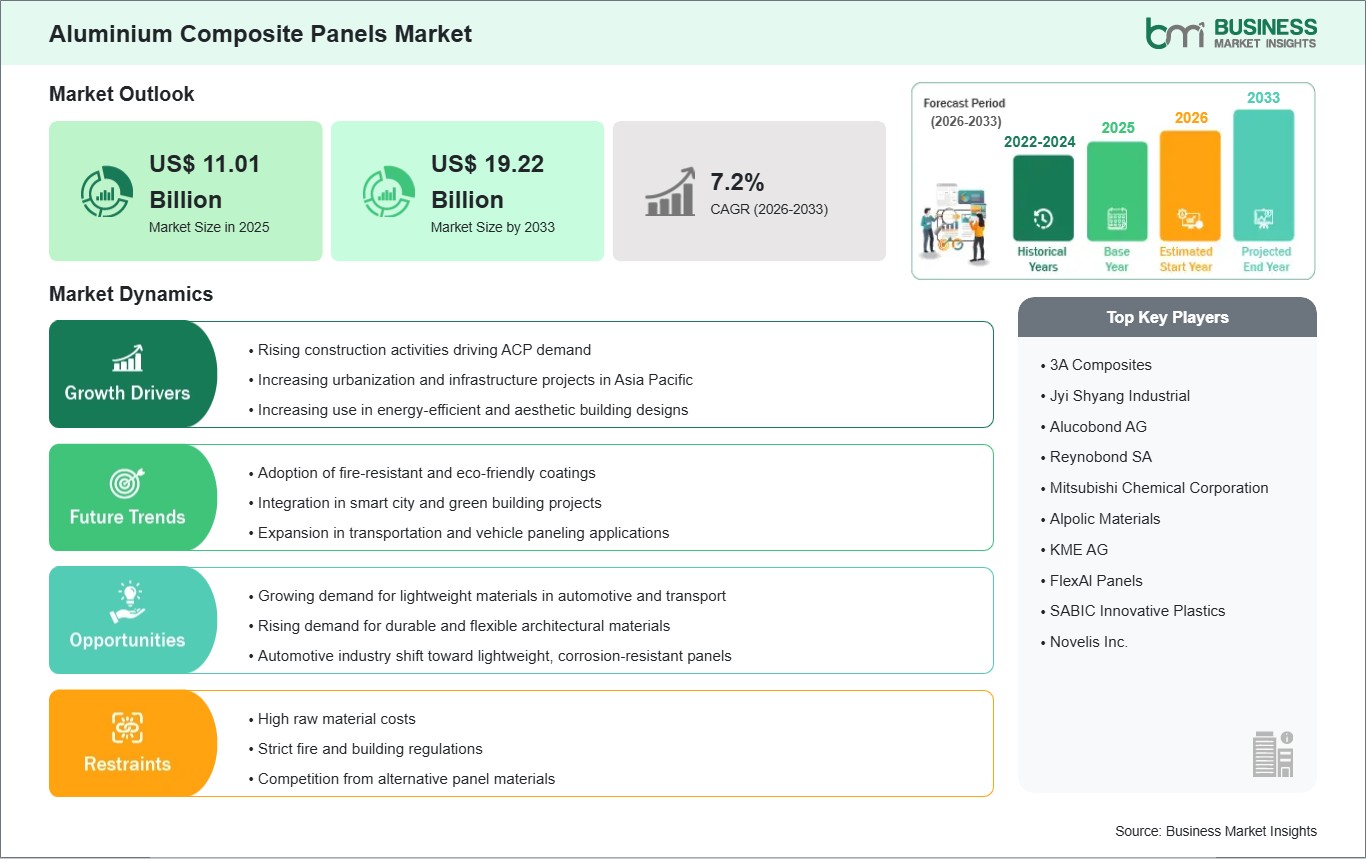
The global aluminum composite panels (ACP) market is driven by rising demand for lightweight, durable, and aesthetically versatile materials across construction, transportation, and advertising sectors. ACPs consist of two aluminum sheets bonded to a non-aluminum core, offering a combination of structural rigidity, weather resistance, and design flexibility. These properties have made them a preferred choice in modern architectural facades, signage, and vehicle paneling applications.
The construction industry remains the primary consumer of ACPs, supported by rapid urbanization, infrastructure development, and increasing preference for energy-efficient and visually appealing building materials. In addition, advancements in coating technologies—such as PVDF and polyester coatings—have enhanced panel durability, UV resistance, and color retention, further expanding their adoption.
From a competitive standpoint, manufacturers are focusing on product innovation, including fire-resistant and eco-friendly panels, to comply with stringent safety and environmental regulations. Sustainability considerations, such as recyclability and reduced carbon footprint, are also shaping product development strategies. Strategic collaborations with construction firms and automotive manufacturers are becoming increasingly common to strengthen market positioning and expand application scope.
Segment Analysis
Aluminium Composite Panels Market Segmentation
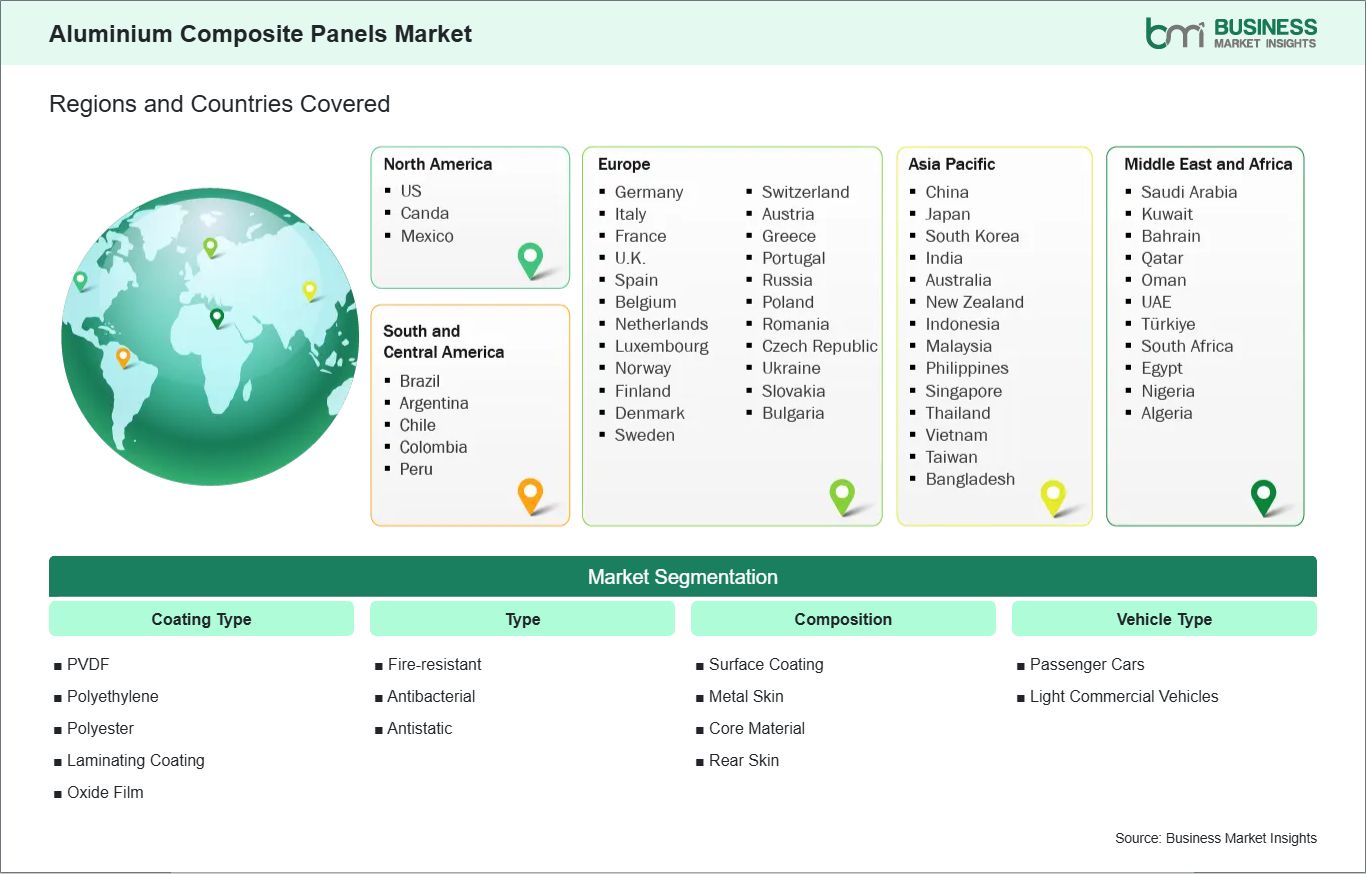
Key segments that contributed to the derivation of the aluminium composite panels market analysis are coating type, type, composition, vehicle type, and application.
- By coating type, the aluminum composite panels market is segmented into polyvinylidene difluoride, polyethylene, polyester, laminating coating, and oxide film. The polyvinylidene difluoride segment dominated the market in 2025.
- Based on type, the aluminum composite panels market is categorized into fire-resistant, antibacterial, and antistatic. The fire-resistant segment dominated the market in 2025.
- In terms of composition, the aluminum composite panels market is classified into surface coating, metal skin, core material, and rear skin. The core material segment dominated the market in 2025.
- By vehicle type, the aluminum composite panels market is segmented into passenger cars and light commercial vehicles. The passenger cars segment dominated the market in 2025.
- In terms of application, the aluminum composite panels market is segmented into building & construction, advertising, automotive, and transportation. The building & construction segment dominated the market in 2025.
Market Forces
Aluminium Composite Panels Market Drivers and Opportunities
Rising Construction Activities Fueling ACP Demand
The construction industry is booming around the world due to rapid urbanization and infrastructure development, which has led to a huge increase in the use of aluminum composite panels (ACPs). Newly developed and developing economies (particularly; India, China and the rest of Southeast Asia), are investing heavily in residential, commercial and industrial construction projects, while the developed markets around the world continue to upgrade and improve their existing infrastructures. Due to their light weight, ease of use and installation, and extraordinary ability to withstand wear and tear, ACPs are becoming more popular than ever in exterior wall cladding, façade applications and in interior applications. Today's architects are leaning towards more sustainable designs and energy efficient construction practices, both of which are positively supported by the thermal insulating value of ACPs, their ability to resist environmental elements and the flexibility of design options available. High-rise buildings, airports, shopping centres and smart city developments are using ACPs as finishing products for creating visually appealing buildings that will last a long time. Many governments worldwide have also created incentives to promote "green" building initiatives, where the use of ACP is one way to support the reduction of energy usage and improve adherence to environmental requirements. The combination of low cost, long life and flexible design have made ACPs an excellent choice among architects and builders for modern infrastructure developments around the world, and as construction activity continues to expand globally, the demand for ACPs will continue to rise and establish the material as an integral part of modern infrastructure development.
Growing Demand for Lightweight Materials in Automotive and Transportation
The automotive and transportation industries are undergoing a transformation as manufacturers prioritize lightweight materials to improve fuel efficiency, reduce emissions, and meet stringent environmental regulations. Aluminum composite panels (ACPs) offer an optimal balance between strength and weight, making them suitable for vehicle interiors, body panels, and transport infrastructure. Their corrosion resistance and design flexibility allow manufacturers to enhance both performance and aesthetics, while advanced coatings and bonding techniques further improve durability. The rise of electric vehicles (EVs) has intensified the need for lightweight materials, as reducing vehicle weight directly extends battery range and efficiency. Public transportation systems, including buses, trains, and metro networks, are also adopting ACPs for interior and exterior applications, benefiting from their ease of maintenance and long service life. Beyond vehicles, ACPs are used in transport infrastructure such as stations and terminals, where durability and modern design are critical. Technological advancements in ACP manufacturing are expanding usability across diverse environments, enabling tailored solutions for automotive and transport applications. As global mobility trends shift toward sustainability and efficiency, ACPs are positioned to play a vital role in shaping the future of automotive and transportation industries, offering both functional and aesthetic advantages.
Size and Share Analysis
Aluminium Composite Panels Market Size and Share Analysis
The Aluminium Composite Panels Market demonstrates steady growth, with size and share analysis highlighting evolving trends and competitive dynamics among key players. The report examines subsegments categorized within coating type, type, composition, vehicle type, and application, offering insights into their contribution to overall market performance.
By coating type, the polyvinylidene difluoride subsegment dominated the market in 2025, driven by its superior weather resistance and long-term durability.
Based on type, the fire-resistant subsegment dominated the market in 2025, driven by increasing safety regulations in construction and infrastructure projects.
By composition, the core material subsegment dominated the market in 2025, driven by its critical role in determining panel strength, insulation, and fire performance.
By vehicle type, the passenger cars subsegment dominated the market in 2025, driven by rising automotive production and demand for lightweight materials.
In terms of application, the building & construction subsegment dominated the market in 2025, driven by extensive use in facades, cladding, and interior design.
Report Coverage
Aluminium Composite Panels Market Report Coverage and Deliverables
The "Aluminium Composite Panels Market Size and Forecast (2022 - 2033)" report provides a detailed analysis of the market covering below areas:
- Aluminium Composite Panels Market size and forecast at global, regional, and country levels for all the key market segments covered under the scope
- Aluminium Composite Panels Market trends, as well as drivers, restraints, and opportunities
- Aluminium Composite Panels Market analysis covering key trends, global and regional framework, major players, regulations, and recent developments
- Industry landscape and competition analysis covering market concentration, heat map analysis, prominent players, and recent developments for the Aluminium Composite Panels Market
- Detailed company profiles, including SWOT analysis
Geographic Insights
Aluminium Composite Panels Market Geographic Insights
The geographical scope of the Aluminium Composite Panels Market report is divided into North America, Asia Pacific, Europe, Middle East & Africa, and South & Central America. North America held the largest share in 2025.
The adoption of aluminum composite panels varies across regions due to differences in construction activity, regulatory frameworks, and industrial growth.
North America and Europe are characterized by stringent building codes and fire safety regulations, which are driving demand for fire-resistant ACPs. These regions are also witnessing increased adoption of sustainable and energy-efficient building materials.
Asia Pacific market is growing due to rapid urbanization, large-scale infrastructure projects, and strong growth in construction and automotive industries in countries such as China and India.
In the Middle East & Africa, growing investments in commercial infrastructure and smart city projects are boosting ACP demand, particularly for high-end architectural applications. South & Central America is experiencing gradual growth, supported by urban development and increasing adoption of modern construction materials.
Across all regions, regulatory compliance, sustainability goals, and technological advancements play a critical role in shaping market dynamics and competitive strategies.
Industry Activity
Recent Developments
The Aluminium Composite Panels Market is evaluated by gathering qualitative and quantitative data post primary and secondary research, which includes important corporate publications, association data, and databases. A few of the key developments in the aluminium composite panels market are:
- In February 2024, 3A Composites announced new Alucobond eco-friendly ACP panels featuring recycled core materials and improved fire resistance. This launch aligns with EU sustainability directives and growing demand for green building materials.
- In April 2025, Jyi Shyang Industrial, a leading ACP manufacturer, expanded its production capacity to meet rising demand in Asia Pacific, particularly in India and Southeast Asia. The company emphasized lightweight ACPs for high-rise construction projects.
Trust & Transparency
Research Methodology
The market analysis combines proprietary research with secondary data from government agencies, company disclosures, regulatory filings, industry databases and expert interviews. Market estimates are validated through data triangulation, cross-market benchmarking and analyst
review.
View Full Research Methodology
Key Sources Referred:
U.S. Environmental Protection Agency (EPA)Occupational Safety and Health Administration (OSHA, USA)European Chemicals Agency (ECHA)European Commission (EC)International Organization for Standardization (ISO)Bureau of Indian Standards (BIS, India)China National Chemical Information Center (CNCIC)United Nations Environment Programme (UNEP)