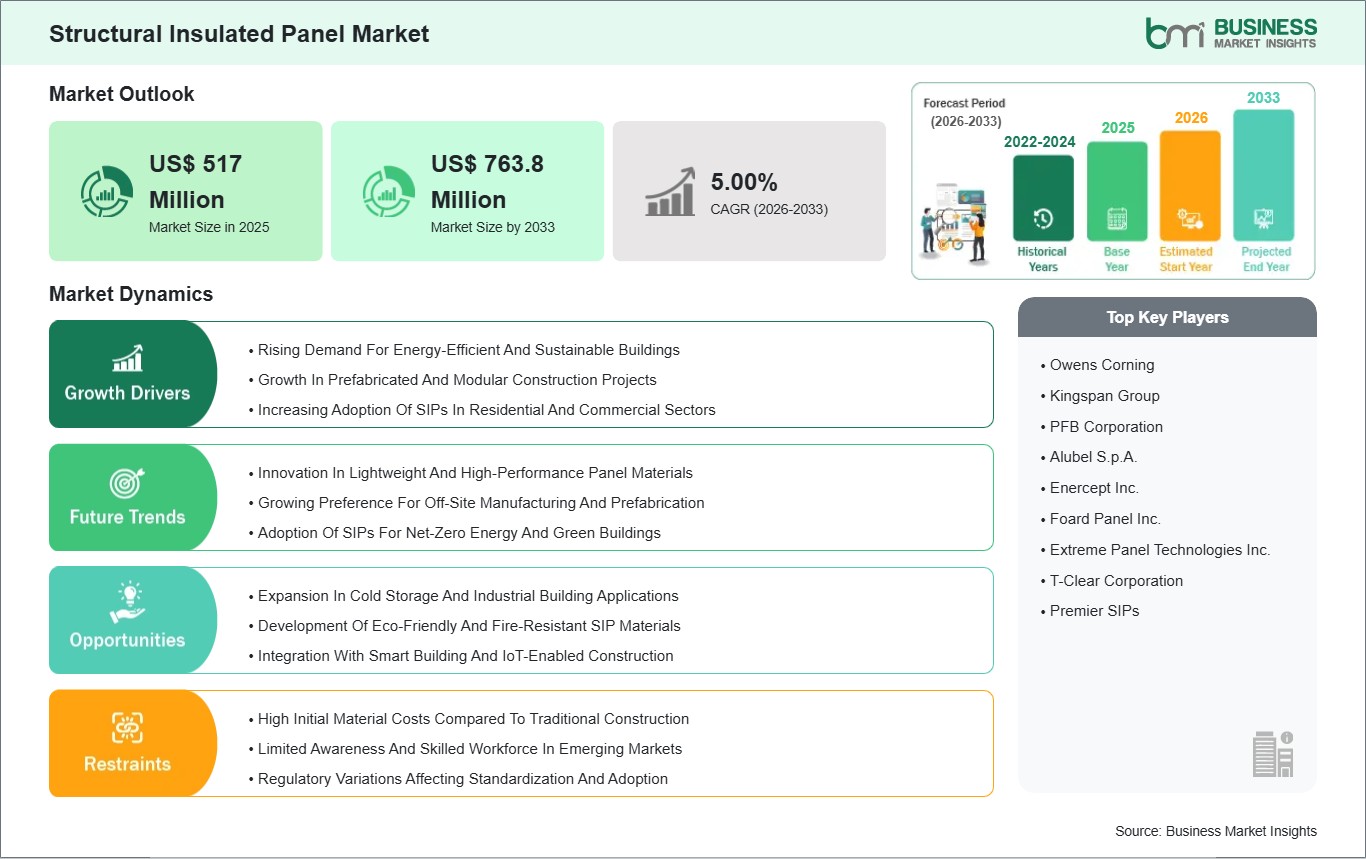
The Structural Insulated Panel Market size is expected to reach US$ 763.8 million by 2033 from US$ 517. million in 2025. The market is estimated to record a CAGR of 5.00% from 2026 to 2033.
The global structural insulated panel (SIP) market is expanding as the construction industry increasingly prioritizes energy efficiency, sustainability, and faster project delivery. The building components known as structural insulated panels consist of an insulating foam core, which construction workers install between two structural facings that typically use oriented strand board (OSB) and metal and cementitious panels. The panels provide excellent thermal insulation and structural durability, which enable developers to construct residential, commercial and industrial projects at reduced labor costs and construction time. The market sees primary growth because customers demand building envelopes that provide both energy efficiency and high performance. The combination of rising energy expenses with stricter building regulations worldwide has led developers, architects and builders to select materials that improve thermal insulation together with materials that decrease energy needs for building operations.
SIPs provide consistent insulation with minimal thermal bridging, which enables structures to meet stringent energy performance requirements and obtain certifications such as LEED and Passive House. The prefabricated design of these products enables construction teams to complete building projects more quickly while generating less waste on construction sites, which matches the construction industries move toward modular construction methods and sustainable building methods.
The market experiences its current condition because green building projects, urban infrastructure programs and renovation projects in established and developing nations experience rapid expansion. SIPs are increasingly used in school buildings, healthcare facilities, cold storage warehouses, and multi‑family housing due to their durability, fire resistance, and acoustic performance. The market operates under multiple existing obstacles. The construction industry needs to overcome two main problems because people think about building material prices, and they do not understand new building methods. The integration of SIPs faces two main obstacles because different regional standards exist, and some areas lack qualified installers. The structural insulated panel market will continue its global growth because panel materials will undergo new innovations, supply chain operations will improve, and construction methods will focus more on low‑carbon practices.

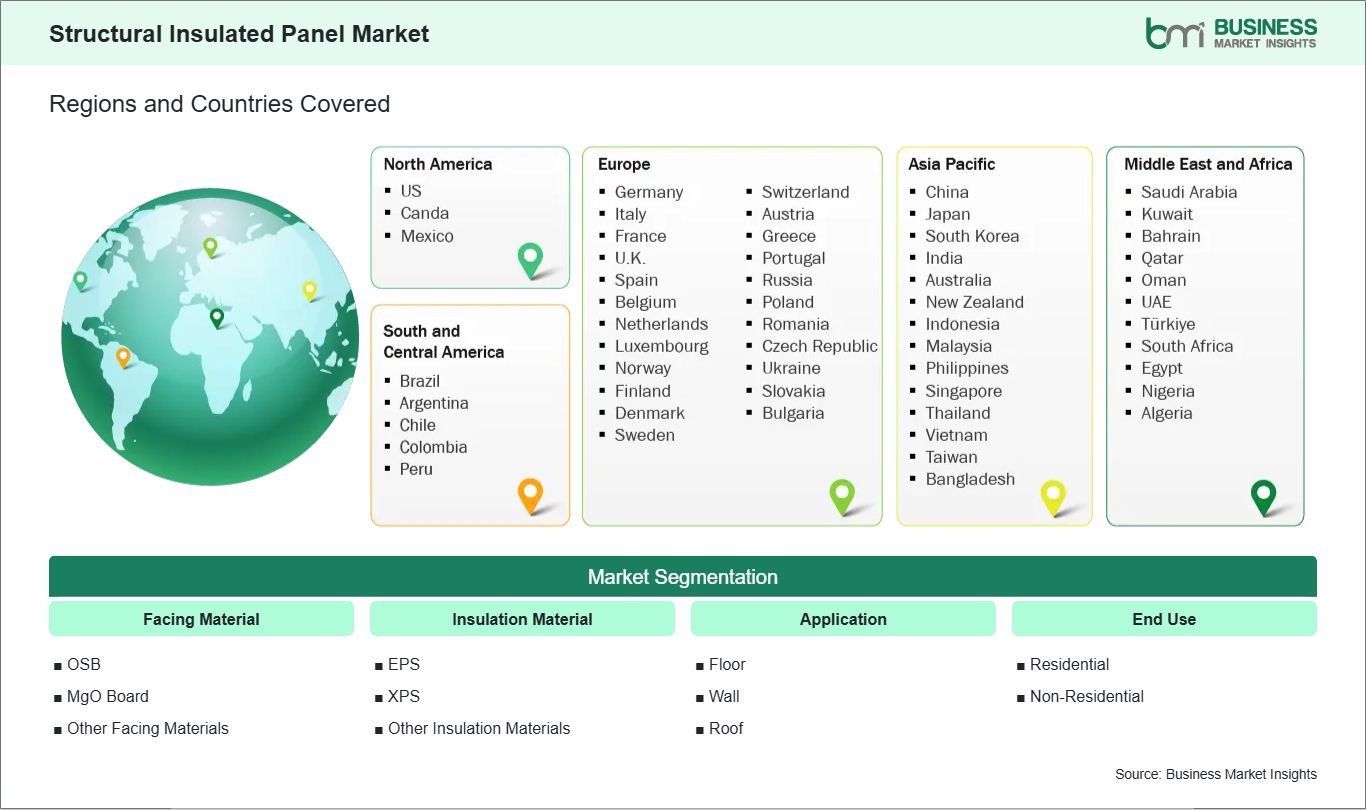
Key segments that contributed to the derivation of the structural insulated panel market analysis are facing material, insulation material, application, and end use.
The global structural insulated panel market is significantly propelled by the rising demand for energy‑efficient and sustainable buildings across residential, commercial, and institutional sectors. As governments and developers focus on reducing energy consumption and minimizing environmental impact, SIPs have emerged as a preferred solution due to their superior thermal performance and minimal thermal bridging. Unlike traditional construction methods that often struggle to meet stringent energy codes, SIP‑based structures deliver consistent insulation, helping buildings maintain occupant comfort while lowering operational energy costs over the long term. This energy focus resonates with global sustainability initiatives and green building certifications that prioritize low‑impact materials and systems.
Increasing awareness of lifecycle performance has pushed architects and builders to specify structural insulated panels in new constructions. In Europe and North America, for example, rigorous building codes and incentives for net‑zero energy certification have driven greater adoption of high‑performance building envelopes. These panels also support healthier indoor environments by reducing drafts and moisture infiltration, which aligns with occupant wellbeing priorities in modern design.
Additionally, the trend toward sustainable urbanization in rapidly developing regions is strengthening SIP demand. In Asia‑Pacific and Latin America, developers are incorporating energy‑efficient panels into high‑rise residential towers, institutional campuses, and mixed‑use developments to strike a balance between rapid growth and environmental stewardship. This convergence of regulatory pressure, consumer preference for green buildings, and the clear economic value of reduced energy use has positioned structural insulated panels as a cornerstone of energy‑efficient construction worldwide.
The expansion of cold storage and industrial building applications is another critical driver for the global structural insulated panel market. Cold storage facilities—used in food processing, pharmaceuticals, and logistics—demand high‑performance insulation to maintain strict temperature controls. SIPs provide a reliable, thermally robust solution that can withstand repeated temperature cycling while minimizing energy loss. As global supply chains become more complex and temperature‑controlled logistics gain importance, manufacturers and warehouse operators are increasingly turning to SIPs to enhance operational efficiency and reduce long‑term energy expenses.
Industrial buildings also benefit from SIP integration due to their structural strength, ease of installation, and ability to support large clear‑span designs. In manufacturing hubs across North America, Europe, and Asia‑Pacific, structural insulated panels are used in factories, distribution centers, and assembly plants that require durable building envelopes capable of supporting heavy equipment and environmental control systems. SIPs also contribute to faster build times, which is particularly valuable in regions where industrial expansion must keep pace with economic development and competitive pressures.
Moreover, emerging economies are recognizing the value of SIPs in industrial applications where climate conditions demand robust insulation. In the Middle East and Africa, for example, SIP‑based cold storage solutions are becoming more common as stakeholders in agribusiness and pharmaceuticals invest in facilities that ensure product integrity amid extreme temperature variations. This geographic diversification in end‑use demand reinforces the importance of structural insulated panels beyond traditional residential and commercial contexts, highlighting their versatility and value in specialized construction sectors.

The structural insulated panel market demonstrates steady growth, with size and share analysis highlighting evolving trends and competitive dynamics among key players. The report examines subsegments categorized within facing material, insulation material, application, and end use, offering insights into their contribution to overall market performance.
By facing material, the OSB subsegment dominated the market in 2025, driven by its cost-effectiveness, high structural strength, and wide availability for use in structural insulated panels.
Based on insulation material, the EPS subsegment dominated the market in 2025, driven by its lightweight nature, excellent thermal insulation properties, and low production cost.
In terms of application, the wall subsegment dominated the market in 2025, driven by high demand in building construction for energy-efficient and easy-to-install structural insulated panels.
On the basis of end use, the residential subsegment dominated the market in 2025, driven by rapid growth in housing construction and the increasing adoption of energy-efficient building materials.
| Report Attribute | Details |
|---|---|
| Market size in 2025 | US$ 517 Million |
| Market Size by 2033 | US$ 763.8 Million |
| Global CAGR (2026 - 2033) | 5.00% |
| Historical Data | 2022-2024 |
| Forecast period | 2026-2033 |
| Segments Covered | By Facing Material
|
|
Regions and Countries Covered
| |
| North America | US, Canada, Mexico |
| Europe | Belgium, Austria, Finland, Denmark, Greece, Poland, Romania, Russia, Ukraine, Czech Republic, Slovakia, Bulgaria, Italy, Luxembourg, Germany, Switzerland, France, Netherlands, Norway, Portugal, Spain, Sweden, United Kingdom |
| Asia-Pacific | Australia, China, India, Japan, South Korea, Indonesia, Malaysia, Philippines, Singapore, Thailand, Vietnam, Bangladesh, New Zealand, Taiwan |
| South and Central America | Brazil, Argentina, Peru, Chile, Colombia |
| Middle East and Africa | Bahrain, Kuwait, Oman, Qatar, Saudi Arabia, United Arab Emirates, Turkiye, South Africa, Egypt, Algeria, Nigeria |
| Market leaders and key company profiles |
|
The "Structural Insulated Panel Market Size and Forecast (2022 - 2033)" report provides a detailed analysis of the market covering below areas:
The geographical scope of the Structural Insulated Panel Market report is divided into North America, Asia Pacific, Europe, Middle East & Africa, and South & Central America. North America held the largest share in 2025.
The global structural insulated panel market shows diverse regional adoption patterns, with North America leading because its construction industry has reached maturity, its building standards focus on energy efficiency and its prefabricated building system facilities. The region uses SIPs for various building types, which include residential spaces, commercial areas and industrial sectors that require quick building time and exceptional insulation capabilities. The region maintains its market leadership because established manufacturers and distributors and industry groups work together to ensure quality control while providing training for professional installers.
The Asia Pacific market shows rapid growth because urban areas expand, construction projects increase and sustainable energy-efficient building practices become more common in China India and Japan. SIPs have become the preferred building material for developers who design residential high-rises, commercial complexes and cold chain facilities because they want to use equipment that enables fast construction and excellent thermal performance.
The European building industry uses SIPs as a result of new regulations that require carbon reductions and energy performance improvements and building certifications, which particularly benefit Germany, France and Nordic countries that use green building practices to create new buildings and retrofit existing structures with prefabricated panels.
The Middle East and Africa region is slowly implementing SIP technology for their industrial and commercial and modular residential building projects, while the United Arab Emirates and South Africa develop sustainable construction solutions to address severe climate conditions and their fast infrastructure development.
The South and Central American market is currently developing because residential construction, cold storage, and commercial modular projects are growing through Brazil and Argentina where developers need energy-efficient building solutions that provide high performance.
The energy conservation knowledge of people through all regions, their need for fast construction work and their movement toward prefabricated and modular building techniques drive growth in all regions.

The Structural Insulated Panel Market is evaluated by gathering qualitative and quantitative data post primary and secondary research, which includes important corporate publications, association data, and databases. A few of the key developments in the structural insulated panel market are:
The Structural Insulated Panel Market is valued at US$ 517 Million in 2025, it is projected to reach US$ 763.8 Million by 2033.
As per our report Structural Insulated Panel Market, the market size is valued at US$ 517 Million in 2025, projecting it to reach US$ 763.8 Million by 2033. This translates to a CAGR of approximately 5.00% during the forecast period.
The Structural Insulated Panel Market report typically cover these key segments-
The historic period, base year, and forecast period can vary slightly depending on the specific market research report. However, for the Structural Insulated Panel Market report:
The Structural Insulated Panel Market is populated by several key players, each contributing to its growth and innovation. Some of the major players include:
The Structural Insulated Panel Market report is valuable for diverse stakeholders, including:
Essentially, anyone involved in or considering involvement in the Structural Insulated Panel Market value chain can benefit from the information contained in a comprehensive market report.
Please tell us your area of interest
(Market Segments/ Regions and Countries/ Companies)