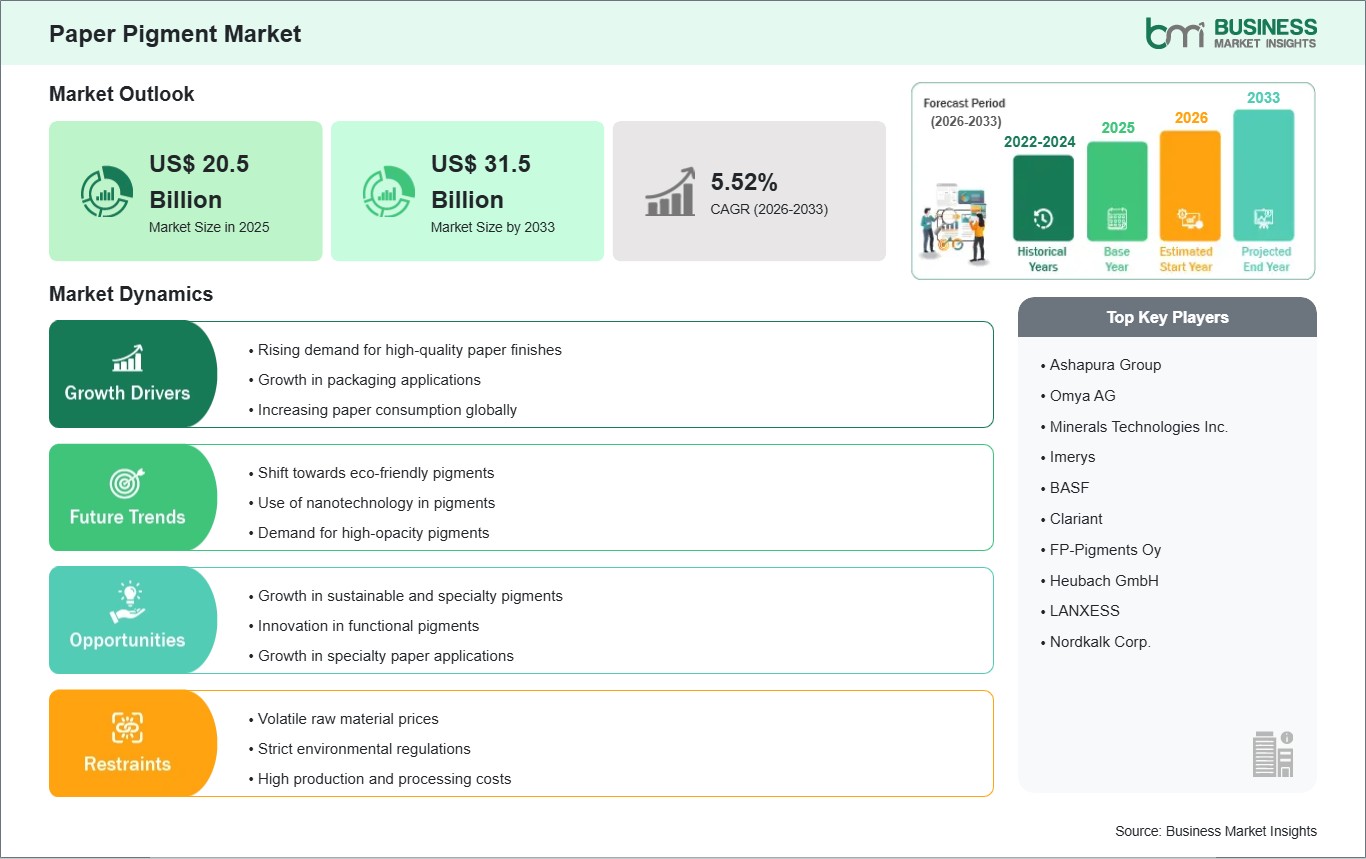
The Paper Pigment Market size is expected to reach US$ 31.5 Billion by 2033 from US$ 20.5 Billion in 2025. The market is estimated to record a CAGR of 5.52% from 2026 to 2033.
The market for paper pigments is growing steadily, and this is attributed to the increasing demand for superior quality papers used for packaging, printing, and specialty papers. Paper pigments, including titanium dioxide, clay, calcium carbonate, and organic pigments, are playing a vital role in improving the opaqueness, brightness, printability, and smoothness of papers. The increasing demand for paper pigments in packaging papers, coated papers, and specialty printing papers is stimulating innovations in pigment formulations, including particle distribution, whiteness, and environmental compliance. Sustainability is turning out to be a key differentiator for paper pigments, and this is attributed to regulatory and consumer demands for eco-friendly pigments that are either derived from sustainable resources or have been formulated to minimize environmental impact. Water-borne and low VOC pigment formulations are finding more acceptability in view of stringent regulations on air quality and chemical safety.
Furthermore, the development of surface-treated pigments has led to multifunctional benefits, such as paper brightness, UV resistance, and durability, which are helping paper manufacturers achieve the desired performance with the least number of additives. Technology has also played an important part in the development of the pigment market. The particle size of pigments, surface-treated pigments, and the development of nano-pigment technology are helping achieve better coating performance and print quality. However, cost optimization and supply chain management are key factors for the commercial production of paper. The paper pigment market is moderately competitive, with global chemical manufacturers dominating the high-performance pigment market. Strategic partnerships with paper mills, converters, and coating formulators will become more important to help speed innovation and satisfy end-user needs.
Overall, the paper pigment market is characterized by a combination of innovation driven by performance, sustainability, and changes in end-user needs for packaging and printing applications. Companies that can provide top-quality pigments that are not only sustainable but also cost-effective will be in a position to seize opportunities in new and mature markets.

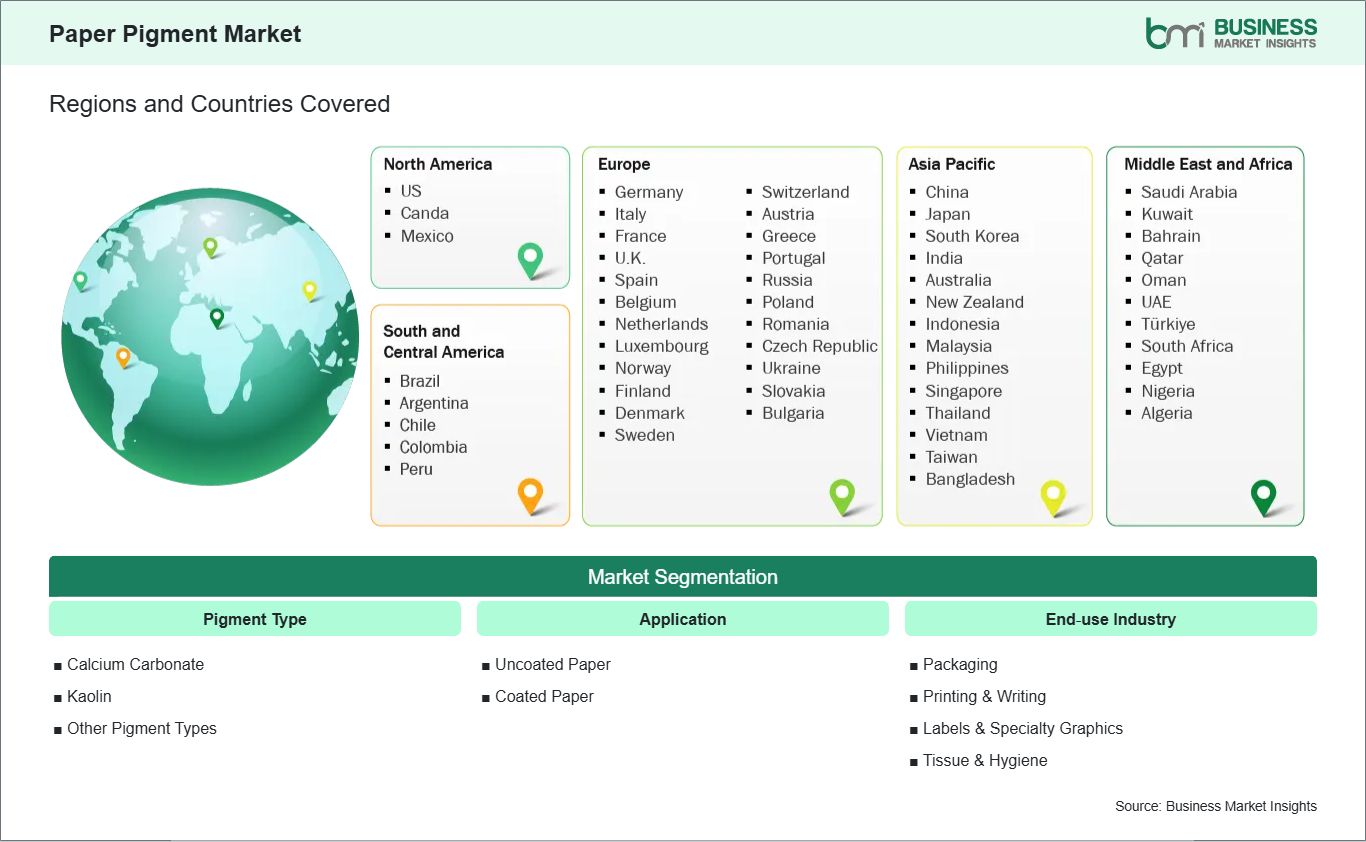
Key segments that contributed to the derivation of the paper pigment market analysis are pigment type, application, and end‑use industry.
The demand for paper pigments is growing as manufacturers seek to improve the look, opaqueness, and printability of paper-based materials. Pigments help to improve the whiteness, brightness, and gloss of paper, giving it a premium look that is required for book publishing, packaging, office paper, and other specialty paper applications. As the quality of print materials improves, paper manufacturers are seeking pigments that can improve the quality of paper while maintaining its cost-effectiveness.
Innovation in the technology of pigments is improving the quality of paper durability, which can withstand environmental factors like moisture and UV light. This enables the manufacture of high-quality paper materials that can meet the requirements of users while improving the look of the final product. Pigments are also being used to improve the weight of paper, allowing for lighter materials to be manufactured while maintaining quality.
Manufacturers are increasingly integrating multi-functional pigments that combine optical, physical, and protective properties. These pigments improve print clarity, color vibrancy, and surface smoothness, contributing to a better end-user experience. As industries like publishing, packaging, and specialty paper continue to expand, the need for advanced pigments that enhance visual appeal and functional performance is driving steady market growth.
The role of sustainability in the development of the paper pigment market is significant. Organizations are looking for bio-based and environmental-friendly pigments to achieve sustainable development goals. These pigments are formulated in a way that performance is maintained with reduced chemical content and recyclability. With the rise of environmental concerns, paper companies are focusing on sustainable pigment solutions to achieve corporate social responsibility.
Innovation in specialty pigments is also contributing to the development of the paper pigment market. With the development of functional pigments, the market is witnessing the growth of specialty pigments. These pigments are used to enhance the brightness, opacity, and texture of the paper. Manufacturers are also developing pigments with improved durability and antimicrobial properties. This is contributing to the growth of the premium paper market.
Research and development efforts continue to focus on combining high performance with environmental responsibility. The use of advanced processing techniques allows pigments to deliver superior optical effects and consistency while meeting sustainability requirements. As consumer and industrial demand for high-quality, eco-friendly paper products increases, the development of specialty and sustainable pigments is expected to drive significant growth in the paper pigment market.
The paper pigment market demonstrates steady growth, with size and share analysis highlighting evolving trends and competitive dynamics among key players. The report examines subsegments categorized within pigment type, application, and end‑use industry, offering insights into their contribution to overall market performance.
By Pigment Type, the calcium carbonate subsegment dominated the market in 2025, driven by its cost efficiency and dual role as filler and pigment.
Based on Application, the coated paper subsegment dominated the market in 2025, supported by high pigment intensity requirements for brightness and smooth surface.
On the Basis of End‑use Industry, the packaging subsegment dominated the market in 2025, propelled by growing demand for paper‑based packaging solutions in e‑commerce and retail.
| Report Attribute | Details |
|---|---|
| Market size in 2025 | US$ 20.5 Billion |
| Market Size by 2033 | US$ 31.5 Billion |
| Global CAGR (2026 - 2033) | 5.52% |
| Historical Data | 2022-2024 |
| Forecast period | 2026-2033 |
| Segments Covered | By Pigment Type
|
|
Regions and Countries Covered
| |
| North America | US, Canada, Mexico |
| Europe | Belgium, Austria, Finland, Denmark, Greece, Poland, Romania, Russia, Ukraine, Czech Republic, Slovakia, Bulgaria, Italy, Luxembourg, Germany, Switzerland, France, Netherlands, Norway, Portugal, Spain, Sweden, United Kingdom |
| Asia-Pacific | Australia, China, India, Japan, South Korea, Indonesia, Malaysia, Philippines, Singapore, Thailand, Vietnam, Bangladesh, New Zealand, Taiwan |
| South and Central America | Brazil, Argentina, Peru, Chile, Colombia |
| Middle East and Africa | Bahrain, Kuwait, Oman, Qatar, Saudi Arabia, United Arab Emirates, Turkiye, South Africa, Egypt, Algeria, Nigeria |
| Market leaders and key company profiles |
|
The "Paper Pigment Market Size and Forecast (2022 - 2033)" report provides a detailed analysis of the market covering below areas:
The geographical scope of the Paper Pigment Market report is divided into North America, Asia Pacific, Europe, Middle East & Africa, and South & Central America. North America held the largest share in 2025.
Regional-level dynamics in the paper pigment market reveal distinct demand patterns shaped by paper production capacity, regulatory frameworks, and end-use industry growth. North America is the dominant market, supported by a mature paper industry and high demand for coated, specialty, and packaging paper. The United States and Canada show strong adoption of titanium dioxide and other high-performance pigments to achieve superior whiteness, opacity, and print quality. Regulatory compliance and sustainability initiatives, including low-VOC and environmentally safe pigments, further drive innovation and adoption in the region.
Europe represents a mature, sustainability-focused market, with Germany, France, and Italy leading demand for coated and specialty paper. Stringent EU regulations on chemical usage and environmental impact have accelerated the use of eco-friendly pigments, including mineral-based and water-dispersible options. European manufacturers emphasize high opacity, brightness, and durability while aligning with circular economy principles.
Asia Pacific is experiencing rapid expansion, led by China, Japan, and India, driven by rising packaging paper consumption, growing printing activities, and urbanization. Domestic paper production capacities are increasing, boosting demand for both inorganic and organic pigments. Environmental regulations and sustainability initiatives are encouraging adoption of water-based and low-impact pigments, while manufacturers focus on cost-efficient solutions for high-volume applications.
Middle East & Africa is an emerging market where paper production and packaging industries are growing steadily. Pigment demand is primarily driven by coated paper for commercial printing and packaging applications. Market growth is concentrated in urbanized regions with expanding industrial and consumer goods sectors.
South & Central America exhibits steady growth, particularly in Brazil and Mexico, where rising industrialization and packaging demand are fueling pigment adoption. Cost-sensitive buyers prioritize efficiency and affordability, but increasing demand for higher-quality printing and coated paper is gradually stimulating the use of advanced pigments.

The Paper Pigment Market is evaluated by gathering qualitative and quantitative data post primary and secondary research, which includes important corporate publications, association data, and databases. A few of the key developments in the paper pigment market are:
The Paper Pigment Market is valued at US$ 20.5 Billion in 2025, it is projected to reach US$ 31.5 Billion by 2033.
As per our report Paper Pigment Market, the market size is valued at US$ 20.5 Billion in 2025, projecting it to reach US$ 31.5 Billion by 2033. This translates to a CAGR of approximately 5.52% during the forecast period.
The Paper Pigment Market report typically cover these key segments-
The historic period, base year, and forecast period can vary slightly depending on the specific market research report. However, for the Paper Pigment Market report:
The Paper Pigment Market is populated by several key players, each contributing to its growth and innovation. Some of the major players include:
The Paper Pigment Market report is valuable for diverse stakeholders, including:
Essentially, anyone involved in or considering involvement in the Paper Pigment Market value chain can benefit from the information contained in a comprehensive market report.
Please tell us your area of interest
(Market Segments/ Regions and Countries/ Companies)