
Bioadhesive Microspheres Market Outlook: Size, Share, Trends, Growth Analysis, Competitive Landscape & Forecast, 2026-2033

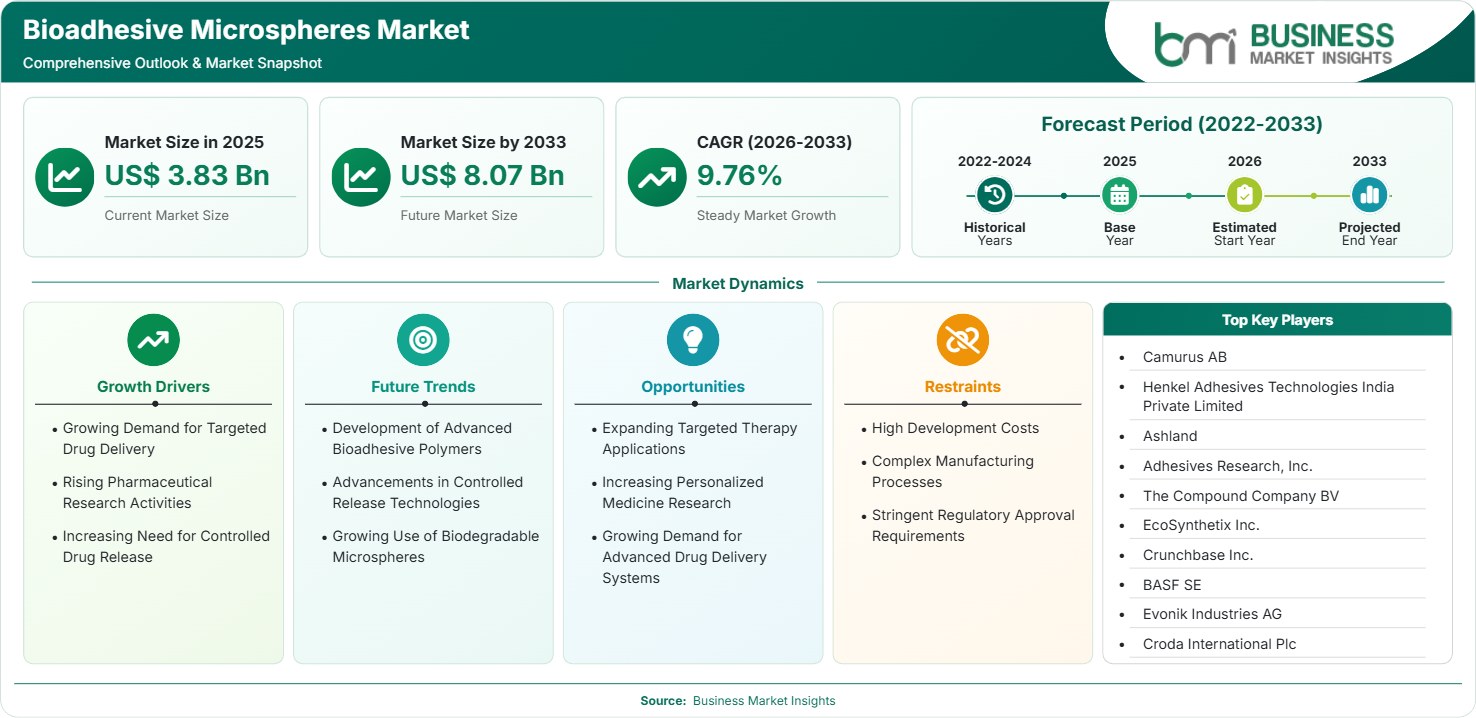
The Bioadhesive Microspheres Market size was valued at US$ 3.83 Billion in 2025 and is projected to reach US$ 8.07 Billion by 2033, growing at a CAGR of 9.76% during 2026–2033, supported by targeted delivery demand, controlled release, pharmaceutical research, and advanced formulation development.

Report Coverage
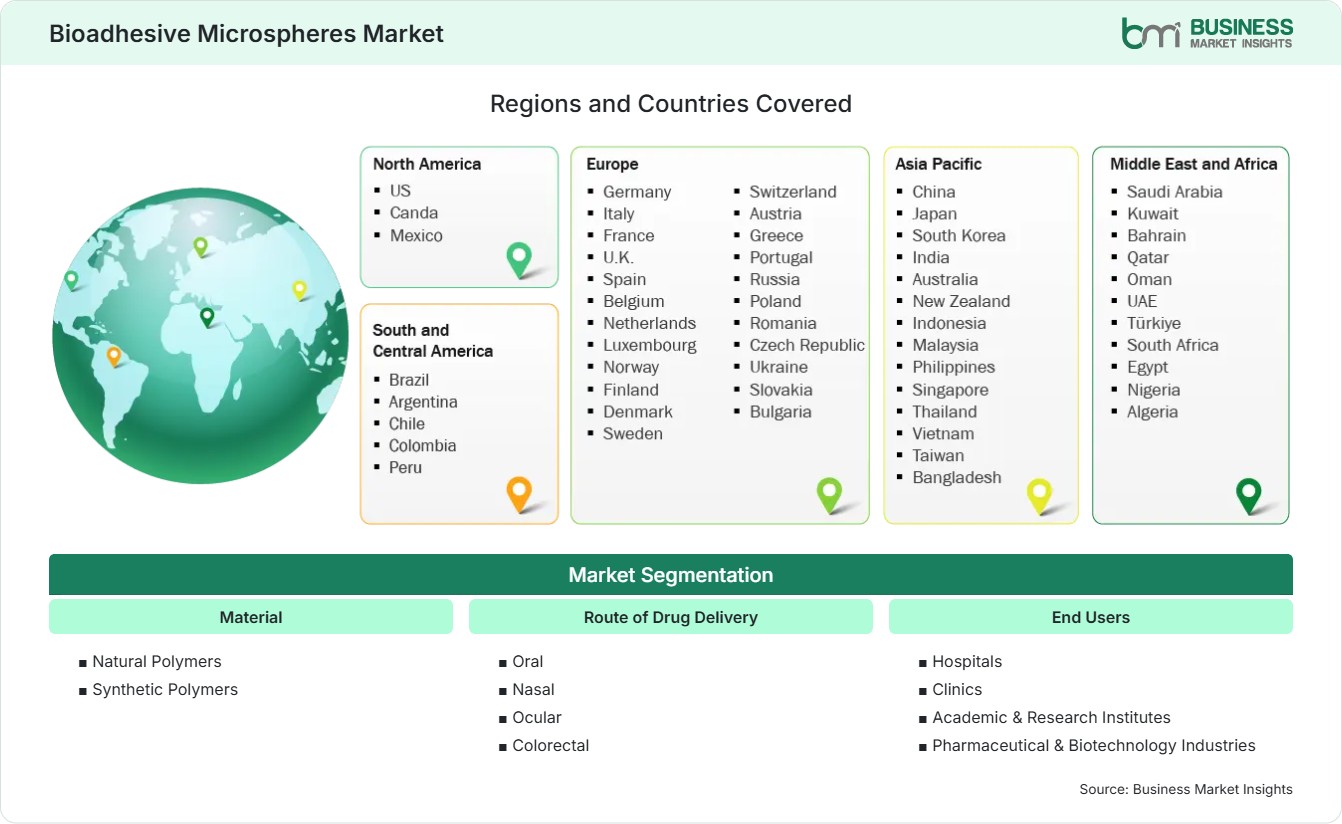
  • Material: Natural Polymers, Synthetic Polymers
  • Route of Drug Delivery: Oral, Nasal, Ocular, Colorectal
  • End Users: Hospitals, Clinics, Academic & Research Institutes, Pharmaceutical & Biotechnology Industries
US$ 3.83 Bn Market size in 2025
US$ 8.07 Bn Market Size by 2033
9.76% CAGR, 2026 - 2033
2026-2033 Forecast Period

AI Overview

Bioadhesive Microspheres Market Summary

  • North America Region: North America holds a 34%–37% share in 2025, growing at a CAGR of 8.7%–9.3% during 2026–2033, influenced by pharmaceutical innovation, advanced formulation research, biologic delivery, specialized clinical development, and established research infrastructure. The U.S. market benefits from sophisticated drug delivery research, pharmaceutical investment, and strong adoption of controlled-release technologies, supporting a CAGR of 8.9%–9.5% during 2026–2033.
  • Fastest Growing Region: Asia Pacific holds a 25%–28% share in 2025, advancing at a CAGR of 11.0%–12.0% during 2026–2033, driven by expanding pharmaceutical manufacturing, increasing formulation research, rising healthcare investment, growing clinical research capabilities, and demand for cost-efficient drug delivery technologies.
  • Leading Segment: Synthetic Polymers represents a 55%–59% share in 2025, expanding at a CAGR of 9.4%–10.0% during 2026–2033, supported by controllable degradation, reproducible formulation characteristics, scalable manufacturing, tunable adhesion, and compatibility with diverse therapeutic compounds.
  • High Growth Segment: Nasal delivery is positioned at a CAGR of 10.5%–11.5% during 2026–2033, supported by interest in localized therapy, improved residence time, non-invasive administration, potential systemic absorption, and formulations designed for enhanced bioavailability.
  • Key Market Opportunity: Development of multifunctional microspheres combining adhesion, controlled release, site-specific delivery, and compatibility with sensitive active ingredients can expand pharmaceutical applications while improving formulation differentiation and lifecycle value.
  • Major Market Players: Camurus AB; Henkel Adhesives Technologies India Private Limited; Ashland; Adhesives Research, Inc.; The Compound Company BV; EcoSynthetix Inc.; Crunchbase Inc.; BASF SE; Evonik Industries AG; Croda International Plc.
Strategic Insights

Bioadhesive Microspheres Market: Strategic Insights

Bioadhesive Microspheres Market Strategic Framework
FREE PDF
Request your free sample
Request free sample
Stakeholder View

Key Takeaways

  • The value chain involves the suppliers of polymers and excipients, the developers of microspheres, the drug manufacturing companies, research organizations, and healthcare organizations. Material consistency and formulating capability are the key competitive advantages.
  • Oral and nasal routes of administration show good promise for future development since bioadhesiveness allows increased duration of stay on biological surfaces with possible controlled exposure, improved absorption, and decreased frequency of drug delivery.
  • Development is moving towards polymers capable of controlling their swelling and degradation rates, interactions with biological surfaces, and drug release.
  • Asia Pacific provides a compelling expansion case because pharmaceutical production capacity, formulation research, and healthcare infrastructure are developing simultaneously, creating demand for scalable advanced drug delivery technologies.
  • Investment priorities increasingly favor platforms that can support multiple active ingredients and administration routes, allowing suppliers and pharmaceutical developers to spread development costs across broader application portfolios.
Geographic Outlook

Bioadhesive Microspheres Market Regional Highlights

North America Bioadhesive Microspheres Market

North America accounts for a 34%–37% share in 2025 and is projected to expand at a CAGR of 8.7%–9.3% during 2026–2033. The region benefits from advanced pharmaceutical research, established formulation capabilities, specialized academic institutions, and demand for differentiated delivery systems. The Bioadhesive Microspheres Market share reflects strong participation from the United States, while Canada contributes through research and pharmaceutical development.

  • Pharmaceutical developers increasingly prioritize delivery technologies capable of extending therapeutic residence while maintaining predictable release profiles and formulation stability.
  • Academic and industrial research capabilities support experimentation with polymer chemistry, particle engineering, encapsulation methods, and route-specific delivery mechanisms.
  • The United States remains the leading national contributor, while Canada provides a smaller but technically relevant research and formulation base.
  • Demand for specialized drug delivery technologies creates opportunities for suppliers offering application-specific polymers, formulation assistance, and scalable manufacturing processes.

US Bioadhesive Microspheres Market

The United States Bioadhesive Microspheres Market represents approximately 29%–32% of the global market in 2025 and is expected to grow at a CAGR of 8.9%–9.5% during 2026–2033. Research programs increasingly examine microsphere-based approaches for improving localized exposure and controlling release. Commercial opportunities remain strongest where bioadhesion can address limitations associated with conventional dosage forms.

  • Pharmaceutical and biotechnology developers provide a substantial addressable customer base for specialized delivery platforms supporting differentiated formulations and lifecycle management strategies.
  • Research organizations continue evaluating polymeric microspheres for controlled release, localized administration, improved retention, and enhanced formulation performance.
  • Commercial adoption depends heavily on reproducibility, scalability, stability, and the ability to demonstrate consistent performance during development and manufacturing.

Europe Bioadhesive Microspheres Market

Europe holds a 27%–30% of the Bioadhesive Microspheres Market share in 2025, with a projected CAGR of 9.0%–9.7% during 2026–2033. Germany, the United Kingdom, France, and Italy represent important pharmaceutical and research markets, while higher-growth opportunities emerge across countries expanding advanced formulation capabilities. European demand emphasizes formulation quality, manufacturing consistency, and technically differentiated drug delivery systems.

  • Germany remains a leading pharmaceutical and industrial research base, with formulation development supporting demand for specialized polymer technologies and scalable microsphere manufacturing.
  • The United Kingdom combines pharmaceutical research depth with strong academic capabilities, supporting investigation of advanced delivery systems and route-specific bioadhesive formulations.
  • France and Italy contribute established pharmaceutical manufacturing ecosystems, creating opportunities for suppliers serving oral, ocular, nasal, and other specialized delivery applications.
  • Emerging European markets can provide incremental growth as pharmaceutical manufacturing capabilities and research infrastructure broaden.

Asia Pacific Bioadhesive Microspheres Market

Asia Pacific represents a 25%–28% of the Bioadhesive Microspheres Market share in 2025 and records the fastest regional expansion at a CAGR of 11.0%–12.0% during 2026–2033. China, Japan, India, South Korea, and other pharmaceutical manufacturing centers are central to regional demand. China and India provide substantial manufacturing opportunities, while Japan and South Korea contribute advanced research capabilities and sophisticated pharmaceutical development environments.

  • China combines pharmaceutical manufacturing scale with expanding formulation research, creating opportunities for polymer suppliers and microsphere technology developers.
  • India provides strong potential through pharmaceutical manufacturing capabilities, formulation expertise, and growing interest in advanced delivery technologies for differentiated products.
  • Japan emphasizes sophisticated pharmaceutical research, quality-focused formulation development, and controlled delivery technologies suitable for specialized therapeutic applications.
  • South Korea offers expanding biotechnology and pharmaceutical capabilities, supporting demand for innovative formulation platforms and advanced drug delivery research.

Rest of World Bioadhesive Microspheres Market

Rest of World represents a 9%–12% share in 2025, with a projected CAGR of 8.0%–9.0% during 2026–2033. South and Central America offer opportunities through expanding pharmaceutical access and local formulation capabilities, while the Middle East and Africa provide longer-term potential as healthcare infrastructure develops. Brazil and Mexico remain important Latin American markets, while Gulf countries offer investment opportunities connected with pharmaceutical localization and advanced healthcare development.

  • Brazil and Mexico provide comparatively developed pharmaceutical ecosystems, supporting gradual adoption of specialized formulation technologies and locally manufactured drug delivery products.
  • Gulf markets can create opportunities for advanced healthcare technologies as pharmaceutical localization, specialized treatment capacity, and research infrastructure receive greater strategic attention.
  • South Africa represents an important African pharmaceutical market where improving healthcare capabilities can support specialized drug delivery adoption over time.
  • Regional growth will depend on formulation expertise, technology transfer, local manufacturing economics, regulatory readiness, and availability of advanced pharmaceutical development capabilities.
Global Market Geography
FREE PDF
Request your free sample
Request free sample
Segment Analysis

Bioadhesive Microspheres Market Segmentation

Material

The Material segment is led by Synthetic Polymers, representing a 55%–59% share in 2025 and expanding at a CAGR of 9.4%–10.0% during 2026–2033. Polymer selection determines adhesion, degradation, encapsulation, release behavior, and formulation stability, making material engineering central to commercial development across delivery routes and therapeutic applications.

  • Natural Polymers: Natural polymers provide biocompatibility and functional versatility, supporting formulation research where biological interaction, biodegradability, and mild processing conditions are important development considerations.
  • Synthetic Polymers: Synthetic polymers offer tunable molecular characteristics, predictable performance, scalable processing, and controlled degradation, supporting demanding formulations requiring reproducible release and adhesion profiles.

Route of Drug Delivery

The Route of Drug Delivery segment is shaped by the need to improve residence time and therapeutic exposure at targeted biological surfaces. Nasal delivery represents the high-growth route, advancing at a CAGR of 10.5%–11.5% during 2026–2033 as non-invasive delivery research expands.

  • Oral: Oral applications benefit from established administration preferences, with microspheres supporting retention, controlled release, protection of active ingredients, and potential reduction of dosing frequency.
  • Nasal: Nasal delivery provides opportunities for localized and systemic therapy, particularly where adhesion can prolong mucosal residence and support improved absorption from formulations.
  • Ocular: Ocular microspheres can address rapid clearance challenges by extending formulation residence, supporting sustained exposure and potentially reducing repeated administration requirements.
  • Colorectal: Colorectal delivery provides opportunities for localized therapeutic exposure, where adhesion and controlled release can improve retention within targeted gastrointestinal regions.

End Users

End-user demand is shaped by drug development requirements, clinical adoption patterns, translational research activities, and manufacturing investments. Pharmaceutical & Biotechnology Industries represented approximately 42%–45% share in 2025 and are expected to grow at a CAGR of 10.5%–11.3% through 2033. The Bioadhesive Microspheres Market share within this segment continues increasing as companies invest in differentiated drug delivery technologies that enhance therapeutic effectiveness and product lifecycle value.

  • Hospitals: Hospitals provide application environments where advanced delivery formulations can support specialized therapies, although adoption depends on clinical suitability, product availability, and treatment economics.
  • Clinics: Clinics represent a targeted end-user opportunity where convenient administration and localized therapeutic delivery can support selected applications requiring controlled exposure or prolonged residence.
  • Academic & Research Institutes: Research institutes drive early-stage experimentation, polymer characterization, delivery-route evaluation, and formulation innovation that can later support commercial pharmaceutical development.
  • Pharmaceutical & Biotechnology Industries: Pharmaceutical and biotechnology companies represent the principal commercialization pathway, using microspheres for controlled delivery, formulation differentiation, lifecycle management, and advanced therapeutic development.
Market Forces

Bioadhesive Microspheres Market Dynamics

Key Market Drivers

Growing Demand for Targeted Drug Delivery

The development of Bioadhesive Microspheres is increasing because the need to find better methods of delivery of localized, sustained action in a site-specific way is on the rise amongst the pharmaceutical companies. The property of Bioadhesive Microspheres of being able to stick to the mucosal membranes while releasing the active pharmaceutical ingredients has the potential to aid the pharmaceutical companies with their formulations for various routes of administration such as oral, nasal, ophthalmic, and rectal routes. The Bioadhesive Microspheres Market growth is driven by the demand for such targeted delivery systems.

Rising Pharmaceutical Research Activities

Pharmaceutical and biotechnology research programs are increasingly evaluating microsphere technologies as adaptable platforms for improving drug delivery performance and formulation efficiency. The development process usually evaluates aspects such as polymer chemistry, particle shape, encapsulation efficiency, particle surface, particle degradation, and drug release kinetics in order to ensure that the system would be appropriate for a particular active pharmaceutical ingredient. Bioadhesive microspheres offer scientists an opportunity to vary these aspects depending on the drug needs and mode of administration. The increase in formulation research is also encouraging the materials suppliers to create new polymers that possess desired adhesion and processing properties.

Increasing Need for Controlled Drug Release

The requirement for predictable and sustained drug exposure supports greater adoption of particulate delivery systems capable of regulating active pharmaceutical ingredient release over defined periods. The need for frequently administered medications and variations in the concentrations of drugs make the immediate release formulation a potential problem for treatments that need to have continuous drug exposures. Bioadhesive microspheres have the ability to integrate both the advantages of extended surface adhesion and controlled drug release by selecting appropriate polymers, particle design, matrix properties, and degradation. These Bioadhesive Microspheres Market trends encourage the development of multifunctional formulations.

Key Market Opportunities

Expanding Targeted Therapy Applications

Expansion of targeted therapy applications is creating opportunities for bioadhesive microspheres to function as localized delivery platforms across specialized pharmaceutical formulations. The ability of these particles to form contact with biological tissues allows prolonged residence times and better chances of drug exposure. Oral, nasal, ocular, and colorectal administration provides unique opportunities for development because each route of administration has its own set of physiological barriers and residence needs. Reformulation of an already existing drug in the form of microspheres, where prolonged residence or controlled release is expected to result in a unique dosage form, can also be considered.

Increasing Personalized Medicine Research

Personalized medicine research is creating demand for adaptable drug delivery platforms capable of accommodating variations in therapeutic requirements, dosage characteristics, and administration conditions. Biodegradable microspheres offer formulation flexibility owing to modifications made to the polymer structure, particle size, surface modification, degradation rate, and release rate. This helps achieve optimization in drug delivery formulation with regard to particular APIs and therapeutic targets. Flexibility can also help suppliers of biomaterial, formulation, and testing services to offer customized solutions. With the increase in the specificity of personalized medicine programs with regard to formulation, this technology could be quite useful.

Growing Demand for Advanced Drug Delivery Systems

Pharmaceutical developers are increasingly assessing advanced drug delivery technologies to improve therapeutic performance and establish differentiated dosage forms within competitive development pipelines. Bioadhesive Microspheres Market Forecast includes integration of adhesion, encapsulation, controlled release, and active pharmaceutical ingredient protection within a particulate platform. The commercial success of such products would be possible through the control of key quality characteristics in the course of formulation design, process scale-up and production. The companies which possess competencies in the field of polymer chemistry, particle engineering, formulation science and analytical characterization could thus become involved in different stages of the development value chain.

Market Restraints and Challenges

High Development Costs

Factor: Development of bioadhesive microsphere formulations requires extensive research activities, polymer optimization, analytical testing, preclinical validation, and clinical evaluation. Impact: Elevated development expenditures increase financial risk, particularly for smaller biotechnology firms and emerging pharmaceutical companies. Formulation complexity often necessitates specialized expertise, advanced laboratory infrastructure, and lengthy optimization cycles before commercialization becomes viable. Regulatory documentation, quality assurance processes, and stability assessments further increase project costs. These financial demands can limit innovation capacity, delay product launches, and reduce the number of organizations capable of advancing sophisticated microsphere technologies from research environments into large-scale commercial production.

Complex Manufacturing Processes

Factor: Production of bioadhesive microspheres requires precise control over particle size distribution, encapsulation efficiency, polymer characteristics, and drug release behavior. Impact: Manufacturing complexity increases operational costs and may create scalability challenges during commercial production. Maintaining batch-to-batch consistency requires advanced processing equipment, highly controlled environments, and rigorous quality-control procedures. Variations in manufacturing parameters can affect therapeutic performance and regulatory compliance. As demand increases, companies must invest substantially in process optimization and production infrastructure.

Company Analysis

Competitive Landscape

The competitive structure combines pharmaceutical formulation expertise, polymer science, adhesives technology, specialty materials, and research capabilities. Bioadhesive Microspheres Market analysis indicates that competitive differentiation is shaped by material performance, application-specific formulation knowledge, scalability, technical support, and the ability to translate laboratory concepts into consistent manufacturing processes.

Company Name

Overview

Products and Services relevant to this market

Camurus AB

Pharmaceutical company focused on advanced drug delivery technologies and formulation approaches for controlled therapeutic administration.

Drug delivery platforms, formulation development, long-acting delivery technologies, and pharmaceutical product development capabilities.

Henkel Adhesives Technologies India Private Limited

Adhesive technology business with expertise in specialty materials and application-focused formulation capabilities.

Specialty adhesives, polymer technologies, formulation materials, technical support, and application development for bioadhesive systems.

Ashland

Specialty materials company serving pharmaceutical and healthcare formulation markets through functional ingredients and technical expertise.

Pharmaceutical excipients, polymers, formulation ingredients, rheology technologies, and functional materials supporting controlled delivery.

Adhesives Research, Inc.

Specialty materials and adhesive technology company focused on engineered adhesive systems and healthcare applications.

Bioadhesive materials, medical adhesives, transdermal technologies, and customized adhesive formulation development.

The Compound Company BV

Specialty compounder developing polymer-based materials and customized formulation solutions for industrial and healthcare applications.

Polymer compounds, customized materials, formulation development, and specialty polymer solutions.

EcoSynthetix Inc.

Biomaterials company focused on renewable polymer technologies and functional materials for specialized applications.

Bio-based polymer materials, functional biomaterials, formulation technologies, and sustainable polymer solutions.

Crunchbase Inc.

Business information and research platform represented in the supplied competitive set.

Company intelligence, market information, business research, and ecosystem mapping relevant to technology and investment analysis.

BASF SE

Diversified chemical company providing specialty materials and formulation ingredients across pharmaceutical and healthcare applications.

Functional polymers, pharmaceutical ingredients, specialty chemicals, formulation materials, and technical development support.

Evonik Industries AG

Specialty chemicals company with extensive pharmaceutical and advanced materials capabilities.

Pharmaceutical excipients, specialty polymers, formulation technologies, drug delivery materials, and development services.

Croda International Plc

Specialty chemicals company supplying high-performance ingredients and materials for pharmaceutical and healthcare formulations.

Pharmaceutical excipients, specialty polymers, formulation ingredients, delivery-enabling materials, and technical formulation support.

Trust & Transparency

Research Methodology

The market analysis combines proprietary research with secondary data from government agencies, company disclosures, regulatory filings, industry databases and expert interviews. Market estimates are validated through data triangulation, cross-market benchmarking and analyst review.

View Full Research Methodology

Questions Answered

Frequently Asked Questions

Where does the Bioadhesive Microspheres Market Report provide the greatest strategic value?

The report supports assessment of material selection, delivery routes, regional opportunities, competitive positioning, formulation requirements, and investment priorities. Its greatest value comes from connecting technology characteristics with commercial development considerations across the value chain.

How can manufacturers reduce commercialization risks?

Manufacturers can reduce risk through robust raw-material specifications, controlled particle-engineering processes, validated analytical methods, consistent encapsulation performance, and early scale-up studies. Process reproducibility is particularly important when laboratory formulations move into commercial production.

Why are synthetic polymers widely used in microsphere formulations?

Synthetic polymers provide greater control over molecular characteristics, degradation, particle formation, and release behavior. This enables developers to tune formulations around specific therapeutic requirements and achieve more reproducible performance during scale-up.

Which delivery route offers the strongest growth opportunity?

Nasal delivery offers an attractive growth pathway because microspheres can potentially extend mucosal residence while supporting localized or systemic exposure. Its development potential is closely tied to formulation stability, adhesion, absorption, and patient administration requirements.

What factors determine the performance of bioadhesive microspheres?

Performance depends on polymer chemistry, particle size, surface characteristics, adhesion strength, swelling, degradation, encapsulation efficiency, active-ingredient compatibility, and release kinetics. These parameters must be balanced against the intended administration route and therapeutic objective.

Access the Full Bioadhesive Microspheres Market Report

Get segment-level forecasts, regional estimates, competitive benchmarking, company profiles and downloadable Excel datasets.

Access the full Bioadhesive Microspheres Market Report
350 pages PDF & Excel | 2026-08-19
Similar Research

Related Market Reports