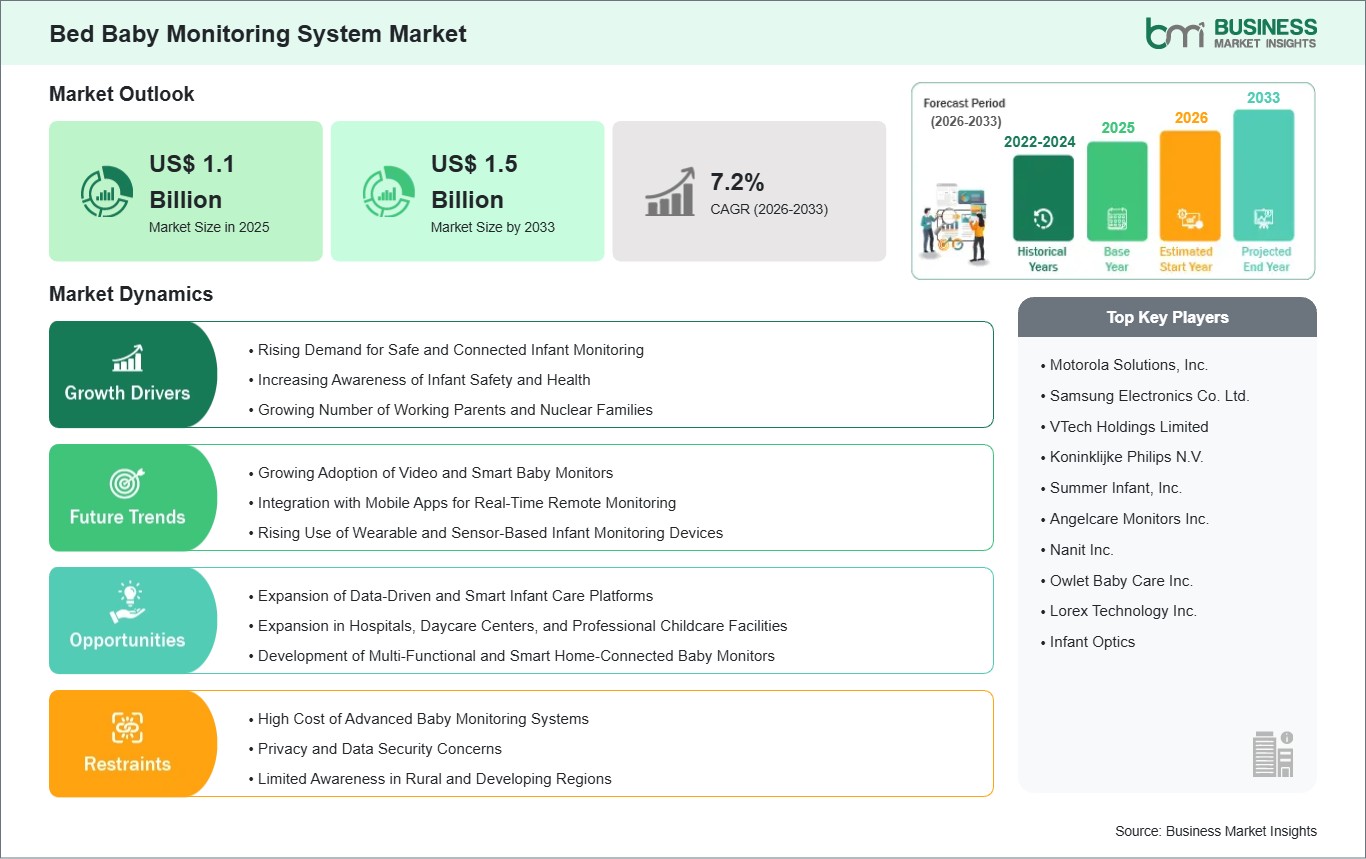
The Bed Baby Monitoring System market size is expected to reach US$ 1.5 billion by 2033 from US$ 1.1 billion in 2025. The market is estimated to record a CAGR of 7.2% from 2026 to 2033.
The Bed Baby Monitoring System market serves as a cornerstone of modern childcare and healthcare technology, enabling continuous, real-time monitoring of infants to ensure safety, health, and comfort. These systems integrate advanced sensors, cameras, wearable devices, and centralized software platforms to track vital signs, movement, sleep patterns, and environmental conditions such as temperature and humidity. Bed Baby Monitoring Systems are critical for alerting caregivers to potential risks like breathing irregularities, unsafe sleeping positions, or sudden movements, thereby reducing accidents and enhancing infant care.
Bed Baby Monitoring Systems play a pivotal role in addressing the growing demands of modern parents and healthcare providers for smarter, connected childcare solutions. Key functionalities include real-time video and audio monitoring, motion and breathing detection, temperature and humidity monitoring, two-way communication, mobile app integration, and cloud-based data storage. Advanced systems also incorporate AI-driven alerts, predictive analytics for sleep and health patterns, and integration with wearable monitors for enhanced tracking and reporting.
Market growth is driven by increasing awareness of infant safety, rising disposable income, and the growing adoption of smart, IoT-enabled childcare devices. Technological advancements, including AI, machine learning, and sensor miniaturization, are enhancing the functionality, reliability, and usability of these monitoring systems. Additionally, the increasing number of nuclear families, working parents, and demand for remote monitoring solutions is accelerating market adoption. Collectively, these factors position the Bed Baby Monitoring System market as a critical component of next-generation childcare and infant healthcare solutions, supporting safe, connected, and data-driven parenting worldwide.

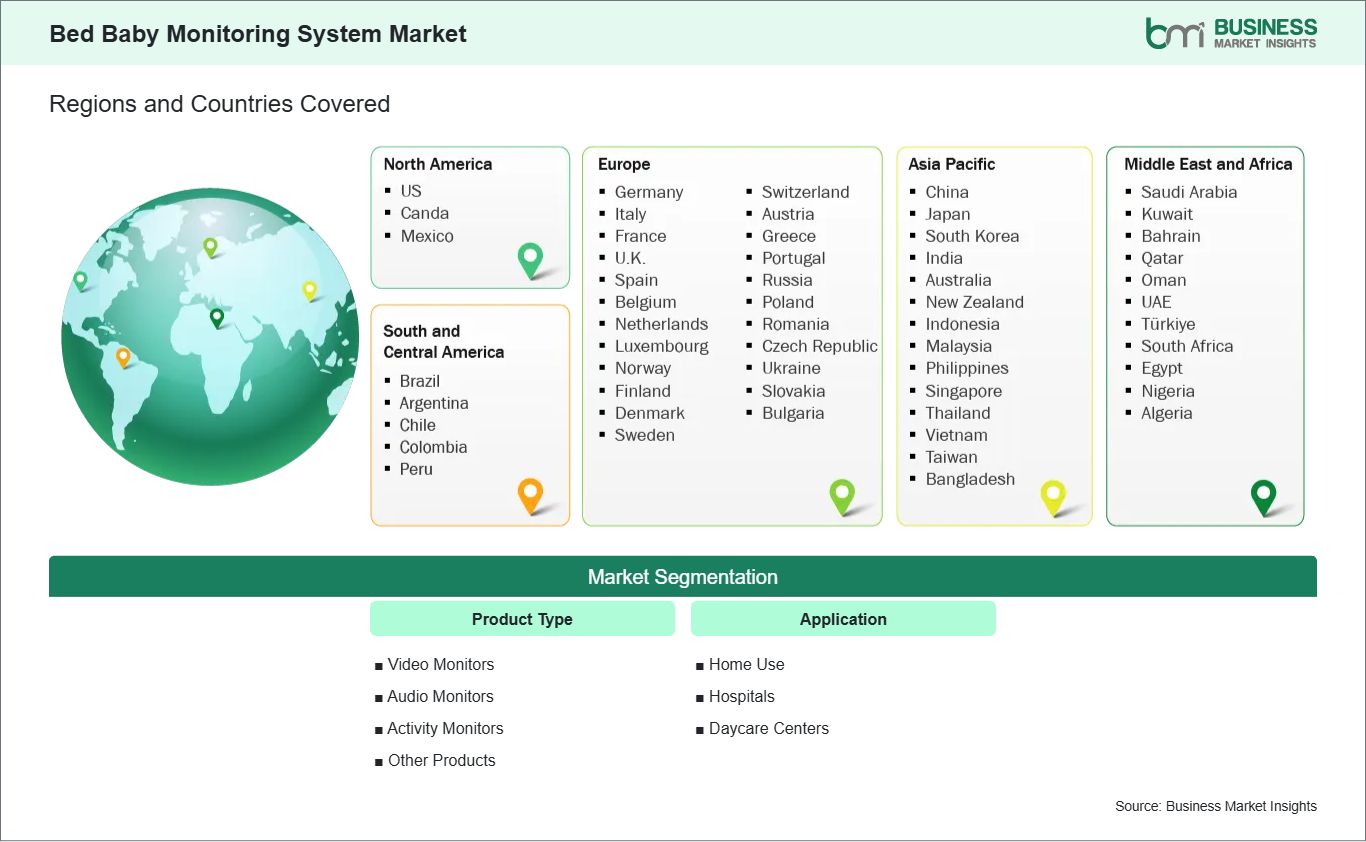
Key segments that contributed to the derivation of the Bed Baby Monitoring System market analysis are product type, and application.
The growing emphasis on infant safety, health, and parental convenience is a key driver of the Bed Baby Monitoring System market. Parents, caregivers, and healthcare providers are increasingly seeking advanced monitoring solutions that provide real-time alerts for potential risks such as breathing irregularities, unsafe sleep positions, temperature fluctuations, or sudden movements. Modern baby monitoring systems—including video monitors, audio monitors, movement sensors, and smart wearable devices—enable continuous monitoring while minimizing caregiver intervention, enhancing safety, and reducing stress.
Rising awareness of sudden infant death syndrome (SIDS), the increasing adoption of smart home and IoT technologies, and higher disposable incomes are accelerating demand for connected and automated baby monitoring solutions. Integration with mobile applications, cloud platforms, and AI-driven analytics allows caregivers to track infant vitals, sleep patterns, and environmental conditions remotely, supporting timely interventions and data-driven childcare decisions. Furthermore, hospitals, daycare centers, and neonatal units are increasingly adopting these systems to enhance infant safety and operational efficiency, fueling market growth globally.
A significant growth opportunity in the Bed Baby Monitoring System market lies in the development of integrated, data-driven smart infant care platforms. Modern monitoring systems generate large volumes of data on infant movement, sleep cycles, breathing, heart rate, and environmental conditions, which can be analyzed to provide predictive alerts, personalized care recommendations, and trend insights over time.
Integration with mobile applications, cloud storage, and AI-powered analytics enables parents and caregivers to receive actionable insights, set custom alerts, and share data with healthcare providers. Advanced systems can also synchronize with other smart home devices, such as temperature regulators, air purifiers, and lighting systems, creating a holistic environment for infant safety and comfort. Rising adoption of connected, AI-enabled baby monitoring platforms, especially in urban areas and developed economies, presents significant opportunities for vendors to offer comprehensive, scalable, and user-friendly solutions that support proactive infant care, reduce risks, and enhance parental peace of mind.

By product type, the Bed Baby Monitoring System market is divided into Video Monitors, Audio Monitors, Activity Monitors, Others. The Video Monitors segment held the larger share in 2024. Video monitors provide parents and caregivers with live feeds of their baby’s activities, enabling continuous supervision even when they are in a different room.
By application, the market is divided into Home Use, Hospitals, Daycare Centers. The Daycare Centers segment held the larger share in 2024. This is driven by the growing demand for professional childcare services that prioritize infant safety, monitoring, and well-being.
| Report Attribute | Details |
|---|---|
| Market size in 2025 | US$ 1.1 Billion |
| Market Size by 2033 | US$ 1.5 Billion |
| Global CAGR (2026 - 2033) | 7.2% |
| Historical Data | 2022-2024 |
| Forecast period | 2026-2033 |
| Segments Covered | By Product Type
|
|
Regions and Countries Covered
| |
| North America | US, Canada, Mexico |
| Europe | Belgium, Austria, Finland, Denmark, Greece, Poland, Romania, Russia, Ukraine, Czech Republic, Slovakia, Bulgaria, Italy, Luxembourg, Germany, Switzerland, France, Netherlands, Norway, Portugal, Spain, Sweden, United Kingdom |
| Asia-Pacific | Australia, China, India, Japan, South Korea, Indonesia, Malaysia, Philippines, Singapore, Thailand, Vietnam, Bangladesh, New Zealand, Taiwan |
| South and Central America | Brazil, Argentina, Peru, Chile, Colombia |
| Middle East and Africa | Bahrain, Kuwait, Oman, Qatar, Saudi Arabia, United Arab Emirates, Turkiye, South Africa, Egypt, Algeria, Nigeria |
| Market leaders and key company profiles |
|
The "Bed Baby Monitoring System Market Size and Forecast (2022–2033)" report provides a detailed analysis of the market covering below areas:
The Bed Baby Monitoring System market is geographically segmented into North America, Europe, Asia Pacific, the Middle East & Africa, and South & Central America. Among these regions, Asia Pacific is projected to witness the strongest growth and maintain a leading market position throughout the forecast period, driven by rising urbanization, increasing disposable incomes, growing awareness of infant safety, and the rapid adoption of smart, connected childcare devices. The region benefits from large populations, expanding nuclear family setups, high smartphone penetration, and favorable government initiatives promoting digital healthcare and smart home solutions, positioning it as a strategic hub for Bed Baby Monitoring System deployment and innovation.
Within Asia Pacific, key markets include China, India, Japan, South Korea, Australia, Singapore, Malaysia, Thailand, Indonesia, Vietnam, Taiwan, and the Rest of Asia. Market growth is propelled by the increasing number of working parents, higher spending on childcare technology, and growing demand for daycare and hospital-grade monitoring solutions. Leading economies such as China, India, and Japan are at the forefront of adopting advanced video and smart monitors, AI-enabled sleep and movement tracking, cloud-based monitoring platforms, and mobile app integration, enabling real-time infant monitoring and proactive care management.
Demand in Asia Pacific is further supported by investments in daycare centers, hospitals, and smart home infrastructure, along with regulatory encouragement for child safety and healthcare technology adoption. Public-private partnerships, innovation in connected devices, and training in infant healthcare technologies strengthen the regional ecosystem, ensuring sustained growth and widespread adoption of Bed Baby Monitoring Systems across homes, hospitals, and childcare facilities.

The Bed Baby Monitoring System market is evaluated by gathering qualitative and quantitative data post primary and secondary research, which includes important corporate publications, association data, and databases. A few of the key developments in the Bed Baby Monitoring System market are:
The Bed Baby Monitoring System Market is valued at US$ 1.1 Billion in 2025, it is projected to reach US$ 1.5 Billion by 2033.
As per our report Bed Baby Monitoring System Market, the market size is valued at US$ 1.1 Billion in 2025, projecting it to reach US$ 1.5 Billion by 2033. This translates to a CAGR of approximately 7.2% during the forecast period.
The Bed Baby Monitoring System Market report typically cover these key segments-
The historic period, base year, and forecast period can vary slightly depending on the specific market research report. However, for the Bed Baby Monitoring System Market report:
The Bed Baby Monitoring System Market is populated by several key players, each contributing to its growth and innovation. Some of the major players include:
The Bed Baby Monitoring System Market report is valuable for diverse stakeholders, including:
Essentially, anyone involved in or considering involvement in the Bed Baby Monitoring System Market value chain can benefit from the information contained in a comprehensive market report.
Please tell us your area of interest
(Market Segments/ Regions and Countries/ Companies)