
Beach Hotels Market Size, Share, Trends & Forecast Report, 2026–2033

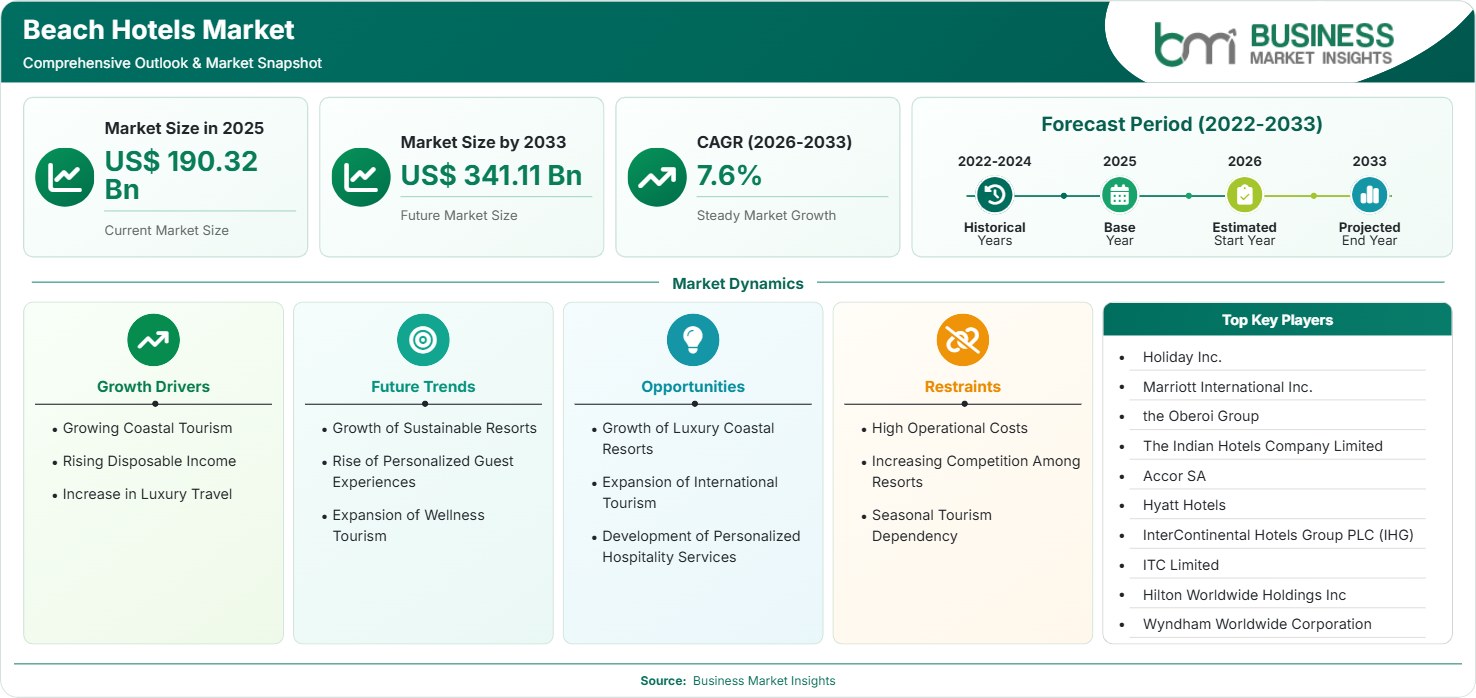
The Beach Hotels Market size was valued at US$ 190.32 Billion in 2025 and is projected to reach US$ 341.11 Billion by 2033, growing at a CAGR of 7.6% during 2026–2033, driven by rising coastal tourism demand, premium resort investments, digital booking adoption, and opportunities in personalized hospitality experiences.

Report Coverage
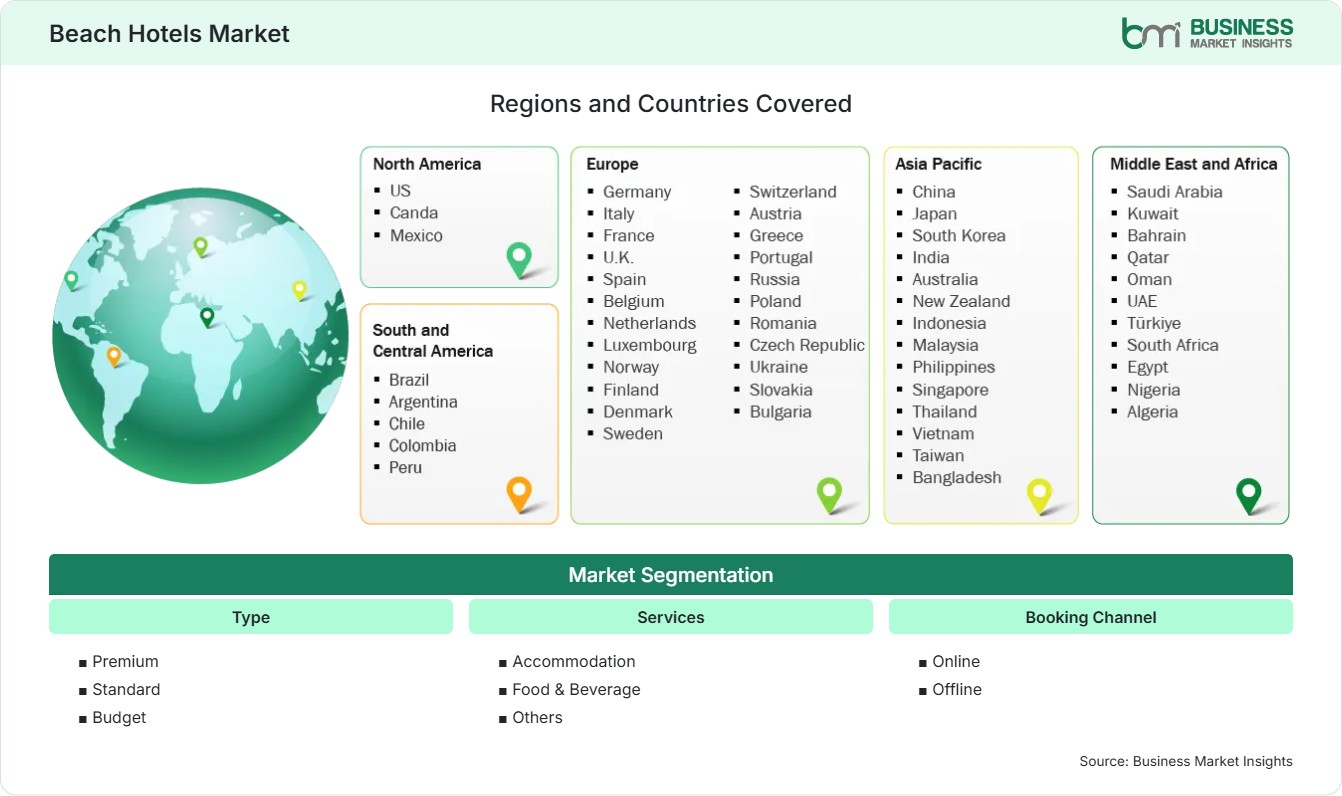
  • Type: Premium, Standard, Budget
  • Services: Accommodation, Food & Beverage, Others
  • Booking Channel: Online, Offline
US$ 190.32 Bn Market size in 2025
US$ 341.11 Bn Market Size by 2033
7.6% CAGR, 2026 - 2033
2026-2033 Forecast Period

01 AI Overview

Beach Hotels Market Summary

  • North America Region: North America holds a market share of 34%–37% in 2025, growing with a CAGR of 6.8%–7.4% influenced by luxury vacations, domestic coastal travel, resort renovations, and wellness tourism opportunities. The US market shows resilient expansion with a CAGR of 6.9%–7.3% from 2026–2033, supported by premium beachfront properties and experiential travel demand.
  • Fastest Growing Region: Asia Pacific holds market share of 28%–31% in 2025, growing with a CAGR of 8.2%–8.8% influenced by international arrivals, emerging island destinations, infrastructure investments, and expanding middle-class travel participation across coastal economies.
  • Leading Segment: Premium type holds market share of 45%–48% in 2025, growing with a CAGR of 7.8%–8.4% influenced by luxury accommodation demand, high-spending travelers, resort branding strategies, and integrated wellness and leisure offerings.
  • High Growth Segment: Online booking channels hold market share of 52%–55% in 2025, growing with a CAGR of 8.5%–9.1% influenced by mobile reservations, digital payment adoption, travel platforms, and data-driven personalization capabilities.
  • Key Market Opportunity: Expansion of luxury coastal resorts, sustainable hospitality models, and technology-enabled guest services creates investment opportunities through differentiated experiences, premium pricing strategies, and emerging destination development.
  • Major Market Players: Holiday Inc., Marriott International Inc., The Oberoi Group, The Indian Hotels Company Limited, Accor SA, Hyatt Hotels Corporation, InterContinental Hotels Group PLC (IHG), ITC Limited, Hilton Worldwide Holdings Inc., and Wyndham Hotels & Resorts, Inc.
02 Strategic Insights

Beach Hotels Market: Strategic Insights

Beach Hotels Market Strategic Framework
FREE PDF
Request your free sample
Request free sample
03 Stakeholder View

Key Takeaways

  • The Beach Hotels Market ecosystem is shifting toward integrated hospitality networks where hotel operators, travel platforms, destination authorities, technology providers, and local suppliers collaborate to enhance guest experiences and improve operational resilience.
  • Premium beachfront properties and wellness-oriented resorts represent high-upside investment areas as travelers increasingly prioritize exclusive experiences, personalized services, and destination-based leisure activities over conventional accommodation choices.
  • Innovation priorities are moving toward artificial intelligence-driven recommendations, smart hospitality infrastructure, contactless services, and sustainability technologies that improve efficiency while meeting evolving traveler expectations.
  • Asia Pacific coastal destinations including India, Indonesia, Thailand, and Vietnam present attractive investment opportunities due to rising international tourism flows, expanding aviation connectivity, and growing domestic travel markets.
  • Strategic partnerships, portfolio expansion, and asset-light growth models are shaping hospitality investments as major operators pursue geographic diversification and stronger presence across emerging coastal destinations.
  • Sustainability-focused resort development is becoming a strategic differentiator, with operators integrating energy efficiency, waste reduction, and conservation practices to align with changing regulatory requirements and environmentally conscious travelers.
04 Geographic Outlook

Beach Hotels Market Regional Highlights

North America Beach Hotels Market

North America market accounted for a 34%–37% share in 2025 and is projected to expand at a CAGR of 6.8%–7.4% during 2026–2033. The region benefits from mature tourism infrastructure, strong domestic vacation demand, and premium coastal destinations across the US, Mexico, and Caribbean-linked markets.

  • Luxury resort renovations and branded beachfront properties are increasing investment activity across Florida, California, Hawaii, and Caribbean-connected destinations through upgraded guest experiences.
  • Wellness tourism, family vacations, and experiential travel preferences are supporting demand for premium coastal accommodation formats with integrated recreation and dining facilities.
  • Advanced digital booking adoption and loyalty programs are strengthening occupancy management, pricing optimization, and customer retention strategies among established hotel operators.
  • Sustainable resort development is gaining momentum as environmental regulations encourage energy-efficient operations and climate-resilient coastal infrastructure investments.

US Beach Hotels Market

US market represented a 28%–31% share in 2025 and is estimated to grow at a CAGR of 6.9%–7.3% between 2026–2033. The country remains a major contributor due to extensive coastal tourism networks, high domestic travel spending, and strong presence of global hospitality brands across leisure destinations.

  • Florida, California, and Hawaii remain leading coastal markets supported by established tourism ecosystems, international connectivity, and year-round leisure demand.
  • Rising preference for resort-style vacations is encouraging operators to expand premium amenities including wellness facilities, private experiences, and personalized services.
  • Technology adoption through mobile check-ins, digital concierge platforms, and revenue management systems is improving operational efficiency across hotel properties.
  • Investment activity is focused on renovating existing assets and developing differentiated coastal properties targeting higher-spending travelers.

Europe Beach Hotels Market

Europe Market held a 24%–27% share in 2025 and is forecast to register a CAGR of 6.5%–7.1% during 2026–2033. The region benefits from established Mediterranean destinations, strong cultural tourism integration, and rising demand for sustainable coastal hospitality. Spain, Italy, Greece, and Portugal remain leading countries, while Croatia and Turkey demonstrate higher growth potential with expanding tourism infrastructure.

  • Mediterranean destinations continue attracting international travelers through heritage tourism, premium resorts, and diversified coastal leisure offerings.
  • Spain and Greece maintain strong hospitality ecosystems supported by international arrivals and investments in upscale beachfront accommodations.
  • Portugal and Croatia are gaining attention from investors due to destination development programs and improving connectivity networks.
  • Sustainability certifications and eco-friendly resort designs are becoming important factors in European coastal property development decisions.
  • Digital travel platforms are increasing direct booking opportunities and improving customer engagement for regional hotel operators.

Asia Pacific Beach Hotels Market

Asia Pacific market accounted for a 28%–31% share in 2025 and is expected to expand at the fastest CAGR of 8.2%–8.8% between 2026–2033. Rapid tourism recovery, expanding middle-class travel, and government-backed infrastructure projects support regional growth. Thailand, Indonesia, India, Vietnam, and the Philippines represent major opportunity markets, with Vietnam and India showing strong expansion potential.

  • Thailand and Indonesia continue attracting global travelers through island tourism, luxury resorts, and diversified coastal destination offerings.
  • India’s coastal hospitality sector is gaining investment interest due to domestic tourism growth and improving tourism infrastructure.
  • Vietnam and the Philippines are benefiting from international arrivals, new resort developments, and increasing airline connectivity.
  • Regional operators are adopting digital booking systems and technology platforms to improve customer acquisition and operational performance.
  • Sustainable tourism initiatives are encouraging environmentally responsible resort development across coastal ecosystems.

Rest of World Beach Hotels Market

Rest of World Beach Hotels Market share represented a 10%–13% share in 2025 and is projected to grow at a CAGR of 7.0%–7.6% from 2026–2033. South and Central America benefit from beach tourism destinations in Brazil, Mexico-linked Caribbean areas, and Costa Rica, while Middle East and Africa markets gain from luxury resort investments in destinations such as the UAE, Oman, and Mauritius.

  • Caribbean destinations are attracting premium travelers through luxury resorts, cruise tourism connections, and exclusive island experiences.
  • Brazil and Costa Rica are expanding coastal tourism offerings through nature-based travel and resort development initiatives.
  • Middle Eastern markets are investing in high-end coastal destinations supported by tourism diversification strategies and infrastructure expansion.
  • African coastal destinations are gaining attention through eco-tourism models, conservation-linked hospitality, and international investment partnerships.
  • Luxury hospitality brands are increasing presence through management agreements and franchise expansion across emerging coastal regions.
Global Market Geography
FREE PDF
Request your free sample
Request free sample
05 Segment Analysis

Beach Hotels Market Segmentation

Type

Type segmentation represented a major portion of the Beach Hotels Market in 2025, with premium properties leading adoption due to increasing demand for luxury experiences. The segment accounted for a 45%–48% share and is expected to grow at a CAGR of 7.8%–8.4% from 2026–2034, supported by high-spending travelers, resort upgrades, and personalized hospitality services.

  • Premium: Premium properties attract affluent travelers through exclusive amenities, private experiences, wellness programs, and luxury dining concepts that enhance destination-based vacation experiences.
  • Standard: Standard beach hotels maintain demand among families and value-conscious travelers by offering balanced accommodation services, convenient locations, and affordable leisure packages.
  • Budget: Budget properties serve cost-sensitive tourists through economical stays, essential facilities, and increasing availability in developing coastal destinations with expanding tourism activity.

Services

Services segmentation plays a critical role in shaping customer satisfaction and operational revenues within the Beach Hotels Market. Accommodation services represented the largest contribution in 2025, while integrated food and beverage offerings continue gaining importance. The segment is estimated to grow at a CAGR of 7.5%–8.1% from 2026–2034 due to evolving guest expectations.

  • Accommodation: Accommodation services remain central to hotel operations, supported by demand for comfortable rooms, resort facilities, location advantages, and customized stay packages.
  • Food & Beverage: Food and beverage services are expanding through premium restaurants, local cuisine experiences, and personalized dining concepts targeting leisure travelers.

Booking Channel

The booking channel segmentation is influenced by the changing nature of consumer purchasing behavior and the rapid pace at which technology is making markets more accessible and reservations more convenient. The online booking channel was one of the leading booking channels in 2025 and is expected to record a CAGR of 8.5%–9.1% between 2026 and 2034. The Beach Hotels Market scope continues expanding through technology-enabled distribution networks and mobile-first travel planning.

  • Online: Online booking channels are growing through travel platforms, hotel websites, mobile applications, digital payments, and personalized recommendations, enhancing customer convenience.
  • Offline: Offline channels remain relevant through travel agencies, corporate partnerships, and direct hotel relationships, serving customers seeking assisted booking experiences.
06 Market Forces

Beach Hotels Market Dynamics

Key Market Drivers

Growing Coastal Tourism

Increasing coastal tourism remains an important driver of demand, as tourists opt for beaches as vacation destinations for relaxation and wellness. As stated by the United Nations World Tourism Organization, the growth of international tourism recovery has been behind the increase in demand for coastal locations and has played a significant role in stimulating Beach Hotels because of the occupancy possibilities and destination development. The Beach Hotels Market trends show the growing desire of tourists for hotels that provide recreational services and sea experiences along with hospitality services.

Rising Disposable Income

Rising disposable income across developing economies is increasing travel participation and supporting higher spending on leisure accommodation. Growing middle-class populations in Asia Pacific, particularly in India and Southeast Asian countries, are driving stronger demand for premium and mid-range coastal stays. The Beach Hotels Market growth is supported by shifting consumer priorities toward experiential vacations, longer leisure trips, and higher accommodation standards. The market trends show that travelers are increasingly allocating more budgets toward personalized services, recreational facilities, and destination-based experiences, encouraging operators to diversify offerings and improve service quality.

Increase in Luxury Travel

The rise in luxury vacations is driving investments into high-end beachfront resorts that offer privacy, wellness amenities, and personalized guest services. Wealthy vacationers are seeking exclusive destinations where they can enjoy not only their stay but also an experience-driven vacation, thereby opening new avenues for luxury hospitality companies. Factors such as premium pricing models, growth in branded resorts, and increased interest in unique vacation concepts are boosting the Beach Hotels Market growth. Trends in the market include a greater preference for personalized itineraries, luxury development projects grounded in sustainability practices, and technology-led guest engagement.

Key Market Opportunities

Growth of Luxury Coastal Resorts

Advancements in luxury resort destinations indicate investment opportunities in high-end accommodation, branding, and hospitality concepts. There is an increasing inclination towards integrated resort destinations having wellness centers, fine dining, leisure, and sustainable infrastructure. New destinations in the Asia Pacific, the Middle East, and the islands present prospects for growth due to rising connectivity and tourism infrastructure developments. Investors prefer to use management contracts and franchises to minimize their capital investments while maximizing their global presence. Such prospects are clearly evident in the Beach Hotels Market Forecasts report, where premium resort developments are seen as a key source of revenue generation and competitive advantage.

Expansion of International Tourism

The expansion of international tourism has created an opportunity for hospitality providers to venture into new coastal markets, supported by an improved aviation network and a more conducive tourism policy environment. Nations that are developing their airports, ports, and destination facilities are attracting international hotel chains seeking new growth markets. Increased demand for border-crossing travelers is driving collaboration among the government, developers, and hospitality providers. The coastal areas of Southeast Asia, the Indian Ocean, and the Middle East have benefited from tourism diversification plans. Providers can meet customer demand through property development that satisfies cultural and sustainable demands.

Development of Personalized Hospitality Services

The development of personalized hospitality services creates opportunities through AI, customer analytics, and engagement systems. Technology tools are being used by hotels to provide customized recommendations, automation of communications, and personalization of guest experiences both pre-stay and during the stay. Personalization via data analysis can assist hoteliers in enhancing customer satisfaction, price optimization, and loyalty programs. New applications include smart rooms, digital concierges, and personalized wellness services. The new technologies will help coastal hotels distinguish themselves from other hotels in competitive locations and increase operational efficiency.

Market Restraints and Challenges

High Operational Costs

Factor: High operational costs associated with beachfront property maintenance, energy consumption, staffing requirements, and climate-related protection measures increase financial pressure on hotel operators. Impact: These costs might bring down profit margins, particularly in the case of standalone resorts that have limited negotiating powers and less efficiency in their operations. Coast resorts may need extra funding to bolster their resilience to weather conditions. Costs of labor and utilities contribute to the factors affecting price setting and investment. Operators are dealing with the problem through energy-efficient technologies, automation, and optimal resource utilization.

Increasing Competition Among Resorts

Factor: Increasing competition among resorts from global hotel chains, independent properties, vacation rental platforms, and alternative accommodation providers intensifies pressure on pricing and customer acquisition. Impact: High levels of competition can impede occupancy growth and necessitate constant brand-building efforts. In beach resorts, there are usually several options to choose from for a given consumer segment, making loyalty more crucial. Hospitality operators have to create a better experience, employ dynamic pricing systems, and come up with distinctive services to stay in the market. Competition also drives innovation, but raises the costs of running the business and marketing.

07 Company Analysis

Competitive Landscape

The Beach Hotels Market analysis highlights a competitive environment shaped by global hospitality groups, regional operators, and resort specialists. Companies are focusing on portfolio expansion, sustainable development, digital transformation, and premium guest experiences to strengthen market positioning. Leading players compete through brand reputation, geographic presence, loyalty ecosystems, and differentiated coastal accommodation offerings.

Company Name

Overview

Products and Services relevant to this market

Holiday Inc.

Global hospitality company operating leisure and business accommodation brands across multiple regions.

Beach resorts, hotel accommodation, dining services, vacation experiences, and hospitality management solutions.

Marriott International Inc.

Global hotel operator with extensive luxury, premium, and resort property networks worldwide.

Luxury beach resorts, branded accommodations, food services, loyalty programs, and guest experiences.

The Oberoi Group

Indian luxury hospitality group known for premium service standards and destination properties.

Luxury coastal resorts, personalized stays, dining experiences, and leisure hospitality services.

The Indian Hotels Company Limited

Leading Indian hospitality company operating diverse hotel and resort brands.

Beach resorts, luxury hotels, restaurants, wellness offerings, and vacation packages.

Accor SA

International hospitality group managing multiple accommodation brands across global destinations.

Coastal hotels, resort accommodation, dining services, digital booking platforms, and lifestyle hospitality.

Hyatt Hotels Corporation

Global hospitality company with luxury and lifestyle resort properties.

Beach resorts, premium accommodation, wellness services, dining, and guest loyalty programs.

InterContinental Hotels Group PLC (IHG)

International hotel group operating branded properties across leisure destinations.

Resort hotels, vacation stays, accommodation services, and hospitality management platforms.

ITC Limited

Indian conglomerate with luxury hospitality operations and resort properties.

Luxury hotels, coastal resorts, dining experiences, wellness facilities, and sustainable hospitality.

Hilton Worldwide Holdings Inc.

Global hospitality company offering branded hotels and resort experiences.

Beach resorts, accommodation, food and beverage services, loyalty solutions, and digital hospitality.

Wyndham Hotels & Resorts, Inc.

Global hotel franchising company with broad accommodation network.

Resort hotels, vacation properties, booking solutions, and hospitality franchise services.

08 Industry Activity

Recent Developments

May 2026

Radisson Hotel Group expanded its beachfront resort portfolio in the Eastern Mediterranean with the opening of Paradise Resort Evia, a member of Radisson Individuals, in Greece. The 322-room Aegean beachfront resort represents Radisson’s first resort under the brand in Greece and adds a large-scale leisure property with wellness, dining, and sports facilities.

February 2026

Minor Hotels announced its expansion into the Adriatic coastal hospitality market through management agreements with MK Group for two resort properties in Croatia and Slovenia. The properties are planned to reopen after refurbishment under the luxury Anantara and Minor Reserve Collection brands, marking the company’s entry into both markets and increasing its focus on Mediterranean leisure destinations.

June 2025

Hyatt Hotels Corporation’s Inclusive Collection expanded its beach resort presence in Eastern Europe with the opening of AluaSoul Sunny Beach in Bulgaria. The 397-room adults-only all-inclusive resort opened on Bulgaria’s Black Sea coast, strengthening Hyatt’s leisure hospitality footprint in one of the region’s key seaside destinations.

June 2025

Marriott International Inc. launched its first JW Marriott Mediterranean beach resort with the opening of JW Marriott Crete Resort & Spa in Greece. Located on the Aegean coastline near Chania, the luxury beachfront property includes 160 rooms, suites, and villas, expanding Marriott’s premium leisure resort offering in Southern/Eastern European coastal markets.

10 Trust & Transparency

Research Methodology

The market analysis combines proprietary research with secondary data from government agencies, company disclosures, regulatory filings, industry databases and expert interviews. Market estimates are validated through data triangulation, cross-market benchmarking and analyst review.

View Full Research Methodology

11 Questions Answered

Frequently Asked Questions

What does the Beach Hotels Market Report indicate about future opportunities?

The Market Report indicates opportunities in emerging coastal destinations, premium resort development, digital hospitality solutions, and personalized services as international tourism patterns continue evolving.

How does sustainability influence beachfront hotel development?

Sustainability is shaping property design, energy management, waste reduction, and environmental compliance strategies. Developers are incorporating renewable energy systems, resource-efficient technologies, and conservation practices to meet regulatory and consumer expectations.

Why are luxury coastal resorts gaining popularity among travelers?

Luxury coastal resorts are attracting travelers seeking exclusive experiences, wellness programs, premium dining, and customized services. Increasing preference for experiential travel is encouraging operators to develop differentiated resort concepts.

How are technology solutions changing beach hotel operations?

Technology is improving reservations, revenue management, customer engagement, and operational workflows. Artificial intelligence, digital concierge platforms, smart rooms, and mobile services are enabling more personalized guest experiences and efficient hotel management.

What factors are influencing investment decisions in the Beach Hotels Market?

Investors are focusing on destination attractiveness, tourism infrastructure, sustainability compliance, brand partnerships, and operational efficiency. Coastal regions with improving connectivity and government-backed tourism programs are gaining attention for new resort development opportunities.

Access the Full Beach Hotels Market Report

Get segment-level forecasts, regional estimates, competitive benchmarking, company profiles and downloadable Excel datasets.

Access the full Beach Hotels Market Report
350 pages PDF & Excel | 2026-07-31