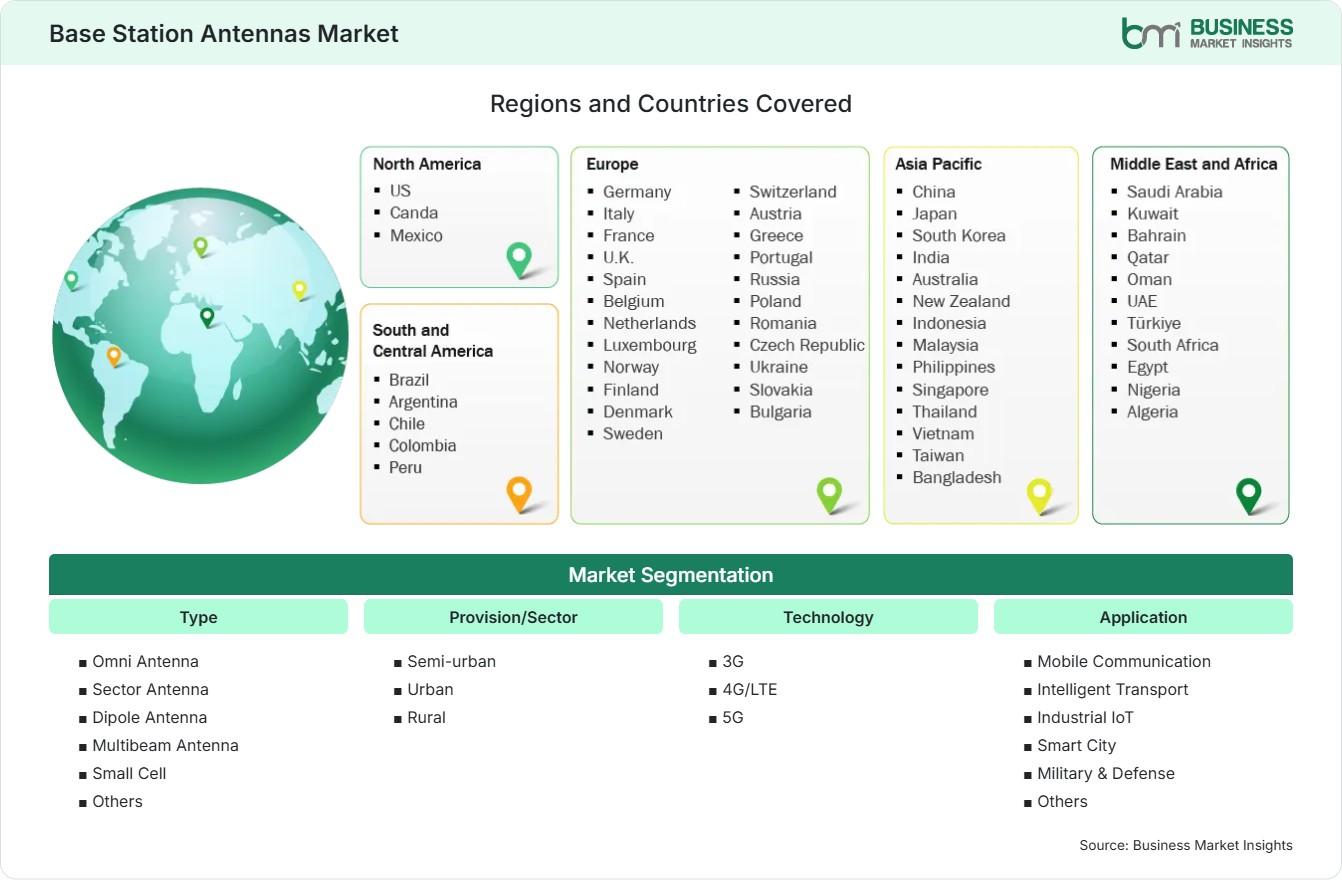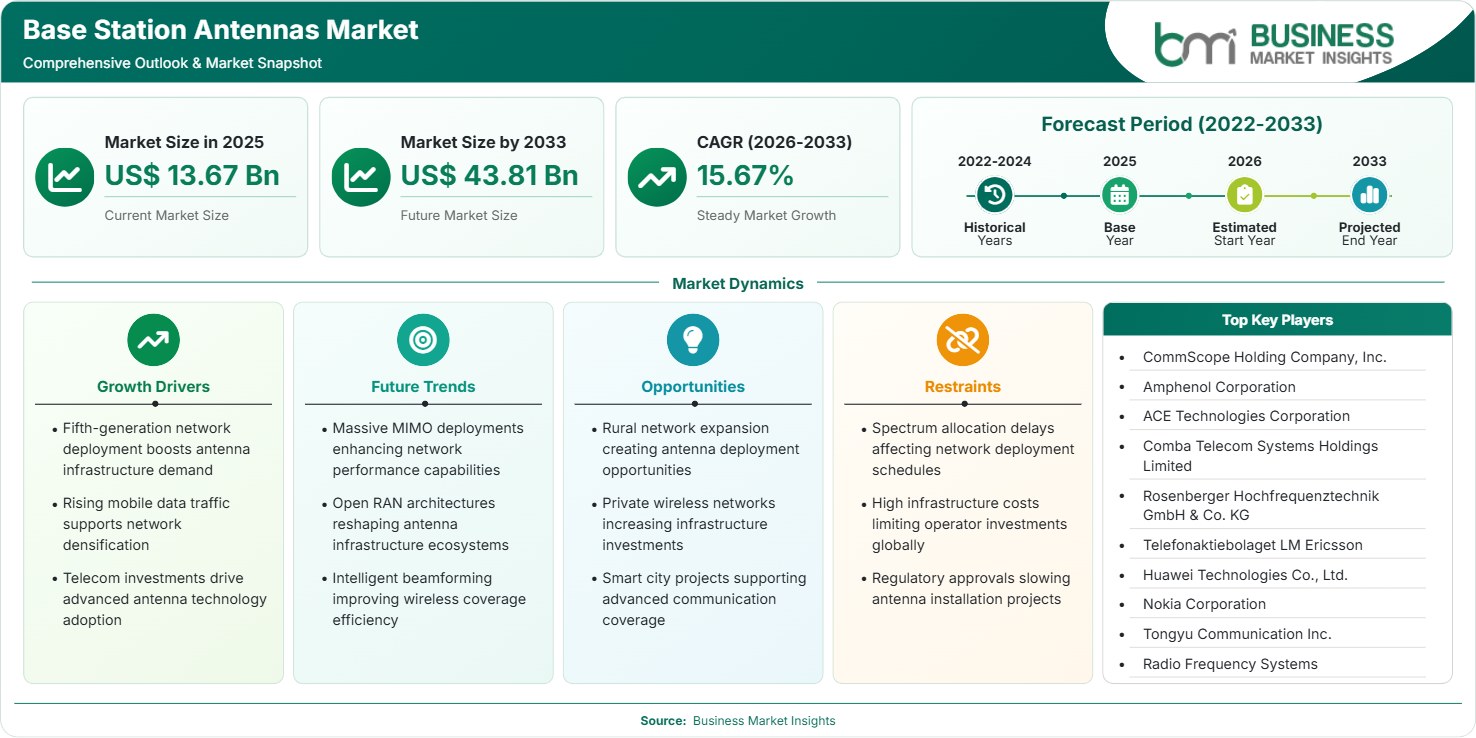
Base Station Antennas Market Regional Highlights
North America Base Station Antennas Market
North America represents 25%–28% share in 2025 and is projected to grow at 13.5%–15.0% CAGR through 2033. The region benefits from 5G networks, enterprise connectivity, spectrum usage, and improvements to the macro-sites. Most of the demand comes from the United States, while Canada has additional demand for rural broadband. With high 5G penetration, purchase drivers become capacity increase, replacements, energy consumption, small form factor, and multi-band. The Base Station Antennas Market share reflects a mature infrastructure environment increasingly driven by densification rather than first-time deployment.
- The need for high-order MIMO antennas rises as mid-band 5G is expanded, since these antennas enable an increase in capacity without causing the site footprints to increase proportionally.
- In the fields of manufacturing, logistics, utilities, and on campuses, private wireless networks have special requirements that go beyond those of conventional macro-cell deployments.
- The limitations imposed by tower loading are such that they support the use of lightweight antennas with a narrow profile, since these require less structural reinforcement and make it easier to obtain engineering approvals.
- The ability to monitor and make adjustments remotely can lessen the number of truck rolls and enhance maintenance productivity at widely spread locations.
US Base Station Antennas Market
The United States represents approximately 75%–80% of North American demand in 2025 and is projected to grow at 14.0%–15.5% CAGR through 2033. Carrier investment remains concentrated on mid-band capacity, rural coverage, and densification. Private 5G adds demand across industrial facilities and logistics sites. The market increasingly rewards antennas combining multiple frequency bands, high isolation, remote electrical tilt, and reduced physical footprint, enabling operators to increase capacity while limiting incremental tower construction and structural costs.
- The expansion of 5G capacity is in favor of sector antennas with a high number of ports and of Massive MIMO in dense metropolitan corridors.
- The rural broadband schemes provide for the replacement of antennas and for step-by-step deployments since propagation efficiency has an effect on coverage economics.
- The demand for 5G private networks is extending into various applications in the areas of industry, logistics, utilities, and transportation that require customized coverage.
Europe Base Station Antennas Market
Europe holds 22%–25% share in 2025 and is projected to grow at 12.5%–14.5% CAGR. Germany, the United Kingdom, France, and Italy remain leading markets, while Spain and Nordic countries provide attractive growth opportunities. Mature mobile infrastructure, 5G adoption, and network modernization support demand. Sustainability requirements increasingly favor energy-efficient equipment, reduced material intensity, longer operating life, and simplified installation. Spectrum policy and infrastructure sharing also influence deployment economics and procurement strategies across national markets.
- Germany and the United Kingdom have mature 5G ecosystems, and their capacity is still being optimized.
- Spain has great potential for growth due to its intelligent infrastructure, tourism sector, events, and unique connectivity needs.
- In the Nordic markets, there is a strong focus on resilient infrastructure, the sharing of networks, and efficient coverage structures.
- The European emphasis on sustainability promotes the use of lighter equipment, a reduced material intensity, and a longer operating life.
Asia Pacific Base Station Antennas Market
Asia Pacific holds 31%–35% share in 2025 and is projected to grow at 17.0%–19.0% CAGR, making it the fastest-growing region. China, Japan, South Korea, and India lead deployment, while Southeast Asia provides a substantial incremental opportunity. High mobile traffic, urban density, industrial digitization, and rural broadband programs support extensive antenna demand. India is particularly attractive because expanding 5G coverage, rising data consumption, local manufacturing, and enterprise digitization are progressing simultaneously.
- China is still a major center for the deployment of sector systems, Massive MIMO systems, and digitally managed antenna systems.
- India gains as a result of the expansion of 5G, improved coverage in rural areas, the use of fixed wireless access, and local manufacturing.
- Both Japan and South Korea stress the importance of high-quality 5G coverage and advanced applications that require sophisticated antenna systems.
- Southeast Asia has great growth potential as companies extend 5G services to the areas of manufacturing, logistics, tourism, and to underserved communities.
Rest of World Base Station Antennas Market
The rest of the world accounts for 15%–18% share in 2025 and is projected to grow at 14.0%–17.0% CAGR. South and Central America benefit from expanding 5G, particularly in Brazil and Mexico. Chile and Colombia offer enterprise opportunities. Middle Eastern markets led by Saudi Arabia and the United Arab Emirates prioritize advanced 5G, smart cities, and industrial digitization. Africa remains underpenetrated, creating longer-term upside from 4G expansion and selective 5G deployment.
- Brazil and Mexico offer great potential since the rise in 5G adoption and urban densification is increasing the demand for modern antennas.
- Saudi Arabia and the United Arab Emirates are putting their money into intelligent infrastructure, which needs high-capacity antenna systems.
- South Africa is still important in the context of network modernization and in relation to the growing demand for mobile data.
- The African markets currently developing have great long-term potential since operators are expanding broadband coverage by making use of efficient infrastructure.